Long-term Memory: Types, Influences, and Retrieval Processes
Slides from Universidad Europea about Long-term Memory. The Pdf, a presentation for University-level Psychology, explores the main effects and influences on long-term memory, including context-dependent memory and the encoding specificity principle, with examples from experiments by Godden and Baddeley (1975) and Tulving and Osler (1968).
See more26 Pages

Unlock the full PDF for free
Sign up to get full access to the document and start transforming it with AI.
Preview
Long-term Memory Overview
LONG-TERM MEMORY ue Long-term memory Explicit memory (declarative) Implicit memory (non- declarative) Semantic memory Episodic memory Motor learning Priming Classical conditioning Universidad Europea
Motor Learning
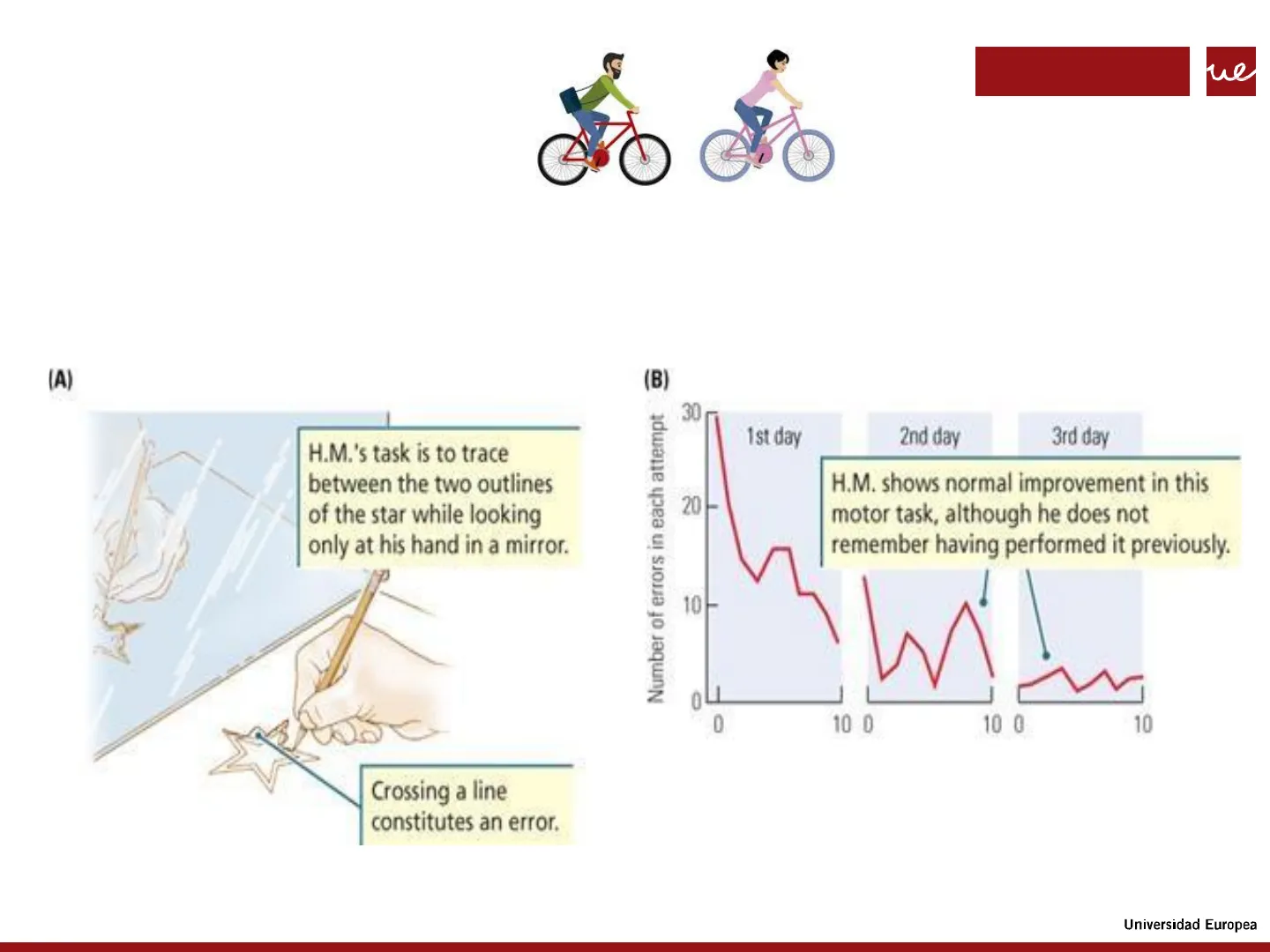
MOTOR LEARNING ue 1 H.M. was not able to create new episodic and semantic memories but was able to learn new motor skills. (A) H.M.'s task is to trace between the two outlines of the star while looking only at his hand in a mirror. Crossing a line constitutes an error. Number of errors in each attempt @ 30 1st day 2nd day 3rd day 20- H.M. shows normal improvement in this motor task, although he does not remember having performed it previously. 10|- 0 0 10 0 10 0 10 Universidad Europea
Motor Learning Definition
MOTOR LEARNING ue Non-declarative memory related to the adquisition of motor skills. It is acquired through practice and repetition. It is slowly learnt but once acquired is very difficult to forget. Usually involves an automatic recall (without effort) from past experiences. 5 Universidad Europea
Brain Basis of Motor Learning
MOTOR LEARNING: BRAIN BASIS que The cerebellum, basal ganglia and motor cortex are the neural basis of the motor skills learning. (A) Basal ganglia Premotor cortex Thalamus (B) Rest of neocortex Basal ganglia Ventral thala- mus Pre- motor cortex Sensory and motor information Substantia nigra Dopamine Amygdala Substantia nigra Cerebellum Universidad Europea
Long-term Memory Categories
LONG-TERM MEMORY ue Long-term memory Explicit memory (declarative) Implicit memory (non- declarative) Semantic memory Episodic memory Motor learning Priming Classical conditioning Universidad Europea
Priming Effect
ue PRIMING The priming effect is the sensibilization of the nervous system to a previously presented stimulus (even with the patient being unconscious of that first stimulus).
- A stimulus is used to sensitize the nervous system to a later presentation of the same or similar stimulus. Example: Gollin Incomplete-Figures Test: test of visually recognizing incomplete objects.
- After some essays, they identify the image sooner than they did the first time, indicating some form of sensory memory for the image.
- Amnesic subjects also show improvement on this test, even though they do not recall having taken it before. Universidad Europea
Priming Effect Conclusion
PRIMING ue The priming effect is the sensibilization of the nervous system to a prey (even unconsci
- A stin nervous of the sar Conclusion: Even if my hippocampus can't "relate" all the information to create an episode ... my brain areas related to perception can learn (their processing of the stimulus improves). Example: Gollin visually re
- After so sooner tl some forn – Amnesic subjects atsu SHOW ImPTUVCITICTIC UIT this test, even though they do not recall having taken it before. Universidad Europea
Priming Studies with Words
PRIMING ue Priming studies using words Phase 1 (study): Series of words. E. g. Elephant Phase 2 (memory): Complete the words Ele E_e_nt If the word has already appeared, the second task is going to be easier (less time and mistakes). Priming Facilitate Universidad Europea
Types of Priming
PRIMING ue Perceptual Based on the form of the stimulus E. g. Table facilitates Ta --- Priming Conceptual Based on the meaning (semantic) E. g. Table facilitates chair Universidad Europea
Long-term Memory Structure
LONG-TERM MEMORY ue Long-term memory Explicit memory (declarative) Implicit memory (non- declarative) Semantic memory Episodic memory Motor learning Priming Classical conditioning Universidad Europea
Classical Conditioning
CLASSICAL CONDITIONING ue Classical conditioning is the association between a neutral stimulus and an unconditioned stimulus. Through this process, neutral stimuli become conditioned stimuli. Emotional memories e.g. Fear conditioning: shutterstock.com - 533471644 Initially, the stimulus doesn't elicitate any response (neutral stimulus). The neutral stimulus is associated with a noxious stimulus (the noxious stimulus elicits the emotion of fear). The neutral stimulus becomes a Conditioned stimulus. "When I see a dog, I feel fear". Universidad Europea
Brain Basis of Classical Conditioning
CLASSICAL CONDITIONING: BRAIN BASIS ue 1. The association of the neutral stimulus and the noxious stimulus happens in the lateral nucleus of the amygdala. 2. The lateral nucleus of the amydala activates the central nucleus. 3. The amygdala central nucleus activates the lateral nucleus of the hyphotalamus (that activates the simpatic nervous system), between others. (A) Hypothalamus Amygdala Lateral nucleus Central nucleus Periaqueductal grey matter (brain stem): behavioural freezing Lateral hyppothalamus: simpatic activation ... Universidad Europea
Meta-memory
META-MEMORY ue Long-term memory Explicit memory (declarative) Implicit memory (non- declarative) 2 Universidad Europea
Meta-memory Definitions
META-MEMORY 1- Meta-memory is "the knowledge of how our memory works" (the knowledge about our memory performance).
- e.g., If we feel that our memory is failing, we will express memory complaints. 2- Another definition of meta-memory is "the control and management of our memory." e.g., The use of memory strategies and techniques that improve our learning.
Subjective Memory Complaints
META-MEMORY Subjetive memory complaints High - Normal cognition Cognitive performance Mild Cognitive Impairment Dementia Low Age Epidemiologic study 2005 (Madrid Salud) n = 1627 older people 32,4 % 54,4 57,1 60 41,4 32,6 40 24,2 27,2 20 I 0 65-69 70-74 75-79 80-84 85-89 >89 Chi2= 64,86 p=0,001 V de Cramer=0,20 Subjective cognitive decline can be a risk factor for cognitive impairment in older adults.
- It is important to assess these complaints and the objective cognitive performance.
- It is essential to perform a follow- up assessment of the patient.
- We must check whether the patient remains normal or worsens over time.
Main Effects and Influences on Long-term Memory
ue Main effects and influences on LTM Universidad Europea
Primacy, Recency, and Von Restorff Effects
MAIN EFFECTS AND INFLUENCES ON LTM que Primacy and recency effects: tendency to better recall information provided first and last. Von Restorff effect: tendency to better remember what is unusual. RESULTS Von Restorff Effect 90 80 Recency 70 60 % Recall 50 40 Primacy 30 20 STM 0 Cat Cow Ferret Zebra Rabbit Finch Briefcase Dog Gerbil Mouse Crow Horse 1 That's why patients should be encouraged to create strange- extravagant images when using visualization strategies. Universidad Europea 10 LTM
Proactive and Retroactive Interference
MAIN EFFECTS AND INFLUENCES ON LTM ue Proactive interference Retroactive interference T Proactive interference: It occurs when the information learned makes the retention of recent information more difficult. Retroactive interference: It occurs when new information is making remembering information previously learnt more difficult. Universidad Europea
Influence of Physical Context on Retrieval
MAIN EFFECTS AND INFLUENCES ON LTM ue Influence of the physical context in the retrieval process. Context-dependent memory, Godden and Baddeley (1975) When the learning context was equal to the retrieving context, the percentage of words remembered was higher (the context helped in the retrieval process). % of words remembered 45 35 25 15 5 Land RECALL Water Words learned on land. Words learned in the water. Universidad Europea
Context-dependent Memory in Crime Investigation
MAIN EFFECTS AND INFLUENCES ON LTM ue Influence of the physical context in the retrieval process. Context- For this reason, in investigating crimes, witnesses must go to the original context where the events took place. The context helps them retrieve information about what happened. When th equal to the percentage of Words remembered was higher (the context helped in the retrieval process). Words learned on land. Words learned in the water. Universidad Europea
Encoding Specificity Principle
MAIN EFFECTS AND INFLUENCES ON LTM ue Influence of the physical context in the retrieval process. Encoding specifity principle (Tulving and Osler, 1968): The more similar the cues available at retrieval are to the conditions present at encoding, the more effective the cues will be. e.g., "I was in the kitchen when I thought I had to return the book to the library. That afternoon, I was in front of the library and didn't remember anything. When I returned home, I went into the kitchen ... and remembered everything!" proces Universidad Europea
Memory Cues and Retrieval
MAIN EFFECTS AND INFLUENCES ON LTM ue Conclusion: we remember what we experience and access our memory by using a fragment of that experience as a key to the whole ("cues"). Why did I come to the kitchen ?... - Solution: remember where you were when you thought you needed something from the kitchen. 2 ? ? Universidad Europea
Effect of Emotional Context: Mood-congruent Memory
MAIN EFFECTS AND INFLUENCES ON LTM ue Effect of the emotional context: . Mood-congruent memory (Blaney, 1986): Bias in the recall of memories such that negative mood makes negative memories more readily available than positive, and vice versa. Mood at retrieval is congruent with the material to be remembered (e.g .: If someone is depressed, they will likely only recall negative or painful memories and dwell on them). I only remember sad events ... Universidad Europea
Effect of Emotional Context: Mood-dependent Memory
MAIN EFFECTS AND INFLUENCES ON LTM ue Effect of the emotional context: · Mood-dependent memory (Eich, Macaulay, and Ryan, 1994): A context dependent effect whereby what is learnt in a given mood, whether positive, negative or neutral, is best recalled in that mood. Mood at retrieval is identical to the mood at encoding. Mood in the learning stage *Researchers induced participants' emotional states in the learning and retrieval stages through different stimuli (eg., sad sentences, sad music ... ). = same mood > better recall = different mood worse recall Mood in the retrieval (2 days later) Universidad Europea
Anxiety and Memory Encoding
MAIN EFFECTS AND INFLUENCES ON LTM ue Effect of the emotional context: Anxiety has an important effect on encoding (we tend to pay attention to potential threats). Enconding process The Professor is looking at me all the time! Retrieval process I remember the Professor was very attentive to our performance during the exam! Universidad Europea
Reconstructive Memory
MAIN EFFECTS AND INFLUENCES ON LTM ue Reconstructive memory: Remembering is a re-construction of the past, not a direct copy. It is based on: · New learnings, motivations, contexts, experiences and feelings ... · It is not only based in the past itself. · Filling the gaps of memory: a tendency to fill the gaps in our memory even inventing elements (related to the use of schemas but also to specific events) .* · Therefore, remembering is an active process which outcome could be different than the original experience. * Dooling and Christiaansen (1977): Carol Harris's need for professional help: Carol Harris was a problem child from birth. She was wild, stubborn, and violent. By the time Carol turned eight, she was still unmanageable. Her parents were very concerned about her mental health. There was no good institution for her problem in her state. Her parents finally decided to take some action. They hired a private teacher for Carol. Participants were told a story. After one week, they were encouraged to remember the story. Some of them were told the original story was about another character (Hellen Keller, a deaf, dumb, and blind girl. She was a writer and activist), and a significant percentage of participants believed that. Universidad Europea
Can’t find what you’re looking for?
Explore more topics in the Algor library or create your own materials with AI.
