Guida grammaticale all'inglese: present simple, continuous e avverbi di frequenza
Documento de Bachillerato sobre gramática inglesa: present simple, present continuous, adverbios de frecuencia y pronombres relativos. El Pdf, útil para el estudio autónomo de Idiomas, incluye explicaciones, ejemplos y ejercicios, estructurado para facilitar el aprendizaje.
Ver más53 páginas


Visualiza gratis el PDF completo
Regístrate para acceder al documento completo y transformarlo con la IA.
Vista previa
GRAMMAR
Verbos con ing es para la situación, con ed es para los sentimientos.
- Wow, where, who, why when, what
- Cuando usamos el verbo to be, no usamos el verbo do
Why were you late?
Are you married? Y/N
Is she you sister? Y/N - Cuando las respuestas son sí o no, empieza por are o is, no necesitamos una palabra interrogativa.
Preguntas con otros verbos que no sea verbo to be
- Where did you meet?
- Who do you know at this party?
- Do you like the music? Y/N
Present simple (empower 13) present continuous
3 cosas que hay que tener en cuenta, al principio hay que aprender how to make the gramatic y la otra cosa es when to use the gramatic la tercera cosa es remember to use it
en el presente simple hay dos situaciones:
- Routines and habits. ex. I play football every tuesday: juego al fútbol cada martes.
- General truths or things that don't generally change. ex. He doesn't work very hard.
- Cuando hablamos sobre algo con frecuencia queremos hablar sobre la frecuencia:
- Adverbs of frequency are often used with the present simple
- Always(100%), usually, often, sometimes, occasionally, hardly ever, never (0%) whenever you are talking about a habit/hobbie/routine use an adverb of frequency
- I play football es muy básico, necesitamos saber con quién, cuándo, más información. El adverbio de frecuencia SIEMPRE VA ANTES. Usually the adverb of frequency before the main verb. Example.
- I usually/sometimes/never go to work at the weekend.
- I dont often eat broccoli (después del verbo). The frequency adverb goes AFTER THE VERB "TO BE" example.
- I am often tired in the morning
- She is usually at work at
1Always: siempre: I always drink coffe in the morning
Usually( por lo general): I usually go to the university
Often( a menudo): I often play football / I
Sometimes(a veces): I sometimes go for a work in a
Occasionally(de vez en cuando) : I occasionally cook at the weekend
Hardly ever( casi nunca): I hardly ever drink tea in the
Never(nunca): I never watch football at the weekend
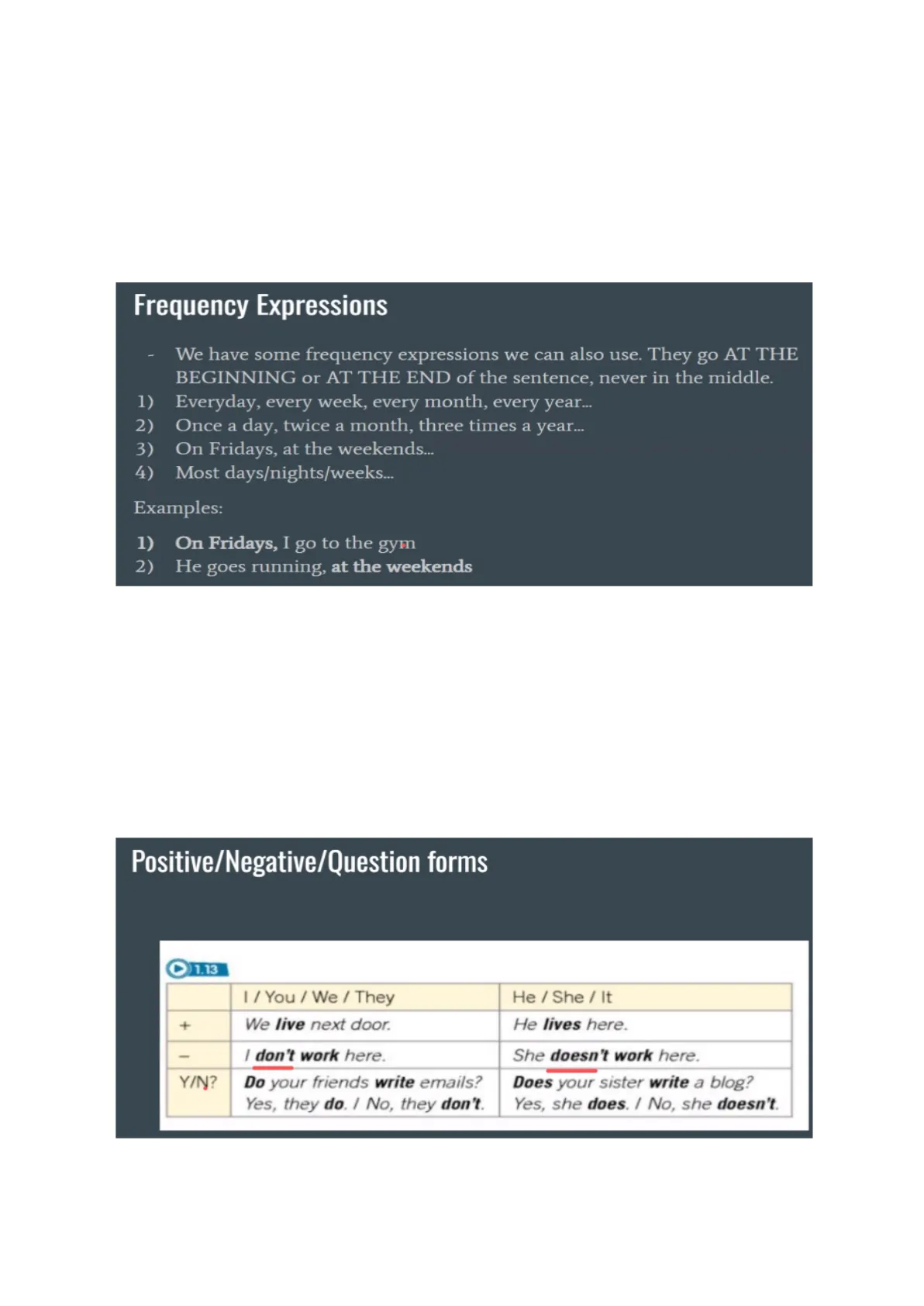
Frequency Expressions
- We have some frequency expressions we can also use. They go AT THE BEGINNING or AT THE END of the sentence, never in the middle.
- Everyday, every week, every month, every year ...
- Once a day, twice a month, three times a year ...
- On Fridays, at the weekends ...
- Most days/nights/weeks ...
Examples:
- On Fridays, I go to the gym
- He goes running, at the weekends
Verb TO BE:
very irregular
I am
You are
He/she/it is
We are
You are
They are
Positive/Negative/Question forms
1.13
I / You / We / They
He / She / It
+
We live next door.
He lives here.
-
I don't work here.
She doesn't work here.
Y/Ŋ?
Do your friends write emails?
Yes, they do. I No, they don't.
Does your sister write a blog?
Yes, she does. I No, she doesn't.
2Present continuous (cuándo usarlo)
Acciones que estamos haciendo Right now: ahora mismo
I AM watching TV
Temporary actions that are happening around the present time.
THEY ARE travelling around the country
Por ejemplo I live in Almería (Always - siempre) o I am living in Almería (ESTOY VIVIENDO - por un tiempo )
Present Continuous
We use the present continuous:
- Actions that are happening RIGHT NOW Ex. I am watching TV.
- Temporary actions that are happening around the present time Ex. They are travelling around the country.
Positive/Negative/Question Forms
- We always need to use the verb "to be" + the verb + -ing
1.14
1
He / She / It
You / We / They
+
I'm watching TV.
She's helping.
We're working hard.
-
I'm not feeling well.
It's not raining.
They're not sleeping.
Y/N?
Am I looking
alright?
Yes, I am. I
No, I'm not.
Is he working
late?
Yes, he is. I
No he isn't.
Are they enjoying"
the party?
Yes, they are. I
No, they aren't.
Spelling
SPELLING: verb + -ing
Most verbs
sleep watch say
+ -ing
sleeping
watching
saying
Stressed vowel + one consonant (not w, x, y)
stop run get
2x consonant + -ing
stopping running getting
Consonant + -e
live make have
- - e and + -ing
living making having
3Vowel: vocal
reaching
PRESENT SIMPLE (MIRAR EXTRA HEL EL APARTADO DE GRAMMAR)
Hi David,
1 (1) 'm writing (write) to you from the lovely
holiday home my friends and I have rented, right
next to the sea. I (2)
(sit) in my
bedroom right now, which (3)
(have)
a big window, and I (4)
(look) out
across the waves at a little island. I (5)
(love) it here, and in the evening I sometimes
(6)
(stay) here and watch the sun go
down.
Every day, we (7)
(go) for a walk along
the top of the cliffs. The weather (8)
(get) hotter every day. It was 35℃ yesterday! But we
always (9)
(leave) the house early in
the morning while that cool wind from out at sea
(10)
(blow).
We (11)
(have) a really good time here,
and I (12)
.(not want) to go home!
Bye for now,
Molly
present simple -- > permanent facts, and routines
present continuous -- > temporary situations and things happening right now
2. I am sitting in my bedroom right now, (present continuous)
3. which has a big window,
4. and I am looking out across the waves at a little island.
5. i am love it here it here, and in the evening (stative verbs: love, hate, think, want, en presente simple)
6. I sometimes stay here and watch the sun go down.
7. Every day, we go for a walk along the top of the cliffs (Acantilado). (present simple)
8. is getting (la temperatura está subiendo, es momento temporal, present simple)
9. leave
10. Is blowing (present continuous)
11. are having
12. don't want (present simple)
sometimes, every day, always
cool wind( brisa fresca) poner un adjetivo para describirlo mejor
Blowing (soplar)
PAST SIMPLE
We use the past simple about completed actions in the past
4I ate pizza for dinner. I didn't eat rice. What did you eat? (cuando hablamos en pasado y queremos poner algo en negativo tendremos que usar el verbo do.
Verb "to be" in the past
I / He / She / It
You / We / They
+
The weather was great.
The shops were near the beach.
-
I wasn't very happy.
We weren't tired.
Y/N?
Was your tour guide good?
Yes, she was. / No, she wasn't.
Were you late for your flight?
Yes, we were. I No, we weren't.
verbos regulares usamos -ed.
USAR ESTA ESTRUCTURA GRAMATICAL:
I Used to be used to talking in the past.
Verbo modal, lo usamos para describir algo que pasaba en el pasado pero ya no o algo que no pasaba en el pasado y ahora si.
Used to
Used to is used to talk in the past. There is no present form of "used to"
We use "used to":
- To talk about things that happened regularly in the past but don't happen anymore
Example: I used to drink coffee every morning with my breakfast, but now I drink tea.
Used to: solía hacer pero antes, solo en pasado, ahora no.
Use to: EN NEGATIVO NO SE PONE LA -ED AL FINAL. Porque didn't ya está en negativo.
*** the verb after a modal verb is ALWAYS in the neutral(/normal form
USAR PARA REDACCIONES O HABLAR.
5Past continuous
I was talking with my mum on the phone
When: cuando (past simple)
while: mientras. (past continuous)
Mezclar varias estructuras gramaticales.
Past Continuous
- We use the past continuous to talk about an action happening at a particular time in the past Ex. At 5pm yesterday I was talking with my mum on the phone.
We also use the past continuous with the past simple, usually with the words "when, while"
Example: - I was watching TV when the phone rang. when-> past simple
- While I was driving to work my car broke down. While -> past continuous
Positive/Negative/Question Forms
- We always use the verb "to be" in the past plus the verb in -ing
I / He / She / It
You / We / They
+
I was driving to work.
You were standing on the platform.
-
He wasn't listening.
We weren't watching.
Y/N?
Was she waiting for you?
Yes, she was. I No, she wasn't.
Were they travelling by train?
Yes, they were. I No, they aren't.
Normalmente se usa el pasado simple.
- Countryside: paisaje
- verbo modal, set off: empezar un viaje
I set off at 8 am to go to school
We set of from our hotel and went to the beach - steep hill (muy inclinada)
WRITING EN LOS EXÁMENES
An email or letter to a friend (siempre)
Cambridge
6A story (posible)
A review (critica de algo, libro, peli, etc
An article (posible)
Marking: categorías para usar (normalmente son 5 puntos por categoría) es un 20% del examen, si hacemos cambridge o lengua skill, tendremos dos y aptis, hay 4 partes que tienen actividades diferentes.
- Content (hablar de lo que han pedido básicamente)
ANSWER ALL THE NECESSARY QUESTIONS y evitar poner cosas innecesarias
Content
- Here is an example of an email. Your friend has written you an email asking you for information.
What to include: - Where you live
- If you like your new job (and why)
- Describe the weather
- Talk about your friends
Hi
.I hear you've moved to London!
Where are you living? Do you like
your new job? What's the weather
like there?
Have you made any new friends?
Contestar a las preguntas pero también dar contexto, información, más contenido.
En Cambridge 90-120 words. SI NO LLEGAMOS NOS QUEDAMOS CORTOS Y SI NOS PASAMOS ESTAMOS PONIENDO COSAS INNECESARIAS. - communicative achievement (Estilo de cómo se ha escrito) por ejemplo una carta hay que estructurar como una carta.(to John, love to hear from you soon, etc) Un artículo tiene otro estilo, de forma formal o informal (formal -- > do not informal -- > don't) formal -- > no phrasal verbs formal -- > yes phrasal verbs) Formal -- > We left the house at 8 am, informal -- > we set off at 8 am. Fácil de leer.
- organisation (Paragraps to separe ideas, ** everytime you have a new idea, you need to start a new paragraph. No importa lo largo que sea un párrafo, pero cuando ponemos otra idea empezamos un párrafo nuevo.
7Organisation
- The writing needs to be well organised. For example:
- If it's as story there needs to be a beginning-> middle -> end. A logical progression
- You need to use paragraphs to separate ideas
ESTO NO: My new apartment is in the center of London. I love it here but it rains a lot so I don't get outside much.
USAR LINKING WORDS, and, also, etc. - Language(control de la gramática y control del vocabulario) Try the most advanced grammar and vocabulary, if you try and fail you still can receive marks.
- Por ejemplo, My dog is bigger than my cat.
- Pruebas:
- My dog is biger than my cat (por intentarlo te dan más puntos, aunque falte una letra)
- my dog is more bigger than my cat
- My dog is big. My cat is small.
In Summary
- Content -> answer all the questions and don't put anything unnecessary
- Communicative achievement -> it needs to be appropriate to the task
- Organisation -> logical progression, paragraphs, linking words
- Language -> good control of basics, try the more advanced vocab and grammar
Past simple past continuous
1 past simple acciones o situaciones en el pasado
2 past continuous cuando hablamos de algo que pasaba en el momento en pasado.
3 usar pasado simple y pasado continuo cuando hablamos en el pasado y de repente pasó algo en medio de otra actividad.
usamos en esta situación when con pasado simple y well/as/while(mientras) con pasado continuous
tenemos pasado simple para contar algo que empezó y terminó en el pasado y p.c para contar algo específico en el pasado o algo que está pasando en el pasado por mucho tiempo.
8
¿Non has encontrado lo que buscabas?
Explora otros temas en la Algor library o crea directamente tus materiales con la IA.