Virus Respiratori: SARS-CoV-2 e Adenoviridae, Università di Pavia
Slide dall'Università di Pavia sui Virus Respiratori. Il Pdf, utile per lo studio universitario di Biologia, approfondisce SARS-CoV-2 e Adenoviridae, descrivendo manifestazioni cliniche e caratteristiche molecolari, con una sezione sul sistema respiratorio e le varianti di SARS-CoV-2.
Mostra di più33 pagine

Visualizza gratis il Pdf completo
Registrati per accedere all’intero documento e trasformarlo con l’AI.
Anteprima
DI SITALE OSPITA ATTEO PAVIA
Molecular Virology Unit, Microbiology and Virology Department Fondazione IRCCS Policlinico San Matteo Department of Diagnostic, Pediatric, Clinical and Surgical Science University of Pavia VICINEN ·UNIVERSITAS ALMA
Virus Respiratori
Federica AM Giardina, PhD federica.giardina01@universitadipavia.it federicaannamaria.giardina@unipv.it PAC Molecular Virology UnitThe respiratory system
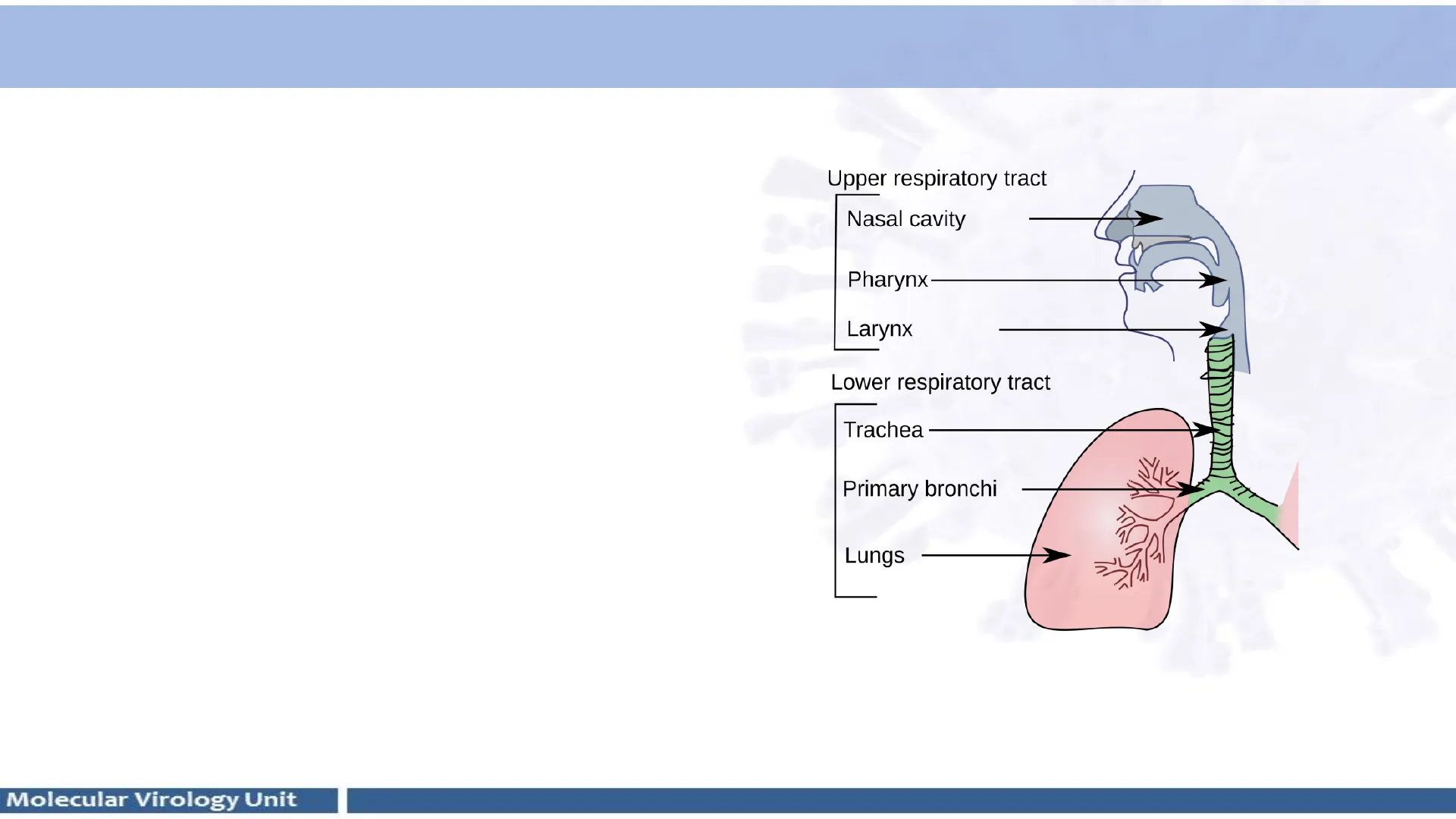
- The upper respiratory tract:
- is continuously exposed to potential pathogens.
- Nasal cavity, sinuses, pharynx, and larynx
- Infections are fairly common.
- Usually nothing more than an irritation
- The lower respiratory tract:
- Lungs and bronchi
- is essentially a sterile environment
- Infections are more dangerous.
- Can be very difficult to treat
Upper respiratory tract Nasal cavity Pharynx Larynx Lower respiratory tract Trachea Primary bronchi Lungs Molecular Virology UnitRespiratory viruses: how many ??
- Influenza virus type A (Flu A)
- H1N1, H3N2, H1N1pdm09
- Influenza virus type B (Flu B)
- Yamagata-lineage and Victoria-lineage
- human respiratory syncytial virus (hRSV)
- type A, type B
- human metapneumovirus (hMPV)
- type A, type B
- human parainfluenza viruses
(hPIV)
- hPIV1, hPIV2, hPIV3, hPIV4
- human coronaviruses
(hCoV)
- OC43, 229E, HKU1, NL63, SARS, MERS, SARS-COV-2
- rhinoviruses
(HRV)
- 100 (A+B) and 60 types (C)
- enteroviruses
(HEV)
- more than 120 types
- adenoviruses
- 52 types
CULAR PREVIOUSLY CONSTITUTES NDED EPITHELIUM VIRO ELDEN PROVISICE ach TED BETACORONAVIRUS ATB SYNDROME RESPONSIBLE POPULATIONS ORGANISATION RESPIRATORY TRANSMISSIONS ST OCCURRENCE COMMUNICABLE MERS MIDDLE REPORTED OCCURS RACTERISTIC AVIRUSES PATTI ESIGNIFICANTLY TRANSMISSION RECOMBINANT COLLOQUIALLY FOUND ANGIOTENSIN RMATION INVESTIGA ACCOURT HONCILIATED GEOGRAPHIC EPENDENT WATER BEHAY ANTAGONIZE MEDIA SPECHT BESTES VERSITY ADDITIONAL CONFIRMED INFECTIONS NOVEMBER DEFINE DEBRIEFING RECEPTORS STORE CD EXPANECTE CONTROL MIDICHE CONTACT RELATIVELY LOEWE TRANSGENIC MA ITIONS CONTACTS GUARDIAN PERHAPS AMOUNTS EXTERNAL PANDEM MORTALITY ALPHA SUPREME REAK PRESENCE JOURNAL GOATS - HUMAN FINDINGS BLOOD WASHING SPREADS INCESEARCHERS NATIONAL SAMPLES CAUSING SPANISH OME ENGLAND TIMEHARBOR & AMBATE ILLNESS TMENT OUTBREAK RESEARCH IFECT RESPIRATORY TPICKILY PREVALENC H7N9 ECTED CITESTE ASSETSE MEASURES COLLECTE HCOMIS PRESENTE WPICTO TRAVEL SE MERE STEIN Pillness Shuman medical! microbiology organism ergaske respiranory & beatty VIRUS medicine lupattis influenza® - cell disease safety tuncer . bucterium health H5N1 NTLY REFERENCES EFFECTIVELY MAIL POSSIBILITY POPULA INFECTIONS GENUS DELTACORONAVIRUSES USE DETERMINE DIABET CE CIRCULATED COV MOLECULAR GROUPINGS GESTS DESCRIBED CURRENTLY VIOUS EL DECEMBER PUBLISHED INTEREST ZOONOTIC MARYLAND COLLE FLU AV EXPOSURE EPIDEMIOLOGICA VIRUS VACCINE IMMERTHE (AdV) CHINATOWN CHINESE ISSUE INFECTIONS DEATHS ARTICLE SCHONNG POUND ANTIBODIES SYMPTOMS MAY INFECTED SUSTOTID SYSTEM CHINA ALSO SINGAPORE PMD CORONAVIRUSES MARCH RESEARCH SARS-COV CON LABORATORY PUBLIC TORONTO QUARANTINE PATIENTS RATE TREATMENT WORLD GLOBAL, CINERA CASES FEE INFORMATION ASIAN "EDIT PROBABILE ALDET GUANGDONG HEALTH RESPIRATORY SEVERE EVEN CANADA VACCINE PATENT STATES RISK TRANSCRIPTION MODEL TRAVEL CURRENTLE HUMANS INECOTION infec "biology REPORTS INTERNATIONAL · microscopic security ONE DISEASE SEVERAL NEW ICAL HOWEVER APRIL EPIDEMIC ILY CASE U REPUBLIC DEVELOPED 2 VIRUS SYNDROME CAUSED CONTROL COMMUNITY NEEDED CORONAVIRUS OFFICIALS IHONG VIRAL ACUTE S SARS UNITED DAYS AL CHEST REPORTED FIRST cut: TAIWAN SULT ORGANIZATION 1 flū emic science RESERVOIRS BETACORONAVONAVIRUSES SINGLE COMMUNITIES = GAMMACORONAVIRUSES AMIZATION VESTIGATION OUTBREAKS INTERFERON NEW ANTIBODIES ORAL ERASMUS DISCOVE WHETHER DETECTION FOLLOWING EVALUAT SEAS INFLUENZA REACTIONS Molecular Virology Unit
Distribution of respiratory viruses in hospitalized patients
80- 70 No. positive samples 60 50 40 30 20 10 0 10-2 Oct-08 Nov-08 Dec-08 Jan-09 Feb-09 Mar-09 Apr-09 May-09 Jun-09 Jul-09 Aug-09 Sep-09 Total samples 148 134 132 159 138 168 107 103 80 87 89 155 Total 88 73 90 108 116 147 80 25 33 21 19 35 positive HRV HEV RSV hCoV hPM AdV wwww hMPV ..... Flu-A ZZZZZ Flu-B 100%- samples detection frequency 1600 Parainfluenza Adenovirus 1400 .hMPV 1200 Coronavirus 1000 RSV 50% 25%- 0%- Oct-08 Nov-08 Dec-08 Jan-09 Feb-09 Mar-09 Apr-09 May-09 Jun-09 Jul-09 Aug-09 Sep-09 4000 30 zzzzzz A(unsubtyped) 3500 A(H3) 25 A(H1)pdm09 3000 Influenza B 20 -percent positive A 2500 -percent positive B 2000 15 1500 10 1000 5 500 0 35 37 39 41 43 45 47 49 51 1 3 5 7 9 11 13 15 17 19 21 23 25 27 29 31 33 0 35 37 39 41 43 45 47 49 51 1 3 2013 Report week 5 7 9 11 13 15 17 19 21 23 25 27 29 31 33 2014 # positive tests ·75% Rhinovirus 800 600 400 200 Molecular Virology UnitDistribution of respiratory viruses in hospitalized patients Overall, influenza A was the most common virus identified (139/226 patients, 61.5%) followed by HRV (33/226, 14.6%), hRSV (13/226, 5.8%), influenza B virus (9/226, 4.0%), hCoVs (9/226, 4.0%), CMV (9/226, 4.0%) and human metapneumovirus (hMPV) (1/226, 0.4%).
100 - 100 90 90- 80- 80 HRV 70 n=139 60 Frequency % 70 RSV 60 50 50 40 40 hCoVs 30 CMV 20- n=33 10- n=13 n=9 n=9 n=9 n=12 Coinf. 0 FluA HRV RSV FluB hCoVs CMV hMPV' hPIVs' coinfections 2009-10 2010-11 2011-12 2012-13 2013-14 2014-15 2015-16 For 205/414 (49.5%) patients we have also retrieved data on bacteriological diagnosis. In 26/205 (12.7%) patients a virus-bacteria co-infection was observed. Molecular Virology Unit
Influenza: caratteristiche generali
- V gruppo di Baltimore
- Genoma ssRNA-
- Famiglia Orthomyxoviridae e tre generi: Influenza A/B/C
- Circolazione nel periodo invernale
- 120-180 nm
- Glicoproteine HA e NA che protrudono dall'envelope
- Capside proteico
- Genoma costituito da 8 segmenti
1 PB2 Transcriptase: cap binding 2 PB1 Transcriptase: elongation 3 PA Transcriptase: protease activity? 4 HA Haemagglutinin 5 NP Nucleoprotein: RNA binding - transport of vRNA 6 NA Neuraminidase: release of virus 7 M1/M2 Matrix protein 1: major component of virion Matrix protein 2: Integral membrane protein - lon channel 8 NS1/NS2 Non-structural protein 2: function not known Influenza Virus Baltimore Group V ((-)ssRNA) Nucleoprotein Neuraminidase Rna Lipid bilayer membrane Hemmaglutinin Matrix protein M1 Matrix protein M2 Molecular Virology Unit Non-structural protein 1: RNA transport, translation, splicing
Influenza: replicazione
- Legame fra HA e recettore contenente acido sialico
- Internalizzazione mediante endocitosi e acidificazione dell'endosoma
- Scapsidazione
- Trasporto nel nucleo e trascrizione primaria
- Sintesi di ssRNA+ Traduzione e sintesi della nuove proteine virali Stampo per la sintesi del genoma della nuova progenie virale
- Assemblaggio del nucleocapside
- Trasporto nel citoplasma e maturazione dei virioni
- Rilascio per gemmazione
Binding to the target cell Release Zanamivir, oseltamivir Haemagglutinin Endocytosis Budding Extracellular Sialidase 225 Cytoplasm Amantadine Assembly (M2) Formation of RNP Amantadine mRNA synthesis Replication CRNA synthesis (NS1, NS2, NP, MI) (RNA polymerase) Ribavirin Nucleus Nature Reviews | Drug Discovery Molecular Virology Unit
Influenza: patologia
La trasmissione del virus avviene per contatto diretto o tramite inalazione di secrezioni respiratorie di un soggetto infetto. Il virus si impianta quindi nella mucosa respiratoria e si replica nelle cellule delle alte vie respiratorie, della trachea e dei bronchi, causandone la necrosi. L'incubazione dura da 1 a 3 giorni e l'infezione è caratterizzata da sintomi tipici: raffreddore, febbre, mialgia, faringodinia, tosse, cefalea. La sintomatologia è generalmente autolimitante. Complicazioni: polmonite, Acute Respiratory Distress Syndrome (ARDS), sovrinfezione polmonare batterica Molecular Virology Unit
Influenza: epidemiologia
- Influenzavirus A
Wild aquatic birds are the natural hosts for a large variety of influenza A. Occasionally, viruses are transmitted to other species
and may then cause devastating outbreaks in domestic poultry or give rise to human influenza pandemics. The type A viruses
are the most virulent human pathogens among the three influenza types and cause the most severe disease.
- 1918-19, "Spanish flu," [A (H1N1)]
- 1957-58, "Asian flu," [A (H2N2)]
- 1968-69, " Hong Kong flu," [A (H3N2)],
- 2009-10, "Mexican-USA flu" [A (H1N1)],
- Influenzavirus B This genus has one species, influenza B virus. Influenza B almost exclusively infects humans and is less common than influenza A. The only other animals known to be susceptible to influenza B infection are the seal and the ferret. The reduced rate of antigenic change, combined with its limited host range ensures that pandemics of influenza B do not occur.
- Influenzavirus C This genus has one species, influenza C virus, which infects humans, dogs and pigs, sometimes causing both severe illness and local epidemics. However, influenza C is less common than the other types and usually only causes mild disease in children.
Molecular Virology Unit
Influenza: riconoscimento dei recettori
HA dell'influenza aviaria riconosce l'acido sialico in forma a-2,3 HA dell'influenza umana riconosce l'acido sialico in forma a-2,6 (alte vie respiratorie) Le cellule della mucosa respiratoria del maiale esprimono sulla loro superficie entrambe queste tipologia di recettore Quindi il maiale è suscettibile all'infezione contemporanea di entrambi i ceppi di influenza (umana e aviaria) e può favorire la ricombinazione
# # MIXING VESSEL # ++ * + 02,3 8A +++ ++ # ++ * + * + Molecular Virology UnitGETTY IMAGES Molecular Virology Unit
Influenza: meccanismi evolutivi
Antigenic shift
Comparsa di un nuovo virus, le cui HA e NA hanno caratteristiche genetiche e antigeniche completamente nuove (evento di ricombinazione ?? )
1 RAPID COMMUNICATIONS Severe acute respiratory infection caused by swine influenza virus in a child necessitating extracorporeal membrane oxygenation (ECMO), the Netherlands, October 2016 PLA Fraaij 12 , ED Wildschut 3 , RJ Houmes 3 , CM Swaan 4 , CJ Hoebe 5 6 , HCC de Jonge 7 , P Tolsma & , I de Kleer 9 , SD Pas 1, BB Oude Munnink 1 , MVT Phan 1 , TM Bestebroer 1, RS Roosenhoff 1 , JJA van Kampen 1, M Cotten 1, N Beerens 10 , RAM Fouchier 1, JH van den Kerkhof 4 , A Timen 4 , MP Koopmans 1 La popolazione umana non ha immunità dei confronti di queste nuove proteine e quindi risulta completamente suscettibile
1 RAPID COMMUNICATIONS Swine influenza A (H1N1) virus (SIV) infection requiring extracorporeal life support in an immunocompetent adult patient with indirect exposure to pigs, Italy, October 2016 F Rovida 12 , A Piralla 12, FC Marzani 3, A Moreno 4, G Campanini 1 , F Mojoli 35, M Pozzi 3, A Girello 1, C Chiapponi 6 , F Vezzoli7, P Prati & , E Percivalle 1 , A Pavan 9 , M Gramegna 10, GA lotti 35 , F Baldanti 111 POTENZIALE PANDEMICO DEL NUOVO VIRUS Molecular Virology Unit
Non hai trovato quello che cercavi?
Esplora altri argomenti nella Algor library o crea direttamente i tuoi materiali con l’AI.