La civiltà digitale: dati e algoritmi, un'analisi approfondita
Slide dall'Università sulla civiltà digitale: dati e algoritmi. Il Pdf esplora la transizione dalla civiltà del codice alla società dei sensori, l'influenza degli algoritmi sulla vita quotidiana e i dibattiti sulle scelte algoritmiche nelle piattaforme social, con i rischi associati ai bias algoritmici, per studenti universitari di Informatica.
Mostra di più35 pagine


Visualizza gratis il Pdf completo
Registrati per accedere all’intero documento e trasformarlo con l’AI.
Anteprima
Lezione 3: La civiltà digitale
Dalla civiltà del codice alla società dei sensori
Lezione 3
La civiltà digitale:
dati e algoritmi
"Le comunità digitali. Elementi educativi e formativi"
Prof. Cosimo Accoto
17 Ottobre 2024Dalla civiltà del codice alla società dei sensori
... ai dati e agli algoritmi
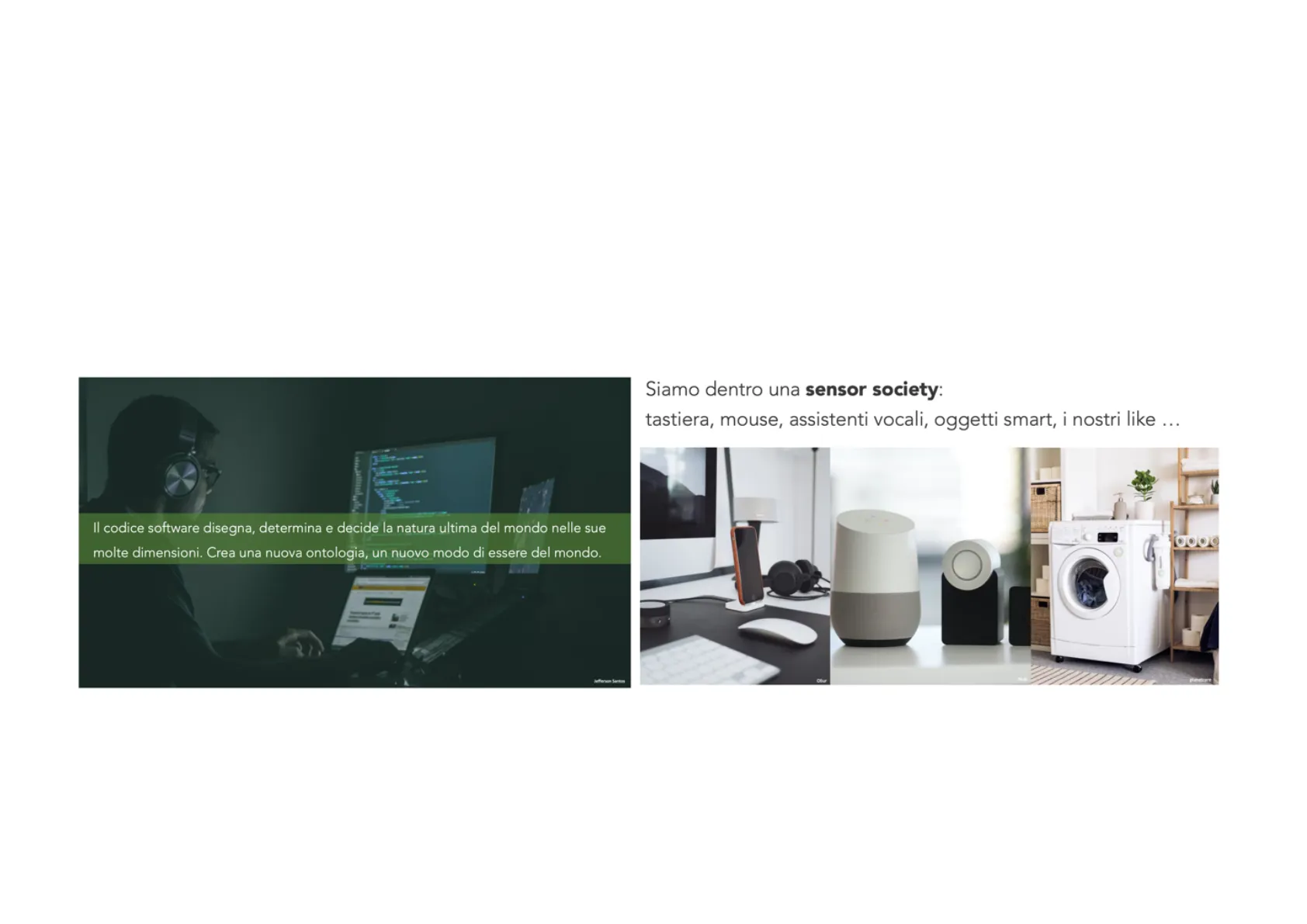
Il codice software disegna, determina e decide la natura ultima del mondo nelle sue
molte dimensioni. Crea una nuova ontologia, un nuovo modo di essere del mondo.
Jeferson Sardon
Siamo dentro una sensor society:
tastiera, mouse, assistenti vocali, oggetti smart, i nostri like ...
planetcare
Le cinque parole chiave della società digitale
- software
- sensori
- dati
- algoritmi
- piattaforme
Una nuova corsa all'oro è cominciata: è l'età d'oro dei datiData a Guide to Humans
.. ..
.4 .-. 5 ..
....-. 4.
S
.. .
. .
PHIL HARVEY AND DR NOELIA JIMÉNEZ MARTÍNEZ
DATA IN DEPTH: What Is Data?
We are going to start this chapter by going deep into a philosophical
experiment that explores the very nature of data. The reason we want
to do this is to reset expectations. To step away from the immediate
concerns of 'the day job' and think about the very nature of the stuff we
are talking about.
Why is that useful? Doing this will help you to question your assump-
tions about what you hold as an a posteriori"28 truth when it comes to
your work with data. Regardless of your science, your statistics, your
programming or your problems when operating empathically in the real
world, an a priorit29 truth is a feature of how people think and develop
their needs and feelings. If your reasoning about a system can't truly be
separated from the experiential reality you see before you, then you
won't be able to have a significant impact in our new data-driven
world. Simply put, 'we have always done it like that' is not good
enough.
A Definition of Data
Ask yourself, what is data? Not the literal 'that which is given' meaning
of the word or discussion about the correct modern use of data as a
grammatical plural. But what is it? If you are interested, we are separ-
ating the philosophy of the phenomenology of data from the ontology of
data.
Now let's break it down, stripping away the layers of the phe-
nomenon until we can't go any deeper and find the fundamental ele-
ments of data that make it what it is. This is presented as a set of
cumulative axioms (true sentences) to make up our definition:
- The same piece of data can be stored in a multitude of different
formats. For example, a database binary format such as CSV, JSON
or XML, bytes and hand-written (a non-exclusive list). - Data has many representations, which means that data itself is not
any single representation but is that which is represented. - Stripping away what makes up the representation therefore leaves
only the pure elements of data itself. - Alone a number isn't data, it is a number, meaningless except in its
representation of scale. Similarly, a word or symbol isolated is not
data, it is only its own utility. - The elements of data are interdependent. Each element of data
provides context for each other element of data. This interdepend-
ence is necessary for the set of data to retain meaning as data. - Data is neither the formatting nor the individual elements of itself.
As such it is gestalt, which means it is, as an organised whole,
something more than just the sum of its parts. - Data, as a word, is technically plural. Datum is an individual part
of that plurality and, as such, a more correct, but less commonly
used, word for what we have discussed above. - Therefore, data is a collection of gestalt datum that only exists as
the combination of its elements regardless of containing
representation. - This gestalt datum represents an atomic partial state of a universe,
real or conceptual. The atomicity of features of that state and the
gestalt nature of the datum are a transliteration of each other. In
database systems, atomicity is used to describe an indivisible (all or
nothing) set of operations. - Data itself is generated out of this conceptual realm by recording
partial states of a universe.
How on earth could this be valuable? When it comes to a more
empathic approach to data and data technology, it means that your
decisions about data are entirely bound to your domain of execution and
your perspective. Others working with the exact same data from a differ-
ent domain or perspective can have completely different needs, feelings
and expectations from your own.
In the remainder of this chapter we will look at a few more terms
and what they mean.
The Data Journey
The value of data is realised by that data going on a journey. The tradi-
tional academic perspective of this journey is known as the DIKW pyr-
amid. DIKW stands for Data, Information, Knowledge and Wisdom. The
goal in this model is for data to go on a journey to wisdom.
Back to page 175
Page 39
Page 40
17 pages left
. . 1.i dati sono oggi la risorsa
economica più importante al
mondo; stiamo entrando
dentro una nuova economia,
quella dei dati ...
The
Economist
Subscribe
2 Log in or register
Regulating the internet giants
The world's most valuable resource
is no longer oil, but data
The data economy demands a new approach to antitrust rules
amazon
Google !!!
IL Print edition | Leaders >
May 6th 2017
f
A NEW commodity spawns a lucrative, fast-growing industry,
prompting antitrust regulators to step in to restrain those who
control its flow. A century ago, the resource in question was oil.
Now similar concerns are being raised by the giants that deal in
data, the oil of the digital era. These titans-Alphabet (Google's
parent company), Amazon, Apple, Facebook and Microsoft-
look unstoppable. They are the five most valuable listed firmsI dati di oggi sono diversi dai dati di un tempo ...
Una definizione sfuggente di Big Data
"Big data" refers to datasets whose size is beyond the ability of typical database
software tools to capture, store, manage, and analyze. This definition is
intentionally subjective and incorporates a moving definition of how big a
dataset needs to be in order to be considered big data-i.e., we don't define
big data in terms of being larger than a certain number of terabytes (thousands
of gigabytes). We assume that, as technology advances over time, the size of
datasets that qualify as big data will also increase. Also note that the definition
can vary by sector, depending on what kinds of software tools are commonly
available and what sizes of datasets are common in a particular industry.
Mckinsey
Le 3 V dei Big Data
Le 3 V*
dei Big Data:
volume
velocità
varietà
* Le 3V sono del modello di Douglas Laney
VOLUME
Terabytes
Records
Transactions
Tables, files
3 Vs of
BIG DATA
VELOCITY
VARIETY
Batch
Near Time
Real Time
Streams
Structured
Unstructured
Semistructured
All the Above
https://aadamov.wordpress.com/2015/04/24/understanding-big-data-3vs-of-big-data/
Volume di dati a livello mondiale (2010-2025)
Volume of data/information created, captured, copied, and
consumed worldwide from 2010 to 2025
(in zettabytes)
200
181
150
120
97
100
79
64.2
50
41
33
26
15.5
18
12.5
9
6.5
5
2
0
2010
2011
2012
2013
2014
2015
2016
2017
2018*
2019*
2020*
2021*
2022*
2023*
2024*
2025*
@ Statista 2021
Un volume crescente di dati
Data volume in zetabytes
147
Prefissi del Sistema internazionale di unità di misura
Prefissi del Sistema internazionale [ modifica I modifica wikitesto ]
Prefissi del Sistema internazionale di unità di misura
Prefisso
Simbolo
Notazione
scientifica
Numero decimale
Scala lunga
[note 1]
Scala corta
[note 2]
Adozione
[note 3]
yotta
Y
1024
1 000 000 000 000 000 000 000 000
Quadrilione
Septillion
1991[1]
zetta
Z
1021
1 000 000 000 000 000 000 000
Triliardo
Sextillion
1991[1]
exa
E
1018
1 000 000 000 000 000 000
Trilione
Quintillion
1975[2]
peta
P
1015
1 000 000 000 000 000
Biliardo
Quadrillion
1975[2]
tera
T
1012
1 000 000 000 000
Bilione
Trillion
1960[3]
giga
G
109
1 000 000 000
Miliardo
Billion
1960[3]
mega
M
106
1 000 000
Million
1960[3]
Wikipedia
Piattaforme e produttori di dati
Piattaforme, social media, siti di contenuti e
community sono grandi produttori di dati
JUL
2021
DIGITAL AROUND THE WORLD
ESSENTIAL HEADLINES FOR MOBILE, INTERNET, AND SOCIAL MEDIA USE
INTERNET USER NUMBERS NO LONGER INCLUDE DATA SOURCED FROM SOCIAL MEDIA PLATFORMS, SO VALUES ARE NOT COMPARABLE WITH PREVIOUS REPORTS
TOTAL
POPULATION
UNIQUE MOBILE
PHONE USERS
INTERNET
USERS
ACTIVE SOCIAL
MEDIA USERS
we
are
social
7.87
BILLION
5.27
BILLION
4.80
BILLION
vS. POPULATION:
60.9%
4.48
BILLION
vS. POPULATION:
56.8%
8
SOURCES THE UN, LOCAL GOVERNMENT BODIES, GSMA INTELLIGENCE, ITU GWI EUROSTAT, CNNIC, AN, SOCIAL MEDIA PLATFORMS' SELF-SERVICE ADVERTISING TOOLS, COMPANY
EARNINGS REPORTS MEDIASCOPE "ADVISORIT& INTERNET USER NUMMERS NO LONGER INCLUDE DATA SOURCED FROM SOCIAL MEDIA PLATFORMS, SO VALUES ARE NOT COMPARAME
we
are
social
Hootsuite®
JUL
2021
DAILY TIME SPENT WITH MEDIA
THE AVERAGE AMOUNT OF TIME' EACH DAY THAT INTERNET USERS AGED 16 TO 64 SPEND WITH DIFFERENT KINDS OF MEDIA AND DEVICES
TIME SPENT USING THE
INTERNET (ALL DEVICES)
TIME SPENT WATCHING TELEVISION
(BROADCAST AND STREAMING)
TIME SPENT USING
SOCIAL MEDIA
TIME SPENT READING PRESS MEDIA
(ONLINE AND PHYSICAL PRINT)
K
6H 55M
AQOQ: - 0.2%
3H 20M
AQOQ: +1.5%
2H 24M
AGOQ: +1.4%
2H 03M
AQOQ: +6.0%
TIME SPENT LISTENING TO
MUSIC STREAMING SERVICES
TIME SPENT LISTENING
TO BROADCAST RADIO
TIME SPENT LISTENING
TO PODCASTS
TIME SPENT PLAYING VIDEO
GAMES ON A GAMES CONSOLE
W
are.
social
GWI.
1H 33M
AQOQ: 0%
1H OOM
AQOQ: +3.4%
OH 55M
AQOQ: +5.8%
1H 12M
AQOQ: +2.9%
SOURCE: GWI (21 2021) FIGURES REPRESENT THE FINDINGS OF A BROAD GLOBAL SURVEY OF INTERNET USERS AGED 16 10 64. SEE GWICOM FOR MORE DETAILS. "NOTES: CONSUMPTION
10
OF DIFFERENT MEDIA MAY OCCUR CONCURRENTIE " ADOGY REPRESENTS QUARTER-ON-QUARTER CHANGE. TELEVISION INCLUDES BROADCAST [LINEAR) TY AND CONTINT COUVERID VIA
STREAMING AND VIDEO ON DEMAND SERVICES, PRESS INCLUDES ONLINE AND PHYSICAL PUNE MEDIA, BROADCAST RADIO DOES NOT INCLUDE INTERNET RADIO
we
are.
social
Hootsuite®
10 DATA PUBLISHED IN PREVIOUS REPORTS. SOCIAL MEDIA USER NUMBERS MAY NOT REPRESENT UNIQUE INDIVIDUALS. . COMPARABILITY ADVISORY: SOURCE AND BASE CHANGES
https://wearesocial.com/blog/2021/07/digital-2021-i-dati-di-luglio/
URBANISATION:
56.6%
vs. POPULATION:
66.9%
GWI.
Non hai trovato quello che cercavi?
Esplora altri argomenti nella Algor library o crea direttamente i tuoi materiali con l’AI.