Il ruolo della psicopatologia descrittiva e i disturbi psicopatologici
Documento sulla psicopatologia descrittiva che esplora il ruolo di questa disciplina, coprendo i principali disturbi psicopatologici come schizofrenia e disturbi d'ansia. Il Pdf, utile per lo studio universitario di Psicologia, discute i sistemi di classificazione diagnostica (DSM e ICD) e la distinzione tra normalità e patologia, con riferimenti a figure come Karl Jaspers.
Mostra di più19 pagine


Visualizza gratis il Pdf completo
Registrati per accedere all’intero documento e trasformarlo con l’AI.
Anteprima
Il ruolo della psicopatologia descrittiva
10/03/25 - (09.30-11.30) Psychiatry- Martinotti Sbobina: Maria Cecilia Aronne (Revisione: Rotem Bross) THE ROLE OF DESCRIPTIVE PSYCHOPATHOLOGY In this course, the major psychopathological disorders will be covered, with particular focus on schizophrenia, which will take up about four to five lessons. The course will also cover bipolar disorder, mania, depression, obsessive-compulsive disorder, various anxiety disorders, and substance use disorders, given the numerous issues substance usage presents.
Semeiotica psichiatrica e psicopatologia
PSYCHIATRIC SEMEIOTICS AND PSYCHOPATHOLOGY Ferro Filippo, Pettorruso Mauro, Mosca Alessio, Chiappini Stefania, D'Andrea Giacomo, Di Carlo Francesco Substances have the potential to induce psychotic symptoms such as anxiety and mood swings, and this will be a key area of focus. To fully understand these conditions, it's essential to analyze each individual symptom. For example, consider "delusion" (in Italian, delirio) which will help us understand how it manifests in different pathologies and is crucial for making a proper diagnosis. In psychiatry, the DSM classification system is used for accurate diagnosis - understanding the diagnostic criteria is crucial, it is the most IMPORTANT point for the exam. This tool helps differentiate between conditions such as schizophrenia and other mental health disorders. Basic understanding of psychiatry within general medicine is vital. For instance, just recently, a colleague working in the emergency department shared a study indicating that 45% of patients admitted to the emergency room have psychiatric issues. While in some cases it is a comorbidity (not the cause of hospitalization), this statistic highlights the importance of recognizing psychiatric symptoms. In an emergency setting, a doctor might encounter a patient presenting with physical symptoms like chest pain, which could either be related to a medical condition or be the result of a panic attack. Recognizing the specific symptoms and making the correct diagnosis can make a significant difference in treatment. In addition, managing pharmacotherapy for psychiatric patients is also crucial. While complex conditions like schizophrenia require specialized expertise, even a general physician may encounter patients with depression or panic attacks. In such cases, knowing how to prescribe medications such as antidepressants, tranquilizers, and benzodiazepines becomes essential. Having this knowledge is a fundamental aspect of medical practice.
(During the lessons he presents cases that are very important to understand). Thedor Jaspers was a philosopher, he belongs to existentialism together with Hussler. Jaspers at the beginning of last century, wrote a very important book:" the general psychopathology" before becoming a full philosopher he was a psychiatrist. In the book, he described all the symptoms of interest in these disciplines, for example the definition of delusion. Karl Theodor Jaspers (1883 -1969) 1 10/03/25 - (09.30-11.30) Psychiatry- Martinotti Sbobina: Maria Cecilia Aronne (Revisione: Rotem Bross)
Cos'è la psicopatologia?
What is psychopathology? It has two main focus:
- Describing the individual's psychic and behavior alterations;
- The classification of those alterations.
The focus is not primarily concerned with diagnostic definitions or the delimitation of various pathological entities. In medicine, it's common to identify a condition clearly, such as saying: "this is diabetes" based on factors like blood sugar levels. In psychiatry, however, it's somewhat different. While classification is possible and necessary, often there is a continuum between normality and pathology (the line can be blurry). As a result, distinguishing between the two becomes more challenging in psychiatry.
Obiettivi della psicopatologia descrittiva
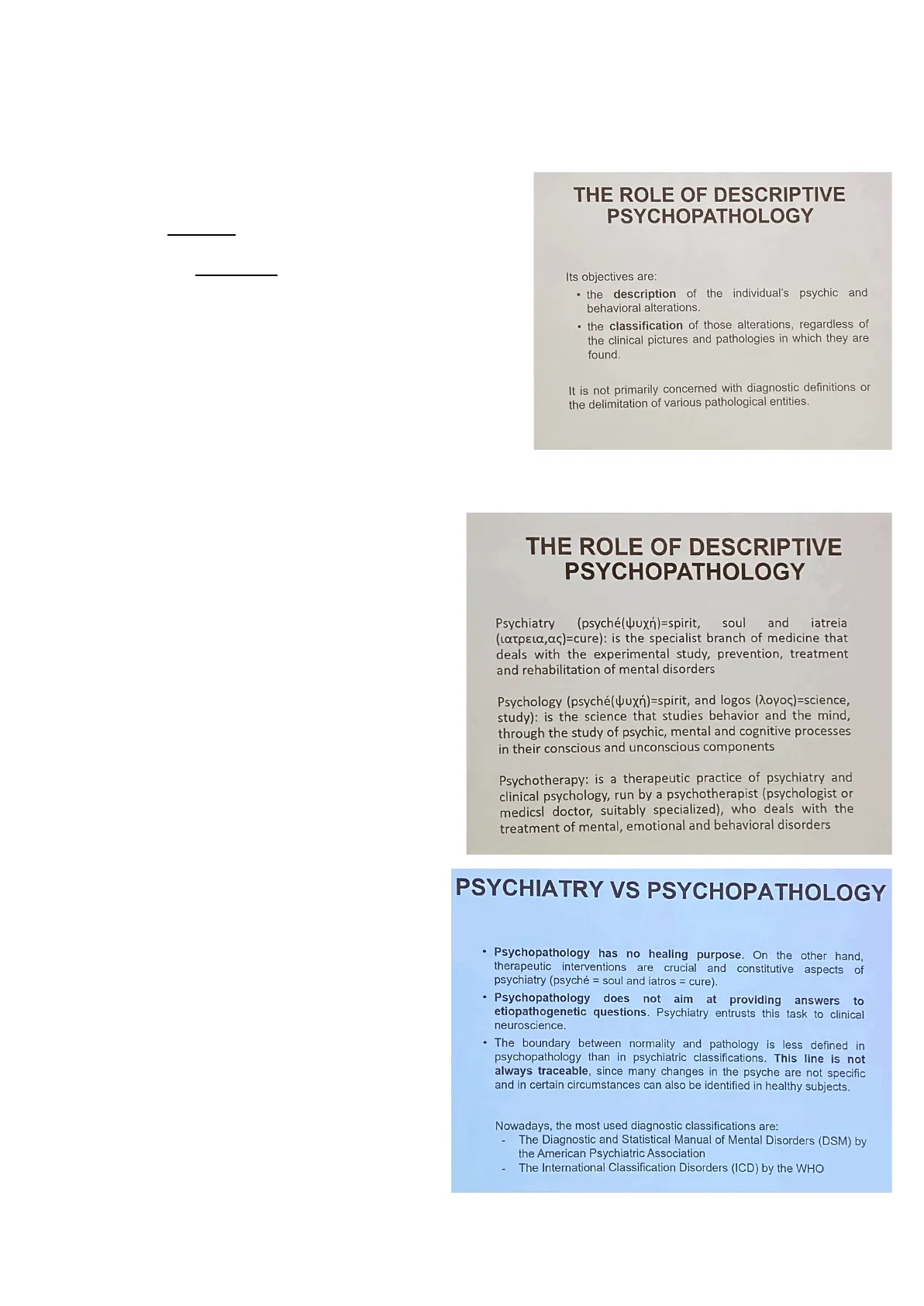
THE ROLE OF DESCRIPTIVE PSYCHOPATHOLOGY Its objectives are: • the description of the individual's psychic and behavioral alterations. • the classification of those alterations, regardless of the clinical pictures and pathologies in which they are found. It is not primarily concerned with diagnostic definitions or the delimitation of various pathological entities.
Terminologia: psichiatria e psicologia
Let's speak about some terms: Psychiatry: 'psyche'= spirit and 'iatrieia'= cure; we can define it as the branch of medicine that deals with the experimental study, prevention, treatment and rehabilitation of mental disorders. Psychology: 'psyche'= spirit and 'logos'= science. It is the science that studies behavior and the mind. So, psychology itself does not directly involve treatment. Psychologists do not prescribe medications or offer medical treatments; their role is primarily to engage with patients, communicate, and understand the 'logos' of the mind. A psychologist may, however, become a psychotherapist if they pursue additional training after obtaining a degree in psychology. Psychologists can administer assessments, such as psychometric scales, and conduct evaluations, but they do not treat patients directly. On the other hand, psychiatrists, after completing their residency, are able to provide both psychotherapy and medical treatment. Psychopathology has no healing purpose. Psychopathology does not aim at providing answers to etiopathogenetic questions. The line between normality and pathology is not always traceable, since many changes in the psyche are not specific and in certain circumstances can also be identified in healthy subjects. When discussing various disorders, it's important to consider how they manifest in the body. Take mood disorders like depression, for instance: experiencing feelings of depression is quite common. The difference between normal and pathological THE ROLE OF DESCRIPTIVE PSYCHOPATHOLOGY Psychiatry (psyché(ψυχή)=spirit, soul and iatreia (ιατρεια, ας)=cure): is the specialist branch of medicine that deals with the experimental study, prevention, treatment and rehabilitation of mental disorders Psychology (psyche (ψυχή)=spirit, and logos (λογος)=science, study): is the science that studies behavior and the mind, through the study of psychic, mental and cognitive processes in their conscious and unconscious components Psychotherapy: is a therapeutic practice of psychiatry and clinical psychology, run by a psychotherapist (psychologist or medical doctor, suitably specialized), who deals with the treatment of mental, emotional and behavioral disorders
Psichiatria vs. psicopatologia
PSYCHIATRY VS PSYCHOPATHOLOGY • Psychopathology has no healing purpose. On the other hand, therapeutic interventions are crucial and constitutive aspects of psychiatry (psyché = soul and iatros = cure). • Psychopathology does not aim at providing answers to etiopathogenetic questions. Psychiatry entrusts this task to clinical neuroscience. • The boundary between normality and pathology is less defined in psychopathology than in psychiatric classifications. This line is not always traceable, since many changes in the psyche are not specific and in certain circumstances can also be identified in healthy subjects. Nowadays, the most used diagnostic classifications are: - The Diagnostic and Statistical Manual of Mental Disorders (DSM) by the American Psychiatric Association - The International Classification Disorders (ICD) by the WHO 210/03/25 - (09.30-11.30) Psychiatry- Martinotti Sbobina: Maria Cecilia Aronne (Revisione: Rotem Bross) depression lies in the duration and severity of the symptoms. Pathological depression can last for an extended period and be much more severe, whereas temporary, less intense feelings of sadness may be a part of normal emotional experience. For example, in a group of women, statistically, about 30% will develop depression at some point in their lives. With men it's a little lower, around 12%. This is not surprising, as depression is relatively common. Nowadays, the most used diagnostic classification are the DSM and ICD.
Differenze di genere nella depressione
Q:" I assume in females the hormonal fluctuation during the monthly cycle has an impact, but do you think that the difference between male and female is about biological differences or is it that male do not talk about that and do not treat it? A:" For male is less percentage, the biological reason is very important." Q:" Do you think that there is a relationship between the role of the female and the male from a society point of view that is not equal?" A:" Society's reason can be important as well. So, first point: biological issues; If we talk about progesterone and estrogen the 3 days before menstruation are crucial this is because female are very sensitive to this, and so the possibility, a part the 3/4 days, to induce a very severe mood swings that can be last much more. Also If you look at the percentage, this can be explained from the period between 15-50 y o (the period of the menstrual cycle that can give a specific effect). If we are speaking about a population below the age of 15: same data in males and females. If we are speaking about the population over 50 years old, the percentage is the same (worst for males after the age of 40-50). Both biological and social factors are important in the same manner even if the biological issue is the main one. Of course it is easy for a woman to speak about mood rather than a male and his role: he can not show his fragility because he must be an ' 'alpha man".
Normalità e anormalità in psichiatria
Criteri di valutazione della normalità
Talking about normality in psychiatry and psychopathology If we are doing differences between normality and abnormality If we look at the table, the sociocultural one can be important if we can give a normal judgement about it from a psychological point of view. Normality can be the compliance between social norms of the group and own culture; Abnormality can be non confirmatory and may involve deviations from these norms, which could be seen as socioanthropological differences from the surrounding context. NORMALITY IN PSYCHIATRY AND PSYCHOPATHOLOGY To define the presence of a mental disorder, the existing diagnostic systems are mainly based on two criteria: 1) the presence of alterations in psychosocial functioning; 2) the presence of subjective suffering and distress. EVALUATION CRITERIUM NORMALITY JUDGMENT ABNORMALITY and / or PATHOLOGY STATISTICAL How often a behavior, a trait or a characteristic is present in a population Infrequency and rarity of similar behaviors in a population BIOLOGICAL Normal functioning of the biological processes underlying thought and behavior Biological alterations underlying thought and behavior SOCIO-CULTURAL Compliance with social norms of the group and own culture Non-conformity, socio-anthropological deviation from the context PSYCHOPATHOLOGICAL Understanding of experiences and behaviors by the observer Loss of comprehensibility SUBJECTIVE SUFFERING Low or transient levels of suffering State of marked subjective suffering PSYCHOAFFECTIVE DEVELOPMENT Developed psychic maturity Significant alterations in psychic and affective maturation ETHOLOGICAL Consistency with some basic behaviors of the human species (and mammals in general) Alteration or disintegration of multiple basic behaviors However, it's important to consider that cultural norms vary across regions. For instance, if someone comes from a Southern African culture, their social and cultural norms may differ significantly from those in Northern regions. This cultural diversity makes it challenging to draw a clear line between normality and pathology, especially in the context of psychopathology. Additionally, subjective suffering plays a critical role in this distinction, as personal experiences of distress or discomfort must also be taken into account when assessing normality or abnormality. 3
Non hai trovato quello che cercavi?
Esplora altri argomenti nella Algor library o crea direttamente i tuoi materiali con l’AI.