Le Basi Neurofarmacologiche delle Dipendenze, Presentazione Unicam
Slide da Unicam Università di Camerino sulle basi neurofarmacologiche delle dipendenze. Il Pdf esplora i meccanismi di rinforzo positivo e negativo, il coinvolgimento del sistema limbico e dell'amigdala, e il rilascio di dopamina, utile per studenti universitari di Biologia.
Mostra di più20 pagine

Visualizza gratis il Pdf completo
Registrati per accedere all’intero documento e trasformarlo con l’AI.
Anteprima
UNICAM Università di Camerino
1336 CNS CENTER for NEUROSCIENCE University of Camerino
Neuroscience seminar series
Le Basi Neurofarmacologiche delle dipendenze Nazzareno Cannella Neurofarmacologia dei farmaci d'abuso e sviluppo di terapie innovative nella dipendenza da sostanze Camerino mercoledì 1º marzo 2023 ore 8.30 - 13.30 Polo Carla Lodovici - Edificio A - Aula AA1- via Madonna delle Carceri 7
UNICAM Università di Camerino
1336 CNS CENTER for NEUROSCIENCE University of Camerino
Funzione del cervello
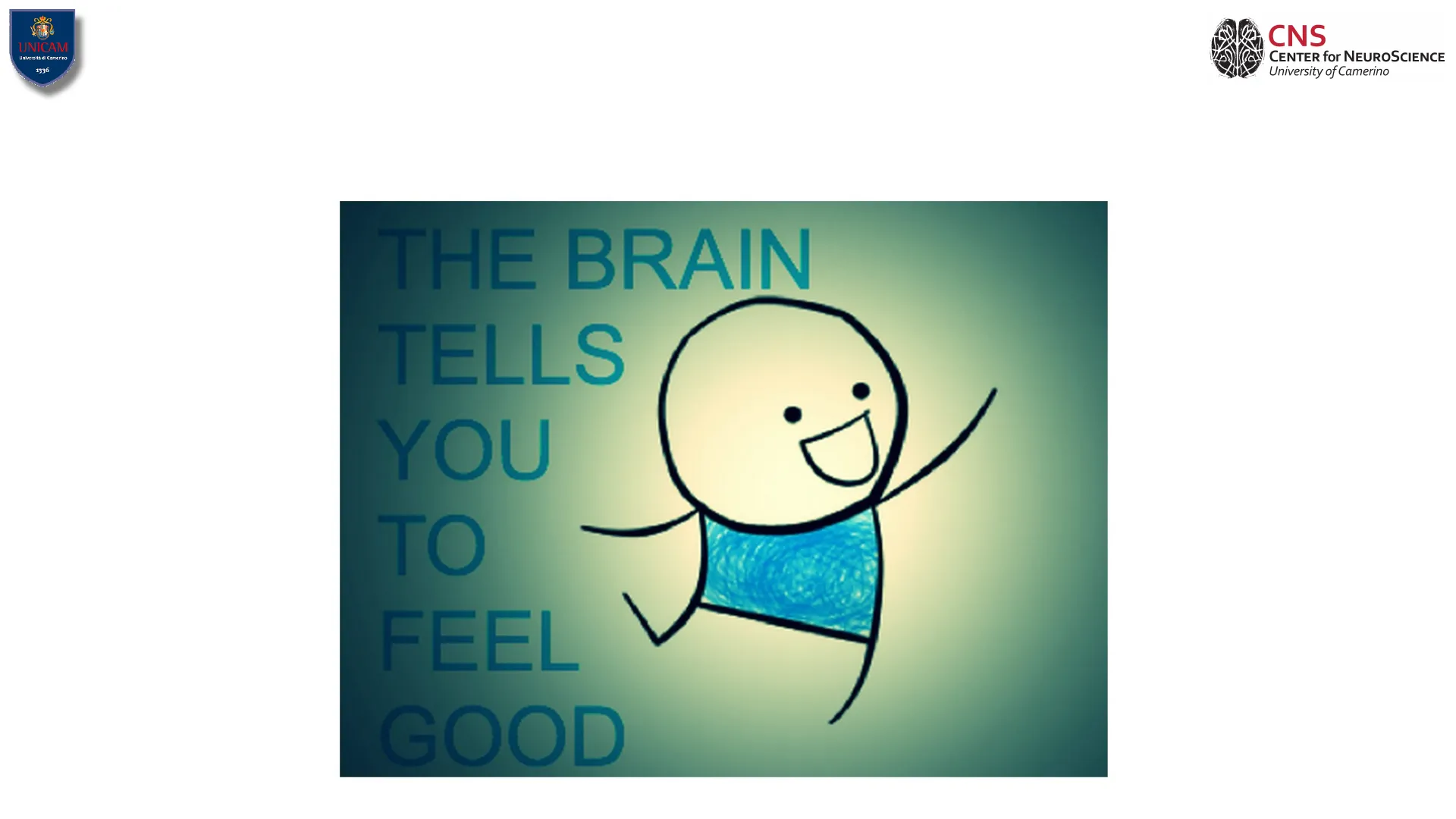
Sapreste riassumere in una breve frase la funzione del cervello? THE BRAIN TELLS YOU TO FEEL GOODE come fa il cervello ad espletare la sua funzione ?
Rinforzo positivo e negativo
Positive Reinforcement FREDDY IS HAPPY TO HAVE GOT SOMETHING NICE
Negative Punishment FREDDY IS DISSAPOINTED TO HAVE LOST SOMETHING HE LIKES OH SHITO WOOHOO! friends primary renforcers attention OUCH! aversive Pressure PHEW! threats scary stuff . lide + FREDDY IS UPSET TO HAVE EXPERIENCED SOMETHING NASTY
Positive Punishment FREDDY IS REUEVED TO HAVE ESCAPED OR AVOIDED SOMETHING NASTY Negative Reinforcement
Sistema limbico e controllo esecutivo
Il sistema limbico codifica la gratificazione L'amigdala estesa codifica stati di stress e malessere Le aree cortico-frontali esercitano il controllo esecutivo e pianificano comportamenti futuri
ACC Thal dIPFC DS GP VIPFC vmPFC NAC HPC BNST CeA OFC Insula Figura adattata da Koob & Schulkin Neuroscience and Biobehavioral Reviews 106 (2019) 245-262
Gratificazioni naturali e dopamina
Le gratificazioni naturali inducono rilascio di dopamina dalla VTA al nucleo accumbens
PFC NAC HIPP AMY GABA Glutamine Dopamine Created in BioRender.com bio Natural Rewards Elevate Dopamine Levels Food Sex 2001 NAc shell % of Basal DA Output 150- 150 100 50 1 F Empty, Box Feeding 0 0 60 120 180 Time (min) DA Concentration (% Baseline) 200 100- VTA Female Present Sample 1 2 3 4 5 6 7 8 Number Di Chiara et al., Neuroscience, 1999.,Fiorino and Phillips, J. Neuroscience, 1997. NIDA
Neurobiologia del sistema mesolimbico dopaminergico
Rewards Rewards D1 and 2 receptors VTA A10 Ventral Tegmental Area Nucleus Accumbens 1 Interneuron O NAC Rewards Disinhibition GABAA receptors Long-loop GABAergic feedback trends in Neurosciences VOL 22, ISSUE 11, P521-527, NOVEMBER 01, 1999
Farmaci d'abuso e rilascio di dopamina
Anche i farmaci d'abuso inducono rilascio di dopamina
a Nicotine 200 O Vehicle 12 @ MR antagonist Spironolactone Dopamine (pg/40ul) 10 8 morphine injection 6 4 I 2 0 -80 -60 -40 -20 0 20 40 60 80 100 120 140 160 180 ## 600- T ## 'U Cocaine ## AUC 60-120 min 400- ## 300 ** # 200- 100- 0 I - ve * * * J-J-0-VL 5-0- vel 0.0- 0 30 60 90 120 150 180 Time (min) after alcohol challenge Extracellular concentrations of dopamine in the nucleus accumbens Dopamine (% of Baseline) 150 100 -o- nAc 50 - -0- DMS -0- DLS 0 - -60 -40 -20 0 20 40 60 80 100 120 140 Time (s) a 4.5 O Alcohol-naive rats 4.0 Dopamine Output (fmol/min) · Alcohol-drinking rats 3.5 3.0 2.5 2.0 I 1.5 1.0 0.5 ** 0 20 40 60 80 100 120 140 160 180 200 Time (min) 500-
Perché i farmaci d'abuso sono gratificanti?
Nicotine, alcohol + Opiates Opioid peptides Glutamate inputs (e.g. from cortex) - Alcohol VTA interneuron GABA ? PCP Alcohol ? Stimulants NMDAR DA NAChR - DA DAR or D2R + Cannabinoids Glutamate inputs (e.g. from amygdala) VTA NAc https://www.researchgate.net/figure/ACTIONS-OF-A-VARIETY-OF-DRUGS-ON-ACCUMBAL-DOPAMINE-ACTIVITY-Nearly-all-drugs-of-addiction_fig2_235938326 Opiates Nicotine +Ciò significa che un farmaco d'abuso crea dipendenza a causa delle sue qualità gratificanti?
Teoria del processo opponente
The Opponent-Process Theory of Acquired Motivation RICHARD L. SOLOMON University of Pennsylvania First Few Stimulations +1001 State A PEAK OF A ADAPTATION STEADY LEVEL OF A Neutral o Baseline ‘DECAY OF B PEAK OF B State B ON OFF OFF +100 TIME Figure 4. The standard pattern of affective dynamics produced by a relatively novel uncon- ditioned stimulus. AMERICAN PSYCHOLOGIST . AUGUST 1980 . 691 Vol. 35, No. 8, 691-712
Stato affettivo e processi a e b
Lo stato affettivo in cui ci troviamo è la sommatoria degli stati a e b
Panel A. FIRST FEW STIMULATIONS
Panel B. AFTER MANY STIMULATIONS A a-b g-b MANIFEST AFFECTIVE 0 RESPONSE Bİ 1 UNDERLYING OPPONENT PROCESSES b b 1 STIMULUS EVENT TIME Figure 7. The comparison of the effects of b processes for relatively novel unconditioned - stimuli and for unconditioned stimuli that are familiar and have frequently been repeated. (Note that the strengthening of the b process is assumed to shorten its latency, increase its asymptotic value, and lengthen its decay time. The standard patterns of affective dynamics shown in Figures 4 and 5 are produced by differing b-process strengths.) AMERICAN PSYCHOLOGIST . AUGUST 1980 . 691 Vol. 35, No. 8, 691-712
Dipendenza da droghe, disregolazione della ricompensa e allostasi
Drug Addiction, Dysregulation of Reward, and Allostasis George F. Koob, Ph.D., and Michel Le Moal, M.D., Ph.D.
a allostasi (+) Mood omeostasi (-) b NEUROPSYCHOPHARMACOLOGY 2001-VOL. 24, NO. 2A A Abstinence Use B Mood Homeostatic Point b Figura adattata da Koob & Schulkin Neuroscience and Biobehavioral Reviews 106 (2019) 245-262
Incentive Salience e craving
Incentive Salience Preoccupation/anticipation "craving" Pratrontal cortex: Orbital, modial and cingubria Subjective offacts - craving Sensory Information Hippocampus Contad! ExecutivG control BILA Conditioned cuas Nogatvo omotional Reinforcement Habits Thalamus Insula Intotocoptve cuas Strass COA, BNST Acb shollcora Dorsal stratum CRF NE -- & Brain stam -- DA Hypothalamus & brainstom effectors (autonomic, somIfic, neuroendocrina) VIA SNO VOP X DOP Withdrawal/ negative affect Binge/intoxication B a Allostatic Points a a Mood a Homeostatic Point b b b Figura adattata da Koob & Schulkin Neuroscience and Biobehavioral Reviews 106 (2019) 245-262 Allostatic State b ACC Thal diPFC DS GP VIPFC vmPFC NA HPC BNS -CeA Insula OF Preoccupation Anticipation Negative Affect Withdrawal Executive Function Deficits Reward Deficit & Stress Surfeit Binge Intoxication 1a Preoccupation/anticipation "craving" Prefrontal cortex: Orbital, modal and cinguiato Subjective effects - crliving 1 Sensory Information Hippocampus Context Executivo control Thal mPFC (AC) DS GP BLA Conditionod cups Negativo emotional state Stress Reinforcement Habits Thalamus Insula Interoceptive Cues CeA. BNBT Acb shellicore Dorsal striatum CRE NE 1 DA Brain stom 1 DÁ 1 VTA Hypothalamus & brainstem effectors (autonomia, somatic, neuroendocrine) SNo VGP DGP Withdrawal/ negative affect Binge/intoxication -Hippo OFC AMGc Preoccupation/anticipation "craving" Prefrontal cortex: Orbital, medial and cingulate Subjective effects - craving 1 Sensory information Hippocampus Context Executivo control Thal mPFC (AC) DS GP BLA Conditioned cues Negative emotional stato Reinforcement Habits Thalamun Insula Interoceptive cues Stross CeA, BNST Acb shall/core Dommal striatum CRE NE 1 DA Brain stom - VIA Hypothalamus & brainstem effecton (autonomic, somatic, neuroendocrine) SN VGP DGP Withdrawal/ negative affect Binge/intoxication Hippo OFC AMGb Preoccupation/anticipation "craving" Prefrontal cortex: Orbital, medial and cingulate Subjective effects - craving 1 Hippocampus Context Sensory Information Exodusve control 1 Thal mPFC (AC) DS GP BLA Conditioned cues Negative emotional stato Stress Reinforcement Habita Thalamus Insula Intoroceptive cung CeA BNST Acb shellicore Dorsal striatum CRF NE 1 DA Brain stem DÁ Hypothalamus & brainstem effectors (autonomic, somatic, neuroendocrine) SNC VGP DGP Withdrawal/ negative affect Binge/intoxication CYST - Hippo BNST OFC AMG
Rinforzo positivo e negativo
opioid peptides positive reinforcement GABA DA VTA nucleus accumbens negative reinforcement CRF NA brain stem amygdala B a a Mood - Homeostatic Point b tttPositive Reinforcement FREDDY IS HAPPY TO HAVE GOT SOMETHING NICE WOOHOO!
Fattori di rischio e rinforzo negativo
Traumi giovanil Predisposizione Isolamento sociale Traumi infantili Assunzioni ripetute Stress Stimoli ambientali condizionati aversive Pressure threats scary stuff FREDDY IS RELIEVED TO HAVE ESCAPED OR AVOIDED SOMETHING NASTY Negative Reinforcement
UNICAM Università di Camerino
1336 Grazie per l'attenzione CENTER for NEUROSCIENCE University of Camerino CNS
Non hai trovato quello che cercavi?
Esplora altri argomenti nella Algor library o crea direttamente i tuoi materiali con l’AI.