Immunoassays: Understanding Antigens, Antibodies, and ELISA Techniques
Slides from University about Immunoassays. The Pdf provides an introduction to immunoassays, explaining fundamental immunology terms, the nature of antigens and antibodies, and methods for producing polyclonal and monoclonal antibodies. The Presentation is suitable for university-level Biology students.
See more28 Pages


Unlock the full PDF for free
Sign up to get full access to the document and start transforming it with AI.
Preview
Immunoassays
Dr Karen Ball
Topics to cover
- Reminder of basic terms in immunology
- Antigens and antibodies; specific affinities for each other
- The production of polyclonal and monoclonal antibodies
- Using antibodies in immunoassays (to quantify antigens)
- Different types of immunoassays (e.g. ELISA) and the ways that
antibodies are labelled
Reminder of some terminology in immunology
Immunology is the study of the immune system that protects us from
other organisms/agents, which if allowed to spread, would result in
our death.
The immune system is capable of recognising, eliminating, and
destroying, as well as remembering foreign cells.
The immune system consists of;
The "innate immune system" - which we have from birth and is non-
specific - just recognising anything that is "not self".
The "adaptive immune system" - where during our lives our immune
system changes in character following an infection to make it more
capable of fighting the infection. The adaptive immune system is
very specific with a specific cell or agent of the immune system (e.g,
an antibody) being produced to fight a specific invasion.
Adaptive Immunity and Antibodies
Each cell involved in the adaptive immunity has specialised receptors
that can bind to clusters of molecules on the surface of foreign cells -
known as epitopes. One group of adaptive immune cells are known as
B Lymphocytes or B cells. They secrete their receptors in large
amounts - and the secreted receptors are called "Antibodies".
Epitope
Antigen
The foreign invader is known as an antigen - but the area on the
antigen that specifically binds to the antibody is known as an
epitope.
Immunoassays in Practice
Scientists working in many fields are interested in this process. e.g ;
· Vaccinations
. Immunoassays: The specific affinity that antibodies have antigens
can be exploited in immunoassays.
A common illness e.g. TB - will have a specific epitope on it surface. You could break up the cells causing
TB and get small fragments containing the epitopes - but not being functional to cause the diseases. By
injecting this into a human you can get them to produce clones of the TB fighting B cells - and produce
memory cells - so that if the person was ever exposed to TB the body could quickly remove the infection
before it has a chance to cause any problems.
Immunoassay Definition
immuno = immune system e.g. antibodies and antigens
assay = determine how much of something is present
Therefore an immunoassay exploits the specific
binding affinity an antibody has for a specific antigen
to help to quantify how much of either the antibody or
antigen is present.
There are two major requirements for an immunoassay;
An antibody
An detection system
The Antibody Structure
1. The Antibody
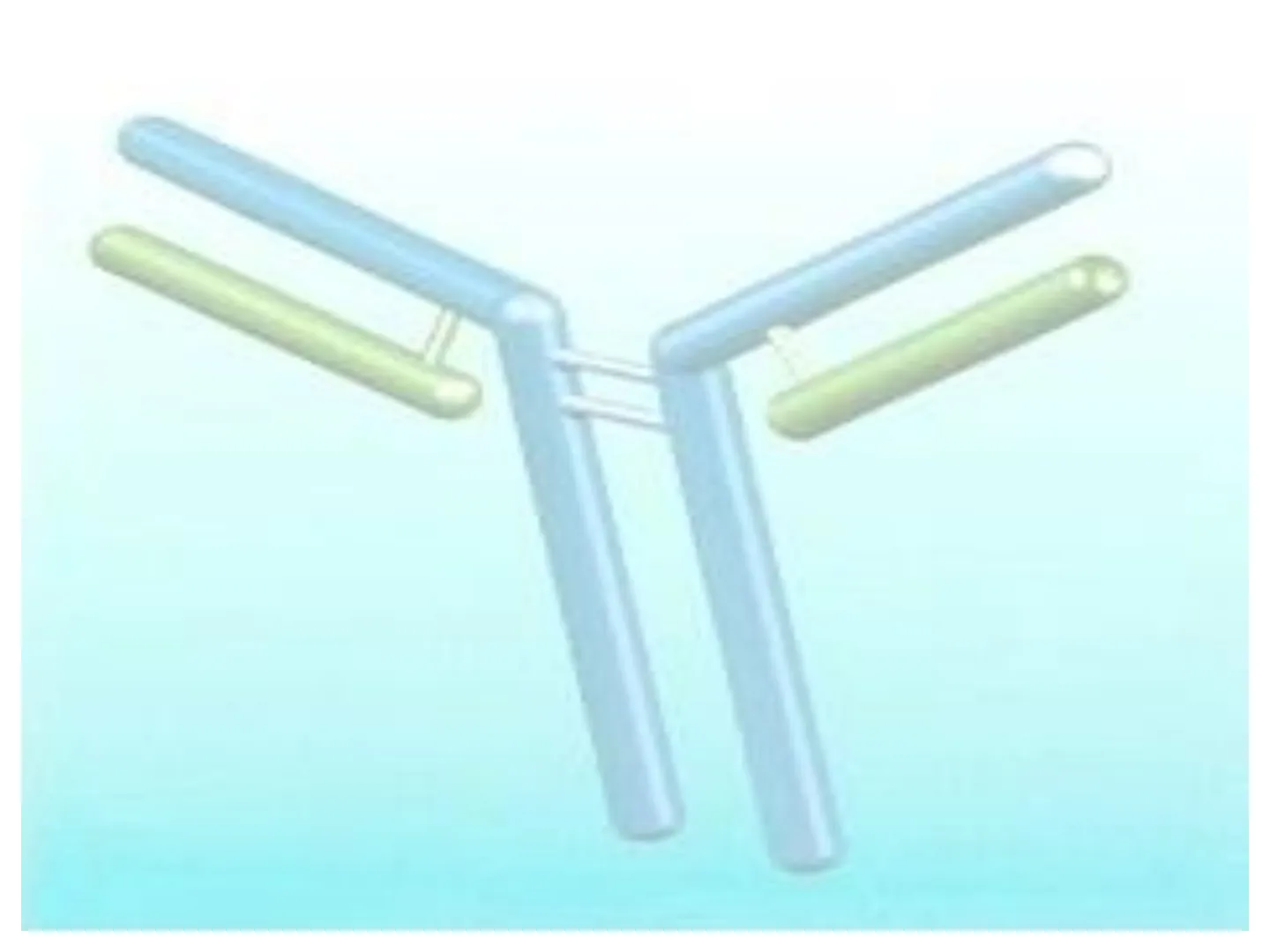
Antibodies are immune system-related proteins called
immunoglobulins. Each antibody consists of four polypeptides- two
heavy chains and two light chains joined to form a "Y" shaped
molecule.
Antigen binding sites
Variable region
on heavy
chain
S
Light
chain
Variable region
on light chain
Disulfide
bridges
Constant region
on light chain
Heavy chain
Constant region
on heavy chain
The a.acid sequence in the tips of
the "Y" varies among different
antibodies. This region (110-130
a.acids) gives the antibody
specificity.
The constant region determines the mechanism used to destroy
antigen. Antibodies are divided into 5 major classes, IgM, IgG, Iga,
IgD and IgE, based on their constant region structure and immune
function.
Antibody Diversity Creation
How is diversity created on antibodies variable sites?
(a) By having multiple gene sequences
(b) Inaccurate and multiple joining - random component
(c) Different heavy and light chain combinations
(d) Somatic mutation - occurs 1 million times more often in variable
regions of antibodies compared to other amino acid chains.
Obtaining Antibodies: Production Methods
Obtaining antibodies: The production of antibodies
Do we want a monoclonal antibody or a polyclonal antibody?
Epitope
Antigen
Monoclonal
polyclonal antibodies
Epitope
Antigen
Polyclonal
Polyclonal Antibody Production
Polyclonal antibodies are produced using the following method;
- Immunise animal
with antigen - Reimmunise animal
to get 2º response - Take a blood sample
and test to see if
it has made the antibody - Can continue to take blood
samples from the rabbit during its
life - a source of the
polyclonal antibodies
Monoclonal Antibody Production
Monoclonal antibodies are obtained in the following way;
- Innoculate animal
- Reinnoculate to
get 2º response - Sacrifice animal - remove spleen
(as often not enogh blood to sample) - Isolate lymphocytes and grow on
a cell culture - check to see if
antibody is produced.
Remove B-cells from the spleen of an animal that has been challenged
with the antigen. These B-cells are then fused with myeloma tumor
cells that can grow indefinitely in culture (myeloma is a B-cell
cancer).
The fused hybrid cells (called hybridomas) will multiply rapidly and
indefinitely (since they are cancer cells) and will produce large
amounts of antibodies.
Comparison of Polyclonal and Monoclonal Antibodies
Comparison between polyclonal and monoclonal antibodies:
- Monoclonal
- Restricted to mouse
- Can develop and grow cell
culture (quick and cheap) - Lifelong culture
- Constant antibody source
- Little purification needed
- Most often used in
immunoassays - Polycolnal
- Many animals can be use (as long
as big enough). - Need animal houses - strict
regulations - Finite source - as animal will
eventually die of old age and the
source changes each time a new
animal is used. - Must purify antibody's from all
other cell components - Best for large antigens who's
epitopes may change e.g. bacteria
Animal Selection for Antibody Production
What animal should you try and induce antibody production in?
Monoclonal - Mouse
Polyclonal - normally a large animal e.g a rabbit, goat, sheep. In
choosing the animal you must consider;
. Foreignness - Antigen should be foreign to the animal
. Convenience -easy to buy/look after/don't take up too much space
. Genome - even animals of the same species have slightly different
genomes. Best to use the same strain of animal.
Antigen Selection for Inoculation
What antigen should be used to inoculate the animal?
Not all antigens work well - consider;
(a) Molecular size - Bigger the better
(b) Composition - should have varied amino acids
(c) Heterogeneity - a difficulty is posed if a particular antigen has a
number of different forms
(d) Haptens - small non-protein molecules have Antigenicity (can be
recognised by the immune system and bind to antibodies) but lack
immunogenicity (the ability to initiate an immune response). You
can trick the immune system to create antibodies by binding it to a
protein - known as a carrier
(e) Solubility of the antigen - Large insoluble antigens are better at
causing antibody
Adjuvant Use and Administration
Consider the use of an "Adjuvant" to promote antibody response to the
antigen.
Adjuvants work by;
· Prolonging the persistence of the antigen in tissues
· Co-stimulating an immune response (getting B cells to rush to the area)
e.g. water in oil suspensions containing some killed Tuberculosis
microbacterium is commonly used as a suspension for vaccinations.
How do you administration an antigen to an animal?
Possible routes include; intravenous (directly into the blood - useful in
mice for monoclonal antibody production); Subcutaneous (under the
skin - goes in via the lymph nodes).
Best to inoculate animal at least twice to get 2º response.
Antigen Dosage Considerations
How much antigen should be administered?
Low dose tolerance; if you don't put enough in - you will not
stimulate enough of the immune system
High dose tolerance: If you put too much in you can sometimes get
unresponsiveness of the immune system - still not clear why this
occurs.
Alternative Antibody Production
Alternative way to produce antibodies without the use of animals;
By using Libraries of antibodies DNA sequences
Adv: overcome problems of foreignness
Dis: each time you want a new antibody you must screen 108
antibodies - very complex and time consuming.
Immunoassay Detection Systems
Immunoassay - The detection system
An immunoassay uses the specific binding of an antibody to an
antigen.
However in order to know that binding has occurred we need to be
able to detect this.
There are two main categories of detection systems that exist;
- Those which exploit a change in physical properties when they i.e.
if it leads to precipitation - Those that require the use of a label e.g. a radiolabel or enzyme
label that can cause a signal linked to when binding occurs
Immunoassays Exploiting Physical Changes
Immunoassays - exploiting physical changes in solution
Two physical properties can be exploited in these techniques;
(a) Precipitation - the correct ratio of antibody to antigen (no more or
less) can lead to crosslinking - causing precipitation (ppt)
(b) Agglutination - Similar requirements except crosslinking does not
result in ppt - just a change in turbidity of the solution which can be
measured using nephelometry (i.e shine light through the solution).
Both of these methods require both the antibody and the antigen to
be bivalent (i.e the antibody must bind to two antigens - and the
antigen must bind to two antibodies);
Antibody
-- Antigen
Epitope
The ppt or agglutination will
only occur when there is the
correct ratio of antibody to
antigen. This is important since
it is the basis for determining
how much antigen is present.
But why is this so?
Excess antibody Prevents
crosslinking as enough antibody
to bind to each individual antigen
- therefore statistically unlikely to
find the antigen shared by two
antibodies -no crosslinking.
Excess antigen This means that the
antigens will bind to all available
antibody sites and again this
doesn't facilitate cross linking.
Equivalence Amount in Immunoassays
Equivalence amount
At a specific ratio of antibody to antigen (specific to a set immunoassay)
- there is optimum chance of crosslinking between the antibody and the
antigen. This is when ppt of agglutination will occur.
A plot of antibody ppt vs amount of antigen added will look like this.
This can be used as a standard curve so an unknown antigen
concentration can be determined.
Excess antibody
Excess antigen
Equivalence
ppt
Antigen added
Specific Immunoassay Techniques: Precipitation
Specific examples of immunoassay techniques exploiting precipitation
Mancini test (radial immunodiffusion)
Fill a petri dish with gel containing your
specific antibody
Place the antigen in the centre and allow it
to diffuse out.
At the very centre the conc. of antigen is
too high, as it diffuses it will eventually
reaches the equivalent causing a ring of ppt Radius a Concentration
A standard curve can be used
Other techniques e.g looking as changes in turbidity of solutions exist
Specific Immunoassay Techniques: Labels
Specific examples of immunoassay techniques using lables
Examples:
· Radioimmunoassay (RIA)
· Enzyme Linked ImmunoSorbent Assay (ELISA)
Can’t find what you’re looking for?
Explore more topics in the Algor library or create your own materials with AI.
