Topic 2 - Madrid Primary Education - English, Magister Notes
Document from Magister about Topic 2 - Madrid Primary Education - English. The Pdf focuses on communication in English as a foreign language, exploring verbal and non-verbal communication, extralinguistic strategies, and theories of communicative competence. It is structured for civil service exams in Languages.
See more29 Pages

Unlock the full PDF for free
Sign up to get full access to the document and start transforming it with AI.
Preview
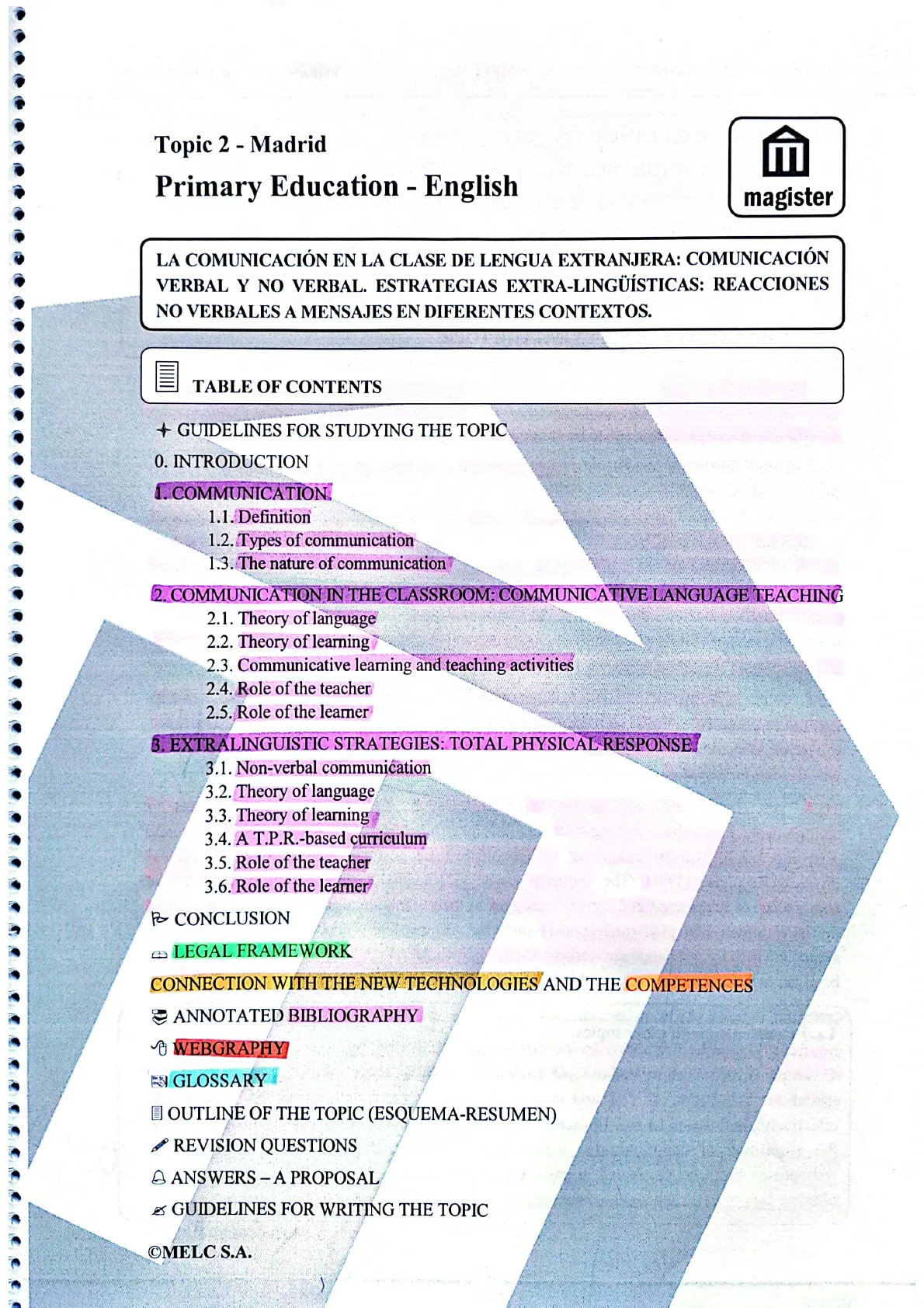
LA COMUNICACIÓN EN LA CLASE DE LENGUA EXTRANJERA: COMUNICACIÓN VERBAL Y NO VERBAL. ESTRATEGIAS EXTRA-LINGÜÍSTICAS: REACCIONES NO VERBALES A MENSAJES EN DIFERENTES CONTEXTOS.
TABLE OF CONTENTS
- GUIDELINES FOR STUDYING THE TOPIC
0. INTRODUCTION COMMUNICATION
1.1. Definition 1.2. Types of communication 1.3. The nature of communication
2. COMMUNICATION IN THE CLASSROOM: COMMUNICATIVE LANGUAGE TEACHING
2.1. Theory of language 2.2. Theory of learning 2.3. Communicative learning and teaching activities 2.4. Role of the teacher 2.5. Role of the learner
3. EXTRALINGUISTIC STRATEGIES: TOTAL PHYSICAL RESPONSE
3.1. Non-verbal communication 3.2. Theory of language 3.3. Theory of learning 3.4. A T.P.R .- based curriculum 3.5. Role of the teacher 3.6. Role of the learner CONCLUSION
- LEGAL FRAMEWORK CONNECTION WITH THE NEW TECHNOLOGIES AND THE COMPETENCES ANNOTATED BIBLIOGRAPHY
U WEBGRAPHY ES GLOSSARY I OUTLINE OF THE TOPIC (ESQUEMA-RESUMEN) REVISION QUESTIONS
- ANSWERS - A PROPOSAL
- GUIDELINES FOR WRITING THE TOPIC
MELC S.A. 1MAGISTER OPOSICIONES OMELC S.A. Primary - English. Topic 2 - Madrid
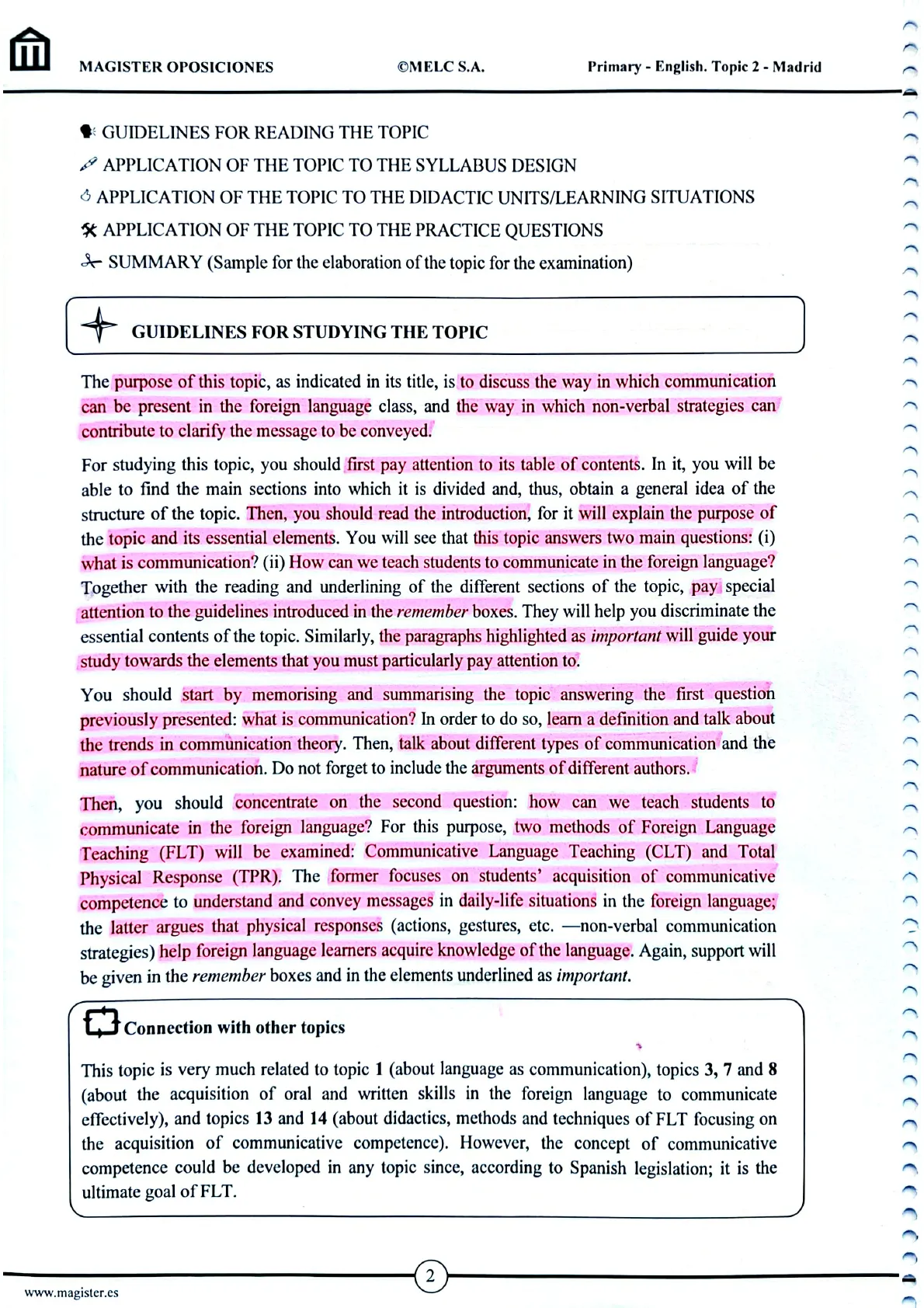
GUIDELINES FOR READING THE TOPIC
APPLICATION OF THE TOPIC TO THE SYLLABUS DESIGN
- APPLICATION OF THE TOPIC TO THE DIDACTIC UNITS/LEARNING SITUATIONS
- APPLICATION OF THE TOPIC TO THE PRACTICE QUESTIONS
- SUMMARY (Sample for the elaboration of the topic for the examination)
GUIDELINES FOR STUDYING THE TOPIC
The purpose of this topic, as indicated in its title, is to discuss the way in which communication can be present in the foreign language class, and the way in which non-verbal strategies can contribute to clarify the message to be conveyed.
For studying this topic, you should first pay attention to its table of contents. In it, you will be able to find the main sections into which it is divided and, thus, obtain a general idea of the structure of the topic. Then, you should read the introduction, for it will explain the purpose of the topic and its essential elements. You will see that this topic answers two main questions: (i) what is communication? (ii) How can we teach students to communicate in the foreign language?
Together with the reading and underlining of the different sections of the topic, pay special attention to the guidelines introduced in the remember boxes. They will help you discriminate the essential contents of the topic. Similarly, the paragraphs highlighted as important will guide your study towards the elements that you must particularly pay attention to.
You should start by memorising and summarising the topic answering the first question previously presented: what is communication? In order to do so, learn a definition and talk about the trends in communication theory. Then, talk about different types of communication and the nature of communication. Do not forget to include the arguments of different authors.
Then, you should concentrate on the second question: how can we teach students to communicate in the foreign language? For this purpose, two methods of Foreign Language Teaching (FLT) will be examined: Communicative Language Teaching (CLT) and Total Physical Response (TPR). The former focuses on students' acquisition of communicative competence to understand and convey messages in daily-life situations in the foreign language; the latter argues that physical responses (actions, gestures, etc. - non-verbal communication strategies) help foreign language learners acquire knowledge of the language. Again, support will be given in the remember boxes and in the elements underlined as important.
Connection with other topics
This topic is very much related to topic 1 (about language as communication), topics 3, 7 and 8 (about the acquisition of oral and written skills in the foreign language to communicate effectively), and topics 13 and 14 (about didactics, methods and techniques of FLT focusing on the acquisition of communicative competence). However, the concept of communicative competence could be developed in any topic since, according to Spanish legislation; it is the ultimate goal of FLT.
www.magister.es 2 ( ( ( ( (MAGISTER OPOSICIONES @MELC S.A. Primary - English. Topic 2 - Madrid
INTRODUCTION
There appears to have been a desire to differentiate between the study of modern languages and classical languages right from the beginning of foreign language teaching at the end of the nineteenth century. Languages were considered not to be subjects in the sense of packages of knowledge. They are fundamental parts of human beings and in order to learn to use a language, most of us have to become involved in it as an experience. We do this by using languages for real communication.
Although developing pupils' ability to communicate at a very early stage was one of the primary aims of foreign language teaching since its beginning, it has taken a great effort to define precisely what the nature and form of communication are (part 1), and to put into place a system of pedagogy capable of delivering them (part 2).
The ability to communicate plays a decisive role in the language programme of most European countries. However, modern approaches insist on this communication no being only of an audio- visual experience, but a total one which must include gesture, behaviour, mime and other aspects occurring in first language communication and which are traditionally neglected in the foreign language classroom. In part 3 we will study the Total Physical Response method, which puts stress out of the language learning experience by providing pupils with ways of showing their understanding of the task being undertaken without an overt linguistic response.
It is important to establish the connection between our topic and the law. The Organic Law 3/2020, of 29th December which modifies the Organic Law 2/2006 of 3rd May of Education (LOE-LOMLOE), the Royal Decree 157/2022, 15 March, which establishes the organization and minimum teachings of Primary Education, and DECREE 61/2022, of July 13, of the Governing Council, which establishes for the Community of Madrid the organization and curriculum of the stage of Primary education, indicate that, among the general objectives of Primary Education, is the acquisition of a basic communicative competence in a foreign language. Students will thus have to be able to understand and convey messages in a variety of daily-life communicative situations (in both writing and speech).
COMMUNICATION
Definition of Communication
CONNECTION: Since the topic deals with communication in the foreign language classroom, we will start off by providing a definition of communication and analysing different trends in communication theory. Once we know what communication is and its main types, we will be able to move on to explain how to teach communication to foreign language learners.
® Communication, the exchange of meanings between individuals through a common system of symbols, concerned scholars since the time of ancient Greece. (Savignon (1997: 15) defines language and further emphasises the contextual dimension of language use and that one's success in communicating may vary from situation to situation:
www.magister.es 3MAGISTER OPOSICIONES OMELC S.A. Primary - English. Topic 2 - Madrid
Communication takes place in an infinite variety of situations, and success in a particular role depends on one's understanding of the context and on prior experience of a similar kind. Success requires making appropriate choices of register and style in terms of the situation and the other participants.
Since about 1920 the growth and apparent influence of communications technology has attracted the attention of many specialists who have attempted to isolate communication as a specific facet of their particular interest.
® In the 1960s, Marshall Mcluhan drew the threads of interest in the field of communication into a view that associated many contemporary psychological and sociological phenomena with the media employed in modern culture. McLuhan's idea, "the medium is the message", stimulated numerous film-makers, photographers, and others, who adopted Mcluhan's view that contemporary society had moved from a print culture to a visual one.
i By the late twentieth century the main focus of interest in communication seemed to be drifting away from Mcluhanism and to be centring upon:
- The mass communication industries.
- Persuasive communication and the use of technology to influence dispositions.
- Processes of interpersonal communication as mediators of information.
- Dynamics of verbal and non-verbal (and perhaps extrasensory) communication between individuals.
- Perception of different kinds of communications.
- Uses of communication technology for social and artistic purposes, including education.
- Development of relevant criticism for artistic endeavours employing modern communications technology.
In short, a communication expert may be oriented to any number of disciplines in a field of inquiry that has, as yet, neither drawn for itself a conclusive roster of subject matter, nor agreed upon specific methodologies of analysis.
Types of Communication
CONNECTION: After having discussed the definition of communication, let us deal with the different types of communication.
Language is but one of the aspects of human communication. All these are the subject matter of Semiotics. Crystal has designed the following table where language is related to other aspects of semiotics1.
1Semiotics is the general theory of signs and symbolism. It is usually divided into pragmatics (causal and other relation between words, expressions, and their uses), semantics and syntactics.
www.magister.es 4 COCO CCI (Primary - English. Topic 2 - Madrid @MELC S.A. MAGISTER OPOSICIONES
SEMIOTICS
| Auditory-vocal | Visual | Tactile | Olfactory | Gustatory |
| 1. Speech | 1. Sign languages. | 1. Deaf & blind | ||
| 2. Physiological reflexes | 2. Writing codes. | languages. | ||
| (e.g. coughing). | 3. Kinesics. | 2. Secret codes. | ||
| 3. Musical effects. | 3. Proxemics. | |||
| 4. Voice qualities. |
Some of these aspects have a linguistic nature, such as speech, deaf and deaf-blind sign languages and written language. The communicative use of the visual and tactile modes in their non-linguistic aspects is referred as 'non-verbal communication' or 'body language'. Olfactory and gustatory modes in human communication play a less active role. The communicative use of body odour, on the other hand, seems to have a mainly sexual role in human society.
Nature of Communication
CONNECTION: Now that the types of communication have been established, we will go on to address the nature of communication.
Though communication between humans is a very complex phenomenon, scholars have found certain characteristics which seem to apply in every situation. If we want our teaching to be really communicative we will have to follow these characteristics. Following Harmer (1983) we can say that when one person speaks:
- He wants to speak, it is his decision to address someone.
- He has a communicative purpose, i.e. he wants something to happen as a result of what he says.
- He selects from his language store, he uses the language he feels appropriate for his purpose.
These generalizations apply to both written and spoken linguistic codes. On the other hand the person listening:
®
- Wants to listen to something
- Is interested in the communicative purpose of what is being said
- Processes a variety of language.
All these factors were not traditionally taking into account when designing language learning activities. It is only with the advent of the Communicative Approach to Language Teaching that real communication enters the classroom.
www.magister.es 5 ®
```Can’t find what you’re looking for?
Explore more topics in the Algor library or create your own materials with AI.
