QRISK® Learning Outcomes: Cardiovascular Risk Assessment
Slides from University about QRISK® Learning Outcomes. The Pdf, a presentation for university students in Biology, details the QRISK® system for cardiovascular risk assessment, including disease types, QRISK®3 functionality, and patient communication.
See more30 Pages

Unlock the full PDF for free
Sign up to get full access to the document and start transforming it with AI.
Preview
Learning Outcomes
Revise Cardiovascular Disease
Describe the NHS Health Check Service
Describe QRISK®3 and how it is used
Discuss how to talk to patients about their cardiovascular score
Describe ways to reduce a patients cardiovascular risk/score.
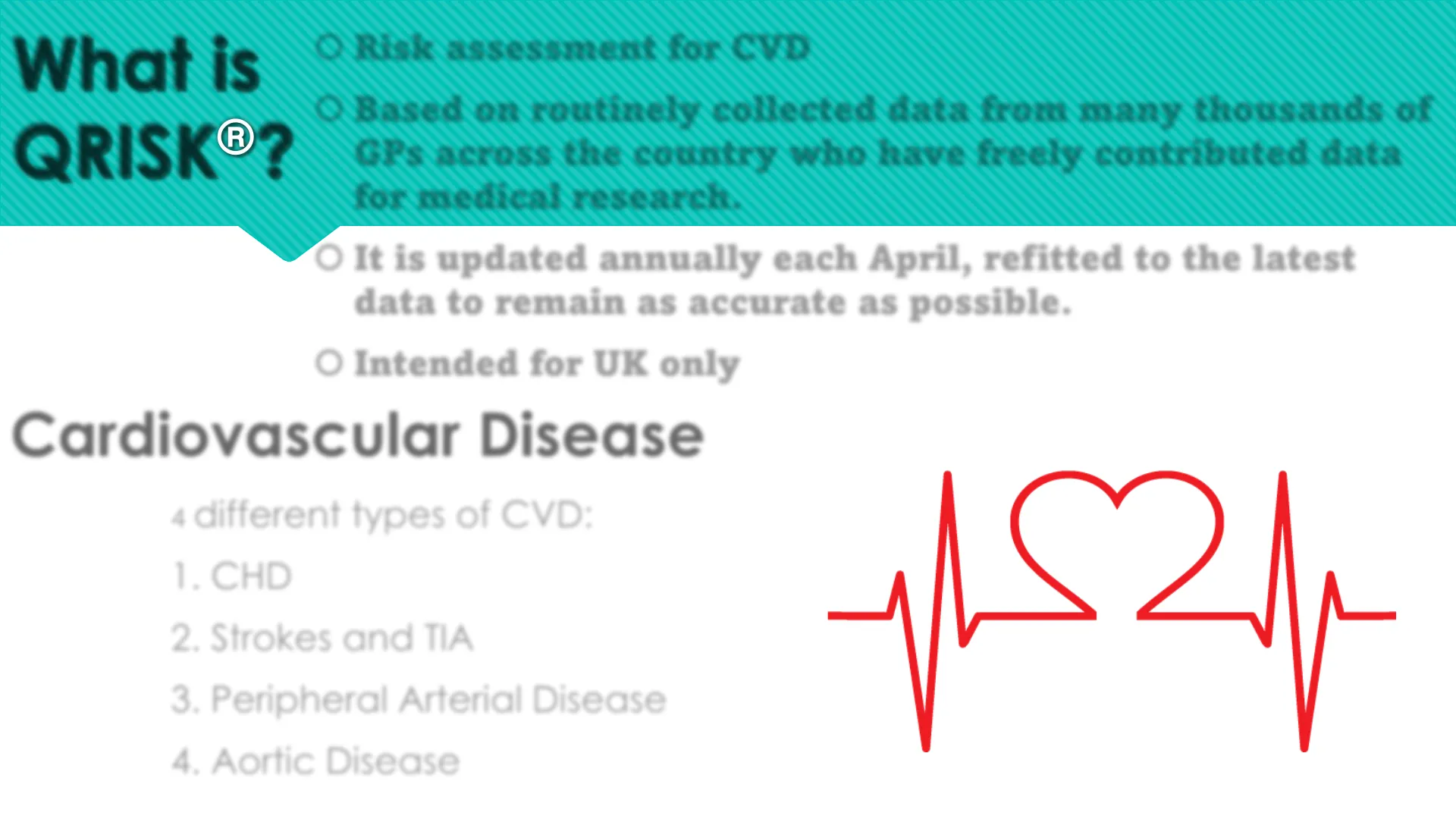
What is QRISK®?
Risk assessment for CVD
Based on routinely collected data from many thousands of
GPs across the country who have freely contributed data
for medical research.
O It is updated annually each April, refitted to the latest
data to remain as accurate as possible.
O Intended for UK only
Cardiovascular Disease Types
4 different types of CVD:
1. CHD
2. Strokes and TIA
3. Peripheral Arterial Disease
4. Aortic Disease
Why Focus on CVD Prevention?
- Around 7 million people in the UK are affected by cardiovascular disease (CVD).
- 26% of deaths in the UK are caused by CVD
O Responsible for 1/5th of all hospital admissions.
O NHS Long Term Plan identifies CVD as a clinical priority and the single biggest condition where
lives can be saved by the NHS over the next 10 years.
O Significant improvements have been made in the treatment of vascular disease over the last decade.
O Between 2001 and 2010 there was a 40% reduction in deaths from CVD in people under 75 years old. - Focus needs to be on prevention earlier in life.
- Enable people to make more informed decisions about lifestyle
Risk Factors for CVD
- Increasing age
- Hypertension
- Smoking
- High Cholesterol
- Diabetes
- Inactivity
- Being overweight
- Family History
- Ethnic Background
- Gender
- Diet
- Alcohol
- Medical conditions
- Certain medication
NHS Health Check
What To Expect from NHS Health Check
- For adults between 40-74
O Receive a letter from the GP
or local council inviting you
to a free NHS health check
O Designed to spot early signs
of stroke, kidney disease,
heart disease, type 2
diabetes or dementia.
O As get older at higher risk of
developing one of these
conditions.
1
I
O
20-30 minutes appointment
O Nurse, pharmacist, doctor or
healthcare assistant.
O Questions, measurements and tests
O You will have your individual
cardiovascular risk calculated and
explained to you.
O
Given advice on how to improve your
health and lower risk.
O Seen every 5 years unless a high risk
NHS Health Check Eligibility
- People 40-75 who do not have any of the
following:
O Heart disease
O CKD
O Diabetes
O High blood pressure
O Atrial fibrillation (AF)
O TIA/Stroke
O Familial hypercholesterolemia
O Heart Failure
O Peripheral arterial disease
O Currently prescribed statins
O Previous checks found that you have a 20%
or higher risk of getting cardiovascular
disease in the next 10 years.
Cardiovascular Risk Calculator
QRISK®3 Calculator
- QRISK®3
O Now included in the Department of Health's Standard Operating procedures for Vascular Screening
and the national GP contract (QOF).
O All medical decisions need to be taken by a patient in consultation with their doctor.
How Does QRISK®3 Work?
- Estimate 10 year risk of having a cardiovascular event in people who do not already have heart
disease. - Web based calculator used by physician.
- It presents the average risk of people with the same risk factors as those entered for that person.
- Used for primary prevention
V
^ qrisk.org/three/
ClinRisky
Welcome to the QRISK®3-2018 risk calculator https://qrisk.org/three
This calculator is only valid if you do not already have a diagnosis of coronary heart disease (including angina or heart attack) or stroke/transient ischaemic attack.
Reset
Information
Publications
About
Copyright
Contact Us
Algorithm
Software
CE
About you
Age (25-84):
64
Sex:
Male
Female
Ethnicity:
White or not stated
-UK postcode: leave blank if unknown
Postcode:
Clinical information
Smoking status:
non-smoker
Diabetes status
none
Angina or heart attack in a 1st degree relative < 60?
Chronic kidney disease (stage 3, 4 or 5)?
Atrial fibrillation?
On blood pressure treatment?
Do you have migraines?
Rheumatoid arthritis?
Systemic lupus erythematosus (SLE)?
Severe mental illness?
(this includes schizophrenia, bipolar disorder and
moderate/severe depression)
On atypical antipsychotic medication?
Are you on regular steroid tablets?
A diagnosis of or treatment for erectile disfunction?
-Leave blank if unknown
Cholesterol/HDL ratio:
Systolic blood pressure (mmHg):
Standard deviation of at least two
most recent systolic blood pressure
readings (mmHg):
Body mass index
Height (cm):
Weight (kg):
Welcome to the QRISK®3-2018 risk calculator
Welcome to the QRISK®3-2018 Web Calculator. The QRISK®3 algorithm calculates a person's risk of developing a heart attack or
stroke over the next 10 years. It presents the average risk of people with the same risk factors as those entered for that person.
The QRISK®3 algorithm has been developed by doctors and academics working in the UK National Health Service and is based
on routinely collected data from many thousands of GPs across the country who have freely contributed data to the QResearch
database for medical research.
QRISK®3 has been developed for the UK population, and is intended for use in the UK. All medical decisions need to be taken by
a patient in consultation with their doctor. The authors and the sponsors accept no responsibility for clinical use or misuse of this
score.
The science underpinning QRISK®3 has been published in the BMJ -- see the publications tab for details.
What is the difference between QRISK®3 and QRISK®2?
QRISK®3 includes more factors than QRISK®2 to help enable doctors to identify those at most risk of heart disease and stroke.
These are
. Chronic kidney disease, which now includes stage 3 CKD
· Migraine
· Corticosteroids
· Systemic lupus erythematosus (SLE)
· atypical antipsychotics
· severe mental illness
· erectile dysfunction
· a measure of systolic blood pressure variability
Has QRISK®3 been validated?
Yes. QRISK®3 has been validated on a separate group of practices from that used to develop the score and the performance is
very good. See the academic paper for more details.
Why change the name from QRISK®2 to QRISK®3?
It's the same science and team behind the score, and the way that we intend it to be used remains exactly the same. In many
ways it is very similar to our usual annual updates -- however, we thought that as we are introducing several new parameters, we'd
upgrade its major version number.
What will now happen to QRISK®2?
QRISK®2-2017 will be the last version of QRISK®2 that we will produce. QRISK®3 will be the standard version of QRISK®
https://qrisk.or
g/three/QRISK®3
- Age 25-84 Years old
- Gender
- Ethnicity
- UK Post code
- Smoking Status
- Diabetic
- Angina/Heart Attack in a first degree relative
<60years old - CKD - stages 3, 4 & 5
- Atrial Fibrillation
- On blood pressure treatment
- Migraines
- Rheumatoid arthritis
- Systemic lupus erythematosus
- Severe mental illness
- On atypical antipsychotic medication
- Are you on regular steroid tablets
- Diagnosis of or treatment for erectile disfunction
- Cholesterol/HDL Ratio
- Systolic Blood pressure
- BMI - Height and Weight
Why Postcode Matters
O Those in the most deprived 10% of the
population are almost twice as likely to
die as a result of CVD, than those in the
least deprived 10% of the population.
BBC
Sign in
News
Sport
Weather
iPlayer
Sounds
NEWS
Home |UK
World
Business
Politics
Tech
Science
Health
Family & Education
Health
Poorest women's life expectancy
declines, finds report
1 25 February 2020
f
Share
GETTY IMAGES
There has been an increase in the number of food banks across the UK in recent years
Life expectancy among women living in the poorest communities in England
has declined since 2011, says a report warning of growing health inequalities.
Overall, life expectancy growth has stalled over the past decade - for the first time
in 100 years.
Post Code and Life Expectancy
Change in life expectancy (years) by region
Most deprived communities in four regions 2010-12 to 2016-18
Male
North East
-0.5
West Midlands
0.3
South East
0.1
London
1.2
Female
North East -0.8
West Midlands
0.1
South East
-0.3
London
0.9
Source: Marmot Review/Public Health England
BBC
His follow-up report, after a decade of austerity, finds the picture has got worse.
Why Severe Mental Health?
- Significant health inequalities for people living with
severe mental illness - Life expectancy is 15-20 years lower than the general
population. - People have a 53% higher risk of having CVD
- 85% higher risk of death from CVD
- Patients with severe mental illness maybe on an
atypical antipsychotic medication
Why The Others?
- CKD - raised concentrations of albumin in urine increase the risk of
cardiovascular disease by two to four times. - Migraines - link between migraine (especially with an aura)and ischaemic
stroke - Rheumatoid arthritis - inflammatory substances fuel joint destruction
and blood vessel damage. - Inflammation causes plaque build-up in the arteries,
- Systemic lupus erythematosus - risk factor for atherosclerosis
- Regular steroid tablets - can cause hypertension and dyslipidemia
- Diagnosis/treatment of erectile disfunction - can be a warning sign of
CVD
Primary Prevention
% 10 year risk
Risk
Risk <10%
Low Risk
Conservative management looking at
lifestyle
Risk 10%-20%
Moderate Risk
Monitor risk profile every 6-12 months
Risk 20%-30%
High Risk
Monitor risk profile every 3-6months
Risk >30%
Very High Risk
Monitor risk profile every 3-6months
WATCH FOR
THE PERIODS
NEDDED TO
MONITOR THE
RISK PROFILE
CAUSE
THEY'RE
CRUCIAL IN
THE
COUNSELLING
BIT
How to Tell a Patient
- If a person has a 20% estimated risk, the following kind of phrases may be useful:
O "We would target interventions for people with CVD risk of 10% or more, which includes
you."
O "Your risk of having a heart attack or stroke within the next 10 years is 20%."
O "In other words, in a crowd of 100 people with the same risk factors as you, 20 are likely to
have a heart attack or stroke within the next 10 years."
O The score cannot predict what will happen to each individual person.
How to Lower your Risk
- Focus is on lifestyle advice, diet, physical activity, alcohol etc.
- May need to add in medication if lifestyle advice has not reduced cardiovascular risk
- Need to tailor advice to the patient
Can’t find what you’re looking for?
Explore more topics in the Algor library or create your own materials with AI.
