Spain 1902-1939: Alfonso XIII, Second Republic and Civil War
Slides about Spain 1902-1939: Alfonso XIII, Second Republic and Civil War. The Pdf, a presentation for High school History, examines key events like the Crisis of 1898 and the timeline of the late 19th century.
See more34 Pages


Unlock the full PDF for free
Sign up to get full access to the document and start transforming it with AI.
Preview
Spain from Alfonso XIII to Democracy
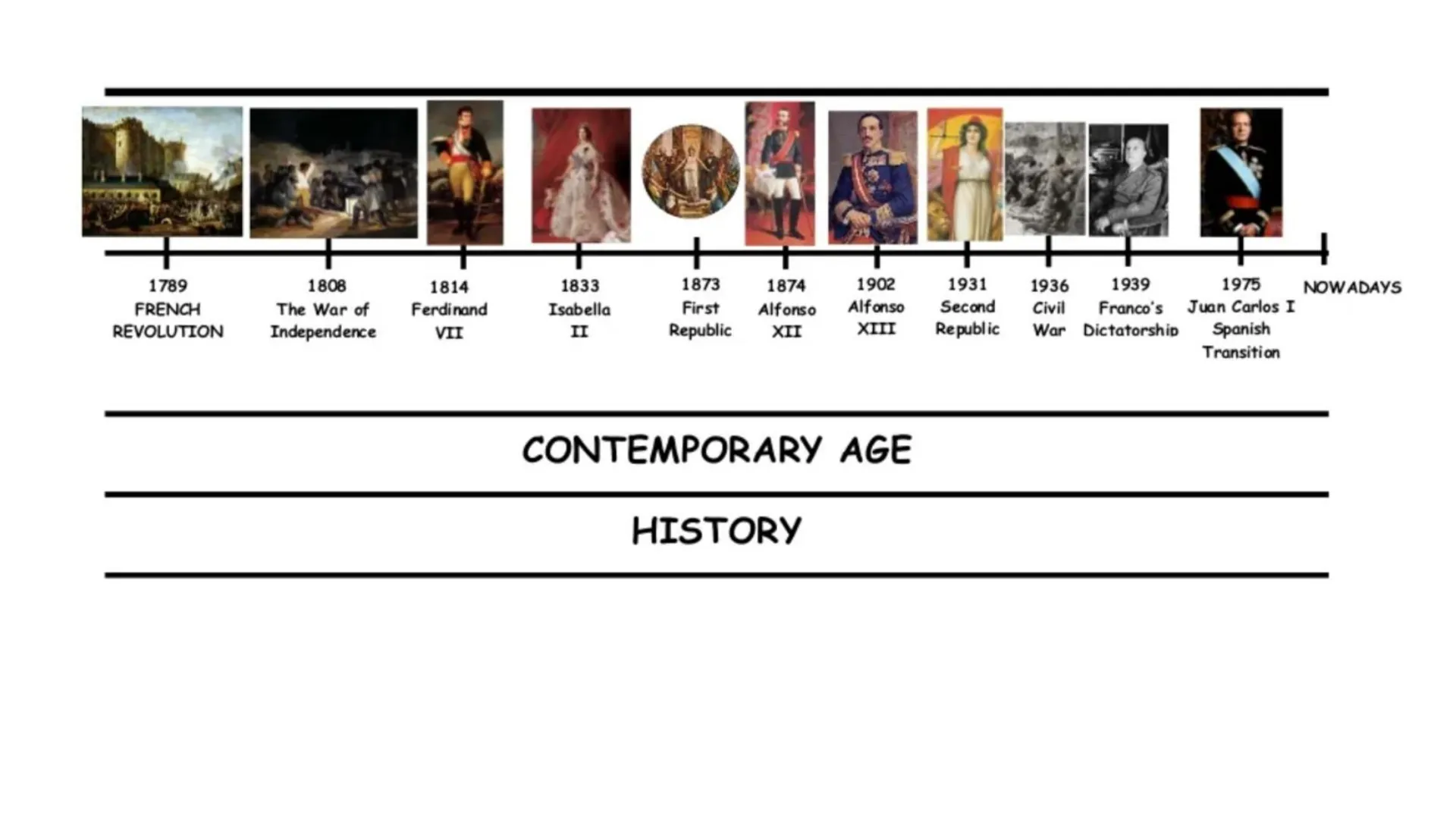
Unit 5: Spain from Alfonso XIII to Democracy1789 FRENCH REVOLUTION 1808 The War of Independence 1814 Ferdinand VII 1833 Isabella II 1873 First Republic 1874 Alfonso XII 1902 Alfonso XIII 1931 Second Republic 1939 1936 Civil Franco's War Dictatorship NOW ADAYS 1975 Juan Carlos I Spanish Transition CONTEMPORARY AGE HISTORYTimeline of the last decades of the 19th century
19th Century Spain: Political and Social Landscape
It established limited male suffrage Approval of the conservative Constitution of 1876 Only two official parties altemated in power. Disaster of '98 As a result of the Spanish- American War of 1898, Spain lost its last remaining colonies to the United Sates: Cuba, Puerto Rico and the Philippines. 1874 1876 1885 1898 1 Alfonso XII was proclaimed King of Spain The last Carlist War ended in 1876 with the victory of Alfonso XII and his forces Alfonso XII died / María Cristina, his wife, became regent The Republicans opposed the government because they felt excluded from the political system. The Disaster of 98' had serious consequences: many people criticized the government; loss of the colonial markets; and working-class protests against conscription. Spain became a parliamentary monarchy There were only two official parties, the Liberals and the Conservatives, who alternated in power by manipulating election results. Regionalist movements developed in Andalucía, Cataluña, Galicia and País Vasco.
Reign of Alfonso XIII (1902 - 1931)
Crisis of 1898 and its Aftermath
· The loss of the last Spanish colonies began with an uprising in Cuba in 1894 and a revolt in the Philippines in 1896. The uprisings were a result of poor economies in both colonies and Spain's refusal to grant the colonies more autonomy. · The rebels had the support of the United States. · Spanish fleets were destroyed by the US. Spain was forced to sign the 1898 Treaty of Paris, where they recognised the independence of Cuba, Puerto Rico and the Philippines.
Spanish-American War, 1898: Caribbean and Philippines
The Spanish-American War, 1898: the Caribbean The Spanish-American War, 1898: the Philippines 20°E Hong Kong (Br.) 20°N . U.S. forces U.S. blockade Spanish forces Luzon * Battle PHILIPPINE ISLANDS Havana June 14-July 1, 1898 May 1, 189% Manila 20°N Santiago Mindoro Samnar DOMINICAN HAITI REPUBLIC> South China Sea Panay PACIFIC OCEAN Negros Palawan Caribbean Sea 400 Miles onn Vilamatora 80°W ATLANTIC OCEAN FLORIDA Tampa 800 Kilometers BAHAMAS U.S. forces Battle (Br.) , 400 Miles - April 25-April 30, 1898 CUBA PUERTO RICO JAMAICA (Br.) May, 1898 Mindanao
The war had a negative impact on Spanish exports. It also led to a deep moral crisis among the Spanish population, causing what was known as regenerationism, which was an intellectual and political movement that sought to solve the country's deep-rooted problems, such as political corruption.Alfonso XIII became King of Spain in 1902 at the age of 16, after the regency of his mother, Maria Cristina. The early years of his reign were plagued with different issues inherited from his father Alfonso XII and his mother regency. Spanish society was still bitter after the defeat of the 98, inequalities were common, and the people had started to lose faith in the corrupted political system.
War of the Rif (1909-1926)
- Wanting to regain international renown, Spain tried to occupy and colonise the region of the Rif in Morocco that was assigned to Spain in the Berlin Conference (1885).
- The treaty signed at the Algeciras Conference (1906) divided Morocco into two protectorates: one in the north of Morocco under French control and the other in the north and south under Spanish control.
- Spanish occupation of its protectorate led to a war in 1909 with the inhabitants of the Rif that fought against the occupation. This war required reservists to be called up.
- This war was not approved by all of the Spanish society and in 1909 violent protests occurred in Barcelona, known as "The Tragic Week" of 1909".
Morocco Protectorates Map
LEGEND Spain and Spanish Colonies Spanish Morocco French Colonies French Morocco Tangier Rabat Oujda Casablanca MOROCCO MADEIRA (Port.) · Marrakech ATLANTIC OCEAN CANARY ISLANDS oIfni Draa River ALGERIA Villa Bens [Tarfay ) . Tindouf Laâyoune· SEGUIA EL HAMRA Villa Cisneros (Dakhla] RIO DE ORO MALI MAURITANIA Gibraltar (UK) Tangierp .Ceuta Melilla Tétouan 250 km PORTUGAL SPAIN WESTERN SAHARA CAPE JUBY
The Tragic Week (26 July - 2 August 1909)
- It was a series of violent confrontations between the Spanish army and anarchists, socialists and republicans of Barcelona and other cities in Catalonia during the last week of July 1909.
- It was period of civil unrest characterized by protests and violent revolts against the king, the war in Morocco and the harsh working conditions of the working class.
- It was triggered by the decision of the Spanish government to draft reservists to fight in Morocco. This decision was deeply unpopular among the working class, who saw it as a way for the ruling class to send poor men to fight in a colonial war.
- The Spanish government responded with a violent approach, deploying troops to suppress the protests. Hundreds of people were arrested, injured, or killed.
- The execution of the teacher Ferrer I Guardia increased social unrest and caused an international discredit of the government. LIBERTAD JUSTICIA PROFPRESOS
- President Antonio Maura was forced to resign.
The Crisis of 1917
Carestía hasta de garantías - ¡ Ya, ya !... Lo poco que puede una comprar, caro, malo y falto de peso; estos acaparadores lo exportan tode al extranjero. - ¡ Tenga usted cuidado con lo que dice, porque si la oye la censural ... The turbulent social and political atmosphere in 1917 led to protest movements across Spain due to: · The public's dissatisfaction with the authoritarian government and the conservative government of Eduardo Dato. • The poverty and the living conditions of the lower classes worsened due to the rise in prices as a consequence of WWI. . Discontent in the army over the management of the Rif War and demanded higher wages.
Social Unrest and Independentism
The social unrest keep rising and left-wing political parties and trade unions (UGT and CNT) carried out several general strikes against the government, many demanding improvements in the working conditions of the period. Some rights were granted after these strikes, like the workdays of 8 hours. Meanwhile in Catalonia the independent movements were growing stronger and demanded official status for the Catalan language, the establishment of Catalan political parties and courts, and Catalan autonomy. Sabino Arana in the Basque Country defended regional charters and traditions.
The System Collapses (1917-1923)
When the crisis was finally over, in the period from 1919 to 1923 Spain experienced a period of political decline and was forced to form unity governments made up of members from all the different parties (pluralism). These governments did not last long and faced several domestic and foreign challenges.
Domestic Challenges
Social conflict increased as a response to the economic crisis that came after the First World War and as a result of the Russian Revolution. Both of these events led to violent clashes between workers and bosses, and numerous strikes.
Foreign Challenges
Spain suffered a brutal defeat in the Rif War against Morocco in what was known as the Disaster at Annual- June-August, 1921-, resulting in 10 000 deaths and widespread public commotion, negatively influencing public opinion.
The Dictatorship of Primo de Rivera
In 1923, Captain-General of Catalonia Miguel Primo de Rivera led a coup d'état against the government. This coup was supported by the King Alfonso XIII, businessmen, landowners and conservative politicians; and allowed Primo de Rivera to form his own government. He ended the democratic regime from 1876 and started a dictatorship. He claimed his military dictatorship would guarantee social order.
Stages of the Dictatorship
The Military Dictatorship (1923-1925)
In this stage, Primo de Rivera: · Suspended the constitution · Dissolved the Cortes · Prohibited political parties · Suppressed the labour movement · Limitted individual freedoms · Supressed the autonomy of Catalonia and nationalist parties in Catalonia and Basque Country. · Banned public use of Catalan and Basque languages. . Defeated the Moroccans after the Alhucemas landing in 1925. ... .... × × X
The Civil Directory (1925-1930)
- A single political party called the "Union Patriótica" was created and the "Asamblea Nacional Consultiva" (parliament) was established, but its members were not elected democratically.
- Implement a planned economy: · Program of public works (roads, canals and ports) · Creation of state companies (Telefonica, Campsa, etc).
- Negative context of international economic crisis (Crash of 1929)
- Opposition to dictatorship grew: socialista, republicans, nationalist.
- Primo de Rivera resigned in January of 1930. General Berenguer was appointed president by Alfonso XIII with the objective to return to the previous system, call elections and reinstall the rights guaranteed under the Constitution. All the political parties that opposed the dictatorship (socialist, republicans and nationalist) signed in August of 1930 the Pact of San Sebastian: demanding democratic elections and the establishment of a republic.
The End of the Reign of Alfonso XIII
In January of 1930, due to the 1929 crash, the rise in unemployment, the spread of the labour movement, nationalist problems and rejection by many intellectuals, Primo de Rivera was forced to resign. General Berenguer was appointed president by Alfonso XIII to turn back to the model of the Restoration, granting several rights back and taking back several policies. All the political parties that opposed the dictatorship (socialist, republicans and nationalist) signed in August of 1930 the Pact of San Sebastian: demanding democratic elections and Alfonso XIII to abdicate. In April of 1931, in the first municipal elections, the Republican parties won in 43 of the 50 province capitals. This will lead to the declaration of the Second Spanish Republic the 14th of April of 1931. Alfonso will go to the exile the 17th of April to never come back to Spain.
Newspaper Headline: Proclamation of the Spanish Republic
NUM. 104. AHORA DIARIO GRAFICO Madrid, miércoles 15 abril de 1931 Director: propistartet LUIS MONTIET. Gerente: LUIB DR MIQUEL EXTRANJERO 21.00 ptas. trimestre Apartado 8.094. PASEO DE SAN VICENTE, 18 Teléfono 18340 SE HA PROCLAMADO LA REPUBLICA ESPANOLA Don Alfonso XIII dejó de ser Rey de España a las ocho y media de la noche y al amanecer había aban. donado el territorio español Llega a Palacio el general Aznar tle In Ochernactin y Retfonda, Fata ót conjefuzur in que les purecos, Eve por avian pars venie n Pulanto No pl/ que tima, dertilandoas a lon periodistaa, dijau venir, io miami en de staden que de prende neturrtr. Bopengo que et presidente les habrá nuautres en materia de enjaturni, Arriba sata el noode de Romanones «dijeron ing periodistas. Parece que " Plinthe el premidesin del Conteje. diebn In que tuvierw que dastrist Y stades. Teapusieron . pteter El conde de Romanones y el mar- paderot7 : Para no vengn s cats hora Indie Jos cina para despachar con el quên de Alhucemas dok, y, por in viati le ba correspondida con Al ministro de Estado AÑO II. PRECIOS DE BUSCHIFCION MADRID .. 2,30 plan, al mes. PROVINCIAS 0,00 utan. trimestre" Subdirector: M. CHAVES NOGALES
Can’t find what you’re looking for?
Explore more topics in the Algor library or create your own materials with AI.
