Cells HL Membranes and Transport: Structure and Function
Document about Cells HL Membranes and Transport. The Pdf explores cellular membranes and transport, focusing on membrane fluidity, cholesterol, and phospholipid roles. It includes sections on vesicle fusion and formation, with examples of endocytosis and exocytosis, useful for University Biology students.
See more16 Pages

Unlock the full PDF for free
Sign up to get full access to the document and start transforming it with AI.
Preview
Syllabus Overview & Objectives
B2.1.11 AHL Fatty Acid Composition and Fluidity
Relationships between fatty acid composition of lipid bilayers and their fluidity Unsaturated fatty acids in lipid bilayers have lower melting points, so membranes are fluid and therefore flexible at temperatures experienced by a cell. Saturated fatty acids have higher melting points and make membranes stronger at higher temperatures. Students should be familiar with an example of adaptations in membrane composition in relation to habitat.
B2.1.12 AHL Cholesterol and Membrane Fluidity in Animal Cells
Cholesterol and membrane fluidity in animal cells Students should understand the position of cholesterol molecules in membranes and also that cholesterol acts as a modulator (adjustor) of membrane fluidity, stabilizing membranes at higher temperatures and preventing stiffening at lower temperatures.
B2.1.13 AHL Membrane Fluidity, Fusion, and Vesicle Formation
Membrane fluidity and the fusion and formation of vesicles Include the terms "endocytosis" and "exocytosis", and examples of each process.
B2.1.14 AHL Gated Ion Channels in Neurons
Gated ion channels in neurons Include nicotinic acetylcholine receptors as an example of a neurotransmitter- gated ion channel and sodium and potassium channels as examples of voltage- gated channels.
B2.1.15 AHL Sodium-Potassium Pumps as Exchange Transporters
Sodium-potassium pumps as an example of exchange transporters Include the importance of these pumps in generating membrane potentials.
B2.1.16 AHL Sodium-Dependent Glucose Cotransporters
Sodium-dependent glucose cotransporters as an example of indirect active transport Include the importance of these cotransporters in glucose absorption by cells in the small intestine and glucose reabsorption by cells in the nephron.
B2.1.17 AHL Adhesion of Cells to Form Tissues
Adhesion of cells to form tissues Include the term "cell-adhesion molecules" (CAMs) and the understanding that different forms of CAM are used for different types of cell-cell junction. Students are not required to have detailed knowledge of the different CAMs or junctions.
1 | PageFatty acid composition of lipid membranes & fluidity:
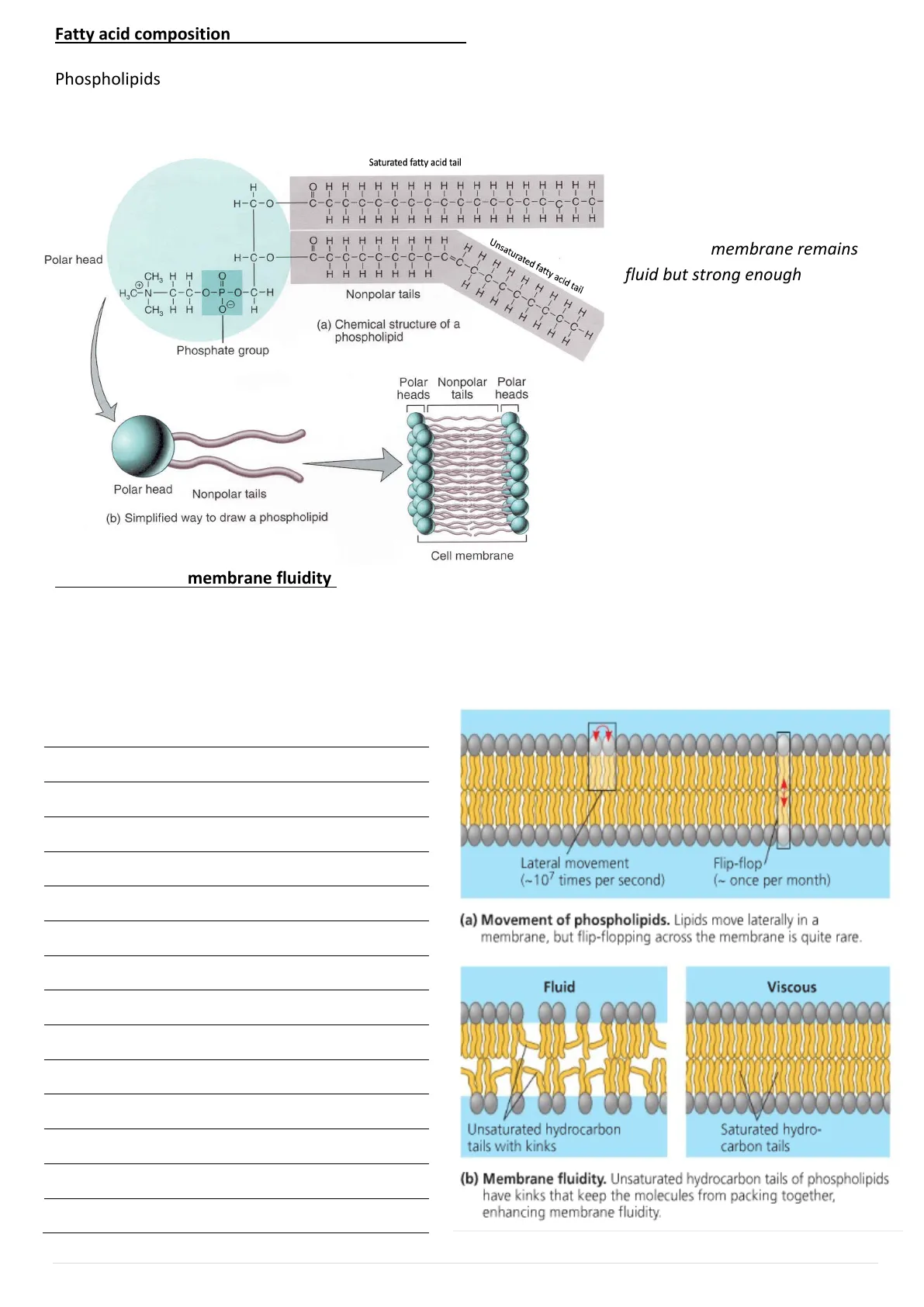
Phospholipids are important structural components of cell membranes. A phosphate group PO43- replaces one of the three fatty acids normally found on a lipid. The addition of this charged group makes a polar "head" and two non-polar "tails".
Saturated fatty acid tail H O=0 I-O-I I-O-I I-O-I I-O-I I-O-I I-O-I I-O-I I-O-I I-O-I Unsaturated fatty acid tail 5-2- I-O-I I-O-I O=0-0 H3C-N-C-C-O-P-O-C-H O Nonpolar tails CH3 H H H (a) Chemical structure of a phospholipid Phosphate group Polar Nonpolar Polar heads tails heads Polar head Nonpolar tails (b) Simplified way to draw a phospholipid
The amounts of saturated and unsaturated fatty acids in the phospholipid bilayer is regulated so that the membrane remains fluid but strong enough to avoid becoming perforated. The ideal ratio of saturated : unsaturated fatty acids depends on the temperature. E.g. an artic fish has a higher percentage of unsaturated fatty acids in their membranes than fish from warmer waters.
Factors Affecting Membrane Fluidity
Movement around the horizontal plane takes place on many occasions - this contributes to membrane fluidity. Movement along the vertical plane is rare for the membrane integrity.
Ratio of Saturated to Unsaturated Fatty Acids and Tail Length
How does the ratio of saturated to unsaturated fatty acids in the membrane and length of fatty acid tails affect membrane fluidity?
- The more unsaturated fatty acids the phospholipid bilayer have, the more fluid the membrane is - they are more spaced out. The less double bonds, the more viscous the membrane.
Lateral movement (~107 times per second) Flip-flop (~ once per month) (a) Movement of phospholipids. Lipids move laterally in a membrane, but flip-flopping across the membrane is quite rare.
Fluid Viscous Unsaturated hydrocarbon tails with kinks Saturated hydro- carbon tails I-O-I I-O-I I-O-I I-O-I I-O-I Polar head H-C-O 0=0 I-O-I I-O-I C- CH3 H H HHHHHHHH I-O HHHHHHHHH ._ C=C-C-C-C-C-C-C-C-C-H 5
- The shorter the hydrocarbon tails, the more fluid the membrane. The more fluid a membrane, the lower its melting/freezing point - the membrane will be less likely to freeze. reduced van der Waals interactions with neighbouring lipids (weaker interactions); decreased viscosity; less packed.
I-O-I I-O-I エ ー C-H I-O-I I-O-I I-O-I H-C-O Cell membrane (b) Membrane fluidity. Unsaturated hydrocarbon tails of phospholipids have kinks that keep the molecules from packing together, enhancing membrane fluidity.
2 | PageData-based questions: Frost hardiness and double bonds in chickpeas
Freezing temperatures cause cytoplasm to leak out of leaf cells in chickpea plants (Cicer arietinum). This kills the cells. The effectiveness of two treatments preventing leakage was investigated. The treatments were: · acclimatization of plants by keeping them at temperatures close to freezing point for two weeks · spraying the outside of the leaves with ABA, a hormone produced by plants in response to stress.
3.0 · 2 weeks warm, no ABA o 2 weeks warm, ABA applied 2.8- 2 weeks cold, no ABA double bond index 2 weeks cold, ABA applied 2.6. 2.4- O 2.2 2.0 O . 1.8 -18 -16 -14 -12 -10 -8 -6 LT 50 (C) Figure 17 The proportions of saturated and unsaturated membrane lipids were measured after the treatments (double bond index). Frost hardiness was assessed by finding the temperature that killed 50% of leaf cells. The graph in Figure 17 shows the results.
- a. State the relationship between LT 50 and double bond index. [1] b. Explain the relationship. [2]
- Using only the data in the graph, outline the effects of ABA on the chickpea plants. [2]
- Deduce the effects of cold treatment on the proportions of saturated and unsaturated membrane lipids in chickpea plants. [2]
- Gardeners are advised to "harden off" plants that have been raised in a warm greenhouse before planting them outside in colder conditions. Discuss whether spraying with ABA or 2 weeks of cold acclimatization is likely to be more effective. [3]
3 | PageCholesterol and membrane fluidity in animal cells:
Cholesterol is an important component in cell membranes of animals, and it contributes to the stability and fluidity of membranes at temperature outside the optimum (so at low and high temperatures). This is important, as otherwise the permeability of membranes would be compromised.
B,-adrenergic receptor Ligand Cholesterol CH3 CHN-CH3 CH2 CH3 O O=P-0 OH 3-01 CH-CH-CH2 C=0Xc=o
Chemical Properties of Phospholipid and Cholesterol Components
What chemical properties do the fatty acid tails of the phospholipid have? The fatty acid tails of the phospholipid are non-polar and hydrophobic.
What chemical properties does the hydroxyl (-OH) head of the cholesterol have? The head group of cholesterol is a hydroxyl group (-OH), making this part slightly polar & hydrophilic.
What chemical properties does the phosphate group of the phospholipid have? The phosphate head of the phospholipid is polar and hydrophilic.
How Properties Aid Membrane Stability
How do these properties help membranes to be more stable? The hydrophilic phosphate group is attracted to the hydroxyl group of the cholesterol molecule, and the hydrophobic hydrocarbon tail of cholesterol is attracted to the fatty acid tails of the phospholipid.
The similar chemical properties hold the molecules together like glue. This causes its rigid, steroid rings to interact with the regular packing of the hydrocarbon tails.
Presence of cholesterol helps maintain an optimal level of membrane fluidity.(stability)
polar head groups region stiffened by cholesterol more-fluid region OH ] polar head group * Hydrophilic Polar Head Group Hydrophilic Polar Head CH3 CH3 CH 1 CH2 CH2 nonpolar hydrocarbon tail CH2 1 CH Hydrophobic Chains CH3 CH3 (B) a (b) Without cholesterol, cell membranes would be too fluid, not firm enough, and too permeable to some molecules. In other words, it keeps the membrane from turning to mush. (A)
What chemical properties do the steroid ring & hydrocarbon tail of the cholesterol have? Cholesterol's steroid ring and its hydrocarbon tail are largely nonpolar & hydrophobic.
CH2 CH. CH CH CH2 CH, CH CH CH CH2 hydrophilic head CH CH2 CH2 CH2 CH, hydrophobic tails hydrophobic tail CH CH2 CH, CH CH 2 CH two hydrophobic tails CH3 CH3 H3 CH2 CH 1 CH2 CH2 CH2 CH2 CH, CH. CH2 CH2 CH2 CH2 CH2 cell membrane section CH, CH2 C CH. CH2 CH b One of the phospholipids hydrophilic head (orange) -CH3 CH CH d Cholesterol CH3 rigid steroid ring structure Rigid Sterol Hydrophobic Chains
4 | Page -o-A. High temperature No cholesterol K Too fluid Cholesterol present Increased rigidity B. Low temperature No cholesterol Cholesterol present Too rigid Increased fluidity
Effect of Temperature on Membranes
High Temperature No Cholesterol fluid-like without cholesterol membrane fluidity with cholesterol Low Temperature No Cholesterol With Cholesterol solid-like T m temperature
Look at the diagram above. Then describe and explain the effect of temperature on membranes a) without cholesterol and b) with cholesterol being present.
In high temperatures, phospholipids normally become more mobile and fluid compromising the permeability of the membrane, but cholesterol constrains the motion of fatty acid tails and therefore Fluidization decreases fluidity.
+ In low temperatures the bilayer would normally become less fluid & rigid, but with cholesterol the close packing of the nonpolar fatty acid chains is disrupted and therefore fluidity is increased.
1 Temperature 1 Rigidification Cholesterol reduces the fluidity of the membrane, due to its ability to fill the space between phospholipids, and its action as "glue" due to polar interactions.
Cholesterol
5 | Page
Membrane Fluidity, Fusion, and Vesicle Formation
Vesicles are fluid filled sacs composed of a single phospholipid bilayer which surrounds the fluid/solutes inside. They can move materials into (endocytosis) and out of a cell (exocytosis) but can also serve internal transport of substances. They often involve transport of proteins from the rER to the Golgi apparatus and finally to the membrane.
Fig.1: A vesicle budding off from the cell membrane through exocytosis. (A)
The fluidity of the membrane allows it to change shape, break and re-form during endocytosis and exocytosis. ATP is required for this process.
vesicle The membranes begin to fuse. This step requires ATP. Remember the fluidity of the plasma membrane - the phospholipids can flow around each other. For a moment, there is a single phospholipid bilayer at the point of contact. The membrane pores opens, allowing the contents to pass through. Notice that through the whole process, there is never an unbroken section of the bilayer.
Endocytosis: Modes of Uptake
Endocytosis: The uptake of substances can occur through phagocytosis, pinocytosis or receptor mediated endocytosis.
Phagocytosis Pinocytosis Receptor-mediated endocytosis Large particle . Ligand Plasma membrane Receptor Vacuole Vesicle Coated vesicle (c) (a) (b)
Watch the video shown in class and outline the differences between these three modes of uptake:
- Phagocytosis: Vesicles form at the plasma membrane to bring solid particles into the cell - 'cell eating'. Eg. bacteria, viruses and cellular debris
- Pinocytosis: Vesicles form at the plasma membrane to bring fluids and small molecules into the cell - 'cell drinking'. Eg: extracellular fluid, dissolved nutrients
- Receptor-mediated endocytosis: Target molecules bind to the receptor proteins on the cell membrane triggering vesicle formation.
6 | Page solid liquid 0 1 um The vesicle approaches the plasma membrane. All membranes are made of the phospholipid bilayer, so share the same properties.
Can’t find what you’re looking for?
Explore more topics in the Algor library or create your own materials with AI.
