Ventilation and blood gas transport by UAG School of Medicine
Slides from Uag Universidad Autónoma De Guadalajara School of Medicine about Ventilation & blood gas transport. The Pdf discusses key concepts like partial pressure and diffusion, factors influencing gas diffusion, and the relationship between metabolism and partial pressures of oxygen and carbon dioxide. It also defines ventilation-perfusion (VA/Q) and the transport of O2 and CO2 in body fluids for University Biology students.
See more43 Pages


Unlock the full PDF for free
Sign up to get full access to the document and start transforming it with AI.
Preview
Ventilation and Blood Gas Transport
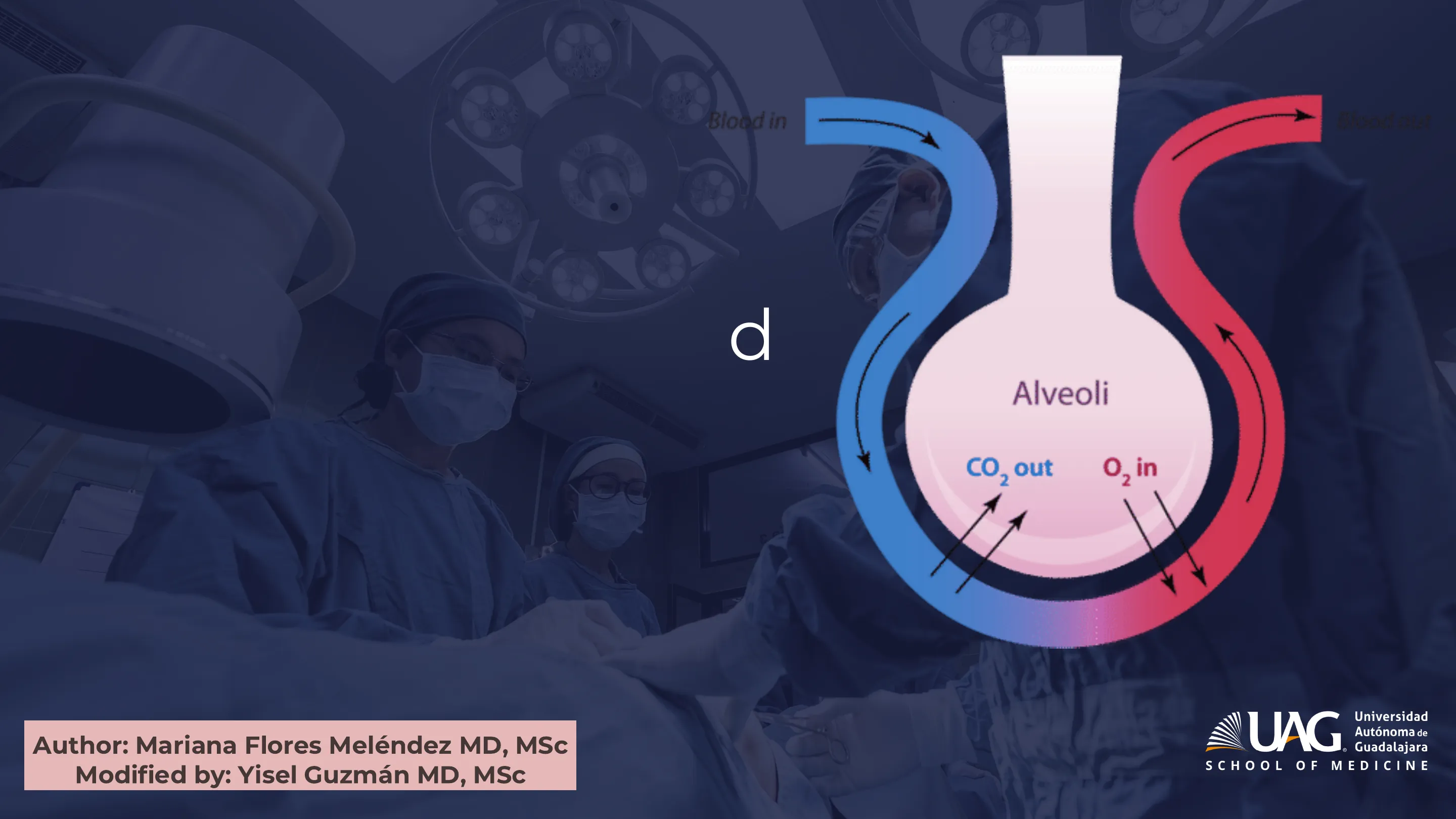
Blood in Ventilation & blood gas transport Blood out Alveoli CO2 out O2 in Author: Mariana Flores Meléndez MD, MSc Modified by: Yisel Guzmán MD, MSc UAG Universidad Autónoma de Guadalajara SCHOOL OF MEDICINE WE MAKE DOCTORSObjectives
- Review the functions of the respiratory system and the mechanics of respiration that play a role in accomplishing this functions.
- Define partial pressure, solubility and diffusion.
- Discuss all the factors that can affect diffusion of gases.
- Explain the relation between partial pressure and diffusion of oxygen and carbon dioxide.
- Correlate metabolism with partial pressure of oxygen, consumption of oxygen, partial pressure of O2 and CO2 production.
- Define ventilation perfusion (VA/Q) and explain how VA/Q will change according to the lung area.
- Explain the transport of Oxygen and CO2 in the blood and tissue fluids. UAG SCHOOL OF MEDICINEFresh air-> inspiratory phase > 02 & CO2 exchange > Expiratory Phase
150 Air JUL Po2 mm Hg 100 Gas A Cap Art 50 Diffusion Shunt Tissues 0 Atmosphere Mitochondria
- Function RS-> exchange of oxygen and carbon dioxide between the environment and the cells of the body UAG SCHOOL OF MEDICINE
Alveolar Ventilation and Dead Space
Alveolar ventilation
- Rate at which new air reaches the alveoli (gas exchange areas) Dead space
- Air that never reaches gas exchange areas
- Fills conducting zones (Respiratory passages) UAG SCHOOL OF MEDICINE
Partial Pressure of Gases
Partial pressure The rate of diffusion of each gas (from the mix= N2, O2, CO2) The partial pressure is directly proportional to the pressure caused by the gas alone. 79% Nitrogen P n2 = 600 mmHg 21% oxygen P o2 = 160 mmHg AIR UAG SCHOOL OF MEDICINE TOTAL PRESSURE = 760 mmHgPartial pressure
- Attraction, physical or chemical, to water molecules.
- Others are repelled
- When the molecules are attracted, far more of them can be dissolved without building up excess partial pressure within the solution In water or tissue? -Gases also exert pressure -They have partial pressures -NOT ONLY DETERMINED BY CONCENTRATION [ ] 1 There is a SOLUBILITY COEFICIENT of gas UAG SCHOOL OF MEDICINE Hall, J. E., Guyton, A. C., & Hall, M. E. (2021). Physiology (14ª). Elsevier. Chapter 40
Henry's Law and Solubility Coefficients
Henry's law Solubility coefficients Partial pressure = Concentration of dissolved gas Solubility coefficients Oxygen: 0.024 Carbon dioxide: 0.57 Carbon monoxide: 0.018 Nitrogen: 0.012 Helium: 0.008 For a given partial pressure, the higher the solubility of the gas, the higher the concentration of gas in the solution. UAG ® SCHOOL OF MEDICINE Hall, J. E., Guyton, A. C., & Hall, M. E. (2021). Physiology (14ª). Elsevier. Chapter 40
Gas Diffusion
Diffusion FROM GAS PHASE > DISSOLVED PHASE
- Partial pressure of each gas in alveoli tends to force molecules of that gas into solutions in the blood of the alveolar capillaries
- Conversely the molecules of gases that are already dissolved in the blood are bouncing randomly in the fluid of the blood & some of these bounding molecules escape back into the alveoli.
- The rate they escape is directly proportional to the partial pressure in the blood. UAG SCHOOL OF MEDICINE
Net Diffusion and Pressure Differences
NET DIFFUSION Gas movement from an area of high pressure to the areas of low pressure is - equal to the # of molecules bouncing in the forwards direction minus the number bouncing in the opposite direction PRESSURE DIFFERENCE FOR CAUSING DIFFUSION
- Net diffusion is determined by the difference between the 2 partial pressures (gas vs. dissolved state).
- PO2 -> is higher in gas phase
- PCO2-> is higher in dissolved state UAG SCHOOL OF MEDICINE
Factors Affecting Gas Diffusion in Fluids
Other factors that affect the rate of gas diffusion ... (in fluids)
- Solubility of the gas in the fluid
- The cross-sectional area of the fluid
- The distance through the gas must Diffuse
- The molecular weight of the gas
- Temperature of the fluids 2 1 D ox APXAXS dxVMW 3 4 UAG SCHOOL OF MEDICINE The characteristics of the GAS determine 2 factors of the formula
Diffusion Coefficient of Gases
DIFFUSION coefficient of the gas The relative rates at which different gases at the same partial pressure levels will diffuse are proportional to their diffusion coefficient in FLUID. The diffusion of gases through tissues, including through the respiratory membrane, is almost equal to the diffusion of gases in water. S/VMW Oxygen: 1.0 Carbon dioxide: 20.3 Carbon monoxide: 0.81 Nitrogen: 0.53 Helium: 0.95 UAG SCHOOL OF MEDICINE PO2 > is higher in gas phase PCO2-> is higher in a dissolved state Hall, J. E., Guyton, A. C., & Hall, M. E. (2021). Physiology (14ª). Elsevier. Chapter 40
Diffusion Through Tissue
Diffusion through TISSUE
- Important gases are tightly liposoluble = HIGH solubility in cell membrane
- Major limitation to movement is the rate at which the gases can diffuse through the tissue water, instead of cell membrane. DIFFUSION TISSUE = DIFFUSION WATER UAG SCHOOL OF MEDICINE
Alveolar vs. Atmospheric Air
AIR ALVEOLAR VS. ATMOSPHERIC
- Alveolar air is only partially replaced by atmospheric air with each breath
- 02 is constantly absorbed from alveolar air
- Co2 is constantly diffusing from blood into alveoli
- Atm. Air is humidified before reaching the alveoli WATER DILUTES OTHER GASES = DECREASES PP UAG SCHOOL OF MEDICINE
Alveolar Air Replacement
150 Anatomic dead space Tidal volume = 500 ml 350 Conducting airways Alveolar air from previous breath Inspired air that fills conducting airways Inspired air that participates in gas exchange Alveoli Alveolar air from previous breath Inspire one VT End-expiration End-inspiration
- With normal alveolar ventilation 1/2 of gas is removed in 17 seconds
- Slow replacement of alveolar air helps stabilize respiratory control
- This prevents excessive decrease or increase in tissue [ ] of CO2 & O2 1st breath 2nd breath 3rd breath UAG SCHOOL OF MEDICINE Hall, J. E., Guyton, A. C., & Hall, M. E. (2021). Physiology (14ª). Elsevier. Chapter 40 4th breath 8th breath 12th breath 16th breathC C Concentration of gas (% of original concentration) 100 80 60 40 20 - 0 0 10 20 30 40 50 60 Time (seconds) UAG SCHOOL OF MEDICINE Hall, J. E., Guyton, A. C., & Hall, M. E. (2021). Physiology (14ª). Elsevier. Chapter 40 Slow replacement of alveolar air helps stabilize respiratory control 1/2 normal alveolar ventilation 2 x normal Normal alveolar ventilation mal alveolar ventilation
Oxygen Concentration in Alveoli
OXYGEN
- New 02 is constantly being breathed into the alveoli from the atmosphere
- The more rapidly is absorbed = LOWER [ ] in alveoli
- The more rapidly is breathed = HIGHER [ ] in alveoli [ ] & Partial pressure are controlled by > ✓ RATE OF ABSORPTION INTO BLOOD 149 mmHg is the maximum Po2 in humidified air at sea level ✓ RATE OF ENTRY OF NEW O2 BY VENTILATORY PROCESS. UAG SCHOOL OF MEDICINE Hall, J. E., Guyton, A. C., & Hall, M. E. (2021). Physiology (14ª). Elsevier. Chapter 40
Alveolar Partial Pressure of Oxygen
150 T C C C Alveolar partial pressure of oxygen (mm Hg) Upper limit at maximum ventilation 250 ml O2/min 125 100 - A Normal alveolar PO2 75 The more rapidly is absorbed = LOWER [ ] in alveoli 50 1000 ml O2/min 25 0 0 5 10 15 20 25 30 35 40 Alveolar ventilation (L/min) UAG SCHOOL OF MEDICINE Hall, J. E., Guyton, A. C., & Hall, M. E. (2021). Physiology (14ª). Elsevier. Chapter 40
Carbon Dioxide Dynamics
CARBON DIOXIDE
- CO2 is formed in the body and then carried in the blood to the alveoli
- CO2 is removed by VENTILATION
- The Alveolar PCO2 increases directly in proportion to the route of CO2 excretion. -MORE EXCRETION = INCREASE alveolar PCO2
- The Alveolar PCO2 decreases inversely to alveolar ventilation -HIGHER AV = LOWER alveolar PCO2 UAG SCHOOL OF MEDICINE Hall, J. E., Guyton, A. C., & Hall, M. E. (2021). Physiology (14ª). Elsevier. Chapter 40
Alveolar Partial Pressure of Carbon Dioxide
175 MORE EXCRETION = INCREASE alveolar PCO2 T 2 Alveolar partial pressure of CO2 (mm Hg) 150 125 800 ml CO2/min 100 - 75 - 50 - Normal alveolar Pco2 A 25 200 ml CO2/min 0 - 0 5 10 15 20 25 30 35 40 Alveolar ventilation (L/min) UAG SCHOOL OF MEDICINE Hall, J. E., Guyton, A. C., & Hall, M. E. (2021). Physiology (14ª). Elsevier. Chapter 40CO2 The [ ] of both gases in the alveoli are determined by the rates of ABSORPTION/EXCRETION & ALVEOLAR VENTILATION 2 UAG SCHOOL OF MEDICINE Hall, J. E., Guyton, A. C., & Hall, M. E. (2021). Physiology (14ª). Elsevier. Chapter 40
Pressures of Oxygen and Carbon Dioxide
160 140 The expired air is a combination of dead space (HIGH PO2) and alveolar air (HIGH PCO2) Oxygen (Po2) 100 - (mm Hg) 80 Dead space air Alveolar air and dead space air Alveolar air 60 - Carbon dioxide (Pco2) 40 20 - 0- 0 100 200 300 400 500 Air expired (milliliters) UAG SCHOOL OF MEDICINE Hall, J. E., Guyton, A. C., & Hall, M. E. (2021). Physiology (14ª). Elsevier. Chapter 40 Pressures of O2 and CO2 120
Diffusing Capacities of Gases
Diffusing capacities for carbon monoxide, oxygen, and carbon dioxide in the normal lungs under resting conditions and during exercise INCREASE pulmonary blood flow VASODILATATION = greater diffusion capacity of the respiratory membrane INCREASE alveolar ventilation 1300 Resting 1200 Exercise Diffusing capacity (ml/min/mm Hg) 1100 1000 900 - 800 700 600 - 500 400 300 200 100 0 UAG SCHOOL OF MEDICINE Hall, J. E., Guyton, A. C., & Hall, M. E. (2021). Physiology (14ª). Elsevier. Chapter 40 CO O2 CO2
Ventilation-Perfusion Ratio (VA/Q)
Effect of ventilation - perfusion ratio on alveolar gas [ ]
- Not all alveoli are ventilated equally
- Not all blood flow through the capillaries is the same Areas can be well ventilated, but have almost no blood flow / Others have excellent blood flow and are not ventilated THIS MEANS THAT THE GAS EXCHANGE IS ALTERED OR IMPAIRED UAG SCHOOL OF MEDICINE Linda S. Costanzo, PhD. Physiology, 6th Edition. Elsevier. Chapter 5VA / Q
- Ventilation-perfusion ratio
- VA= ALVEOLAR VENTILATION
- Q= blood flow If one of the values is ZERO or INFINITY, there is NO EXCHANGE OF GASES through the respiratory membrane UAG SCHOOL OF MEDICINE Linda S. Costanzo, PhD. Physiology, 6th Edition. Elsevier. Chapter 5
VA/Q Below Normal
VA/Q BELOW normal
- INADEQUATE VENTILATION to provide the 02 needed to fully oxygenate the blood flowing through capillaries
- A fraction of the blood doesn't oxygenate = SHUNT BLOOD -Also, blood through bronchial vessels (2% of cardiac output) THE GREATER THE PHYSIOLOGICAL SHUNT, THE GREATER THE AMOUNT OF BLOOD THAT FAILS TO BE OXYGEATED Alveolus = ZERO Pulmonary capillary UAG SCHOOL OF MEDICINE LowVIÓ Linda S. Costanzo, PhD. Physiology, 6th Edition. Elsevier. Chapter 5
Can’t find what you’re looking for?
Explore more topics in the Algor library or create your own materials with AI.
