Glycolysis: Metabolic Process and Enzymatic Regulation
Slides about Glycolysis. The Pdf explores the fundamental metabolic process of glycolysis, including its enzymatic regulation and key enzymes like hexokinase. The Pdf, suitable for University level Biology students, also covers aerobic and anaerobic glycolysis, clinical correlations, and the pentose phosphate pathway.
See more50 Pages


Unlock the full PDF for free
Sign up to get full access to the document and start transforming it with AI.
Preview
Lecture 12: Glycolysis
Learning Objectives
- Get an overview of the individual steps of glycolysis, the enzymes involved in each step, and their regulation
- Know the steps where energy is consumed and generated
- Describe the difference between aerobic and anaerobic glycolysis and how much energy is produced by each
- Know the difference between hexokinase and glucokinase
- Know the regulation of hexokinase, glucokinase, phosphofructokinase-1 (PFK-1) and pyruvate kinase
- Understand how PFK-2 regulates PFK-1
- Learn the role of glucagon and insulin in the regulation of glycolysis in the liver and the kidneys
- Understand clinical correlates related to glycolysis: heavy metal poisoning, arsenic poisoning, pyruvate kinase deficiency
- Get an overview of the pentose phosphate pathway (PPP) and its important products, NADPH and ribose and how glucose-6-P dehydrogenase deficiency results in hemolytic anemia
Glycolysis Overview
- Breakdown of glucose employed by all tissues to provide energy (ATP) and intermediates for other metabolic pathways
- Occurs in cytosol of all cells
- In neurons, red blood cells, and most other cells glycolysis is always active and regulated by local/allosteric control
- In the liver and in the kidneys, it is a "blue" pathway that occurs in the fed state and is stimulated by insulin and inhibited by glucagon
- Why is glycolysis OFF in the fasting state in the liver and the kidneys? Because gluconeogenesis, the opposite pathway to glycolysis, is active in the fasting state.
Liver fed state Insulin Glycogenesis Glycogen Glucose 6-P Glycolysis Free fatty acids PEP Pyruvate Fatty acid synthesis Acetyl COA Citrate Oxaloacetate TCA ATP
Glycolysis: Two Outcomes Depending on Oxygen Availability
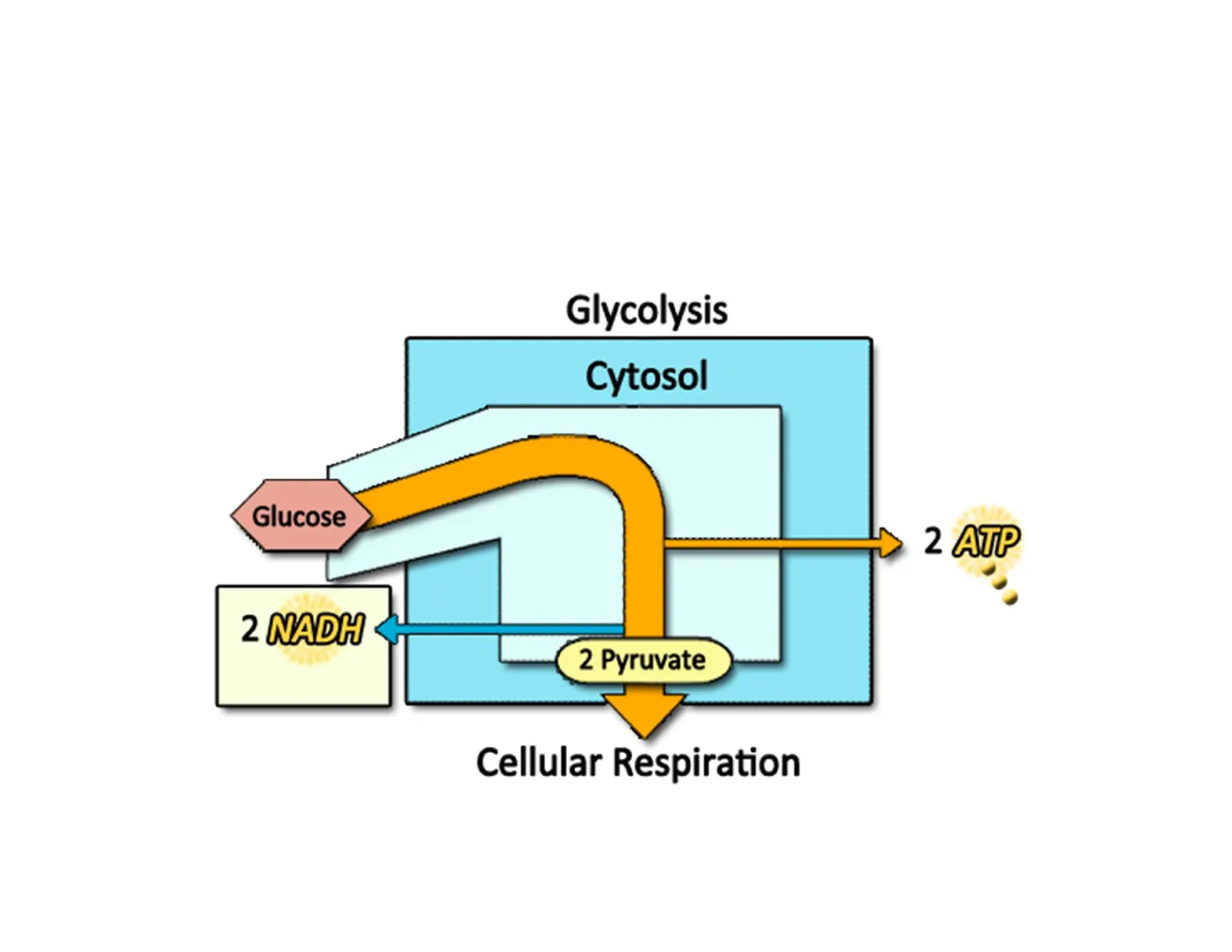
- Aerobic glycolysis: 2 ATP, 2 NADH, and 2 pyruvate are the end products in cells with mitochondria and adequate supply of oxygen. NADH is reoxidized to NAD+ in the electron transport chain in the mitochondria generating additional ATP, pyruvate is converted to acetyl-CoA which generates more energy in the TCA cycle
- Anaerobic glycolysis: 2 ATP and 2 lactate are the end products. NADH is used to reduce pyruvate to lactate which regenerates NAD+ and allows glycolysis to continue. Occurs in red blood cells (have no mitochondria) and skeletal muscle during heavy exercise.
A 6-P Gluconate Glycogen Galactose B Aerobic glycolysis Ribulose 5-P 6-P Gluconolactone UDP-Glucose + + Galactose 1-P 1 1 Ribose 5-P Glucose 1-P UDP-Galactose + Glucose 6-P Glucose Glucose 6-P Glucose 11 Sedochestudos 7º Fructose 6-P Fructose Fructose 6-P Fructose 1,6-bis-P -Glyceraldehyde +-+ Fructose 1-P Glyceraldehyde 3-P Glyceraldehyde 3-P ; Dihydroxyacetone-P Fructose 1,6-bis-P 1.3-bis-Phosphoglycerate Glycerol-P 41 3-Phosphoglycerate Glyceraldehyde 3-P > Dihydroxy- 2-Phosphoglycerate NAD+ acetone-P Ala Fatty acyl CoA. Cys > Phosphoenolpyruvate - NADH< Ser Thr Lactate $= Pyruvate Malonyl CoA 1,3-bis-Phosphoglycerate Try I.co, Leu Phe NH,- .co2 Acetyl-CoA Acetoacetate Trp Asn Lys Carbamoyl-P B-Hydroxybutyrate Aspartate ; Oxaloacetate *Citrate 11 Malate Isocitrate Gir 2-Phosphoglycerate Ornithine Fumarate @-Ketoglutarate ; Glu + 11 Succinate Succinyl CoA +-Methylmalonyl CoA Phosphoenolpyruvate Urea Î Ile Propionyl-CoA Phe Val F.Acetyl COA Oxidative Tyr Thr Fatty acyl-CoA phosphorylation Pyruvate (odd-number carbons) 11 3-Phosphoglycerate „Citrulline 17 Argininosuccinate It -co. Pro His Arg 1 Aco. / Arginine Mel Ferrier, D. R. Lippincott's illustrated reviews Biochemistry No cell wants to do anaerobic glycolysis instead of aerobic glycolysis but some cells have no choice 1 1 - Xylose Sp Erythrose 4-P 1 11 Gly Tyr
Glycolysis Phases
- Two phases
- Energy investment = Uses 2 ATP for chemical reactions
- Energy generation = Produces 4 ATP and 2 NADH
- Net payout (aerobic) = 2 ATP, 2 NADH, and 2 pyruvate
- Cytosolic NADH can produce 2 or 3 ATP, so net energy payout for aerobic glycolysis is 6 to 8 ATP per glucose (2 ATP + 2 to 3 ATP/NADH = 2 ATP + 4 to 6 ATP = 6 to 8 ATP)
- Net energy payout for anaerobic glycolysis is only 2 ATP
Glucose Energy investment phase 2 ADP 2 ATP
Glycolysis: Energy-Investment Phase
- First stage of glycolysis is energy consuming
- 2 ATP are used for phosphorylation of substrates
- Two reactions in this initial stage are important control points
Glucose ATP phosphorylation G6P P isomerization F6P P ATP phosphorylation P FBP P cleavage P GAP DHAP P @ 2008 John Wiley & Sons, Inc. All rights reserved.
Reaction 1: Glucose Phosphorylation
CH2OH H -0 H H OH H + ATP HO OH H OH Glucose 1 hexokinase Mg2+ CH2OPO2- 3 H H H OH H + ADP + H+ HO OH H OH Glucose-6-phosphate (G6P) 2008 John Wiley & Sons, Inc. All rights reserved.
- Hexokinase or glucokinase use ATP to phosphorylate glucose to glucose-6-phosphate (G6P)
- Traps glucose inside the cell
- Makes glucose metabolically active
- Virtually irreversible reaction
- One of the control steps of glycolysis
- Not unique to glycolysis since G6P can be used for the hexose monophosphate pathway/pentose phosphate pathway (all cells) or for glycogen synthesis (liver and skeletal muscle)
Reaction 2: G6P Isomerization
-203POCH2 H 5 - O. H H 4 1 OH H HO OH 3 12 H OH Glucose-6-phosphate (G6P) 1 phosphoglucose isomerase (PGI) -203POCH2 6 O 1 CH2OH 5 H HO 2 H 4 OH 13 HO H Fructose-6-phosphate (F6P) 2008 John Wiley & Sons, Inc. All rights reserved.
- Phosphoglucose isomerase changes G6P to Fructose-6-phosphate
- Necessary for the overall chemistry of the reactions that follow
- Reversible
Reaction 3: F6P Phosphorylation
2 03POCH2 6 1 O CH 2OH 5 H HO H 4 OH 13 HO H Fructose-6-phosphate (F6P) phosphofructokinase (PFK) Mg2+ -203POCH2 6 O 1 CH 20PO3- 5 H HO 2 + ADP + H+ H 4 13 HO H Fructose-1,6-bisphosphate (FBP) 2008 John Wiley & Sons, Inc. All rights reserved.
- Phosphofructokinase-1 (PFK-1) uses ATP to add a phosphate to F6P to generate Fructose-1,6-bisphosphate
- This is a rate limiting reaction
- Committed reaction that is irreversible
OH + ATP 2
Reactions 4 and 5: Fructose-1,6-bisphosphate Cleavage
H H-C-O-P C=O HO-C-H - H-C-OH H-C-OH H-C-O-P H Fructose 1,6-bisphosphate 4 Aldolase H H-C-O-(P) C-H H-C-OH H-C-O-P 5 C=O H-C-OH H Triose phosphate isomerase H Glyceraldehyde 3-phosphate Dihydroxyacetone phosphate Ferrier, D. R. Lippincott's illustrated reviews Biochemistry GAP DHAP
- Aldolase (a lyase) cleaves F1,6BP into dihydroxyacetone phosphate (DHAP) and glyceraldehyde-3-phosphate (GAP)
- Two 3 carbon compounds
- Reversible
- Triose phosphate isomerase interconverts GAP and DHAP
- Only GAP is degraded in the downstream glycolytic reactions
- Reversible
These steps convert a hexose into two trioses O
Energy Investment Stage Question
Which statement about the energy investment stage (first stage) of glycolysis is incorrect? A. Energy is consumed in the form of 2 ATP B. Two reactions are important control points C. ATP is used to phosphorylate substrates D. One NADH is produced E. The end products are two phosphorylated trioses
Overview of Energy Investment Phase
Glucose ATP phosphorylation G6P P isomerization F6P P ATP phosphorylation P FBP P cleavage P GAP DHAP P 2008 John Wiley & Sons, Inc. All rights reserved.
- Hexose sugar is phosphorylated on both ends (1 and 6 carbons)
- 2 ATP are required (used)
- Phosphorylated hexose is cleaved in half yielding 2 glyceraldehyde 3-phosphate molecules
Glycolysis: Second Stage (Energy Generating)
GAP P NAD+ NADH generation of "high-energy" compound ® 1,3-BPG ® ADP substrate-level phosphorylation ATP 3PG ® rearrangement 2PG ® generation of "high-energy" compound PEP ® ADP substrate-level phosphorylation ATP Pyruvate 2008 John Wiley & Sons, Inc. All rights reserved.
- Second stage of glycolysis is energy generating
- 2 ATP are made
- 1 NADH is made
- Because there are 2 molecules of glyceraldehyde phosphate made from each glucose molecule there are 4 ATP and 2 NADH synthesized per glucose
- Net payout is 2 ATP (4-2), 2 NADH, and 2 pyruvate
Reaction 6: GAP Oxidation and Phosphorylation
0 H H-C-OH + NAD+ + Pi 3 CH2OPO3 Glyceraldehyde-3-phosphate (GAP) 1: glyceraldehyde-3-phosphate dehydrogenase (GAPDH) OPO3 1C H-C-OH + NADH + H+ 3 CH2OPO3 1,3-Bisphosphoglycerate (1,3-BPG) 2008 John Wiley & Sons, Inc. All rights reserved.
- GAP is oxidized and phosphorylated by glyceraldehyde-3-phosphate dehydrogenase to create 1,3-bisphosphoglycerate (1,3-BPG)
- 1,3-BPG has high energy potential; used in the next step
- Oxidation of GAP results in the reduction of NAD+ to NADH
- Reversible
Reaction 7: ATP Generation from 1,3-BPG
O OPO3- 2- 1 1C + ADP H-C-OH 21 CH 2OPO3- 2- 3 1,3-Bisphosphoglycerate (1,3-BPG) Mg2+ 1 phosphoglycerate kinase (PGK) -0 O 7℃ H-C-OH 2 CH 2OPO3- 2- + ATP 3 3-Phosphoglycerate (3PG) 2008 John Wiley & Sons, Inc. All rights reserved.
- ATP is generated by phosphoglycerate kinase during the conversation of 1,3BPG to 3-phosphoglycerate
- Substrate-level phosphorylation (energy needed for production of ATP comes from a substrate rather than from the electron transport chain/oxidative phosphorylation)
- Reversible
Reaction 8: 3PG to 2PG Conversion
Phosphoglycerate mutase converts 3PG to 2-phosphoglycerate O O I H-C-OH H-C2-OPO2- I H phosphoglycerate mutase (PGM) 1 H-C-OPO2 I H-C3-OH I H 3-Phosphoglycerate (3PG) 2-Phosphoglycerate (2PG) 2008 John Wiley & Sons, Inc. All rights reserved.
Reaction 9: PEP Formation
- 2-phosphoglycerate is dehydrated by enolase to form phosphoenolpyruvate (PEP)
- Water is removed
- PEP has high energy potential which is used in the next step
0 C 1 H-COPO2 H-C-OH I H O O C enolase I C-OPO2- + H20 H-C I H 2-Phosphoglycerate (2PG) Phosphoenolpyruvate (PEP) 2008 John Wiley & Sons, Inc. All rights reserved.
Reaction 10: Pyruvate and ATP Generation
C C C-OPO2- 3 + ADP + H+ = CH2 Phosphoenolpyruvate (PEP) pyruvate kinase (PK) O C C=0 + ATP CH3 Pyruvate 2008 John Wiley & Sons, Inc. All rights reserved.
- Pyruvate kinase transfers the phosphate from phosphoenolpyruvate to ADP generating pyruvate and ATP
- Substrate level phosphorylation
- Irreversible
- Control step in glycolysis
Mutase Function Question
What is the function of a mutase? A. Causes mutations in DNA B. Cause relocation of functional groups C. Phosphorylates proteins D. Removes phosphates from proteins E. Synthesizes NADH F. Synthesizes ATP
Can’t find what you’re looking for?
Explore more topics in the Algor library or create your own materials with AI.
