DNA Replication: Models and the Meselson-Stahl Experiment
Slides from University about DNA Replication. The Pdf provides a detailed explanation of DNA replication, covering various models and key facts. The Pdf is suitable for university-level Biology students, illustrating the process with clear diagrams and discussing the Meselson-Stahl experiment.
See more51 Pages

Unlock the full PDF for free
Sign up to get full access to the document and start transforming it with AI.
Preview
DNA Replication Overview
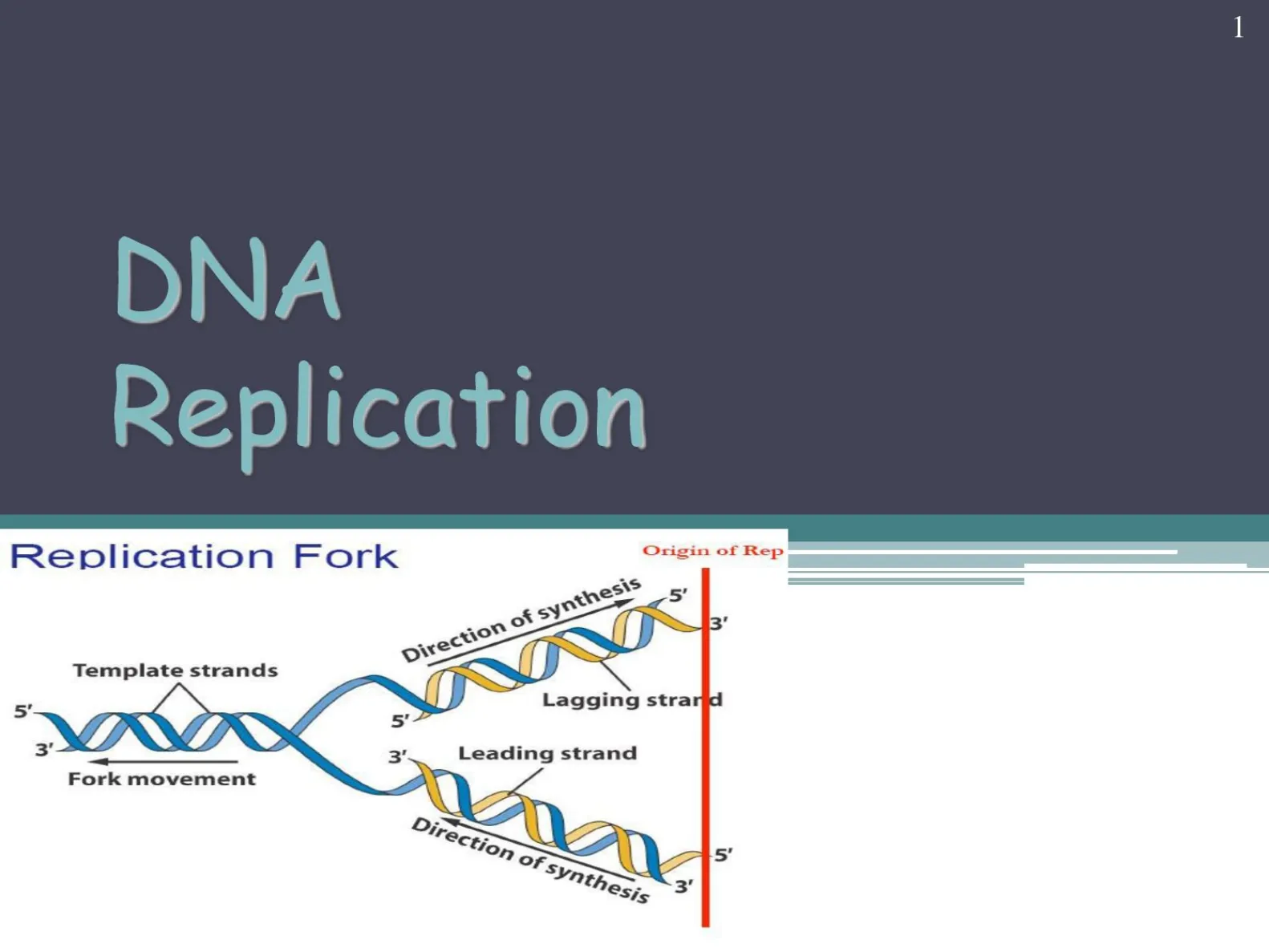
1 DNA Replication Replication Fork Origin of Rep Direction of synthesis 5' 3' Template strands Lagging strand 5' 5' 3' 3' Leading strand Fork movement Direction of synthesis 5' 3'2 DNA REPLICATION
Replication Facts
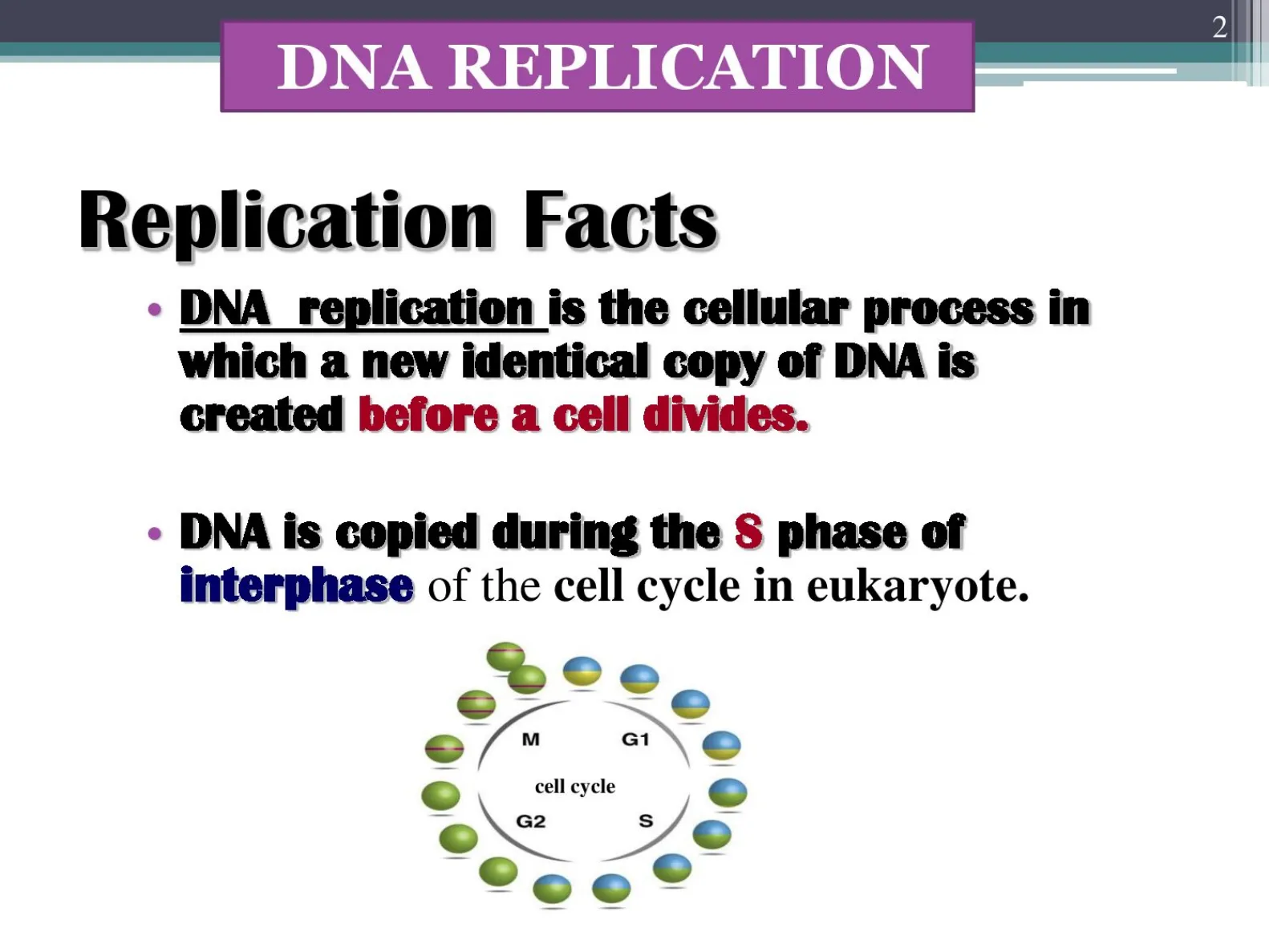
- DNA replication is the cellular process in which a new identical copy of DNA is created before a cell divides.
- DNA is copied during the S phase of interphase of the cell cycle in eukaryote. M G1 cell cycle G2 S3
Hypothesized Models of DNA Replication
Hypothesized three models of DNA Replication: 1. Conservative model 2. Dispersive model 3. Semi-conservative model4
Conservative Replication Model
Conservative replication: In conservative replication During DNA replication, the parental (original) strands never completely separate and remain together and serve as a single template that replicates to produce two daughter (new) DNA molecules, each daughter DNA molecule contains only parental strands and the other contains only new formed strands. Conservative replication
Dispersive Model
Dispersive model, in this model, suggested that DNA double helix breaks into small units and only copies itself for short chunks that reassemble and producing new strands of alternating parent and daughter DNA fragments. Dispersive replication
Semi-conservative Model of Replication
Semi-conservative Model of Replication Idea presented by Watson & Crick . The two strands of the parental molecule separate completely, and each acts as a template for a new complementary strand and makes a copy of itself. · Each new DNA molecule consists of one PARENTAL (original) and one NEW strand of DNA. DNA Template Parental DNA 1/ New DNA Semiconservative replication
The Meselson-Stahl Experiment
Evidence for Semi-conservative Replication
The Meselson - Stahl experiment Evidence for semi-conservative replication of DNA in in 1958 14 generations of growth E.coli E.coli N15 N14 N14 Semi- conservative Replication CsCL C 2 3 4 Generation ultracentrifuge Density 505% N14 100% 50% 25% 12% NIS 100% + - O 20 40 60 80 Time (min.) - E.coli bacteria were grown in two different mediums, one containing N-15 and other N-14. Extracted DNA was separated in a CsCl density gradient tube containing a solution of cesium chloride (CsCI) using Ultracentrifuge, the DNA extracted from E. coli grown on heavy N15 medium moved to a position nearer the bottom of the tube whereas the one grown on light N- 14 medium migrated more towards the less dense top of the tube. Thereafter, Bacteria with N-15 DNA were grown in medium containing N-14, after this round noticed that extracted DNA was separated at point midway between the locations predicted for wholly N- 14 DNA and wholly N- 15 DNA, this refers that replication mode is consistent with both expected models, the semiconservative and dispersive models. After that these E. coli bacteria were permitted to go through another round of replication in the N-14 medium, their extracted DNA separated into two bands; one at the N14- N 15 intermediate position and one at the wholly N 14 position. The two band observation is consistent with the semiconservative model which predicts one wholly N 14 duplex and one N 14- N 15 duplex.The Meselson - Stahl experiment Evidence for semi-conservative replication of DNA E. coli cultures DNA in CsCI gradient DNA composition Photographs of DNA bands Densitometric scans Start 15N-containing medium 15N-15N (heavy) DNA Continue growing first generation in 14N medium Replication cycle 1 15N-14N (intermediate density) DNA Continue growing Replication cycle 2 14N-14N DNA 15N-14N (intermediate density) DNA Continue growing Replication cycle 3 14N-14N 14N-14N 14N-14N 15N-14N 15N-15N DNA (heavy) - 15N-14N DNA (intermediate) 14N-14N DNA (light) · 15N-15N DNA (heavy) 15N-14N DNA (intermediate) 14N-14N DNA (light) @ 2010 Pearson Education, Inc.8
Prokaryotic DNA Replication
Sequential and Molecular Events
Initiation Stage
A) Initiation stage: 1) Identification of Ori site (origin of replication) 2) Formation of the replication bubble and replication fork through opening up and unwinding of DNA double helix to provide separate single DNA strands that act as templates. 3) Activation of nucleotides - dNMPs >dNTPs
Elongation Stage
B) Elongation stage It is a stage in which free nucleotides are incorporated to the newly growing complementary strand to extend it to the end of the template strand.
Termination Stage
C) Termination stage It is a stage of terminating DNA replication after the new complementary strand is entirely synthesized. Helicase Replicator Initiator i ii iii :ATAAATAAAAAAAATTA 3' AT Ori site GTATTTATTTTTTTTAAT 5' origin of replication leading strand lagging strand DNA pol III 5' 3' 3' 5' lagging strand leading strand - overall directions of replication Adapted from Biology by Campbell and Reece @ 2008 Pearson Education, Inc.
Main Requirements for DNA Replication
....Main Requirements for DNA replication 10 - Single stranded DNA strands (Templates) - DNA binding proteins (SSB proteins) - Deoxynucleoside triphosphate (activated nucleotides) by phosphorylase - RNA primers for initiation of replication - Enzymes to catalyze and facilitate the DNA replication process such as: Single strand binding Proteins H2N N NH N 0 0 11 N NH- -0 C 0 CH OH - Initiator proteins, Helicase, Topoisomerase, Primase, DNA polymerases, ligase. (A) Prokaryotic The pre-replication complex binds to the ori sequence. 2 Two replication forks grow away from one another. 3' 5 Origin of replication Parental strand Daughter strand Bubble Replication fork Initiation of replication 000000 god 200000F Replication forks move away from each other. 0000x 2000000 2000000 0000000 20000000 1000000 00 5ª RNA Primer ori ori Pre-replication complex ori ori (B) Eukaryotic ori ori 00000000000000000000000000000000000000000000000000000000000000000000000 ori There are multiple origins of replication. =N HO- 0=1-6 HO-P-O-P-O-P-O- N N Two daughter DNA molecules Replication bubbles in eukaryotic cell
Required Enzymes and Proteins for DNA Replication
DNA Replication (required Enzymes and Proteins) 1) Helicase - to open up the double-stranded helix of DNA by breaking down the hydrogen bonds to provide single strands that serve as templates on which new complementary DNA stand is formed. 2) Topoisomerase - responsible for removing supercoils and also releasing the torsions of DNA strands caused by helicase, by cutting the strands and resealing them at the same time with the help of another enzyme (ligase). 3) Single-strand DNA binding proteins(SSBP) - to stabilize the two parental single-strand DNA and prevent them to get the double stranded form during DNA replication. 4) Ligase - to help in joining Okazaki DNA fragments in lagging strand during the replication process and helps Topoisomerase to release supercoils and torsions ahead of a replication fork. 5) DNA polymerase I- helps in removal of primers and filling the gaps in lagging strands. 6 Primase (DNA-dependent RNA polymerase)- is the main enzyme responsible for RNA primers synthesis. 7) DNA-polymerase III- it plays the main role in the DNA synthesis, composed of 3 subunits - a Subunit - 2 catalytic domains (2 cores) - & subunit - 3'-5' exonuclease domain (involved in proofreading) - 32 subunit - it functions as a sliding clamp (2 sliding clamps) Direction of Replication Machine Movement DNA polymerese Hit Primase DNA Pelicase 8) Phosphorylase - helps in activation of deoxynucleosides monophosphate to deoxynucleosides triphosphate (dNMPs dNTPs)12
Supercoils and DNA Structure
1 2 Cut in both strands 4 M Relaxed + Under-wound ~ 10.5 bp Over-wound Supercolls transit through chromatin structure V Core particle (147 bp) (1 constrained under- wound supercoil) Linker DNA (7-101 bp) Unconstrained DNA supercoils 0 RELAXED
Initiation Process in Prokaryotes
1-Initiation process (in prokaryotes) Origin (Ori) site_is a particular sequence composed of 250-300 bp (contains A-T rich repeats) at which replication is initiated. In order for the cell to begin DNA replication, a protein called initiator protein (Dna A) must recognize and locate the origin site of replication and bind to it (called, Pre-replication complex). This results in melting of DNA duplex by breaking hydrogen bonds of 9 bp and provide single DNA strands for binding of Helicase protein (Dna B) with help Dna C loader protein. Helicase (Dna B/Dna C) is driven by ATP to open up and separate DNA double helix by breaking hydrogen bonds in order to provide single strands that serve as templates. Thereafter, SSB-proteins bind to ssDNA and prevent them from reannealing again and reforming DNA double helix. > Topoisomerases I catalyzes removal of positive supercoils particularly that are being formed by helicase ahead of replication fork. DNA Helicase binds with primase (Dna G) to form a complex known primosome. Once the helicase opens up the DNA, it exposes the bases of the two complementary strands and primase (DnaG) can initiate the synthesis of an RNA primers on both single DNA strands, from which the DNA polymerases III can begin DNA synthesis at the two replication forks in both directions. 1- Replication process is Bidirectional, because replication begins at a site of origin and simultaneously moves out in both directions from this point. - Prokaryotic cell has only one site of origin on its chromosome whereas eukaryotic cell has multiple sites of origin. Pre-initiation complex A+T rich Dna A Proteins recognize Ori Ori Ori segment X Ori binding b b: Binding of 'O' protein a: ori A + T region Denaturation and unwinding occur Binding of SSB proteins occur Replication cubic Ori Dua A C protein SSB proteins c: Unwinding of DNA helix to form two ssDNA Unwound parental duplex DNA replication Covalently closed circular temnlate Overwound region O proteinUnwound parental duplex Pre-replication complex Origin of replication Replication fork Primase (Dna G) DNA polymerase I + Ligase K Helicase (Dna B/Dna C) Initiator Initiator protein (Dna A) Parent cell DNA 4 Replication Overwound region End of replication Topoisomerase Daughter cell DNA DNA REPLICATION Prokaryotic DNA replication during cell division 3 5 SSB DNA helicase 3ª 5' Type I Topoisomerase 3' 5 Supercoiled 3' in DNA polymerase r lagging strand Nick one strand Unwind Religate 3 5 leading strand Relaxed RNA primer - Primosome DNA plymerase III Daughter cell DNA 11-Initiation process 9 mer DnaA O 88 ydratysis Initial binding ATP hydrolysis Replication bubble forms ATP hydrolysis 1 DnaB/Dnac Helical unw as initiated winding The RNA primers act as a signal for another protein called DNA polymerase III to bind and begin replication by adding individual nucleotides to the growing daughter strand.
Can’t find what you’re looking for?
Explore more topics in the Algor library or create your own materials with AI.
