Strategic Evaluation and Implementation: McKinsey 7S Framework, Ceu Universidad San Pablo
Slides from Ceu Universidad San Pablo about strategic evaluation and implementation. The Pdf, an academic resource for University students in Economics, details the process of evaluating and selecting strategies, organizational support, and the McKinsey 7S Framework.
See more52 Pages


Unlock the full PDF for free
Sign up to get full access to the document and start transforming it with AI.
Preview
T.6 STRATEGIC EVALUATION AND IMPLEMENTATION
6.1 The Process of Evaluating and Selecting Strategies.
CEU
Universidad
San Pablo
6.2 Strategic Implementation and Organizational Change.
6.3 Organizational Support for the Strategic Implementation.
6.3.1 The Design of the Organizational Structure.
6.3.2 Strategy: Management , Leadership and Human
Resources.
6.3.3 Organizational Culture.
6.4 Strategic Planning and Control.
Innovation
Branding
Solution
Marketing
Analysis
Ideas
Success
Management
.- .-
$
---
- --
Of
x
Source: Guerras y Navas (2022)6.1 The Process of Evaluating and Selecting Strategies.
Rational Approach to Strategy Selection
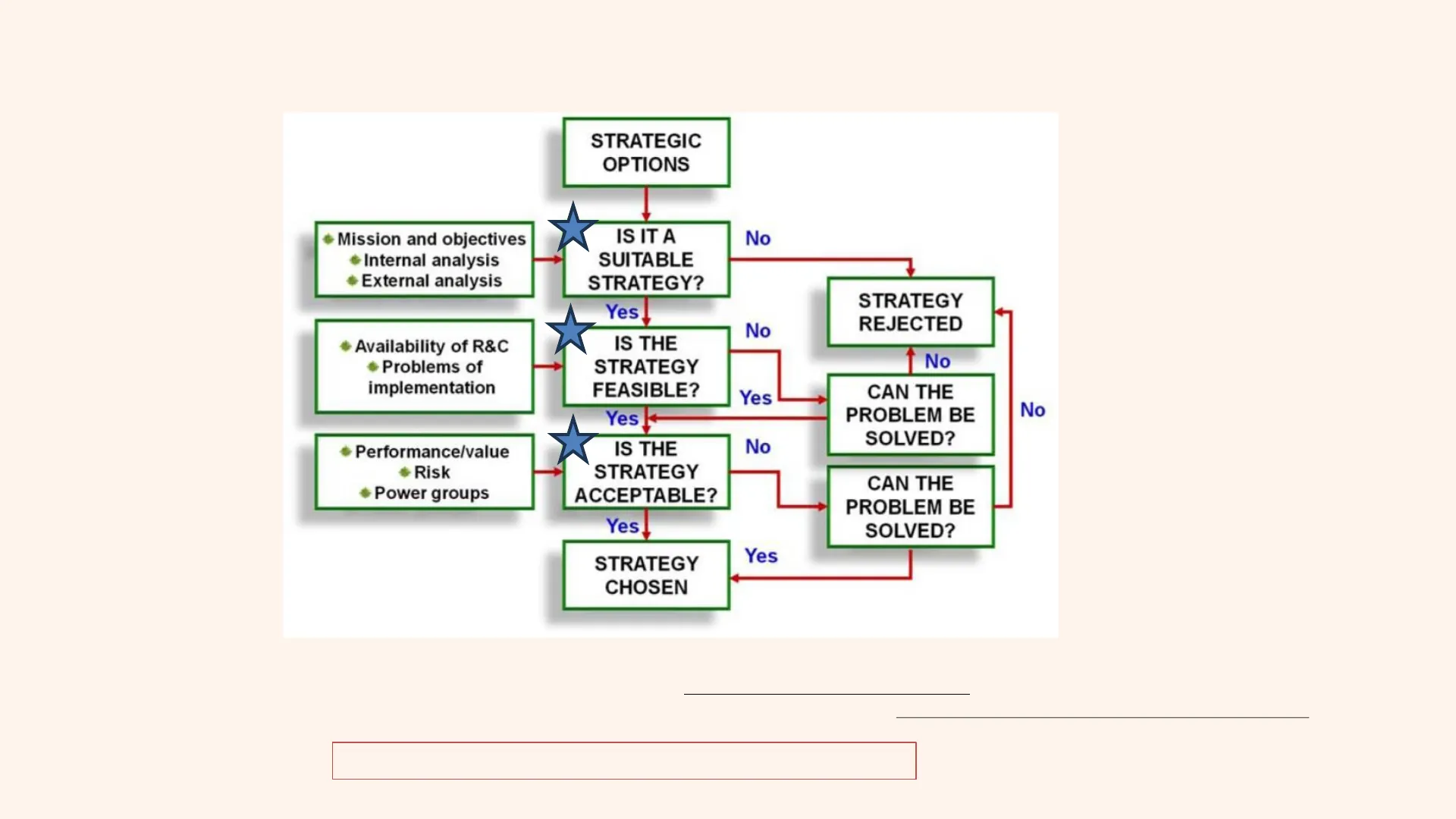
RATIONAL APPROACH: Strategies subjected to logical and systematic analysis of strategic rationality.
STRATEGIC
OPTIONS
Į
Mission and objectives
+ Internal analysis
IS IT A
SUITABLE
STRATEGY?
No
· External analysis
Yes
STRATEGY
REJECTED
Availability of R&C
Problems of
implementation
IS THE
STRATEGY
FEASIBLE?
No
No
Yes
No
Yes k
CAN THE
PROBLEM BE
SOLVED?
· Performance/value
Risk
IS THE
STRATEGY
ACCEPTABLE?
No
. Power groups
CAN THE
PROBLEM BE
SOLVED?
Yes
Yes
STRATEGY
CHOSEN
- The strategy that meets the three criteria will be implemented.
- If there are several strategies that meet the three criteria: establish a hierarchy among them.
- If the criteria conflict with each other and no strategy meets them simultaneously: weigh the advantages and disadvantages of each.
The process can never be entirely rational or formalizable.
Source: Guerras y Navas (2022)6.1 The Process of Evaluating and Selecting Strategies.
Criteria for Strategy Evaluation
CRITERIA FOR THE EVALUATION OF STRATEGIES
Suitability Criterion
SUITABILITY
"Address weaknesses and threats.
Consistency with the situation
defined by strategic analysis
(strategic adjustment).
"Exploit strengths and opportunities.
"Alignment with the organization's objectives.
Feasibility Criterion
FEASIBILITY
Feasibility of implementation.
Analyze the operation
Strategy in practice
(organizational adjustment).
Availability of resources and capabilities.
"Time horizon for changes.
Acceptability Criterion
ACCEPTABILITY
"Subjective criterion: stakeholder expectations.
Measuring the consequences of
adopting a strategy.
"Identify for whom it must be acceptable.
Power relations.
Evaluating Suitability
SUITABILITY
Evaluates the adaptation of the strategies (of the different levels) to the MISSION AND OBJECTIVES,
and to the situation identified in the STRATEGIC ANALYSIS
EXTERNAL Analysis
Threats and Opportunities
INTERNAL analysis
Strengths and Weaknesses
Ways to Evaluate Suitability
Ways to evaluate SUITABILITY
" A priori logical reasoning process.
"Seeks the best solution for a given context.
Strategic models
"Based on theoretical analysis models (strategic matrices, value chain,
life cycle, etc.).
· Relate obtained results with strategies used to:
. Understand which strategies have worked best in different
situations.
Empirical evidence
· Conditions under which a particular strategy works best.
"It is necessary to have abundant information about companies,
strategies followed, and results obtained through:
· Databases (PIMS, SEPI Business Strategy Survey).
Research in strategic management.
Evaluating Feasibility
FEASIBILITY
Consistency on implementation possibilities
REQUIRES:
v Organizational Adjustment: Adjustment of the strategy with the organization in which it is going to be
implemented in:
▪
Organizational Design
HR Policy
· Leadership style
· Organizational culture
v Availability of R&C : necessary for the success of the strategy:
Financial feasibility (first limitation to implement a strategy but easy to solve.)
· Other R&C: intangibles and individual and organisational capabilities (difficult to quantify but
more important).
v Adequacy of the time horizon to the expected changes.
Evaluating Acceptability
ACCEPTABILITY
Measures the consequences of adopting a particular strategy for stakeholders and is subjective as it relates to
their expectations.
Perspectives on Acceptability
Perspectives
Economic-rational: creation of value/profitability/risk for the shareholder
Power: Consequences for the rest of the stakeholders
· Economic-financial profitability (EBITDA, ROA, ROE ... )
COMPANY
PERFORMANCE
· Value creation index (*) MVE/BVE>1
· Cost-benefit analysis.
ACCEPTABILITY
Criteria
RISK
· Financial risk of the strategy.
. Financial risk of the company.
. Political risk of the strategy.
STAKEHOLDERS
REACTION
. Conflict of interests.
· Relationship management.
(*)
MVE (Market Value of Equity) (in Spanish "Valor de Mercado de los Fondos Propios" "VMFP" ) or Market Capitalization = Market Price of the Share x Number of Shares.
BVE (Book Value) (in Spanish“Fondos Propios" ;"FP") = capital contributed by shareholders plus retained earnings and reserves = Book Value per Share x Number of Shares.
6.2 Strategic Implementation and Organizational Change.
Interaction Between Formulation and Implementation
INTERACTION BETWEEN FORMULATION AND IMPLEMENTATION
STRATEGY FORMULATION
Suitable
Unsuitable
SUCCESS
RESCUE OR RUIN
Achievement of the
objectives of growth,
value or profits
Proper implementation
may save a poor strategy
and give management
time to correct it, or it
may accelerate its failure
Excellent
?
STRATEGY
IMPLEMENTATION
PROBLEM
FAILURE
Poor implementation may
obstruct a strategy.
Management may
conclude that the strategy
is unsuitable
Cause of the failure is
difficult to diagnose. A
poor strategy marked
by the inability to
implement it
Poor
4.Interrelation of formulation and
implementation: These processes are
interconnected and influence each other, often
overlapping in time.
?
5.Organizational impact: The starting point of
the organization affects strategy development,
which may require organizational changes.
Source: Adapted from Bonoma (1984: 72)
1.Success of a strategy: Achieved by choosing
the correct model and implementing it
excellently.
2.Implementation importance: Proper
implementation can highlight and correct
issues, even if the strategy isn't the most
suitable.
- 3.Poor implementation: Leads to
unsatisfactory outcomes, making the decision
seem incorrect and causing potential failure.
Strategic and Organizational Adjustment
STRATEGIC AND ORGANIZATIONAL ADJUSTMENT
CONTEXT
Alignment between the chosen strategy and the
context - objectives, environment,
internal
resources - in which it will be applied is necessary.
STRATEGIC ADJUSTMENT
EXTERNAL
INTERNAL
STRATEGY
ORGANIZATION
STRATEGIC
OBJECTIVES
I
1
ORGANIZATIONAL ADJUSTMENT
Consistency between the chosen strategy
and the organization in which it will be
implemented is necessary.
Strategic Implementation Activities: The 7S Framework by McKinsey
STRATEGIC IMPLEMENTATION ACTIVITIES: The 7S Framework by Mckinsey
Structure
Strategy
Systems
Shared Values
Skills
Style
Staff
Source: Waterman (1982:70).
o The 7S Framework by Mckinsey is a management model developed by
business consultants Robert H. Waterman, Jr. and Tom Peters in the 1980s.
o This model identifies seven interrelated factors essential for organizational
success:
- Strategy: The plan of action designed to achieve a competitive
advantage. - Structure: The way the organization is structured, including
hierarchies and communication lines. - Systems: The daily procedures and processes used to get the work
done. - Shared Values: The core values and culture of the organization.
- Skills: The capabilities and competencies of the staff within the
organization. - Style: The leadership style and how leaders interact with employees.
- Staff: The people and their roles within the organization.
o This model is used to assess whether all these factors are aligned and
working harmoniously to achieve the organization's objectives.
o The 7-S framework suggests some important ideas:
. There is a set of factors that influence strategic and organizational
change in a company, which implies recognizing the complexity of
such changes.
. The seven factors are interconnected, and it is difficult to achieve
significant results in one factor without also making improvements in
the other factors, highlighting the need for alignment or congruence
among all of them.
. Many well-designed or formulated strategies can fail due to a lack of
attention to several basic factors.
. It is not obvious which of the seven factors will be the most important
or critical in each decision or for each company.
Key Points of the 7S Framework
STRATEGIC IMPLEMENTATION ACTIVITIES: The 7S Framework by Mckinsey (II)
" Complexity of the implementation process.
KEY
POINTS
" Interconnection of the 7 factors.
· Well-designed/formulated strategies can fail due to lack of attention to
several factors.
" It is not obvious which of these factors will be critical in the decision.
DEFINITION OF ORGANIZATIONAL SUPPORT
Structure design
> Management and leadership style
> HR Management
Culture Management
ACTIVITIES
necessary for the
IMPLANTATION
ADMINISTRATIVE SUPPORT SYSTEMS
> Planning Systems
> Control Systems
Information Systems
Structure
Strategy
Systems
Shared Values
Skills
Style
Staff
McDonald's and the 7S Framework Example
STRATEGIC IMPLEMENTATION ACTIVITIES: The 7S Framework by Mckinsey - Example
McDonald's and the 7S Framework
- Strategy
•
McDonald's has developed a strategy centered on global expansion and adapting its menu to local preferences. Their action plan
includes continuous improvement of food quality and customer experience to maintain a competitive advantage. - Structure
•
McDonald's organizational structure is hierarchical, with a clear chain of command and well-defined communication lines. This allows
for efficient management and quick decision-making. - Systems
•
McDonald's uses
advanced systems to manage daily operations, including supply chain management, inventory control, and
customer service processes. These systems ensure procedures are carried out efficiently and consistently. - Shared Values
•
The shared values at McDonald's include quality, service, cleanliness, and value. These values are deeply embedded in the
organizational culture and guide the actions and decisions of employees. - Skills
•
McDonald's invests in training and development to ensure employees have the necessary skills to meet the company's standards. This
includes programs in customer service, management, and operations. - Style
•
The leadership style at McDonald's is collaborative and results-oriented. Leaders encourage innovation and continuous improvement,
interacting openly and transparently with employees. - Staff
•
McDonald's staff comprises
individuals in various roles, from restaurant employees to managers and executives. The company
focuses on hiring people who share its values and are committed to the organization's mission.
Results
Thanks to the alignment of these seven factors, McDonald's has maintained its position as a leader in the fast-food industry, adapting to market
changes and continuously improving organizational performance.
Can’t find what you’re looking for?
Explore more topics in the Algor library or create your own materials with AI.
