English Exam: Linguistic Terminology and Word Formation
Document from an English exam about linguistic terminology and word formation. The Pdf provides a detailed overview of concepts like Pattern, Phraseology, Data-driven learning, Cohesion, Collocation, and Colligation, useful for University students studying Languages.
See more55 Pages


Unlock the full PDF for free
Sign up to get full access to the document and start transforming it with AI.
Preview
Esame ASL
Tempo totale per fare parte 1 e parte 2 di ASL è di 90 minuti = 45' per parte 1 + 45' per parte 2
Parte 1
17 domande brevi
- Domanda 1: rewrite a sentence that contains gender-biased language. You should use gender neutral language.
- Domanda 11 e 12 sono basate sul Longman Grammar: leggere le pagine indicate (vedi ASL syllabus + vedi risposte a wooclap)
Domanda 13: Variabili di registro
- Domanda 13: may ask you about the three register variables: field, tenor and mode. It may also ask you about the information that the Longman Grammar provides about register
Domanda 14 e 15: Terminologia
- Domanda 14 e 15 sono sulla Terminology: lista della terminologia da sapere ○ Pattern - a sequence/string of words that is repeated ○ Phraseology - fixed expressions that may be characteristic of a particular type of text, topic or speaker o Data-driven learning - a type of inductive learning where you examine a concordance and notice patterns. You use these to work out grammatical rules or identify collocation and phraseology. This is different to a teacher telling you what to learn. o Cohesion refers to the way in which the parts of a text are related to one another (see slides and video on Cohesion, Week 9); it is "a close relationship, based on grammar or meaning, between two parts of a sentence or a larger piece of writing" (Longman Dictionary of Contemporary English). According to the Longman Grammar (p. 455) it is "The pattern of relations between structures and lexical items which combine together to form a text. Pronouns like she, conjunctions like but, and linking adverbs like therefore have a particular role in cohesion". Halliday and Hasan (1976:4) say that "The concept of cohesion is a semantic one; it refers to relations of meaning that exist within the text and that define it as a text. Cohesion occurs where the interpretation of some element in the discourse is dependent on that of another. The one presupposes the other, in the sense that it cannot be effectively decoded except by recourse to it". ○ Collocation is how words typically occur together (slides on Dictionary skills, Week 3); it is the way in which some words are often used together, or a particular combination of words used in this way (Longman Dictionary of Contemporary English) ○ Colligation is the syntactic patterning associated with a word, structure or expression. Co-occurrence of grammatical categories. @ Giulia Marcato, 2025
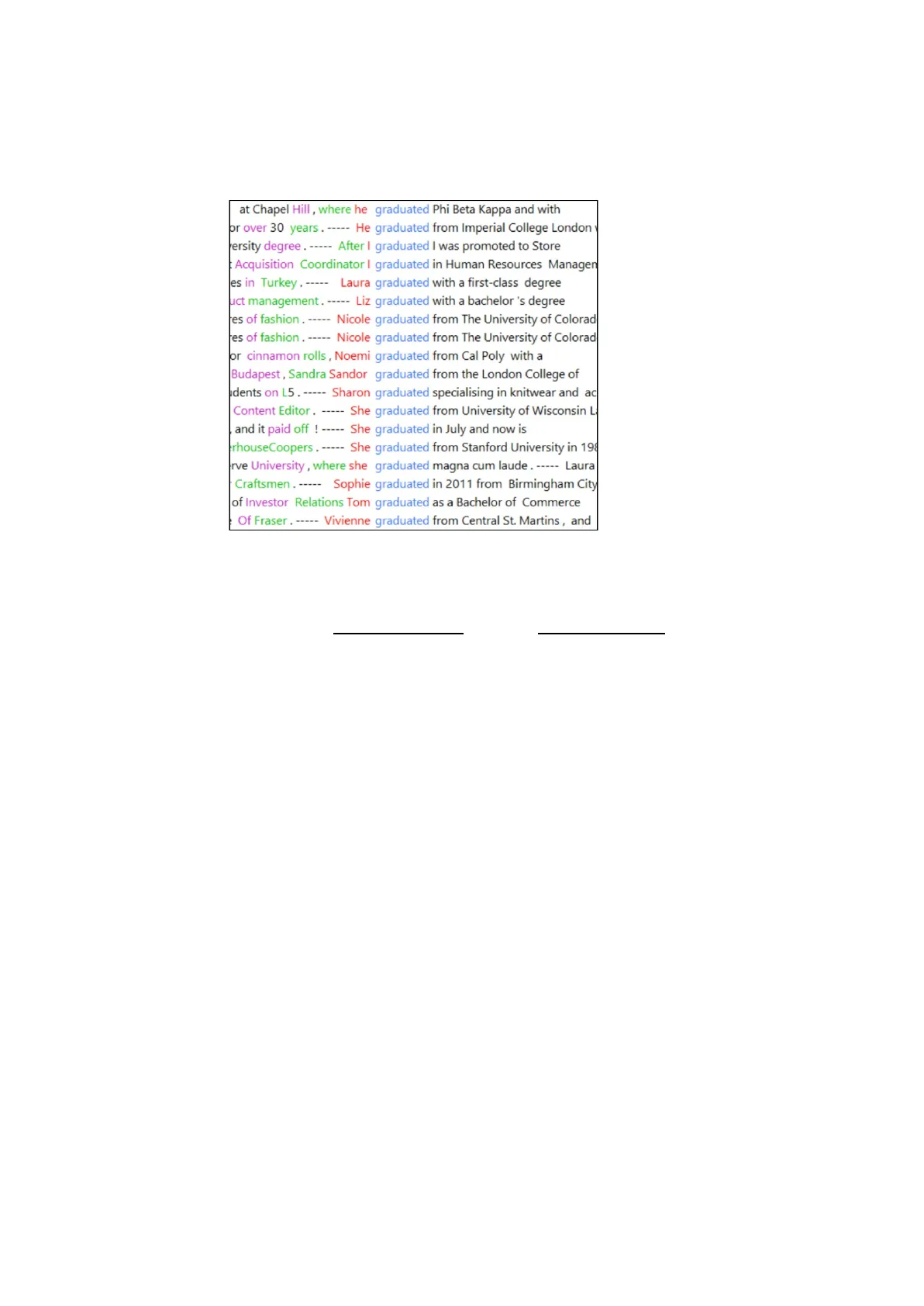
Concordance Example
1o A concordance is a list of results retrieved from a corpus using concordancing software (member of A-E class). Below is an example of a concordance for the word 'graduated'. at Chapel Hill , where he graduated Phi Beta Kappa and with or over 30 years . ----- He graduated from Imperial College London ersity degree . ----- After I graduated I was promoted to Store Acquisition Coordinator I graduated in Human Resources Manager es in Turkey . ----- Laura graduated with a first-class degree uct management . ----- Liz graduated with a bachelor 's degree es of fashion . ----- Nicole graduated from The University of Colorad es of fashion . ----- Nicole graduated from The University of Colorad por cinnamon rolls, Noemi graduated from Cal Poly with a Budapest, Sandra Sandor graduated from the London College of dents on L5 . ----- Sharon graduated specialising in knitwear and ac Content Editor. ----- She graduated from University of Wisconsin L and it paid off ! ----- She graduated in July and now is rhouseCoopers . ----- She graduated from Stanford University in 198 rve University , where she graduated magna cum laude . ----- Laura Craftsmen . ----- Sophie graduated in 2011 from Birmingham City of Investor Relations Tom graduated as a Bachelor of Commerce Of Fraser . ----- Vivienne graduated from Central St. Martins, and
Terminologia Aggiuntiva
- Connotation is a quality or an idea that a word makes you think of that is more than its basic meaning
- A corpus is a collection of texts stored in electronic format. It can consist of texts belonging to one or more registers. It can be analysed using concordancing software. Corpora is the plural. ○ Ellipsis is the omission of a word or group of words whose meaning can be understood from the text o A genre is a staged, purposeful activity that has a meaning in a certain culture. It is realised through a text's register ○ Nominalisation is the process of forming nouns from other parts of speech, usually verbs or adjectives ○ Noun phrase - A phrase is a word or a group of words that forms a unit in a clause. Each word class has a major phrase type. The head of a noun phrase is a noun. ○ Premodification - the part of the noun phrase that precedes the head. It gives information about the head noun. o Post Modification - the part of the noun phrase that follows the head. It gives information about the head noun. Language varies according to the situation and according to the communicative purpose of the speaker/writer. ○ Field refers to what the text is about: the topic, what's happening, who's involved. It can be seen in the vocabulary used. If common background @ Giulia Marcato, 2025
Conoscenza di base e vocabolario
2knowledge is assumed, it affects the speaker/writer's use of specialised or technical vocabulary.
Tenor e relazione tra gli interagenti
- Tenor concerns the relationship between the interactants. It depends on their statuses and roles, the frequency of contact between them, equality of power status, and the level of emotional involvement. Tenor affects degrees of formality of the register.
Mode e produzione linguistica
- Mode is mostly affected by whether the language produced is written or spoken. However, there isn't necessarily a precise distinction between the two and it is necessary to consider whether production is planned or spontaneous, whether there is visual or aural contact, and whether feedback is delayed, immediate or not expected ('aural contact' means that you can hear the speaker).
Domanda 16: Uso di corpora per l'apprendimento linguistico
- Domanda 16: Question about using corpora for language learning (One of the short answer questions requires you to use AntConc with the Report Corpus. Open it BEFORE you start the exam)
Strumenti linguistici basati su Corpus
- SKELL: An online corpus analysis tool. It produces word sketches.
- Longman student grammar; Provides information about how grammar is used in different registers
- Longman dictionary: This provides information about word frequency and collocations.
- AntConc:A corpus analysis tool. It produces concordances
- Report corpus: collection of reports that we analyse using AntConc.
- Concordance: list of each occurrence of a word in a corpus, with the words
Esempi e Quiz
Esempio di parte 1: https://ssu.elearning.unipd.it/mod/wooclap/view.php?id=422396 ✅ Mock test Parte 1: https://ssu.elearning.unipd.it/mod/quiz/view.php?id=422186 Password: mock V Altro quiz (mid-course): Mid-course revision quiz - n.b. the password to get in is 'quiz'
Parte 2: Report di un sondaggio
Parte 2 Report of a survey Esempio di parte 2: https://ssu.elearning.unipd.it/pluginfile.php/1325892/mod_resource/content/7/exam ALS par t2 2023 updated.pdf @ Giulia Marcato, 2025
Cosa studiare
3What to study Learner dictionary skills Read pp.4-7 (1.3 More about Language Variation) What is a learner dictionary? A dictionary that helps us to avoid inappropriate words, to distinguish between words and similar meanings, to find collocations, to help us develop confidence as language learners. HOWEVER Using these dictionaries requires more mental effort. It may be difficult to find a word. Where there are multiple meanings it may be difficult to identify the appropriate one. (Google is NOT a dictionary). Never rely exclusively on bilingual dictionaries.
Dizionari basati su Corpus
Corpus based dictionaries Some of the most popular corpus based learner dictionaries: . Longman Dictionary of Contemporary English online . Cambridge Learner's Dictionary . Oxford Advanced Learner's Dictionary We'll use the Longman Dictionary of Contemporary English as a learner dictionary. Its corpus is very rich (same corpus used for Longman Student Book): it contains 40 millions words of text.
Differenza tra Longman Dictionary of Contemporary English e Longman Student Grammar
Difference between Longman Dictionary of Contemporary English and Longman Student Grammar of Spoken and Written English: - LDCE: It's a dictionary designed to help learners understand the definitions, pronunciations, and usage of a wide range of English words and phrases. = it's the learner dictionary online - LSGSW: It's a comprehensive guide to English grammar, explaining the rules and patterns of the language. = it's the book we have The LSGSW covers different registers: Academic prose, Conversation, News and Fiction. @ Giulia Marcato, 2025
Registri linguistici
4Conversation Fiction News Ac. Prose mode spoken: personal communication written: pleasure reading written: informational purpose written: informational purpose to a more specialized audience Like registers, dialect distinctions can be made. The LSGSW distinguishes American English from British English. This book highlights lexicogrammatical patterns = how lexis and grammar interacts. EX: one set of verbs typically occurs with a type of clause: - Think, say, know ->are followed by a that-clause (I think that ... , I said that ... , I knew that ... ) - Want, like, seem ->are followed by a to-clause (I want to ... , She likes to ... , It seems to ... )
Grammatica prescrittiva vs descrittiva
Perspective vs descriptive grammar: - Prescriptive grammar says how you should use language (rules to follow). - Descriptive grammar says how people actually use language (observing patterns) ->the LSGSW
Cos'è un Corpus
What is a corpus? A corpus is a collection of texts stored in electronic format. Can consist of texts belonging to one or more registers. Can be analysed using concordancing software. Modern English dictionaries are based on databases of millions of words (corpora). Powerful software analyses the word used and help us with: - example sentences taken from the corpora - idiomatic expressions and natural word combinations - info about written english and spoken english - frequency of words - It provides info about how speakers use English grammar in different ways to communicate, in different circumstances (EX: if it's written or spoken english)
Caratteristiche speciali del Corpus
Special Features of corpus: L Any grammatical form, structure, class or rule @ Giulia Marcato, 2025
Can’t find what you’re looking for?
Explore more topics in the Algor library or create your own materials with AI.
