Ocr A Level Biology: Communicable Diseases and Immune System
Document from Savemyexams about Ocr A Level Biology. The Pdf, a set of high school Biology notes, covers communicable diseases, prevention, and the immune system, including common pathogens, immune responses, and types of immunity. It also discusses antibiotics and resistance.
See more59 Pages

Unlock the full PDF for free
Sign up to get full access to the document and start transforming it with AI.
Preview
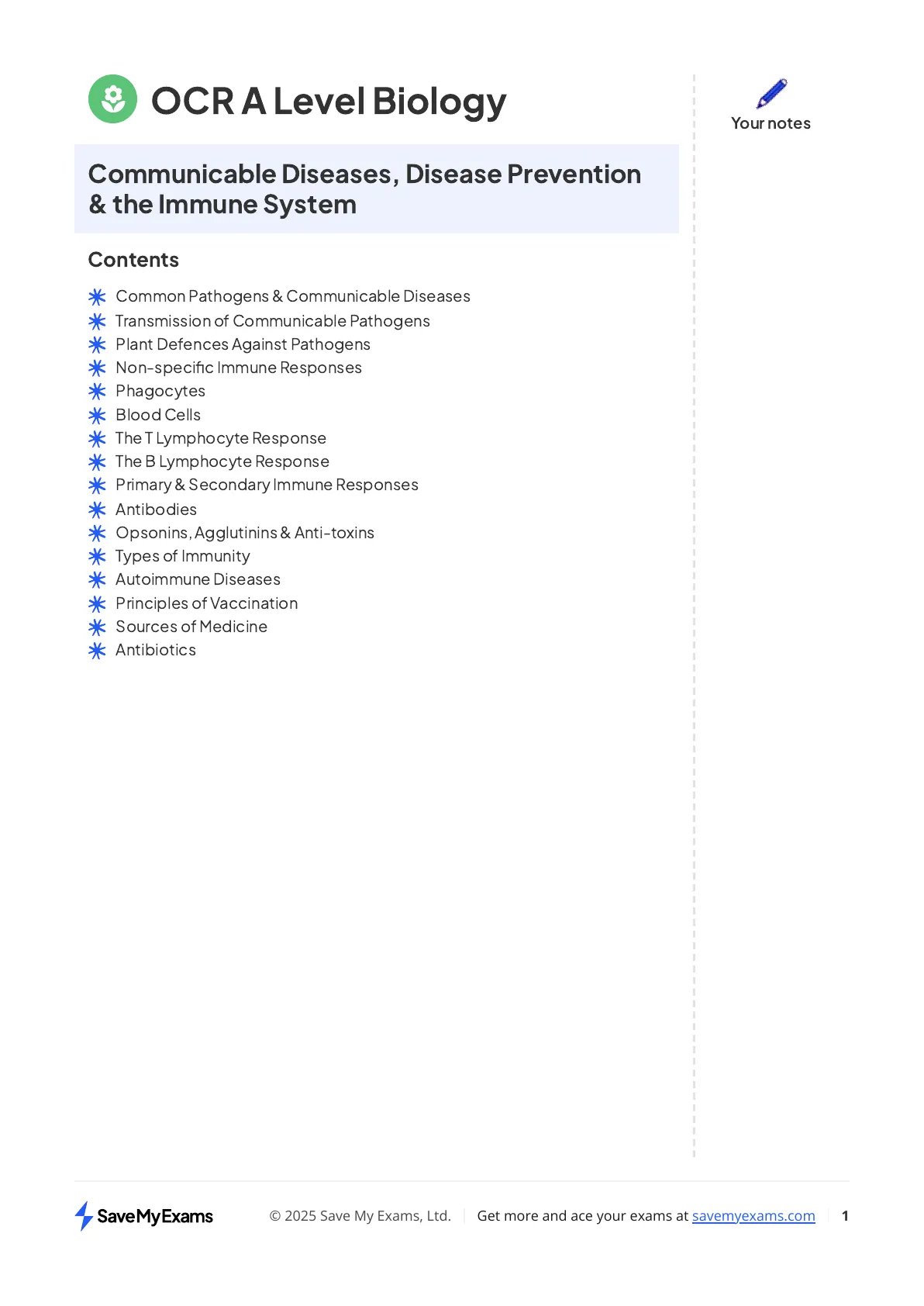
Communicable Diseases, Disease Prevention & the Immune System
Contents
- Common Pathogens & Communicable Diseases
- Transmission of Communicable Pathogens
- Plant Defences Against Pathogens
- Non-specific Immune Responses
- Phagocytes
- Blood Cells
- The T Lymphocyte Response
- The B Lymphocyte Response
- Primary & Secondary Immune Responses
- Antibodies
- Opsonins, Agglutinins & Anti-toxins
- Types of Immunity
- Autoimmune Diseases
- Principles of Vaccination
- Sources of Medicine
Antibiotics
Save My Exams
@ 2025 Save My Exams, Ltd.
Get more and ace your exams at savemyexams.com
Common Pathogens & Communicable Diseases
Common Pathogens & Communicable Diseases
A disease is an illness or disorder of the body or mind that leads to poor health Each disease is associated with a set of signs and symptoms
Communicable/infectious diseases are caused by pathogens and are transmissible (can be spread between individuals within a population)
Both plants and animals can be affected by pathogens
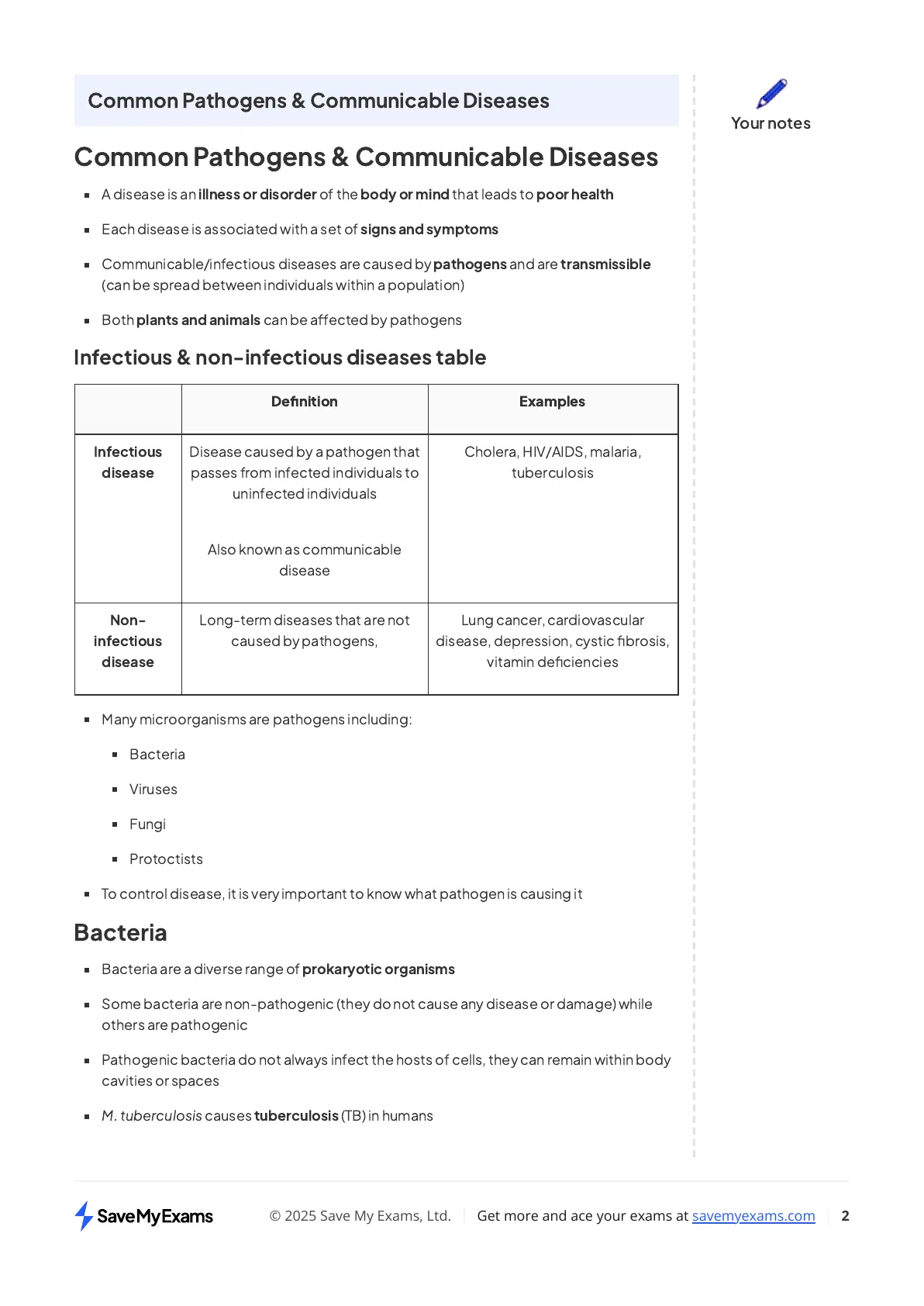
Infectious & Non-Infectious Diseases Table
Definition Examples
Infectious disease
Disease caused by a pathogen that passes from infected individuals to uninfected individuals
Cholera, HIV/AIDS, malaria, tuberculosis
Also known as communicable disease
Non- infectious disease
Long-term diseases that are not caused by pathogens,
Lung cancer, cardiovascular disease, depression, cystic fibrosis, vitamin deficiencies
- Many microorganisms are pathogens including:
- Bacteria Viruses
- Fungi Protoctists
To control disease, it is very important to know what pathogen is causing it
Bacteria
Bacteria are a diverse range of prokaryotic organisms Some bacteria are non-pathogenic (they do not cause any disease or damage) while others are pathogenic
Pathogenic bacteria do not always infect the hosts of cells, they can remain within body cavities or spaces
- M. tuberculosis causes tuberculosis (TB) in humans
Save My Exams
@ 2025 Save My Exams, Ltd.
Get more and ace your exams at savemyexams.com
The bacteria infect the lungs, causing a chronic cough and bloody mucus It is a disease often associated with poor hygiene and sanitation
- M. bovine in cows can also transmit to humans to cause TB Ring rot diseases in potato plants are caused by bacterial pathogens The bacteria infect the vascular tissue and prevent the transport of water, causing the plant to wilt and die
- The infection spreads into the potato tubers where the vascular tissue is arranged in a ring, producing the characteristic black ring of rot
Viruses
Viruses do not have a cellular structure This means they can't respire, produce ATP, replicate genetic material or synthesise protein
They infect host cells and hijack their machinery to replicate their own genetic material and proteins
The first virus ever discovered was the Tobacco Mosaic Virus (TMV) TMV infects several plant species It causes a distinct yellowing of the leaves which produces a mosaic pattern
- Three different influenza viruses infect humans to cause the flu Influenza A, influenza B and influenza C infect the cells that line the airways They cause a high temperature, body aches and fatigue Influenza A is the virus that causes the most cases of flu globally It has a capsid that surrounds 8 single-stranded molecules of RNA
- The human immunodeficiency virus (HIV) infects specific cells of the immune system It is an enveloped retrovirus The viral enzyme reverse transcriptase produces single-stranded DNA from its viral RNA
- DNA polymerase synthesises double-stranded DNA from this single-stranded DNA The double-stranded DNA is inserted into the host DNA and can remain inactive for many years Once activated the DNA provirus is used to synthesise new viruses
Protoctista
Protists are unicellular eukaryotes Plasmodium falciparum is a protist that causes severe forms of malaria in humans The parasite is spread by mosquitoes
Save My Exams
@ 2025 Save My Exams, Ltd.
Get more and ace your exams at savemyexams.com
- Infected individuals experience fever, chills and fatigue
- P. infestans causes the infamous potato blight
- The pathogen is unusual as it has some fungal characteristics It is transmitted via spores The first signs of potato blight are small, dark brown marks on the leaves which quickly increase in size and number The protist destroys potato and tomato crops leaving them completely inedible
Fungi
- Fungi have a similar structure to plants Their eukaryotic cells have cell walls and large central vacuoles However, instead of being made of separate cells, their bodies consist of filaments known as hyphae These hyphae form a network and spread throughout a host/soil Fungal diseases are much more common in plants than animals
- Athletes foot is a fungal disease that exist on the surface of the skin Fungal diseases in plants tend to be much more serious and can threaten entire crops Black Sigatoka is a fungal disease in bananas . It spreads through the leaves of the plant, reducing its ability to photosynthesise The lack of photosynthesis causes parts of the leaf to die; producing black streaks Eventually, the whole leaf dies
Common Pathogens and Related Communicable Diseases in Humans Table
Pathogen type Disease Method of transmission
Bacterium Tuberculosis Airborne droplets
Virus HIV/AIDS Body fluids Influenza Airborne droplets
Protoctist Malaria Female mosquitoes
Fungus Athlete's foot Skin-to-skin contact with an infected individual Contact with an item of clothing
Save My Exams
@ 2025 Save My Exams, Ltd.
Get more and ace your exams at savemyexams.com
Common Pathogens and Related Communicable Diseases in Plants Table
Pathogen type Disease Plant host Method of transmission
Bacterium Ring rot Potato, tomato An infected tuber can lead to the growth of infected new plants Contaminated soil, water and equipment
Virus Tobacco mosaic Tobacco Leaf-to-leaf contact between plants Humans touching different plants
Protoctist Late blight Potato, tomato Spores are carried by wind from plant to plant
Fungus Black sigakota Bananas Leaf-to-leaf contact Spread of spores by humans or within infected plant matter
Examiner Tips and Tricks
These notes contain details of the binomial names of pathogens in order to provide a broad coverage of information about the diseases, however you are not required to memorise the binomial names for your exams.
Save My Exams
@ 2025 Save My Exams, Ltd.
Get more and ace your exams at savemyexams.com
Transmission of Communicable Pathogens
Transmission of Communicable Pathogens
Disease Transmission
In order for a population of pathogens to survive, they must be able to successfully transfer from host to host
If pathogens are unable to find new hosts then they will go extinct
Disease transmission is defined as the transfer of pathogens from an infected host to an uninfected host
Transmission can be very risky for pathogens
During the infective stages, pathogens produce a large number of individuals to increase the likelihood that some will find a new host and survive
Transmission Through Contact Between Individuals
Some pathogens are transferred through physical contact between individuals
If the leaves of plants infected with Tobacco Mosaic Virus (TMV) touch the leaves of another uninfected plant, particles of the virus are transmitted
Sometimes individuals being within close proximity to each other is sufficient for transmission
The influenza viruses are spread in the air via tiny droplets of water. An infected individual breathes out droplets containing the virus and they are breathed in by an uninfected individual
Spores can also be involved in the transmission of pathogens
Spores are very small reproductive structures that are released into the environment. They are dispersed via wind or water
Once they reach a food source (host) they begin growing
Depending on the organism, spores can be produced via mitosis or meiosis so they can be haploid or diploid
P. infestans which causes potato blight produces specialised spores called sporangia. These structures are adapted for wind dispersal
Transmission of HIV/AIDS
Human Immunodeficiency Virus is a retrovirus
The HIV virus is not transmitted by a vector (unlike in malaria)
The virus is unable to survive outside of the human body
HIV is spread by intimate human contact and can only be transmitted by direct exchange of body fluids
Save My Exams
@ 2025 Save My Exams, Ltd.
Get more and ace your exams at savemyexams.com
- This means HIV can be transmitted in the following ways: sexual intercourse
- blood donation
- sharing of needles used by intravenous drug users from mother to child across the placenta mixing of blood between mother and child during birth from mother to child through breast milk
Transmission of Tuberculosis (TB)
- When infected people with the active form of the disease cough or sneeze, the Mycobacterium tuberculosis bacteria enter the air in tiny droplets of liquid TB is transmitted when uninfected people then inhale these droplets TB, therefore, spreads more quickly among people living in overcrowded conditions
- The form of TB caused by Mycobacterium bovis occurs in cattle but is spread to humans through contaminated meat and unpasteurised milk
- Very few people in developed countries now acquire TB in this way, although meat and milk can still be a source of infection in some developing countries
Transmission via a Vector
Vectors are involved in the transmission of pathogens
A vector is any organism that transfers a pathogen from an infected individual to an uninfected individual
The vector themselves usually aren't harmed by the pathogen
Alot of disease vectors tend to be insects
Insects are ideal vectors as they reproduce in large numbers which increases the likelihood of pathogen transmission
Transmission of Malaria
Malaria is caused by one of four species of the protoctist Plasmodium
These protoctists are transmitted to humans by an insect vector:
Female Anopheles mosquitoes feed on human blood to obtain the protein they need to develop their eggs
If the person they bite is infected with Plasmodium, the mosquito will take up some of the pathogen with the blood meal
When feeding on the next human, Plasmodium pass from the mosquito to the new human's blood
Malaria may also be transmitted during blood transfusion and when unsterile needles are re-used
Save My Exams
@ 2025 Save My Exams, Ltd.
Get more and ace your exams at savemyexams.com
Can’t find what you’re looking for?
Explore more topics in the Algor library or create your own materials with AI.
