Consumer Psychology and Neuromarketing: Decision-Making Processes
Slides about Consumer Psychology and Neuromarketing. The Pdf explores consumer psychology and neuromarketing, analyzing rational and emotional decision-making processes, the brain's role, and sensory influences like taste and smell. This University level Psychology material is useful for self-study.
See more64 Pages

Unlock the full PDF for free
Sign up to get full access to the document and start transforming it with AI.
Preview
Consumer Psychology and Neuromarketing Overview
Consumer psychology is about understanding how and why people, both as individuals and groups, engage in consumption activities with products and brands - and how and why they are affected by them.
Consumer psychology is a multidisciplinary subject because psychology itself is multidisciplinary, as there are many specialization areas with sub-disciplines referring to different domain of knowledge (eg. experimental, cognitive, personality, social, clinical psychology ... ).
It's also interdisciplinary as every applied science, because it applies the knowledge of the different psychology areas to marketing purposes.
To answer to real questions about consumers behaviours we need to have an open mind, looking to the different subjects from a known perspective, which can concern:
- Micro consumer psychology - information about the features of the single, the individual;
- Macro consumer behaviour - features characterising a group.
Marketing and psychology are very close: many economical and marketing theories are based on psychological knowledge.
Understanding the Decision-Making Process
The decision-making process is something hard to understand. How do people make decisions?
- Rational decision-maker: decisions are thought;
- Emotional decision-maker: decisions are based on feelings, preferences.
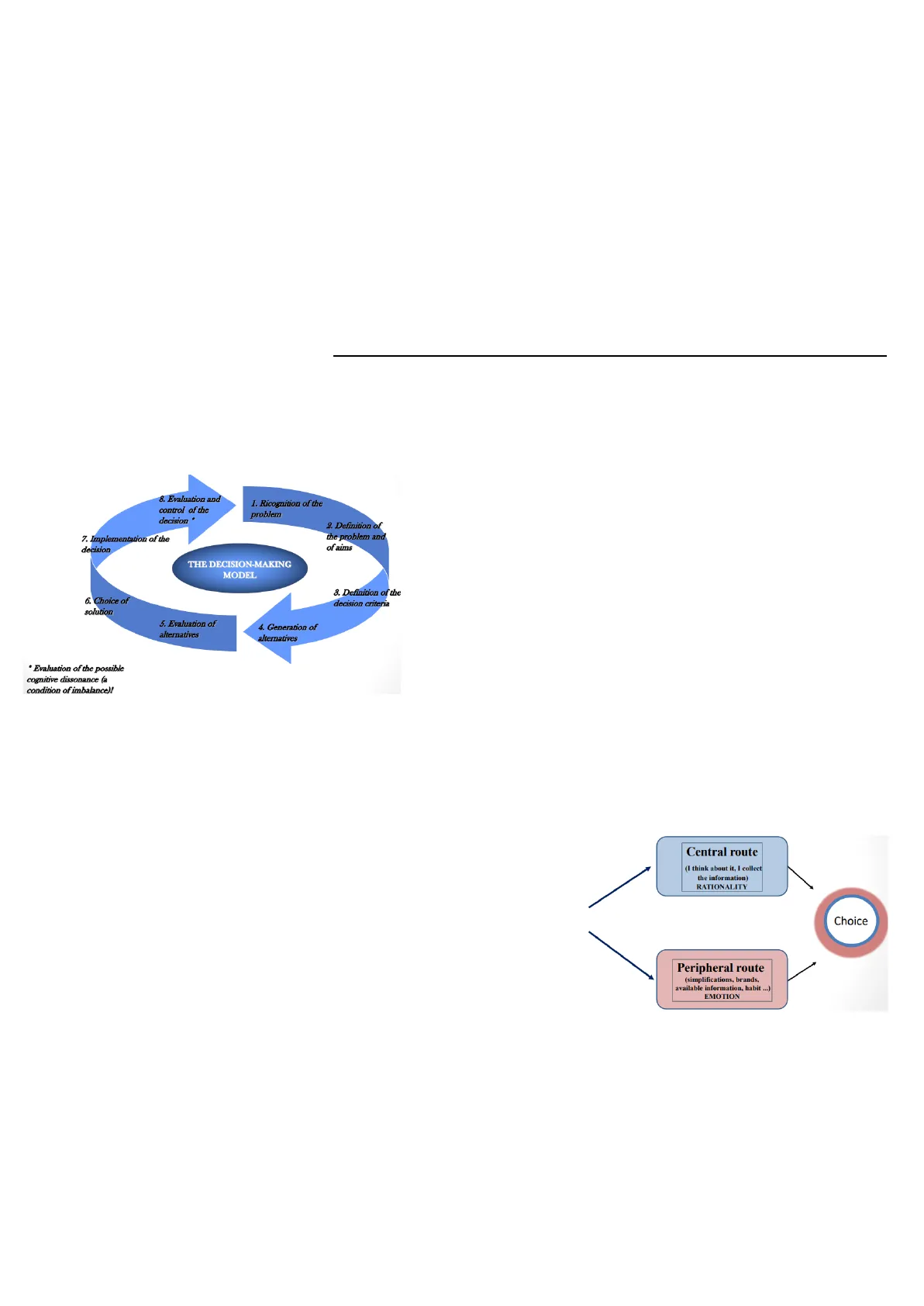
The Classical or Rational Decision-Making Model
8. Evaluation and control of the decision *
1. Ricognition of the problem
Cognitive dissonance = sense of frustration when we think about all the choices that we have available.
7. Implementation of the decision
There are different decisions criteria = reasons for which consumers decide to buy a product instead of another (eg. knowledge of the brand).
We are happy having a lot of choices because we have alternatives. but usually we don't have the time to evaluate all of them. We have difficulties in making a decision, creating a crisis in the rational model (the choice overload paradox).
* Evaluation of the possible cognitive dissonance (a condition of imbalance)!
There is a line btw emotion and rationality and consumer psychology tries to understand this continuum between them in the consumer behaviour.
According to H. Simon (1957) individuals have a bounded rationality: the individual does not seek the optimal solution but the satisfactory one in relation to the context and situation.
Neuromarketing tries to understand the emotions at the basis of the decision-making process.
Two-Way Decision Model
A model in contrast with the rational possibility to decide is the two-way decision model:
Central route (I think about it, I collect the information)
RATIONALITY
Choice
Peripheral route (simplifications, brands, available information, habit ... )
EMOTION
Neuromarketing: What and Why?
> Where does the consumer decision-making process take place?
Up to 50 years ago, consumers were considered as rational beings, scholars thought of them as someone able to reason, with a clear idea of their perception and well aware of everything that happened around them.
But the decision-making comes from different processes:
- Conscious processes driven by rationality, knowledge, reflection;
- Unconscious processes driven by emotions.
According to Herbert Simon rationality is not all. To make the perfect decision we should have all the information about something. This is not possible because consumers don't have all the information, the time or the cognitive ability to process them to make a decision.
Human beings have a bounded, limited rationality. Simon created a new field of psychology where scholars studied emotions as the key to understand why consumers sometimes don't act in the way that is expected.
2. Definition of the problem and of aims
THE DECISION-MAKING MODEL
6. Choice of solution
3. Definition of the decision criteria
5. Evaluation of alternatives
4. Generation of alternatives
When facing a decision we can follow> What is the problem with non-effective products?
We give answers through our conscious mind with the use of logical thinking, long-term memory and critical reasoning, based upon knowledge, reflection, rationality.
But when we buy, the unconscious mind intervenes in our decision-making process, with beliefs, habits, values, insights and emotions.
Herbert Simon was right: it is not just rationality. Since then, scholars study the role of emotions in consumer behaviours.
The conscious mind is investigated through traditional methods (eg. questionnaires, focus groups, interviews, behaviour observation), which lead to reflecting upon things.
The unconscious mind is not easy to intercept, therefore values are measured with other methods: the neural marketing or neuroscientific methods.
Through neuromarketing we can understand the reactions of consumers to different products, what happens in the brain and body, looking at what areas are activated - each area has a specific role. There are many instruments and tools used to understand the reactions of the body: eye-tracking, electroencephalography (EEG), heart rate (HR), galvanic skin response (sweat on the skin that happens when you're feeling emotions), functional magnetic resonance (fMR), virtual reality.
> What is neuromarketing? Neuromarketing is the application of neuroscientific methods to analyse and understand human behaviour in relation to markets and marketing exchanges.
The discipline uses neuroscience tools and insights to better measure, understand and influence consumer behaviour, engagement and choice.
- 2004, spin-off study by McClure et al .: "the infamous pepsi-coke experiment" showed the neural correlates of behavioural preferences for culturally familiar drinks - the motivation behind brand preferences.
Result: when people know about the brand, the knowledge activates different areas of the brain related to memory and emotions. The effect of the brand is understood and can help us understand how our preferences form, this means that specific patterns of brain activation predict purchasing.
- Another study: Unconscious response that predict behaviours - the neural predictors of purchase.
Through neuromarketing tools you can predict if a consumer is going to buy a product or not. In the first 4 seconds when you see a product. you already have decided if to buy it or not.
The goal of neuroscience and neuromarketing is to adapt methods and theories from neuroscience to develop a neuropsychologically sound theory to understand consumer behaviour. It is giving us information about the consumer, how they act and react, how emotion or attention or decision making work.
The Mysterious Brain: Getting to Know the Consumer Brain
The human brain is the organ that houses cells (neurons) connected one to the other and activated when we have conscious and unconscious mental processes.
- It has a unique structure with a complex three-dimensional architecture;
- Weighs 1.5 kg and is about the size of a cantaloupe;
- It is not completely developed until the age of 25;
- It is composed of neurons, which pass the information through electrochemical signals.
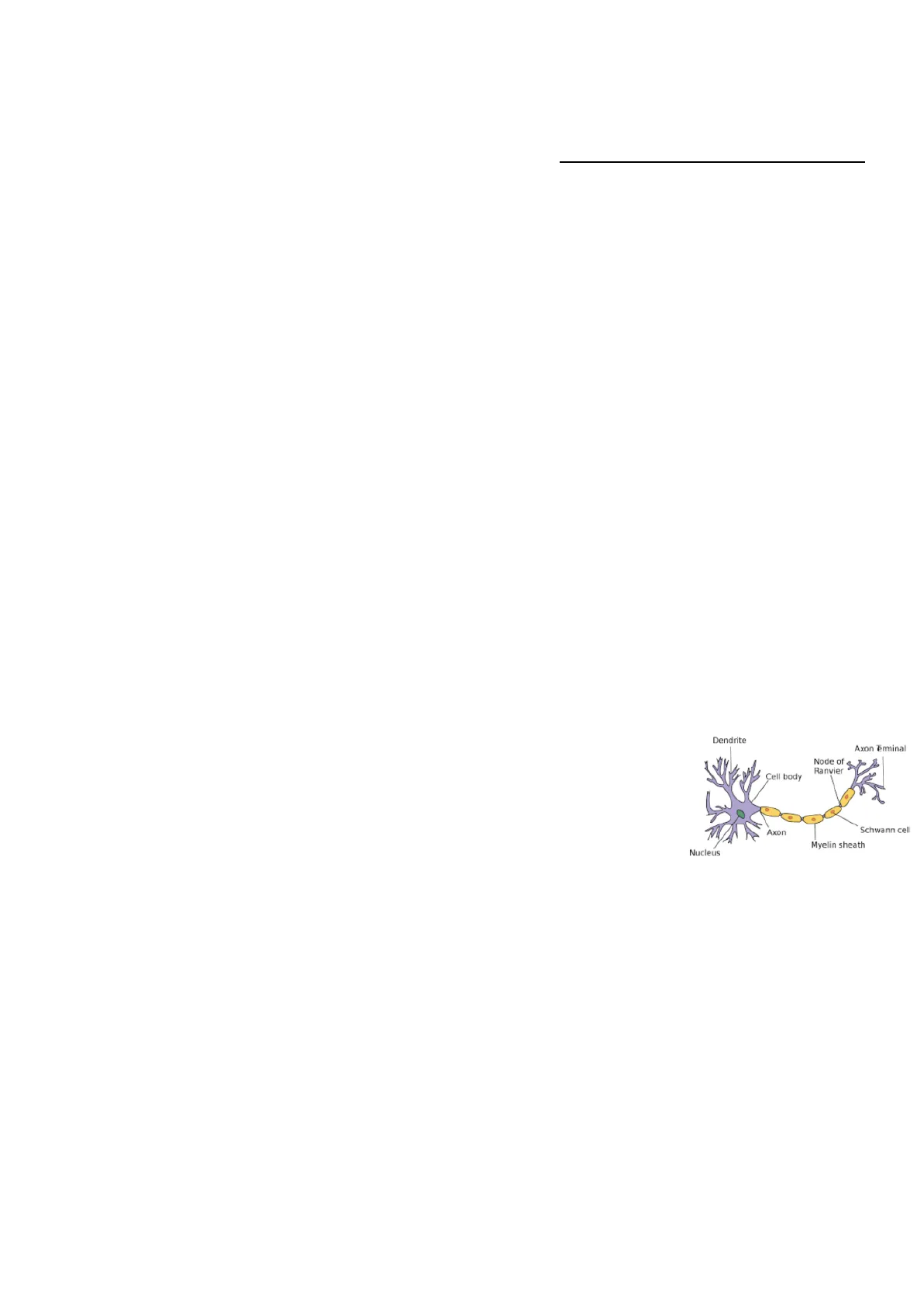
Nucleus Dendrite Axon erminal Node of Ranvier Cell body . . Axon Schwann cell Myelin sheath
In the brain there are approximately 100 billion neurons (electrically excitable cells), which have about 100 trillion connections btw them. Neurons generate thoughts, feelings and choices. They are formed by a nucleus with ramifications, which connect them to other cells through long, spidery arms (dendrites) and communicate with each other by sending and receiving electrochemical signals. A group of connected neurons is called a neural circuit.
The Brain Functioning
The brain has 3 important functions:
- Sensory-perceptive - it receives the stimuli from all the sensorial organs: information coming from the senses;
- Neuro-motor - it emits impulses to control the voluntary and involuntary movements;
- Integrative - related to the generation of mental activities (thoughts, knowledge, memory, language, emotions). All of these activities are elaborated and processed in the cortical and inner area of the brain.
Studying the Human Brain
Studies of the human brain began in the late 80s-begin 90s, one of the most important scholars is Franz Joseph Gall. He came to the (wrong) conclusion that the brain is a muscle.
He gave birth to phrenology, a pseudoscientific approach for which the brain is composed of different areas and each area has one function, one role, one activity. Therefore, the brain is not seen as a single organ but as a muscle composed of 40 regions with 40 functions - he thought that whenever an area was activated, it expanded. His discovery was very important, but Gall wasn't able to explain the different activities. In his age the only way to study the brain was autopsy.* An important step in the knowledge of the brain was given by the mysterious case of Phineas Gage. He was a railroad worker. In 1848, he was working at a new rail line to Cavendish and in charge of a group of men that should work with explosives. Phineas should pack the sand with a tamping iron but he tamped the explosive. The bar hit him and passed his left cheek, destroyed his left frontal lobe and went out. He was alive but his personality completely changed. This helped to understand that specific areas are connected to specific functions.
Pierre-Paul Broca and Karl Wernicke worked separately but came to important results in the area of language = specific areas in the temporal region are activated when you need to speak (Broca - expression) and when you need to recognize words, understand language (Wernicke - word recognition). They used autopsy, especially of brains of people with speech problems or traumas, to understand their functioning. They confirmed the relation btw function and area, they also hypothesized that the regions were interconnected among them.
Broca's area (Anterior speech cortex)
Wernicke's area (Posterior speech cortex)
Regions and Areas: Let's Go Into the Brain!
The brain is characterised by a structural doubling - a symmetry btw its left and right part.
There's no one to one relation btw functions and areas, no neat one-to-one mapping. Their relation can be one to many (one area can serve different functions) or many to one (one function can be processed in different areas).
The Brain Regions
The brain is divided into two main regions:
- The cortical region, seen as the nobel part of the brain and divided into two hemispheres that are nearly symmetrical, each one divided into four major lobes. This region directs the brain's higher cognitive and emotional function;
- The subcortical region, the inner part, composed of the thalamus, hypothalamus, cerebellum and brainstem.
To refer to the different sides of the brain, we should use the proper name:
Top = Dorsal part Bottom = Ventral part Front = Anterior part Back = Posterior part
The two hemispheres are very similar one to the other - it's not true that we have a logic part and a creative part - there's no difference btw them, apart from the Broca area (language) that is in the temporal left part of the brain. Each hemisphere has 4 lobes, the medial area is in between:
1) The Occipital Lobe is responsible for processing visual information and for the recognition of written text - when we see things they pass through the optical nerve and arrive at the occipital lobe. It's related to:
- Colour recognition;
- Distance, depth and size assessment;
- Visual world mapping;
- Bottom-up attention;
- Movement;
- Visual stimuli identification (faces, objects).
> Consumer behaviour - this lobe is responsible for:
- Bottom-up attention: activated when something happens from the external (eg. a light comes out, attention is driven towards that);
- Recognition of products and brands.
2) The Parietal Lobe is the area that houses the somato-sensory cortex (somatic = relating to the body, sensory = of the senses). It has an important role in touch and spatial navigation and a strong relation with the body. It's responsible for:
- Perceiving and interpreting spatial orientation;
- Awareness;
- The allocation of visual attention (top-down);
- Language comprehension.
> Consumer behaviour - this lobe assists:
- Top-down attention (directs attention towards something): processed here together with orientation;
- Product navigation (eg. in a store);
- Product handling.
3) The Temporal Lobe is one of the brain's convergence zones where all the sensory information that we get from different senses are combined and processed jointly. It is a major processing center and has 3 main roles:
- Convergence area of sensorial information: auditory perception, visual recognition (faces, brands, products) and information processed before the auditory/visual/tactile/olfactory senses gets aggregated into a meaningful concept;
- Memory: ability to remember events, factual knowledge);
- Language comprehension (Wernicke area) and speech (Broca).
Can’t find what you’re looking for?
Explore more topics in the Algor library or create your own materials with AI.
