Lecture 7: Acid Base Imbalances Part 1
Slides about Lecture 7: Acid Base Imbalances Part 1. The Pdf, a presentation for University Biology students, explores the regulation of blood pH, factors influencing it, and the classification of imbalances. It also presents clinical scenarios for analysis.
See more8 Pages

Unlock the full PDF for free
Sign up to get full access to the document and start transforming it with AI.
Preview
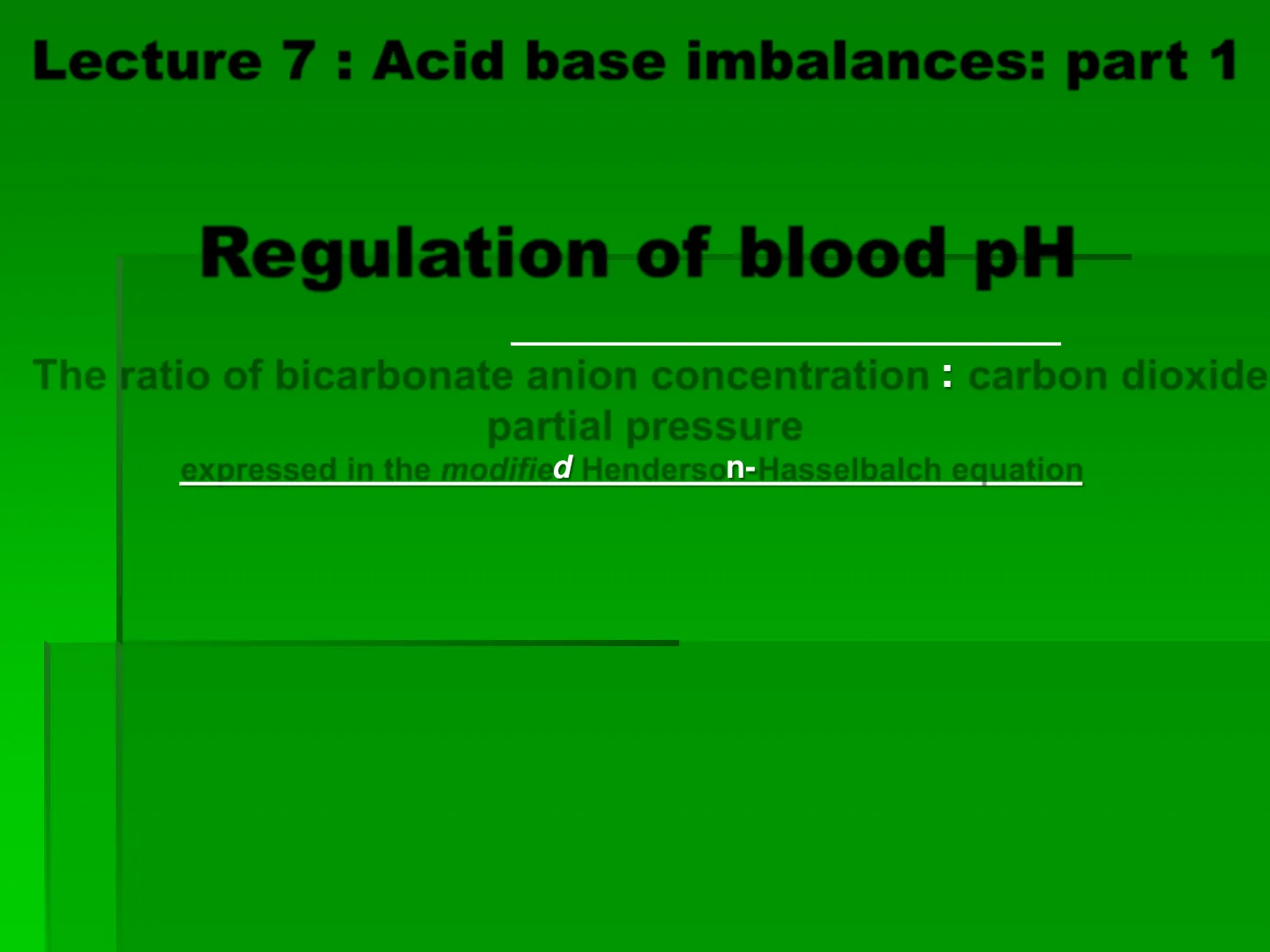
Regulation of Blood pH
We begin this topic by looking at how blood pH is normally regulated and defended
against changes in various acid base imbalance scenarios.
Here we see that blood pH, which is normally maintained at around 7.4, depends on
The ratio of bicarbonate anion concentration : carbon dioxide
partial pressure;
and this is expressed in the modified Henderson-Hasselbalch equation.
Note that pH is proportional to this ratio, not equal to.
Normal values for bicarbonate concentration (regulated by the kidneys) and carbon
dioxide partial pressure (regulated by the lungs) are 25 mM and 40 mm Hg, respectively.
. Blood pH
"is normally maintained at around 7.4
is related to the ratio of bicarbonate anion concentration to
carbon dioxide partial pressure (p) by the modified Henderson
Hasselbalch equation
pH &c [HCO3 ] / pCO2
NB: Normal levels for [HCO3 ] and pCO2 are 25 mM and 40 mm Hg, respectively
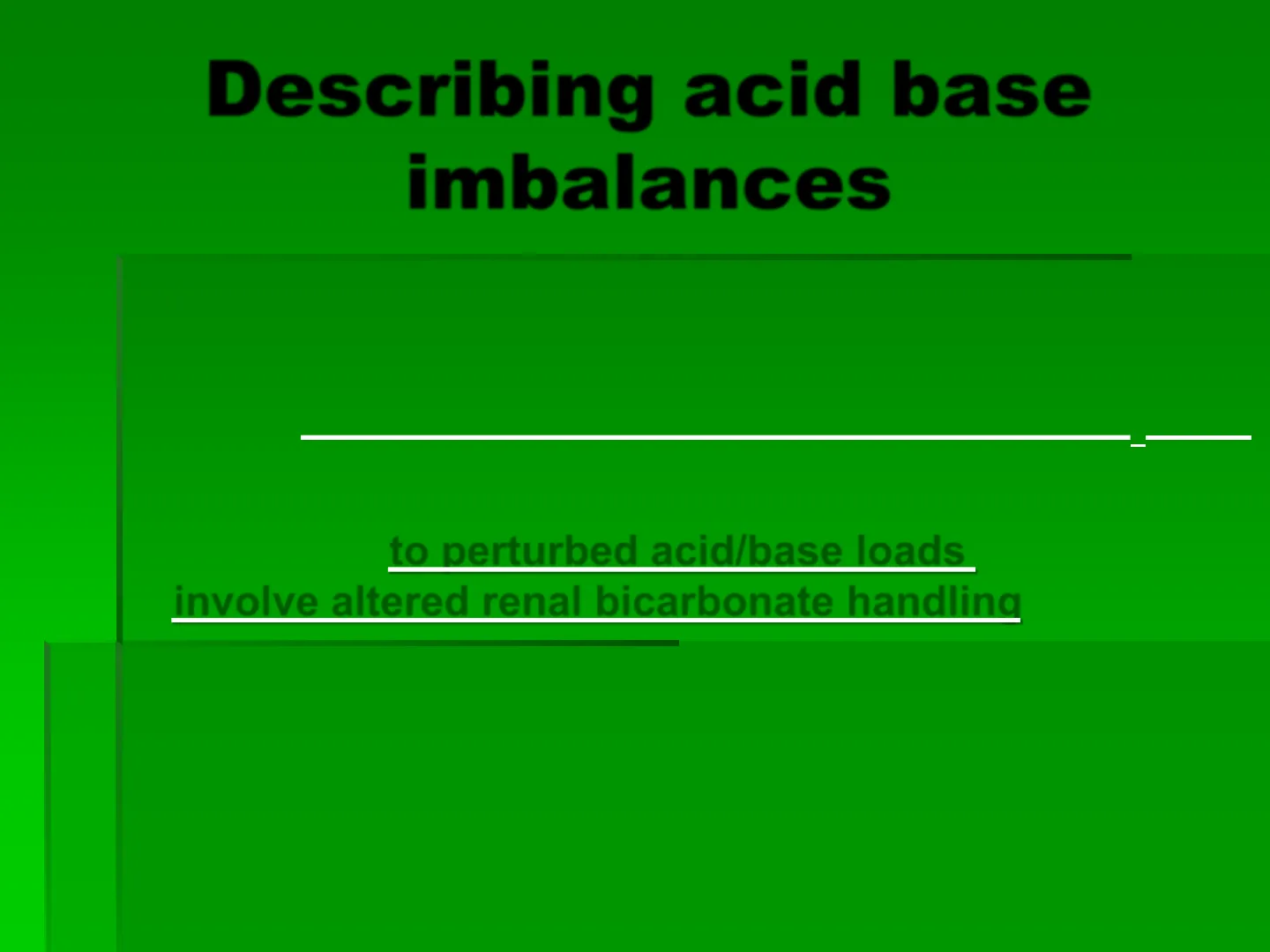
Describing Acid Base Imbalances
- Origin, i.e. cause of imbalance
I.
Respiratory
" due to changes in respiration rate and blood CO2 level
metabolic
mostly due to perturbed acid/base loads but could
involve altered renal bicarbonate handling
I. - Nature, i.e. how pH is affected
▪
acidosis or alkalosis
II. Anion gap (re metabolic acidosis)
▪
HAGMA or NAGMA" There is a basic protocol to follow when describing acid base
imbalances, involving origin and nature. The origin refers to the cause of
the imbalance in terms of either: a change in carbon dioxide level (i.e.
respiratory origin, typically involving either hypo- or hyperventilation);
▪
Or change in bicarbonate level for any reason (i.e. metabolic origin,
typically involving changes in blood acid load and corresponding
loss/gain in bicarbonate or alternatively e.g. the ingestion of
bicarbonate). - The nature is simply how pH is affected, either down (acidosis
direction) or up (alkalosis direction).
In addition, metabolic acidosis can be further characterised and
diagnosed by reporting the anion gap, resulting in either a high anion gap
metabolic acidosis (HAGMA) or normal (or non-) anion gap metabolic
acidosis (NAGMA).
▪
The Anion Gap is numerically defined as the difference
between the (typically serum) concentration of prevalent
cations and anions, which can be represented as [Na+]-([CI-
]+[HCO3 ]); and actually, reflects the difference between
unmeasured anions and unmeasured cations ..
Compensation and Correction of Acid Base Imbalances
Compensation
reachieves the required [HCO3 ]:pCO2 ratio for a blood pH of 7.4
Either through
i.
Altered LUNG function (respiration rate + CO2 venting) in
RESPIRATORY COMPENSATION
ii. OR altered RENAL function (bicarbonate reabsorption + generation)
in RENAL COMPENSATION
Correction
▪
restores normal values of [HCO3 ] and pCO2, as well as
returning the required ratio for a blood pH of 7.4
" by addressing origin of aid base imbalance" In the interests of blood pH homeostasis, physiological efforts will
be made to restore pH to the normal level in the face of an acid
base imbalance scenario.
. This can initially be achieved by a process known as
compensation, by generating the appropriate
bicarbonate : carbon dioxide ratio
V Through the alteration of the levels of either factor, as required. So,
if 1 factor rises, the other factor will need to rise with it (i.e.
compensate) in order to maintain the desired ratio corresponding to
pH 7.4.
Compensation may involve either altered lung function (i.e.,
respiration rate in respiratory compensation) or altered renal
function (i.e. altered renal handling of bicarbonate in renal
compensation), depending on the origin of the acid base imbalance.
The final part of the process is correction, where normal pH value is
accompanied by normal values of bicarbonate and carbon dioxide
(not just the right ratio of these factors). Correction requires that the
origin of the imbalance is addressed.
▪
Table: Origin to Compensation and Correction
Origin of
acid base
imbalance
respiratory
metabolic
Term
affected
pCO2
HCO31
Compen-
sation
renal
respiratory
correction
respiratory
renal" This is a handy table outlining the nature of compensation and
correction according to acid based imbalance origin.
" So e.g., if the origin is a change in carbon dioxide level
(typically in response to respiratory-related changes), this
requires renal compensation (bicarbonate levels will need to
chase the carbon dioxide levels, either up or down, to maintain
a normal ratio and hence pH); and correction will need to
address the origin, in this case a respiratory correction to
normalise carbon dioxide levels (which along with a restoration
to normal bicarbonate levels, will provide normal pH at normal
levels of bicarbonate and carbon dioxide).
. Notice that if the origin is metabolic (which may not involve
renal function-related changes), the correction that follows the
respiratory compensation, is renal. This is in view of the fact
that the kidneys are responsible for regulating blood
bicarbonate levels, either though changes in tubular
reabsorption or generation
Acid Base Imbalance Scenarios
Here we consider some acid base imbalance scenarios. How would you describe the
likely imbalance in each scenario in terms of origin and nature? And what pattern of
compensation and correction would ensue in each scenario? We'll get the answers in
part 2.
- What acid base imbalance is involved with
the following scenarios and what will happen
regarding compensation and correction?
Loss of stomach acid through vomiting
▪
▪
Hyperventilation, e.g. due to high altitude
Overdose with an acidic drug, e.g. aspirin
" Loss of GI bicarbonate in diarrhoea - Difficulty breathing, e.g. in chronic bronchitis
Can’t find what you’re looking for?
Explore more topics in the Algor library or create your own materials with AI.