Principles of Plastic Surgery from Vita-salute Affable University
Document from Vita-salute Affable about Principles of Plastic Surgery. The Pdf details the different branches of plastic surgery, including reconstructive and aesthetic, along with skin aging and surgical suture techniques for hypertrophic and keloid scars.
See more9 Pages


Unlock the full PDF for free
Sign up to get full access to the document and start transforming it with AI.
Preview
Integumentary System Overview
20/03/2024
Integumentary System
AG1
Selin Satar
Principles of Plastic Surgery
Plastics is a surgical branch. The main idea is to transpose the skin (or other) from one place
to another place. It is also one of the first column of surgery, since people have injuries and
they want and need their wounds to be covered. For example, they reconstruct the nose
after a nose injury.
From the slides: The modern definition of plastic surgery is rooted in ancient medicine as
documented by Indian writings of '600 BC that describe a technique of reconstruction of the
nasal pyramid based on the transposition of a frontal skin flap including its arterial-venous
nutritive peduncle.
Plastic Surgery Branches
- Reconstructive:
- Congenital defect: labiopalatoschisis and malformations.
- Acquired: surgical removal of neoplasm (breast tumor) or traumas.
- Burns.
- Aesthetic: enhancement of normal forms, experienced with discomfort by the
patient.
Cutaneous Physiopathology and Langer's Lines
It is kind of an aging pathology. You have the Langer's lines, also
called relaxed skin tension lines (RSTL), and these lines derived by
mimic muscles movement dictate the direction of the incision at the
cutaneous level. This is done to aid wound healing, producing less
scarring and avoiding scar retraction and hypertrophy.
Plastic surgeon is someone who puts the incision where they find
less resistance, less power. When you put the incision where there
is high resistance you have a deeper scar and worse healing.
Plastic surgeons generally take care of these lines, that are
Langer's lines. When you have some incisions and you have to
remove the skin or something, you have to mind the form and you have to study the incision
to improve the process of making an incision. You have to follow the Langer's lines to have
less fraction.
Skin Thickness and Elasticity
There is a difference in thickness in the skin and elasticity. Wound healing strongly depends
upon this difference based on the different body region composition. Thin skin is generally
easy to give a good result because they do not leave any scar and you can see no sign of
the injury. Upper or lower eyelid is so thin that wounds do not leave scars.
Skin Aging Process
Of course, aging is also important. People who are younger can heal better. Babies and
1Selin Satar
Integumentary System
AG1
20/03/2024
young people generally have better healing
compared to other people, because their skin is less
reactive. Over the years the skin undergoes a
progressive process called elastosis, so you lose
elasticity and the ability to produce collagen. As a
result, you become older.
Other factors that affect the skin are time, smoking
and sun exposure. You must protect your skin from
the sun.
Elastosis and UV Radiation
SKIN AGING
VITA-SALIT'S
AFFABLE
Over the years, the skin undergoes a progressive process
of clastosis mainly due to the action of atmospheric
agents and especially uv radiation. In the elderly, the
skin tends to be drier and more analeptic the greater the
sun exposure over the years. Also as a result of this,
surgical scarring in the elderly has a better quality
and is less visible while in a young age there's a greater
tendency to hypertrophy of scars.
Healing Process and Scarring
Healing is the deposition of the new collagen fibers and fibroblasts. In the healing process,
you can have a normal scar if you have no tension and you have chosen the right suture for
the skin. The healing process stops when you remove the suture not when you put the
suture. You have to follow the healing of everything. The healing process is not an "on-off"
process, but it is related to time.
Hypertrophic and Keloid Scars
When you do some sutures, you
must choose when you put the
suture, which suture type you will
use, when to remove it and how
to care after, in order to have a
good scar and avoid keloidal and
hypertrophic scar.
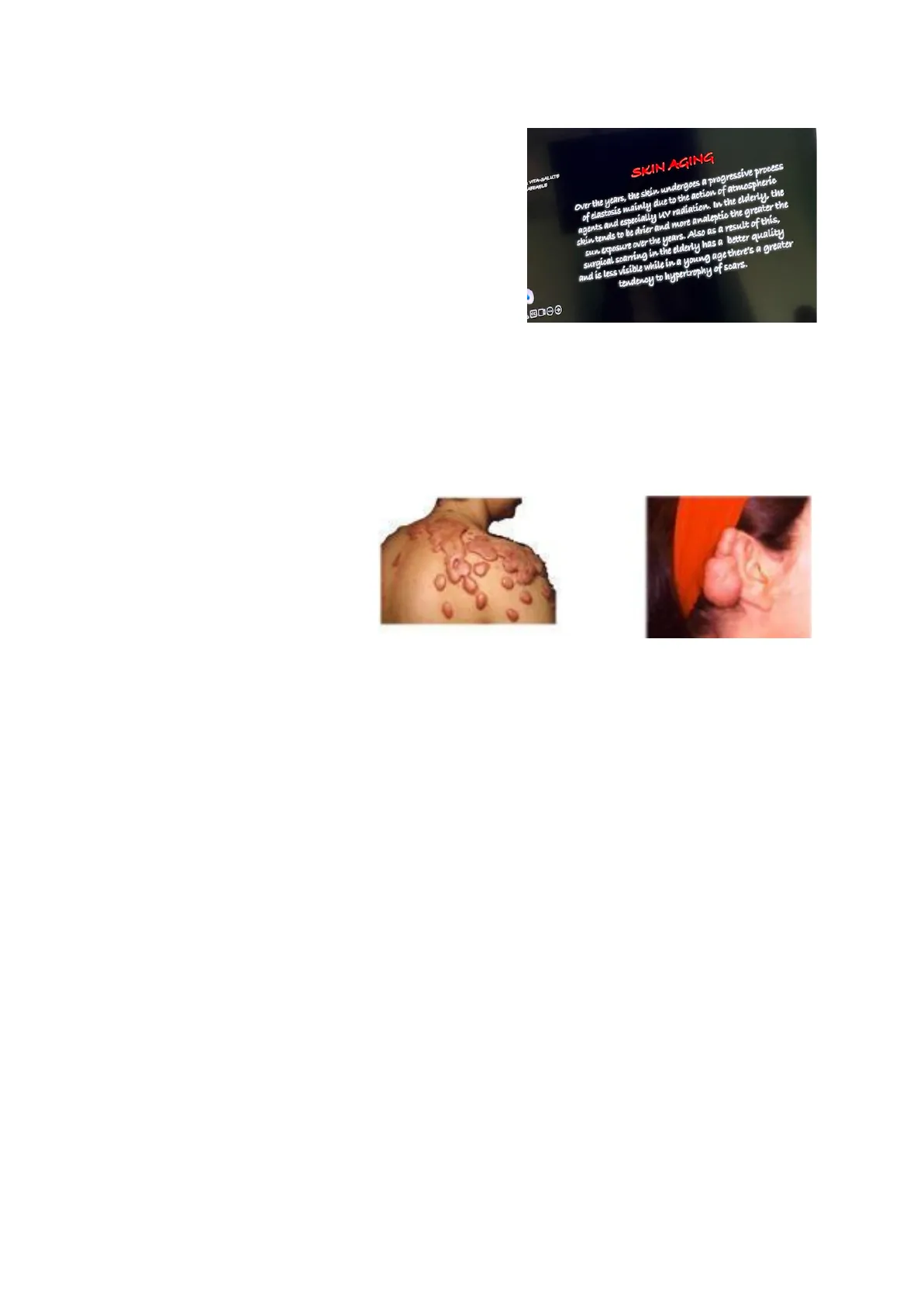
You can have a hypertrophic scar when you have some tension, so you must resolve and
avoid the tension. You can do some flap or movement to avoid the tension, which will be
discussed in future lessons. In the picture on the left we can appreciate a hypertrophic scar.
A hypertrophic scar is a thick raised scar, which follows the original line of incision.
The keloidal scar differently from the hypertrophic scar extends behind the margin of the
suture or surgical incision. It looks like a real tumor that grows like a cauliflower, as in the
image on the right.
The incidence of pathological scars is much higher in black people, in children and in some
body areas (sternum, deltoid), but further external factors contribute, such as wound
infection, tension and margins. In summary, the hypertrophic scar is a growth of the healing
following the line of the injury. It's very difficult to manage, generally you use cortisone
injection or pressure.
Keloid and Hypertrophic Scars: Treatment Options
Surgical incision is easy, but what is the problem? You remove the keloidal scar and after
that, depending on the capacity of the patient, the healing process differs. So, you must find
a solution depending on the patient. Of course, you try to reduce the risk of having a keloidal
or hypertrophic scar, so you can perform many strategies to prevent it. So, there's
compression and silicon strips, that are like a tape that you can put it on to prevent it.
Steroid injections, radiotherapy, and laser therapy can be used too.
Student's question: Isn't there a line of mechanism that stops the biological growth of the
scar? Is it known?
2Selin Satar
Integumentary System
AG1
20/03/2024
Professor's Answer: No, it depends, there are many chemical approaches, but you can use
the laser just to remove it. You can put some sterile injection, but there is an atrophy of the
tissue. It is always a matter of balance, to avoid a keloidal scar as a result. For this reason,
there are many chemicals. The idea I saw is that now, there are some people, some
colleagues of mine that are just doing the laser therapy. They heal and prevent the formation
of the Keloids without any surgical moves. They just make deep prevention: pressure, laser,
and sterile injection.
Dressing and Healing Intentions
Dressing:
First and Second Intention in Healing
The significance of dressing is first and foremost to
protect against external agents and to maintain
optimal, chemical, and physical conditions (hydration,
pH, humidity, etc.).
The most typical aspect of the second intention is
the formation of granulation tissue. When we have a
scar, an injury, and a surgical movement, we can
decide if we are able to close in the first intention, so
we just go to flat, and all just lessen the tissue itself. We pass through this granulation tissue,
followed by the re-epithelialization phase.
Factors Affecting Healing
These two very important phases are influenced and made by several factors: general, local,
and external. General factors depend on the physiology of the patient, for example on
metabolism, as diabetes. Local factors depend on having some kind of infection, or some
pressure, as for decubitus lesions (localized skin and soft tissue injuries that form as a result
of prolonged pressure, typical of coma patients). External factors can be related to the sun
damage. In the picture above we can appreciate the second intention healing, which means
the granulation of the tissue. Because this is the aspect of the tissue. If you leave the healing
by itself this is what will happen. The tissue starts to coat and cover the lesion. It just grows
from the deep of the lesion with this kind of tissue. It's like a scar with a vessel inside so it's
not a good idea to do stitches alone.
From the slides: Factors Affecting Healing:
- Nutritional status and protein balance
- Blood glucose disorders
- Clotting disorders
- Infections
Local Factors in Healing
Factors Affecting Healing: Local
Local factors are important as for humidity, temperature and oxygenation. For example, we
have to know if there are some problems of healing in the acro-localization, as in the lower
leg or the tip of the nose, or the tip of the tongue. This is something that has to do with
terminal vascularization. So, it is important to bring oxygen to the tissues for healing. If you
don't have enough blood supplies, you can find a way to have high oxygen pressure around.
So how can you do that? Hypertrophic growth. That is a way to have the tissue growing
when you have a low oxygen level. When you are not able to manage the healing, we have
granulation and the second intention. When you can manage the margin of the wound of
course you try to close it and approximate the wound without tension. Don't compress the
3Selin Satar
Integumentary System
AG1
20/03/2024
tissue. Tissue needs to be able to stretch. If you strangle the tissue, you will have a bad
healing process. You have to remember not to put tension on the suture too. You have to
remove the suture when the healing is complete, but you have to remove it before the
healing is growing towards the running of the suture.
When our professor started medical school, it was common to do a suture and to leave and
remove it after twenty-one days. For this reason, the scar was just like hypertrophic because
you have all the entry and the exit points of the suture. Why? Because doing that twenty-one
days, or three weeks, you have the right utilization of all the running of the stitch. You have
to remember that your stitch is a kind of injury, and if you let the tissue try to grow in the skin,
try to grow all the time that they follow your stitch. For this reason, you have to remove it
before. Also, the tension you put, the way you do the stitch and the time you remove the
stitch are important for healing.
Basic Surgical Techniques: Sutures
From the slides: The wound's margins are
approximated using sutures, patches, staples, or
adhesive glues. These are used to cancel the
tension forces until healing is complete.
12 crc
- CUTTING NEEDLE
- ATRAUMATIC NEEDLE
A
B
Sutures are absorbable, non-absorbable,
monofilament, and braided. These are the four
big differences in the suture. Every suture, of course, has a different material. Every suture,
of course, has a different needle. Nowadays you have the needle directly engaged to the
stitch. Also the needles are different depending on where you put the stitch (mucosa, skin ... ).
They can be in different shapes like curved, straight, ski shaped.
Suture Techniques
Simple Interrupted Suture
Simple interrupted suture
When you get some sutures, you need to do it in a nice way. It is
important to note that we should come out with the needle and
the suture always at the same distance. So suturing is a method
to achieve and maintain that consistent distance. It can be helpful because it reduces the
strain of the tissue, and ensures well distributed tension, facilitating healing and work of the
incision.
The entry point may be three
TÀ VITA-GALITE
millimeters. I will aim for the right
spot, catch the needle, and
re-engage it with the needle holder
while maintaining the wedge. Then,
I will advance another three
millimeters through my node, and
proceed to the other side, perhaps
three millimeters or even five. I will ensure to maintain this five-millimeter distance for the
subsequent stitches. If you strangle, there is the sufferance of the tissue. It's important to
keep this procedure ordinary.
SUTURE TECHNIQUES
SIMPLE INTERRUPTED SUTURE
SUTURE TECHNIQUES
SIMPLE INTERRUPTED SUTURE
4
Can’t find what you’re looking for?
Explore more topics in the Algor library or create your own materials with AI.
