Il Movimento per i Diritti Civili negli USA e il discorso di Martin Luther King
Slide da Apple Teacher sul Movimento per i Diritti Civili negli USA. Il Pdf, utile per la scuola superiore di Storia, esplora il tema della libertà e dell'uguaglianza, analizzando le conseguenze dell'emancipazione, la segregazione razziale e il ruolo del Ku Klux Klan.
See more9 Pages
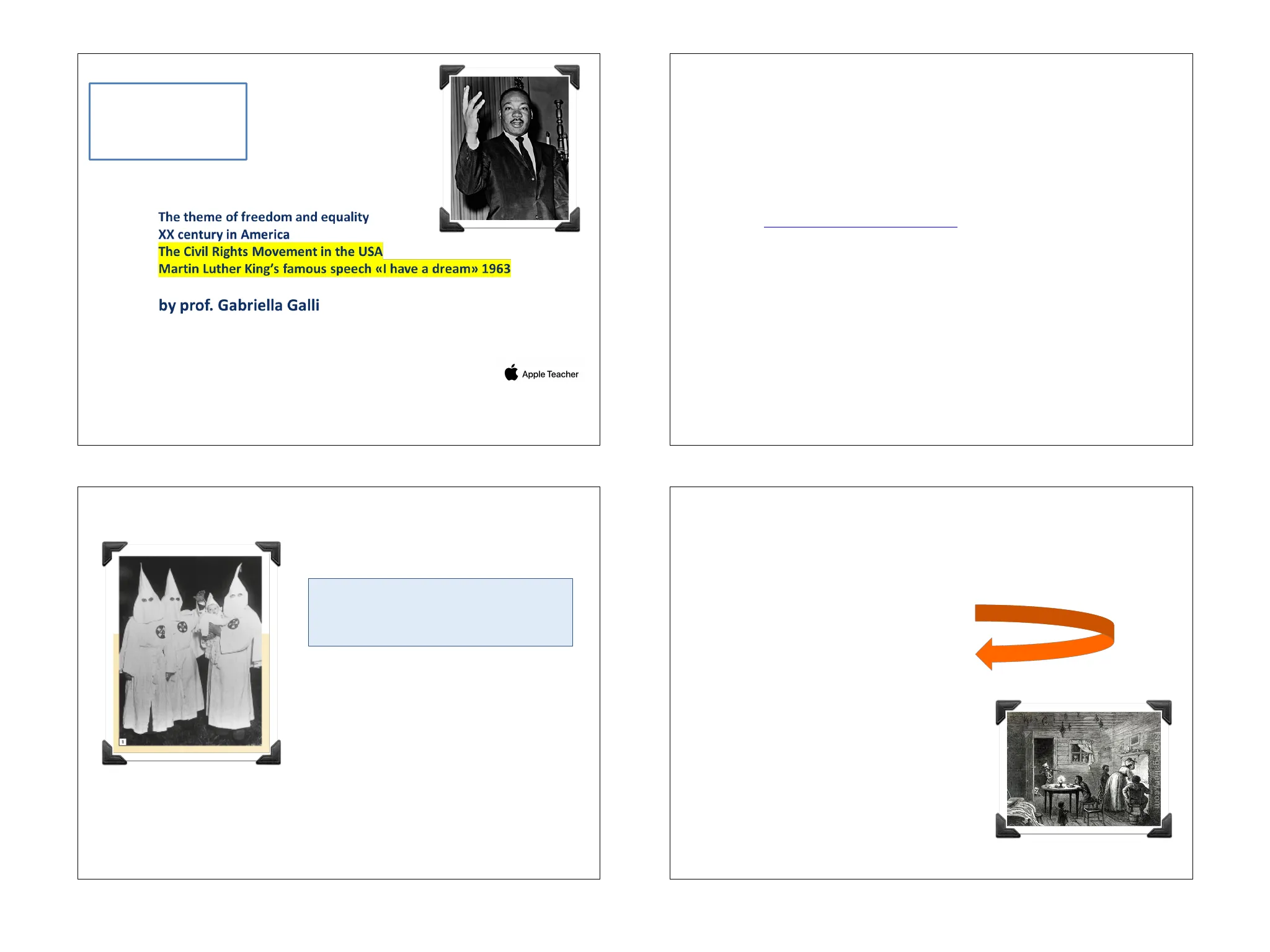
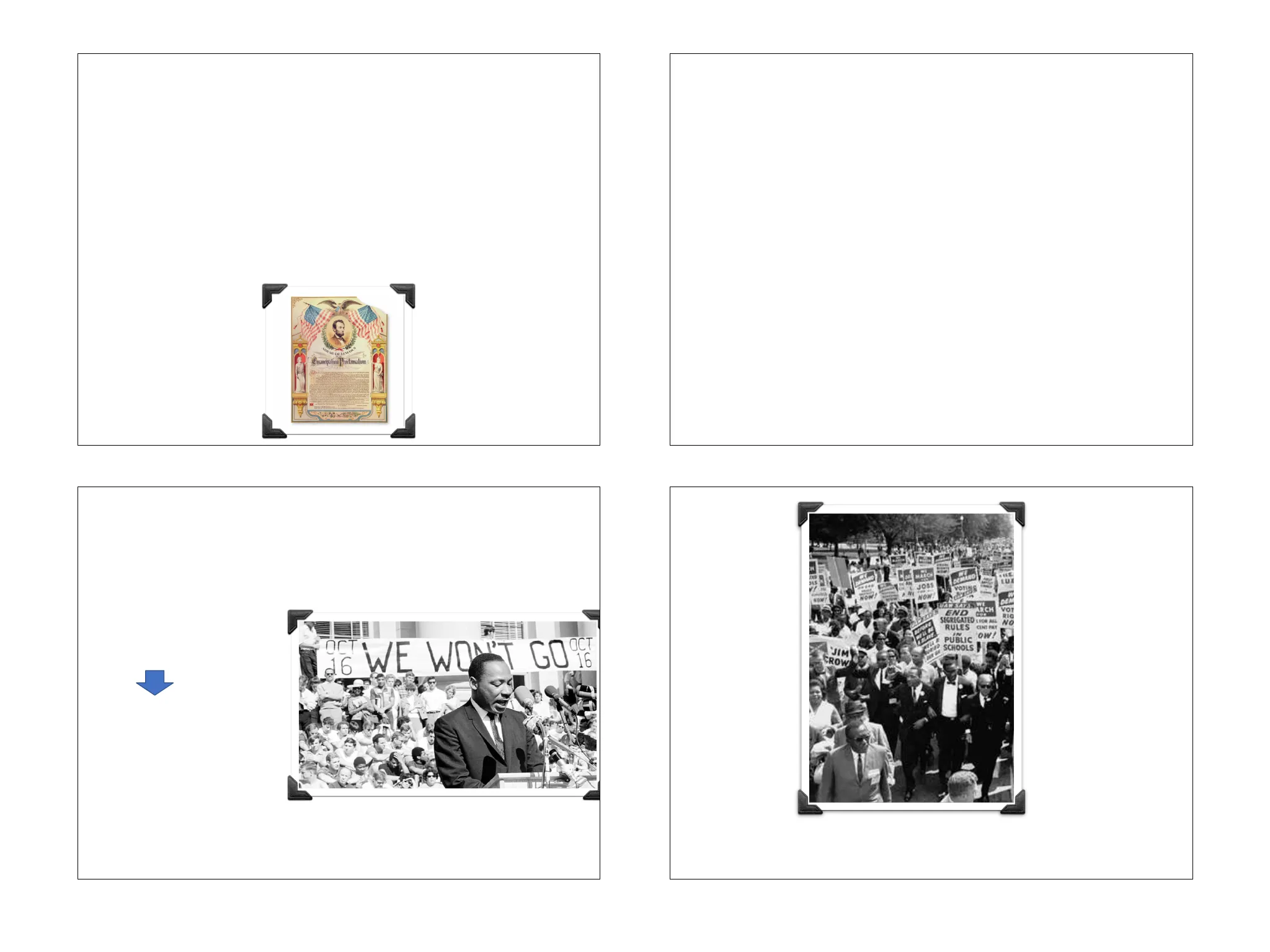

Unlock the full PDF for free
Sign up to get full access to the document and start transforming it with AI.
Preview
Il tema della libertà e dell'uguaglianza
11.5 Pag. 302-303-304 The theme of freedom and equality XX century in America The Civil Rights Movement in the USA Martin Luther King's famous speech «I have a dream» 1963 by prof. Gabriella Galli Apple Teacher
Le conseguenze della proclamazione di emancipazione
1 1 /'ku: 'klaks 'klæn/ The Ku Klux Klan in the 1920s 3 https://www.youtube.com/watch?v=WKEGou1zPII 2 The consequences of the emancipation proclamation
- The racist movement the 'Ku Klux Klan' frightened the blacks and their families.
- The so-called 'black codes' were created the blacks were segregated in schools, hospitals and transport. Ku Klux Klan attack on an African American family, 1879 Ista .gallery.com
Il movimento per i diritti civili negli USA
La proclamazione di emancipazione
4The Civil Rights Movement in the USA The Emancipation Proclamation President Abraham Lincoln issued the Emancipation Proclamation on January 1, 1863, as the nation approached its third year of bloody civil war. The proclamation declared "that all persons held as slaves" within the rebellious states "are, and henceforward shall be free. Emancipation Prodamalion 5
Segregazione e oppressione
The Civil Rights Movement in the USA One hundred years (in 1963) had passed since the Emancipation Proclamation (January 1, 1863), but African Americans living in Southern states still suffered from segregation and oppression based on racism. Laws, enacted from 1876 and 1965, barred them from classrooms and bathrooms, from theatres and train cars, from juries and legislatures /'led 3/slatfar/. 6
Attivisti per i diritti civili
Civil Rights activists Starting from the 1950s, Civil Rights activists used non-violent protest and WE WON'T GO 16 OCT used civil disobedience to bring about change LUI NOW! NOW DEM ARCH VỚI SEGREGATED &VOR ALL NO RULES CINTFAY PUBLIC OW! SCHOOLS JIM CROW Martin Luther King, Jr. (centre), with other civil rights supporters 7 8 END RIC
Le leggi del governo federale
- In 1965 passed the Voting Rights Act
- It outlawed discriminatory practices in voting and voter registration
- In 1964 passed the Civil Rights Act
- It ended segregation laws in America.
- It outlaws discrimination based on race, color, religion, sex, or national origin.
- It prohibits unequal application of voter registration requirements, and racial segregation in schools, employment, and public accommodations. 9
Leader della comunità afroamericana
1957 Sixty black pastors and civil rights leaders - including Martin Luther King - met in Atlanta, Georgia, to coordinate non- violent protests against racial discrimination. KNOW VIOLENCE AGAINST WOMEN 1957 11 Leaders within the African-American community during the Civil Rights era
- Many leaders risked and sometimes lost their lives in the name of freedom and equality On December 1, 1955, in Montgomery, Alabama, Parks rejected bus driver 's order to relinquish her seat in the "colored section" to a white passenger, after the whites-only section was filled. Martin Luther King Jr. Rosa Parks (1913-2005) REMEMBER! CELEBRATE! NOT A DAY OFF ACT! In response the bus boycott began led by Reverend Martin Luther King Jr. which lasted more than a year. 10
Ruby Bridges e l'integrazione scolastica
1960 Six-year-old Ruby Bridges was the first student to integrate William Frantz Elementary School in New Orleans, but she had to go to school escorted by four armed federal marshals. 12
La marcia su Washington
1963 AS MET WE I.U.E. CHUI WE · K SI WALKING DEMAND FOR RCH JOBS FOR ALL FULL OBS NOW! JOP LOYMENT OW! About 200,000 people joined the March on Washington for Jobs and Freedom. The participants assembled at the Lincoln Memorial to listen to Martin Luther King deliver his famous 'I Have a Dream' speech 13
Il Civil Rights Act del 1964
1964 President Lyndon B. Johnson signed the Civil Rights Act, which outlawed major forms of discrimination and ended many areas of segregation. 14
Il concetto di "Black Power"
1967 BLACK POWER SDS BLACK AN Stokely Carmichael, a leader of the Student Nonviolent Coordinating Committee (SNCC), used the phrase 'black power' for the first time. He meant it as an assertion of black pride and 'the coming together of black people to fight for their liberation by any means necessary'. The term's radicalism alarmed many who believed the civil rights movement's effectiveness and moral authority crucially depended on non-violent civil disobedience. 15
Malcolm X
16 1965 Leaders within the African-American community during the Civil Rights era He was an American Muslim minister and human rights activist who was a popular figure during the civil rights movement. He was shot dead in Harlem, New York He was the founder of Afro-American Unity (organization) Malcolm X AFL -CIO NE MARCH FOR N FEPC LAW UAW ALL
L'assassinio di Martin Luther King e il Civil Rights Act del 1968
1968 - Martin Luther King was shot as he stood on the balcony outside his hotel room in Memphis, Tennessee. President Johnson signed the Civil Rights Act of 1968, which prohibited discrimination in the sale, rental and financing of housing. 17
Conseguenze dell'era dei diritti civili
Consequences of the Civil Rights era After the 1960s there was a decline /dr'klain/ in protest activity Overt /au'v3:rt/, forms of racial discrimination and segregation supported by the government came to an end although segregation persisted in public school systems and in other areas of American society. Anti-black violence declined in the South. Black candidates were elected to political offices in communities where blacks had once been barred from voting. Southern colleges and universities began to recruit /ri'kru:t/ blacks. 18
Martin Luther King Jr. (1929-1968)
Biografia e tattiche
Martin Luther King Jr. (1929-1968) NATIONALITY: AMERICAN - Atlanta (South of the USA were racism was very strong). PROFESSION: Baptist /'baptist/minister (pastore) and activist who became the most visible spokesperson and leader in the civil rights movement (movimento per I diritti civili). Martin Luther King Jr. (1929.1968) HIS TACTICS: non-violence In 1968: he was assassinated. I HAVE A DREAM: the most famous speech given by Martin Luther King. It was delivered during the March on Washington for Jobs and Freedom on August 28, 1963. Place: Lincoln Memorial in Washington, D.C .. 19 20
Il discorso "I have a Dream" e il Premio Nobel
Martin Luther King Jr. (1929.1968) In the speech he calls for an end to racism in the United States and called for civil and economic rights. 1964 NOBEL PRIZE: King received the Nobel Peace Prize for combating racial inequality through nonviolent resistance. 21 The speech "I have a Dream" was delivered to over 250,000 civil rights supporters from the steps of the Lincoln Memorial in Washington, D.C. MARCH 22
«I have a dream»
Urgenza del momento
«I have a dream» Pag.304 https://www.youtube.com/watch?v=vP4iY1TtS3s 23 24«I have a dream» It would be fatal for the nation to overlook (non vedere) the urgency of the moment. This sweltering (afoso) summer of the Negro's legitimate discontent will not pass until there is an invigorating autumn of freedom and equality. Nineteen sixty-three is not an end, but a beginning. Those who hope that the Negro needed to blow off steam and will now be content will have a rude awakening if the nation returns to business as usual. There will be neither rest nor tranquillity in America until the Negro is granted his citizenship rights. The whirlwinds (vortici) of revolt will continue to shake the foundations of our nation until the bright day of justice emerges. 25
Unità e non violenza
«I have a dream» The marvellous new militancy (attivismo) which has engulfed the Negro community must not lead us to a distrust (diffidenza) of all white people, for many of our white brothers, as evidenced by their presence here today, have come to realize that their destiny is tied up (legato) with our destiny. And they have come to realize that their freedom is inextricably bound (legato) to our freedom. We cannot walk alone. And as we walk, we must make the pledge (promessa) that we shall march ahead. We cannot turn back. There are those who are asking the devotees of civil rights, "When will you be satisfied?" «I have a dream» But there is something that I must say to my people who stand on the warm threshold (porta d'entrata) which leads into the palace of justice. In the process of gaining our rightful place we must not be guilty (colpevoli) of wrongful deeds (ingiuste azioni). Let us not seek to satisfy our thirst for freedom by drinking from the cup of bitterness (amarezza) and hatred (odio). We must forever conduct our struggle on the high plane of dignity and discipline. We must not allow our creative protest to degenerate into physical violence. Again and again we must rise to the majestic heights of meeting physical force with soul force (forza dell'anima). 26
Insoddisfazione e giustizia
«I have a dream» We can never be satisfied as long as the Negro is the victim of the unspeakable horrors of police brutality. We can never be satisfied as long as our bodies, heavy with the fatigue of travel, cannot gain lodging (alloggio) in the motels of the highways and the hotels of the cities. We cannot be satisfied as long as the Negro's basic mobility is from a smaller ghetto to a larger one. We can never be satisfied as long as our children are stripped of their selfhood (strappati della loro dignità) and robbed of their dignity by signs stating "for whites only." We cannot be satisfied as long as a Negro in Mississippi cannot vote and a Negro in New York believes he has nothing for which to vote. No, no, we are not satisfied, and we will not be satisfied until justice rolls down like waters and righteousness (giustezza) like a mighty stream (potente fiume). [ ... ] 27 28
Il sogno americano
«I have a dream» I still have a dream. It is a dream deeply rooted (profondamente radicato) in the American dream. I have a dream that one day this nation will rise up and live out the true meaning of its creed (credo/fede): "We hold these truths to be self-evident; that all men are created equal." I have a dream that one day on the red hills of Georgia the sons of former slaves and the sons of former slave owners will be able to sit down together at the table of brotherhood. I have a dream that one day even the state of Mississippi, a state sweltering (oppresso) with the heat of injustice, sweltering with the heat of oppression, will be transformed into an oasis of freedom and justice. 29
Il sogno per i figli
«I have a dream» I have a dream that my four little children will one day live in a nation where they will not be judged by the color of their skin but by the content of their character. I have a dream today. 30
Domande e risposte sul testo
Read the text and answer the questions 1 What is King's warning to American society in the first paragraph? He warns America not to overlook the urgency of the moment and not to underestimate the blacks determination, because there will not be rest nor tranquillity in the USA until 'the Negro' is granted his citizenship rights. 31 2 What kind of struggle does he call for? He calls for non-violent struggle, For creative protest conducted on the plane of dignity and discipline. 3 What does he think of his white brothers? He thinks that many of them realised that their destiny is tied to the freedom of the blacks. 32
Can’t find what you’re looking for?
Explore more topics in the Algor library or create your own materials with AI.
