Nucleic Acids: DNA and RNA Composition, Structure, and Genetic Code
Document about Nucleic Acids. The Pdf explores nucleic acids, DNA and RNA, detailing their composition, structure, and the processes of transcription and translation. The Pdf, suitable for university-level Biology students, covers the genetic code, its characteristics, and organization into triplets.
See more12 Pages

Unlock the full PDF for free
Sign up to get full access to the document and start transforming it with AI.
Preview
Nucleic Acids and Genetic Information
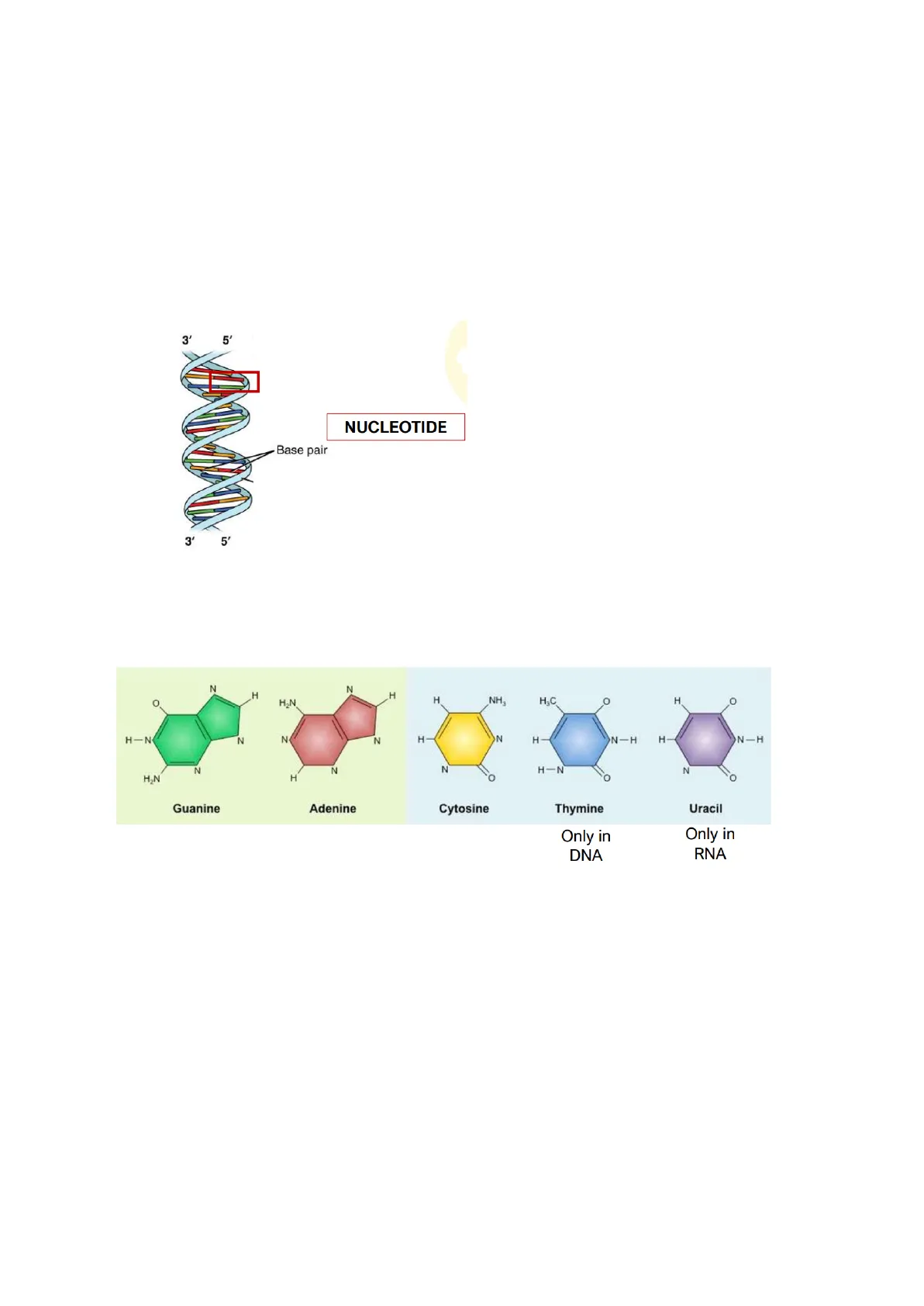
Nucleic acids are complex molecules which carry genetic information. They can be DNA or RNA. RNA (ribonucleic acid). It's (almost always) simple stranded. DNA (deoxyribonucleic acid).It's (almost always) double stranded. DNA and RNA are macromolecules formed by the union of simpler molecules known as nucleotides, that are formed by the union of three molecules: a phosphate, a monosaccharide with 5 carbon atoms (pentose sugar), and a nitrogenous base.
3' 5' NUCLEOTIDE Base pair 3' 5'
The pentose (sugar) can be ribose or deoxyribose. Ribose is found in RNA. Deoxyribose is found in DNA.
The nitrogenous base can be guanine, adenine, cytosine, thymine(exclusive of DNA) and uracil (exclusive of RNA).
N N H H NH, H&C O H O H N-H H-N N O HẠN H Adenine Cytosine Thymine Uracil Only in DNA Only in RNA
Nucleotides join each other forming long chains known as polynucleotides. The pentose of one nucleotide joins with the phosphate of the next one. The nitrogenous base hangs from the pentose.
Types of Nucleic Acids
There are two types of nucleic acids: DNA or deoxyribonucleic acid. RNA or ribonucleic acid. Except for some viruses, living things have their genetic information in the form of DNA.
O H2N H-N N N N H N H- N-H N N N C 0 Guanine
DNA vs RNA Composition
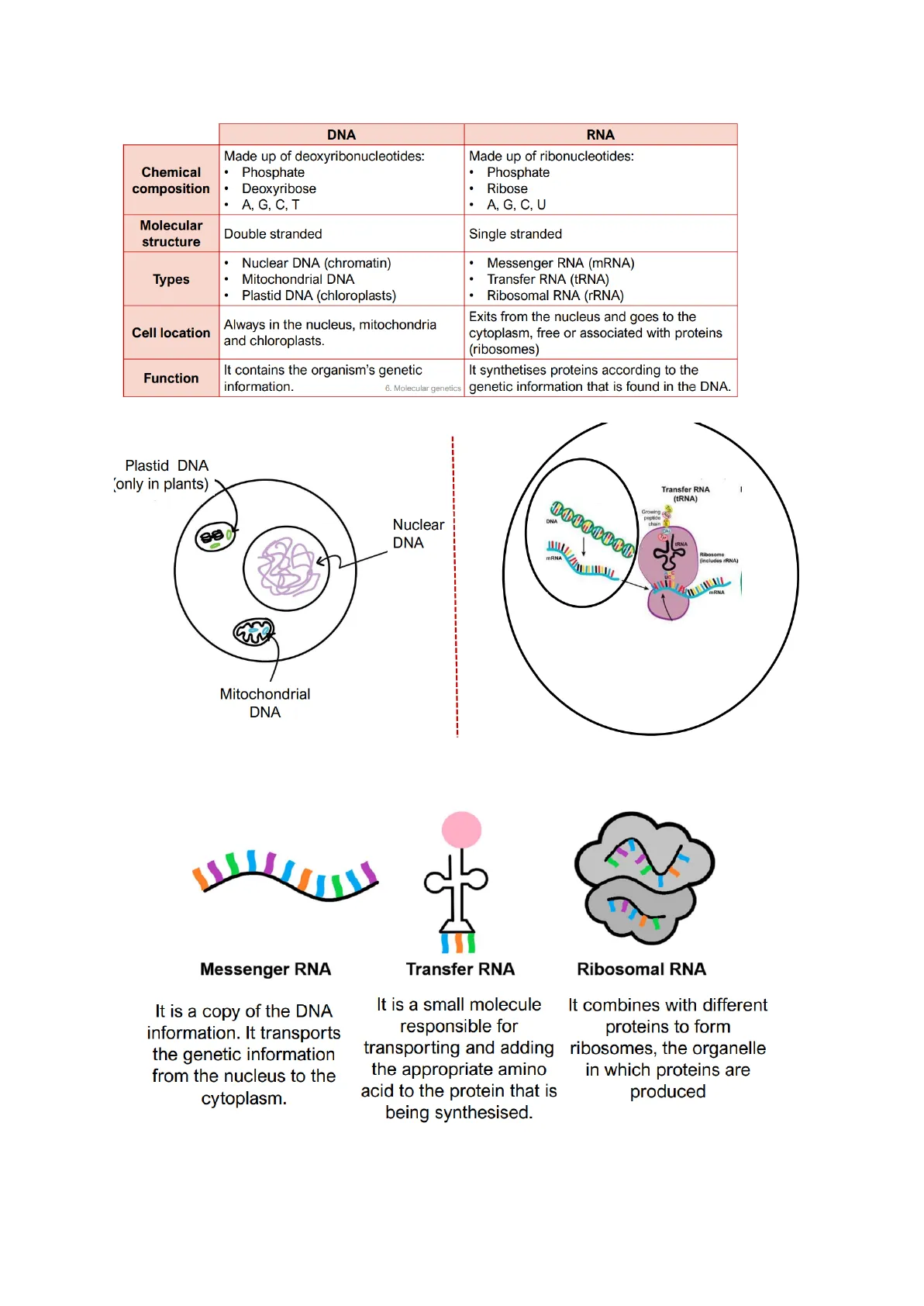
HDNA RNA Made up of deoxyribonucleotides: Made up of ribonucleotides:
Chemical composition · Phosphate · Deoxyribose · A, G, C, T
- Phosphate
- Ribose
- A, G, C, U
Molecular structure Double stranded Single stranded
Types of DNA and RNA
Types · Mitochondrial DNA · Transfer RNA (tRNA) . Plastid DNA (chloroplasts) · Ribosomal RNA (rRNA) · Nuclear DNA (chromatin) · Messenger RNA (mRNA)
Cell Location and Function
Cell location Always in the nucleus, mitochondria and chloroplasts. Exits from the nucleus and goes to the cytoplasm, free or associated with proteins (ribosomes)
Function It contains the organism's genetic information. It synthetises proteins according to the genetic information that is found in the DNA.
Plastid DNA (only in plants) Nuclear DNA Mitochondrial DNA Transfer RNA (tRNA) Growing peptide chain DNA IRNA 1 MRNA Ribosome (includes rRNA) A mRNA Messenger RNA Transfer RNA Ribosomal RNA It is a copy of the DNA information. It transports the genetic information from the nucleus to the cytoplasm. It is a small molecule responsible for transporting and adding ribosomes, the organelle the appropriate amino in which proteins are produced acid to the protein that is being synthesised. It combines with different proteins to form Cell Nucleus Cell u 5' Translation DNA Growing Amino Acid chain Amino Acid Transcription IRINA Transport to cytoplasm RNA 3 IRINA docking Nucleus IRNA leaving codon mRNA Ribosome
Molecular Genetics and DNA Structure
Cytoplasm
Discovery of DNA's Role
In 1910, Thomas Morgan discovered that genes are located inside the chromosomes. Later, in 1944, Avery, McLeod and McCarty proved that chromosomes are made up of DNA and not proteins, as it was previously believed. Between 1953 and 1965, the Central Dogma of Molecular Biology is enunciated and the genetic code was deciphered.
Replication DNA Transcription RNA Translation Protein
Nowadays, we know that genes contain essential biological information and that this is why they are located inside all cells.
Cell Gene (fragment of DNA + Nucleus ChromosomeDNA molecules are double-stranded, as two polynucleotide chains form them. The two strands are connected because the complementary nitrogenous bases are linked together by hydrogen bonds. Adenine always joins with Thymine,through 2 hydrogen bonds. > Guanine always joins with Cytosine,through 3 hydrogen bonds. -> These are the complementary pairs.
Chargaff's Laws and DNA Structure
CHARGAFF'S LAWS Adenine Thymine . HON 3' 5' 0 R OH O NH R N- O O H2N O N N NH® R N Cytosine NH2 HO Guanine 3 The resulting structure looks like a rope ladder that wraps around itself. Each one of the steps represents the link between the nitrogenous bases. Inside a human cell there are found about 4 m de ADN packed in the nuclear space about (5 um). In 1953, James Watson and Francis Crick created a double-stranded model thanks to Rosalind Franklin's DNA studies using X-ray diffraction.
DNA Replication Process
DNA REPLICATION When a cell divides itself, the two resulting daughter cells must have the same genetic material. Before mitosis, during phase S of interphase, the DNA replicates itself. This process is known as DNA replication and happens inside the nucleus. The replication capability is unique to DNA and consists of obtaining two identical molecules taking the initial molecule as a template.
G A A T A A A G 1. The double helix of DNA opens and its chains separate. 2. Free nucleotides join the original strand according to their complementary bases. G C GC A A A GC C G C G G T A 3. The nucleotides connect to each other. SA A A G G G A A A A 4. Two molecules identical to the original DNA are produced. GC G G G T 5'
Gene Expression
DNA contains all the necessary information for the characteristics of living things. This information is expressed in the form of proteins, molecules with the highest diversity of functions. Gene expression is the process through which organisms transform the information in the nucleic acids into proteins.
transcription translation folding protein amino acid chain RNA DNA
We can define a gene as a segment of DNA that contains the essential information to synthesize a protein
Gene Nucleus Cell Chromosomes Protein
Crick's Central Dogma and Modifications
Francis Crick proposed the central dogma of molecular biology in 1958, which states. Each time a cell divides, DNA duplicates itself through replication. When a protein is needed, the DNA gene that codifies that particular protein is transcribed into RNA that leaves the nucleus and goes into the cytoplasm.Then the gene is translated and the protein is synthesized. Crick's proposal has been modified because of the following reasons
- The term "dogma" refers to something that cannot be questioned. This Concept is incompatible with the scientific method.
- Certain viruses, such as HIV, have RNA as genetic material. They Synthesize their DNA from their RNA, in a process called inverse transcription.
- Prions are proteins capable of propagating without the help of DNA.
- Ribozymes are RNA molecules that can self-replicate.
After these modifications, Crick's proposal has been expressed as the following hypothesis (modifications)Replication Ribozymes Transcription Translation Prions (Pro Protein Reverse transcription (RNA Virus)
Transcription Process
TRANSCRIPTION DNA found in the nucleus copies parts of its genetic information into another molecule: RNA (messenger RNA). This process is called transcription: part of the genetic information is copied from the original DNA to mRNA. It takes place in the nucleus of the cell. Then, mRNA is released into the cytoplasm through the pores of the nuclear membrane.
transcription RNA DNA
TRANSCRIPTION The mRNA released is complementary to the fragment of DNA that has been transcribed, which is the sequence that codifies a particular protein that the cell may need. Only one of the strands of the fragment of DNA is transcribed: the template strand. The other strand of DNA that is NOT transcribed is called coding strand.
TRANSCRIPTION DNA found in the nucleus copies parts of its genetic information into another molecule: RNA (messenger RNA). This process is called transcription.
- The double helix of DNA opens in the area where the gene that needs to be transcribed is located.
- Complementary nucleotides are placed in front of the template strand
- Only the template strand is copied. Uracil nucleotides join when there is adenine in the template strand
- A mRNA molecule complementary to the DNA is created
- The newly formed mRNA molecule will exit the nucleus of the cell
Translation Process
TRANSLATION Translation is the process through which proteins are synthesized by using the information contained in the mRNA molecule formed during transcription. It takes place in the ribosomes.It is essential that no mistakes are made when amino acids are incorporated into the growing protein. This is because each type of protein is characterized by the amino acids sequence it carries, as it provides the protein with its particular function.
TRANSLATION AmRNA molecule created from the transcription of a DNA fragment. > Ribosomes, which are organelles capable of 'reading' the mRNA molecule. They can be moving freely in the cytoplasm or joined to the endoplasmic reticulum. They are made up of rRNA and proteins. > Transfer RNA (tRNA), which are RNA molecules that carry amino acids to the ribosomes. > Free amino acids in the cytoplasm.
Free amino acid Amino acid Amino acid chain (protein) tRNA Large subunit mRNA Codon Small subunit
- mRNA exits the nucleus with the copied DNA information.
- mRNA places itself on top of the ribosomes.
- tRNA carries amino acids to the ribosomes according to the genetic message found in the mRNA.
- Ribosomes go over the mRNA chain and join amino acids in the correct order according to the sequence of nitrogenous bases: ribosomes read the mRNA and translate it into a protein.
- The finished protein separates itself from the ribosome.
Genetic Code
The genetic code refers to the relationship between a particular sequence of nitrogenous bases from the mRNA and the sequence of amino acids that form a particular protein.
DNA template strand 3' 5' DNA molecule A C C A A A C G A G T T T T G G C T C A Gene 1 5' 3' TRANSCRIPTION Gene 2 G A mRNA 5 3' Codon TRANSLATION Trp Phe Gly Ser Protein Gene 3 Amino acidThere are 20 different amino acids that can form proteins and 4 different nitrogenous bases in the nucleotides of a chain of mRNA. It has been proved that 3 nucleotide bases (triplets) are needed to codify 1 amino acid.
Lysine Phenylalanine tRNA Methionine U U U Ribosome U A C A A G AUGUU C A A A mRNA Start codon
Deciphering the Genetic Code
The genetic code was deciphered between 1955 and 1966 by Severo Ochoa and his collaborators (Nobel Prize in Medicine in 1959).
Characteristics of the Genetic Code
CHARACTERISTICS OF THE GENETIC CODE
- It is always organized into triplets (codons). Each codon determines an amino acid.
- It is degenerate. There are more possible triplets (64) than amino acids (20). This means that more than one triplet can codify a particular amino acid. Moreover, there are one triplet responsible for initiation of translation and three triplets in charge of finishing the process.
Second letter U C A G U UUU 1 Phe UUC J UUA 1 UUG Leu UCU UCC UCA UCG Ser UAU } Tyr UACJ UAA Stop UAG Stop UGA Stop UGG Trp C Leu CCU CCC CCA CCG Pro CAU Ļ His CAC J CAAL Gin CAG CGU CGC CGA CGG Arg Third letter A AUU AUC Ile AUA AUG ACU ACC ACA ACG - Thr AAU LASn AAC AAA LL AAG JLys AGU Lser AGC J AGA LArg AGG JA G - Val GCU GCC GCA GCG Ala GAUL ASP GAC J GAA ] Glu GAGJ GGU GGC GGA GGG Gly
- There are no overlaps. Each nucleotide belongs to one particular triplet only
3 Overlapping code 2 1 mRNA 1 2 3 1 2 3 Growing protein chain Non-overlapping code 2010 2010 2010 First letter UGU}Cys CUU CUC CUA CUG Met GUU GUC GUA GUG
Can’t find what you’re looking for?
Explore more topics in the Algor library or create your own materials with AI.
