Pidgin, Creoles, and World Englishes: Exploring Linguistic Variation
Slides about pidgin and creoles, analyzing the process of creolization and decreolization. The Pdf presents models of World Englishes, including those by McArthur & Gorlach and Kachru, along with alternative proposals, focusing on linguistic variation and the evolution of English in the world. This material is suitable for university-level Languages studies.
See more12 Pages

Unlock the full PDF for free
Sign up to get full access to the document and start transforming it with AI.
Preview
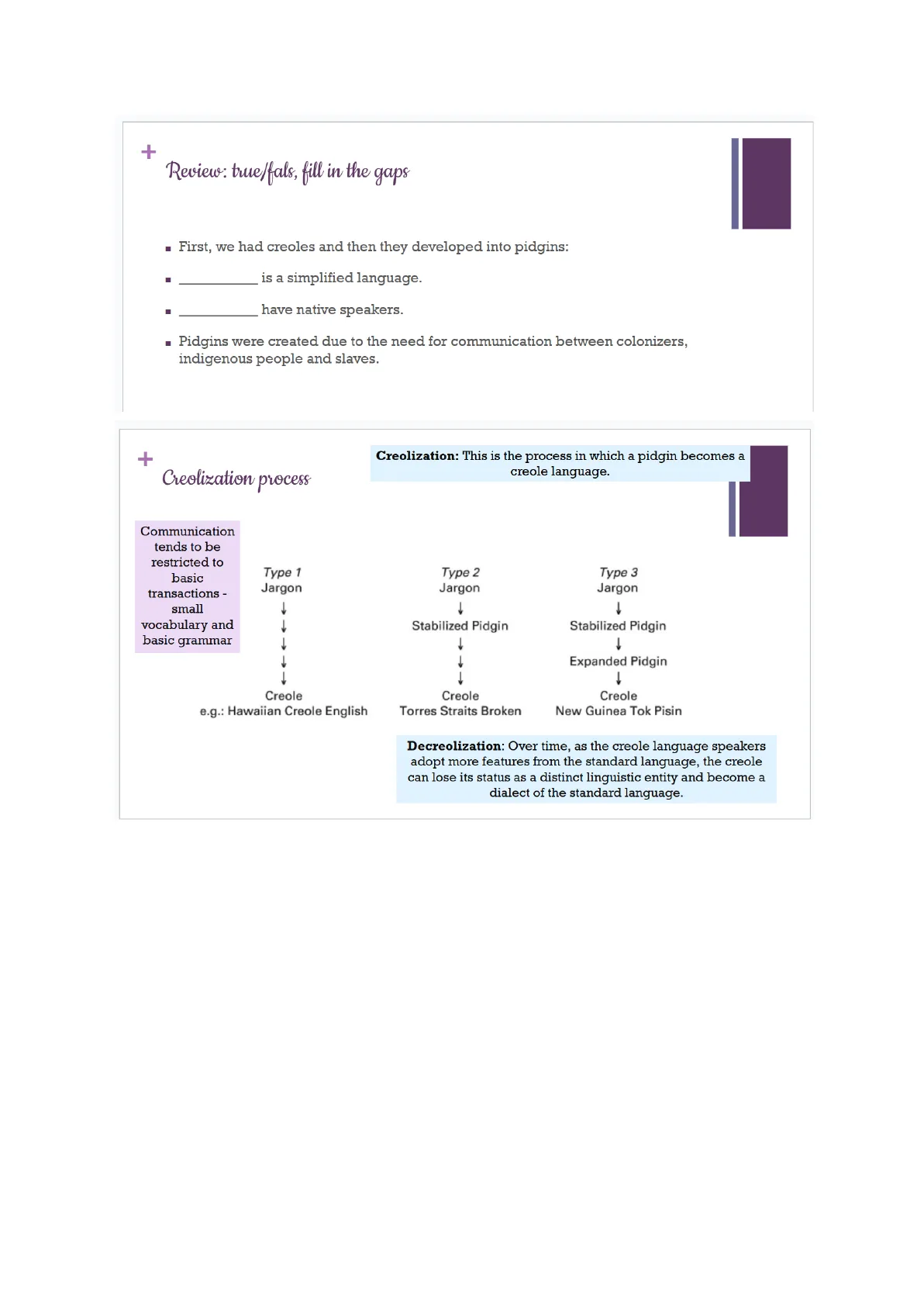
Review: True/False, Fill in the Gaps
Review: true/fals, fill in the gaps . First, we had creoles and then they developed into pidgins: . is a simplified language. . have native speakers.
- Pidgins were created due to the need for communication between colonizers, indigenous people and slaves.
Creolization Process
Creolization: This is the process in which a pidgin becomes a creole language. Creolization process Communication tends to be restricted to basic Type 1 Jargon Type 2 Jargon Type 3 Jargon transactions - small vocabulary and basic grammar - 1 1 Stabilized Pidgin Stabilized Pidgin 1 Expanded Pidgin > Creole e.g .: Hawaiian Creole English Creole Torres Straits Broken - Creole New Guinea Tok Pisin
Decreolization
Decreolization: Over time, as the creole language speakers adopt more features from the standard language, the creole can lose its status as a distinct linguistic entity and become a dialect of the standard language.
Conclusion on Pidgins and Creoles
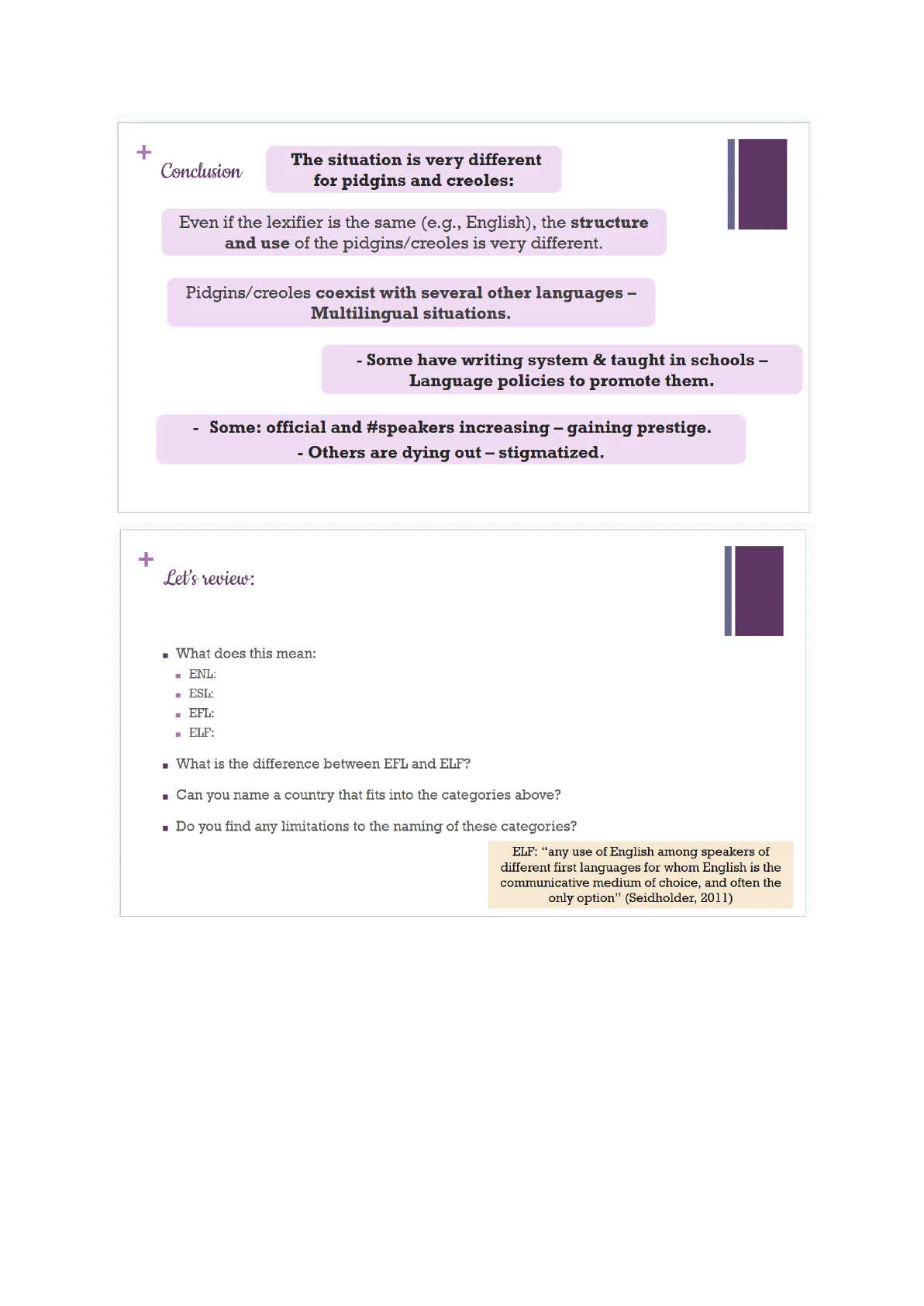
Conclusion The situation is very different for pidgins and creoles:
- Even if the lexifier is the same (e.g., English), the structure and use of the pidgins/creoles is very different.
- Pidgins/creoles coexist with several other languages - Multilingual situations.
- Some have writing system & taught in schools - Language policies to promote them.
- Some: official and #speakers increasing - gaining prestige.
- Others are dying out - stigmatized.
Let's Review English Language Categories
Let's review:
- What does this mean: . ENL: · ESL: · EFL: . ELF:
- What is the difference between EFL and ELF? Can you name a country that fits into the categories above? . Do you find any limitations to the naming of these categories? ELF: "any use of English among speakers of different first languages for whom English is the communicative medium of choice, and often the only option" (Seidholder, 2011)
Connecting Definitions with Labels
Connect the definition with the label #1 around 360 million, although higher if English-based pidgins and creoles are included. # 2is the language of those born and raised in one of the countries where English is historically the first language to be spoken. #3 "the traditional cultural and linguistic bases of English" #4 the English of those whose countries were never colonised by the British, and for whom English serves little or no purpose within their own borders. #6 UK, USA, Canada, Australia, and New Zealand #5 territories such as India, Bangladesh, Nigeria, and Singapore, which were once colonized by the English #8 they typically learned the language in order to use it with its native speakers in the US and UK, though this is no longer necessarily the case. #7 The current number of speakers is difficult to assess #9 360 million 1) English as a Native Language 2) English as a Second Language 3) English as a Foreign Language
Who Speaks English Today?
Who speaks English today? Can you find some difficulties with this traditional; three-way representation?
English as a Native Language
English as a Native Language - is the language of those born and raised in one of the countries where English is historically the first language to be spoken. -UK, USA, Canada, Australia, and New Zealand -are also thought to number around 360 million, although higher if English-based pidgins and creoles are included. - "the traditional cultural and linguistic bases of English" -Their English speakers are thought to number around 360 million.
English as a Second Language
English as a Second Language - territories such as India, Bangladesh, Nigeria, and Singapore, which were once colonized by the English -they typically learned the language in order to use it with its native speakers in the US and UK, though this is no longer necessarily the case. -The current number of speakers is difficult to assess (depends on the level of competence)
English as a Foreign Language
English as a Foreign Language - around one/two billion. - controversial: ELF/EFL ??
Critics and Disadvantages of the Three-Way Representation
Some critics/ disadvantages of the three way representation:
- ENL is not a single variety of English.
- Pidgins and creoles ?? ENL (Caribbean), ESL (West Africa) and EFL (Nicaragua, Panama)
- Large groups of ENL speakers living in ESL territories e.g. India and Hong Kong as a result of colonialism.
- Large numbers of ESL speakers living in ENL: US/ UK ...
- Much of the world is bi- or multilingual.
- Native speakers v. non-native speakers of English- born v. learned it through education.
- ESL (Singapore, Nigeria) - English as their Ll.
- EFL/ELF countries (The Netherlands and Scandinavian countries) English used for intranational (i.e. country internal) purposes rather than as FL.
Strevens (1980): Oldest Model of English Spread
Strevens (1980): oldest model of the spread of English ENGLISH 1 AMERICAN ENGLISH BRANCH ? BRITISH ENGLISH BRANCH 20 U.S.A. - CANADA BRITISH ISLES Anglophone Francophone Canadian Canadian Scottish Irish 4 'English Welsh Midwest NE Coast California | Duarte Rien LINDIA-PAKISTAN JW. Indies AFRICA 7 Forms of Malay \Chinese +U.S. Philippines AUSTRALASIA W. Africa E. Africa Philippines Am Samoa New Guinea Anglophone S. Africa Fij Australia New Zealand 0 Many researchers have tried to describe the spread of English: The models of English - how they are used around the world. FAR-EAST Southern Jamaic& Barbados Trinidad etc. Indian English
The Circle of World Englishes (1985)
The circle of World Englishes (1985) Mc Arthur & Gorlach - Center: 'World Standard English'- does not exist in an identifiable form. - Next : regional varieties including both standard and standardizing forms. Sri Lankan English Standard(izing) British and Irish Standard English Hiberno-English etc Burmese English etc Irish English African English American English Nigerian English West, East and American Ghanaian English South(ern) African Standard Cameroon English Standard(izing) English Midland West African Pidgin Kenyan English Caribbean Standard English Canadian Standard English Black English Vernacular Natio Barbadian/Bajan Trinidadian Bahamian Belizian Guyanese Inuit English Athabascan English Newfoundland English
Kachru's Three Circle Model (1992)
3 circle model (Kachru, 1992) The third diaspora: to the EFL countries China 1,088,200,000 Egypt 50,273,000 Indonesia 175,904,000 Israel 4,512,000 Japan 122,620,000 Korea 42,593,000 Nepal 18,004,000 Saudi Arabia 12,972,000 Taiwan 19,813,000 USSR 285,796,000 Zimbabwe 8,878,000 The "Outer Circle" 'norm-developing' Bangladesh 107,756, Ghana 13,754,000 The second India 810,806,000 Kenya 22,919,000 diaspora to the Malaysia 16,965,000 Nigeria 112,258,000 ESL countries Pakistan 109,434,000 Philippines 58,723,000 Singapore 2,641,000 Sri Lanka 16,606,000 Tanzania 23,996,000 Zambia 7,384,000 The "Inner Circle" USA 245,800,000 UK 57,006,000 Canada 25,880,000 Australia 16,470,000 New Zealand 3,366,000 The first diaspora: the language travelled from Britain, to the other ENL countries. 0 Malaysian English Singapore English Hong Kong English East Asian English Antipodean English Australian English Aboriginal English New Zealand English Maori English Tok Pisin British English BBC English English English Scottish English and South Pacific Standard Scots English Norn South Asian Nepalese English Bangladeshi English Pakistani English Indian English East Asian Standardizing English New Zealand Bislama/Beach la Mar etc South Asian English Chinese Enghlish etc Japanese English Philippines English The circle of World English Jama Nicaraguan etc Ukrainian English etc Frenglish/franglais Quebec English can N South African English etc Zimbabwean English Caribbean English Canadian English Indian English etc Appalachian Gullah Southern Ugandan English Tanzanian English Zambian English English Sierra Leone Krio Network Standard Northern - Eight regions: subvarieties such as Aboriginal English, AAVE, Gullah, Jamaican Nation Language, Singapore English and Ulster Scots ... 'norm-dependent' The "Expanding Circle" . The most useful and influential model. . Three concentric circles,: the Inner Circle, the Outer Circle, and the Expanding Circle. · Represent the types of spread, the patterns of acquisition, and the functional allocation of English in diverse cultural contexts. Australian, Welsh English Ulator Scots English WORLD STANDARD ENGLISH angu 'norm-providing''norm-dependent' The "Expanding Circle" The third China 1,088,200,000 Egypt 50,273,000 diaspora: to the EFL countries Indonesia 175,904,000 Israel 4,512,000 Japan 122,620,000 Korea 42,593,000 Nepal 18,004,000 Saudi Arabia 12,972,000 Taiwan 19,813,000 USSR 285,796,000 Zimbabwe 8,878,000 The "Outer Circle" Bangladesh 107,756, 'norm-developing' Ghana 13,754,000 The second India 810,806,000 Kenya 22,919,000 diaspora to the Malaysia 16,965,000 Nigeria 112,258,000 ESL countries Pakistan 109,434,000 Philippines 58,723,000 Singapore 2,641,000 Sri Lanka 16,606,000 Tanzania 23,996,000 Zambia 7,384,000 The "Inner Circle" USA 245,800,000 UK 57,006,000 Canada 25,880,000 Australia 16,470,000 New Zealand 3,366,000 'norm-providing' The first diaspora: the language travelled from Britain, to the other ENL countries.
Alternative Models and Descriptions
! Several scholars have proposed alternative models and descriptions, s in an attempt to improve on Kachru's model by incorporating more recent developments: Taking the use of English as the starting point.
Limitations of Kachru's Model
3 circle model (Kachru, 1992) The three-circle model has been highly influential and contributed greatly to our understanding of the sociolinguistic realities of the spread of English. Do you find any limitations?
Mediano (1999) Model
Mediano (1999) Learners Goal: Challenge native-speaker centrality; place intelligibility at the core. Proficient in international English Native and foreign language proficiency · Attempts to adapt Kachru's model. · He breaks completely with historical and geographical concerns > global view. People who do not know English · Based on what is mutually comprehensible to the majority of proficient speakers of English, be they native or non-native. The center: those who are proficient in international English: native & non-native. These speakers can communicate with the other circles and they don't have a strong regional accent. Problems: - where do we draw the line between a strong and non-strong regional accent? And who decides? what does it mean to be proficient in 'international English'? We are done with this idea of native like - the most important thing is the communication - to be able to communicate. - "Your English doesn't have to sound British or American to be valid. If it's clear and gets the job done, you're part of the core." Pennycool, 2009: communicative
Other Models of English Spread
Some other models of the spread of Eng English use cannot be separated from the context in which it's spoken. There is no single "correct" English-what matters is if it works in context. ELF (all uses of Eng). The interlingual plans of communicative repertoires Language contexts: The colinguistic use "who says what to whom where"= registers in relation to contextual use The coangulo of English in acece are tim Graddol 2006 Sposter location The idaslinguistic uptake of magning "what gets taken from a language use with ideologies, discourses and beliefs" > "listeners come with language histories and means of interpretation". Three Circles (Inner, Outer, Expanding) but with more focus on how English is used globally today. he challenged the traditional "native-speaker" focus. one of his key contributions is the idea that English is no longer just a foreign language, but a global means of communication. 2. Communication context. English doesn't mean the same thing everywhere. It's shaped by the social, cultural, and political context of each place. Penny - three planes: a higher horizontal plane for "inter/linguistic resources", a vertical one for "who says what to whom where", and a lower horizontal one for "what gets taken from what language use with what investments, ideologies, discourses and beliefs" (2009: 203). "English is always used somewhere, by someone, for something-and that matters."
Mahboob (2014): Language Variation
Mahboob (2014): Language Variation Help us understand how and why English varies across different contexts. · Three parts (continuums). · 1) users of English: the social/geographic distance (global or local) between interlocutors. . 2) uses of English: the purpose - specialized discourse v. casual conversation . 3) mode of communication · Each is an independent continuum but they are not mutually exclusive, · Provide 8 different possible kinds of language variation. Written texts Specialized/technical discourses mode uses Global/ High social distance users Everyday/casual discourses Oral texts - It helps de-center native-speaker norms, by showing that no single variety is universally "better." - Supports contextual and functional understanding of Englishes- variation is normal .. Local/ Low social distance
Can’t find what you’re looking for?
Explore more topics in the Algor library or create your own materials with AI.
