ELT Concourse Teacher Training for Delta: Unlocking Learning Potential
Document from ELT Concourse about teacher training for Delta. The Pdf explores four fundamental concepts: Noticing, Input vs. Output, Inferencing, and Scaffolding, providing a theoretical basis for effective teaching practices in Languages at University level.
See more13 Pages

Unlock the full PDF for free
Sign up to get full access to the document and start transforming it with AI.
Preview
ELT Concourse Home
A-Z site index Delta index Teacher training index Teacher development
For Teachers
For trainers For managers For learners Language questions Other areas Academic English Business English Entering ELT
Courses Index
Basic ELT course TKT The Bridge Language analysis Training to train Transcription Glossaries About language Articles
ELT Concourse Teacher Training
Delta 11 A 1
Four Ways to Unlock Learning Potential
There isn't a word in English to describe something midway between a method and a technique. Procedure is the best we can find. The term is slightly misleading because these are not procedural techniques like drilling, nominating, waiting and so on. Nor are they purely teaching behavioural formulae such as concept checking or Dictogloss.
The four procedures, for want of a better word, described here underlie a good deal of teacher behaviours in the classroom which can lead to real learning.
Why These Four?
Good question.
There is, of course, a very large range of possible procedures and techniques which good teachers use appropriately to enhance learning in the classroom.
Some are managerial issues such as grouping learners effectively, nomination, drilling, concept checking, instructional language, questioning and so on.
Others are purely techniques such as eliciting, dictation of one kind or another, using games, using music, song and poetry, schemata activation, warmers and so on.
What is special about these four is that they are at one stage removed from pure technique because they are the reasons why the technique is employed.
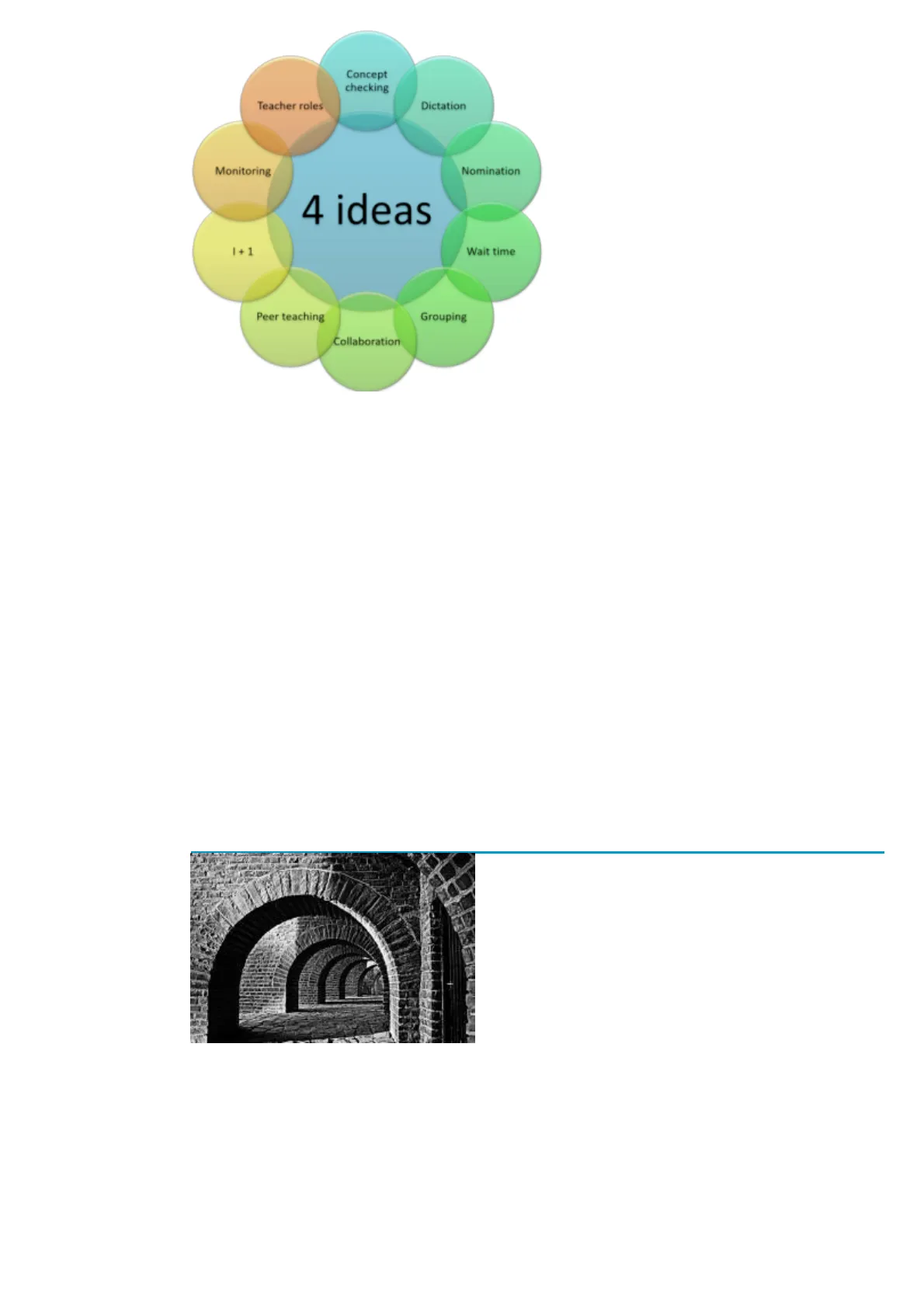
It can be envisioned like this:Concept checking Teacher roles Dictation Monitoring Nomination 4 ideas 1+ 1 Wait time Peer teaching Grouping Collaboration
The graphic is intended to show that these four ideas lie at the heart of much good teaching (not all of it) and are surrounded by a cloud of second-level behaviours which depend on one or more of the key ideas. The outer ring is meant to be indicative rather than exhaustive.
If you have taken an initial training course, you may well be familiar with all the techniques in the outer ring because second-level behaviours such as the ones listed above constitute a good deal of what participants on such courses learn about and should be able to employ in the classroom. Many are taught by demonstration and modelling followed by imitation by the trainee.
However, rarely mentioned on such courses is why the techniques are being employed at all because such courses are usually short and staunchly practical with little time or interest to discover deeper reasons why we do the things we do in the classroom.
One reason why this guide is in the Delta section, although it is linked from elsewhere, too, is that an essential difference between initial- and diploma-level training lies precisely in investigating what underlies good practice.
These four top-level ideas are:
- Noticing
- Input vs. output
- Inferencing
- Scaffolding
All four depend on four overarching hypotheses to do with learning and we'll summarise those first to set the scene.
Overarching Hypotheses
It has not gone unnoticed by most language teaching professionals that learning only happens when the learner is ready for it to happen. Most teachers have experienced times when they know that what they are doing is not working in the sense that, although the learners may seem busy, involved and active, nothing new is being acquired.
At other times, the golden classroom moments, we have also been aware that what is happening is contributing to real progress. Learners are moving on, almost visibly, from where they were towards where they want to be.
Underlying this phenomenon are four connected hypotheses concerning what happens when people learn.
1. Motivation
This is not to do with grand theories of motivation concerning, for example, the difference between intrinsic and extrinsic motivation or between instrumental and integrative motivation. For that, see the guide to motivation linked in the list of related guides at the end. Here, the concern is based more on the individual's understanding of what is useful and usable. There are three related elements: a. Valence: the value attached to an outcome. How much does the learner value learning English? b. Expectancy: the individual's ability to achieve the goals set. Does the learner believe she/he can successfully learn English from this input and these tasks? c. Instrumentality: the likelihood that the effort will be rewarded with a successful outcome. Does the learner believe the learning will help him/her to use English successfully? In other words, have we set a task or a challenge that the learners perceive as useful in terms of affording them an opportunity to get from where they are now to where they want to be? This is the basic starting point for learning. If valence, expectancy and instrumentality are all low, learning is unlikely to happen no matter how entertaining and interesting the lesson is.
2. Interlanguage
This is a key concept and describes where the learners' current language mastery stands on a scale from knowing nothing of the target language to complete mastery. Diagrammatically, it can be pictured like this: 15 language Level 1 Level 2 Level 3 etc. Target language It is important to know where a learner's interlanguage currently is because: a. It tells us what the learner is likely to know already and that helps us plan what to teach. b. It helps us to decide what to correct in class. c. It helps us to recognise whether what we are asking is asking too much or too little - challenge is the word for it. In other words: without a knowledge of where the learners' interlanguage is, we can't set sensible aims for anything: lessons, tasks, questions, activities etc. The origins of interlanguage studies lie in the discovery that although many errors are caused by interference from the learners' first language(s), some clearly are not: they are attempts at forming hypotheses about the language and may be incomplete, over-elaborate or plain wrong. Knowing what hypotheses our learners are currently working from helps us to help them to refine them. There is a little more on this in the guide linked below. This is a cognitive theory of learning and the one which will, for the most part, be accepted here. The theory rests on the assertion that learners of a language are actively hypothesising what its rules are and refining their hypotheses as more data become available. It explains, among
3. Active Construction of Grammar
much else, the fact that second language learners may apply a newly-acquired rule indiscriminately and, for example, put and - ed ending on all verbs to show past tenses before they refine the hypothesis and link the phenomenon only to regular verbs in English. It will also explain errors such as *Do you can come? as evidence that the learner has made a hypothesis that all verbs form questions in this way in English. Only later will the learner reconstruct the hypothesis to exclude modal auxiliary verbs from the scheme. Evidence for this includes what is called the U-shaped learning curve. It has been observed that learners will often begin with the correct form and say, e.g .: I went to the party but will later produce: *I goed to the party because before they acquired the rule, they merely reproduced a chunk of heard language but, having learned the rule they applied it too widely. Later, they will grasp the rule's limitations and revert to the correct form. What follows assumes that learning is not a matter of imitation and repetition (although that may play a role) but an active cognitive process in which the learner is engaged not passively receiving. There is more on this in the guide linked below.
4. The ZPD
The ZPD is the Zone of Proximal Development and the word proximal implies that it is the zone in which the learner is closely approaching mastery of any skill or language item and just needs a small amount of help from a More Knowledgeable Other (which can be the teacher, a peer or even a coursebook writer) to take the next step to learning. The assumption is that learners need to be operating in the ZPD in order efficiently to learn. It can be pictured like this: What the learner will be able to do independently Anxiety zone Level of challenge The Zone of Proximal Development - it is here that the learner needs support and the task needs scaffolding. What the learner can now do independently Boredom zone Level of competence Step outside it to the right where a task is too easy and learners will learn nothing and be bored. Step outside it to the left where the task is too difficult and learners will become anxious and overwhelmed and be unable to learn. Staying in the green zone means that learning and teaching are happening in the most useful place and learners are being neither over- nor under-challenged. There is more on this in the guide linked below.
These four mega-hypotheses underlie all that follows here and reference will be made to them after each discussion.
In what follows, we shall not be focusing on how to encourage noticing, how to make input into intake, how to help people to infer meaning or how to scaffold tasks and smaller learning units. For that kind of information, refer to the links at the end to each guide to the four areas.
Here, we are looking at what underlies the choice of approach or procedure, not what the procedure involves.
Noticing
It has been asserted, famously by Krashen, that language may be acquired by an unconscious process of 'picking it up' and there are those who would assert that they have, indeed, done just that. Krashen's point is that acquisition is a process similar to the way in which children acquire their first language(s). It requires meaningful and frequent interaction in the language in which the speakers are not focused on form but on meaning.
This is not to say that Krashen dismisses instruction altogether because he goes on to state: The classroom is of benefit when it is the major source of comprehensible input. Krashen, 1982 and elsewhere, he makes it clear that for lower-level students, the classroom may be the only place where comprehensible and useful input is obtained.
Learning is, however, a formal procedure which focuses on the explanation of rules and correction of language form and Krashen states: When acquirers have rich sources of input outside the class, and when they are proficient enough to take advantage of it (i.e. understand at least some of it), the classroom does not make an important contribution. Ibid Ellis, reviewing this, points out that: It is clear that 'acquisition', in the sense intended by Krashen, can involve some degree of consciousness (in noticing and noticing the gap). Ellis 1994:363 He goes on to say that one possibility ... ... is that explicit knowledge functions as a facilitator, helping learners to notice features in the input which they would otherwise miss and also to compare what they notice with what they produce. Ibid There are, as Ellis notes above, two forms of noticing:
- Noticing features of the language that you need to learn
- Noticing the difference between what you produce and the target with which you are presented
If Krashen is right that all that is needed for language acquisition to occur is meaningful and frequent interaction in the language in which the speakers are not focused on form but on meaning, then deliberately encouraging noticing has no place.
However, if Ellis is correct and one of the major functions of the teacher is to act as a facilitator and help learners to notice salient input, then it certainly does have a place.
There is guide devoted to noticing on the site, linked below, but here we are concerned not with the how and what of noticing but the when, why and where.
All of the mega-hypotheses outlined above play a role here:
Can’t find what you’re looking for?
Explore more topics in the Algor library or create your own materials with AI.
