James Joyce: Life, Works, and an In-depth Analysis of Dubliners
Slides from Education about James Joyce. The Pdf, a presentation, explores the life and works of James Joyce, with a particular focus on his novel 'Dubliners', analyzing themes like paralysis, epiphany, and symbolic realism. This University-level Literature material is well-structured for study.
See more18 Pages


Unlock the full PDF for free
Sign up to get full access to the document and start transforming it with AI.
Preview
James Joyce's Biography
James Joyce was born in Dublin in 1882. His family fell into poverty but he attended the most prestigious Jesuit schools before going to University College in Dublin, where he demonstrated extraordinary academic ability. In 1902 he went to Paris with the intention to study medicine but he changed his mind and started to write poems and prose sketches developing his highly distinctive aesthetic theories. After the death of his mother in 1903, he met Nora Barnacle whom he persuaded to go to the Continent with him. Joyce called the 16th of June the "Bloom's day" because he meets Nora and he celebrates this day in his masterpiece "Ulysses" that is set in this day. They lived first in Pola and then in Trieste. Joyce worked as an English teacher at the Berlitz School of Languages and they had two children. Joyce published a collection of poetry "Chamber music" and then "Dubliners" in 1914. Joyce was obsessed by two elements: his Irish origin and his catholic education, and he never succeeded to be free of this two elements. So he criticised this two oppressions in his works, like "Dubliners". At the outbreak of World War I Joyce's family went to Zurich in neutral Switzerland. In this period Joyce published his semiautobiographical first novel "A portrait of the artist as a young man". He wrote also his masterpiece "Ulysses", declared obscene and banned in Britain and America but published in Paris. Then he began to work on the experimental novel "Finnegans Wake" that completely breaks down English syntax and grammar and inventing its own poly-linguistic vocabulary. Joyce follows the circular structure of time and he starts with the end of the story. His motive was to keep literary historians busy for the next four hundred years. At the start of World War II Joyce went to France where he gained the permission to return to Switzerland. He died in Zurich in 1941.
Dubliners Collection
"Dubliners" is a collection of 14 stories in which Joyce represents Irish life from childhood to public life. In fact the stories are arranged in four groups: childhood, adolescence, maturity and public life. The significant theme of all the stories is the paralysis of Ireland because Joyce wants to show that Irish people live dead, inhibited by repressive moral codes. He wants to show the paralysis of Ireland because they live dead. The last story, "The Dead" is the culmination of the feeling of stagnation of the characters of all the stories. From a stylistic point of view, the stories are written in a traditional way but the descriptive realism contains many of the elements of Joyce's experimental work, such as the absence of a moralising narrator substituted with an omniscient narrator, description of characters' inner thoughts and use of symbolism.
The Use of Epiphany in Dubliners
The description in each story is realistic and concise with abundance of external details, even the most unpleasant. The use of realism is mixed with symbolism (details have a deeper meaning). Understanding the epiphany in each story is often the key to the story itself. The Joyce's theory of the epiphany suggests the search for something existing under the surface of things and events. The episode described is apparently unimportant but essential to the life of the characters.
Pervasive Theme of Paralysis in Dublin
The paralysis of Dublin which Joyce wanted to portrait is both physical and moral linked to religion, politics and culture. Joyce's Dubliners accept their condition because they are not aware of it or because they lack the courage to break the chains that bind them. But there is not paralysis alone but also its revelation to its victims. The coming to awareness marks the climax of these stories. The main theme is the failure to find a way out of paralysis. None of characters succeeds: they live as exiles at home, unable to cut the bonds that tie them to their own world.James Joyce
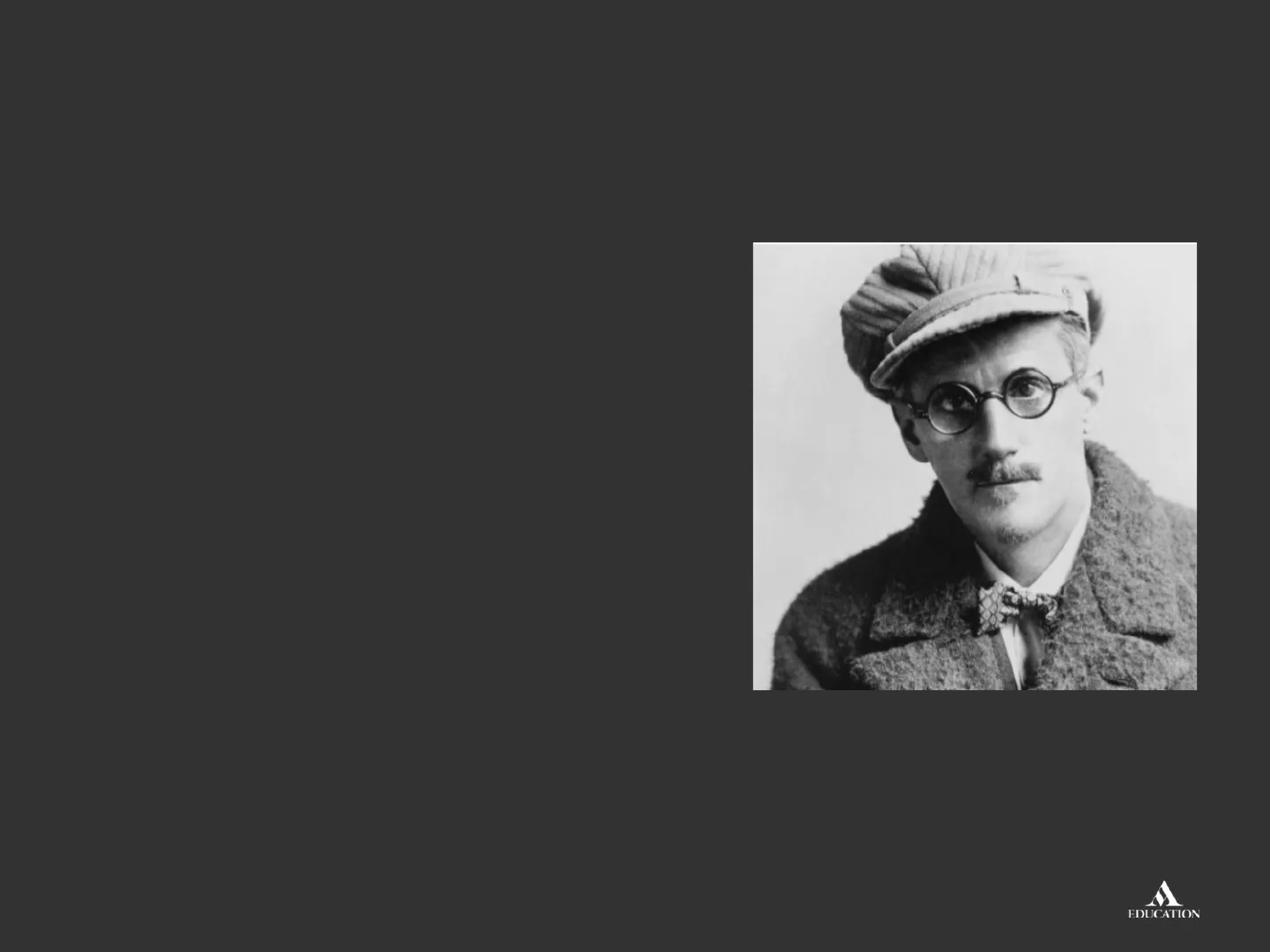
James Joyce's Education and Life
(1882-1941) EDUCATIONLIM Lesson James Joyce (1882-1941)
His Life
- Born in Dublin into a middle-class Catholic family.
- His father had been a supporter of Charles Parnell.
- He attended University College, Dublin.
- In 1902, he went on a self-imposed exile -> Paris, Pula, Trieste.
- At the outbreak of World War I, he left for Zurich.
- In 1920, he moved to Paris.
James Joyce's Works
His Works
- Dubliners (1914)
- A Portrait of the Artist as a Young Man (1916)
- Ulysses (1922)
- Finnegans Wake (1939)
ULYSSES BY JAMES JOYCE
Joyce and Ireland's Complex Relationship
Joyce and Ireland
A complex relationship:
- he rejected everything that was Irish;
- his works are centered on Ireland, Dublin. ↓ Early 20th - century Dublin occupies every page written by Joyce
Joyce's Narrative Style
Joyce's Narrative
His self-imposed style had given him the objectivity he needed to write about Ireland with the necessary emotional and intellectual detachment. ↓ Joyce's novels show a similar shift from:
- the particular to the universal;
- the lyrical style to the epic style.
Dubliners: A Collection of Short Stories
Dubliners
- A collection of 15 short stories -> the failure of self-realization of an inhabitant of Dublin.
- The first 14 were written by 1905, the last and longest story was finished by 1907.
- Joyce's intention was to: 'Write a chapter of the moral history of my country and I chose Dublin for the scene because that city seemed to me the centre of paralysis'.
- This sense of paralysis is presented in four stages:
- childhood,
- adolescence,
- maturity,
- public life.
Realism and Symbolism in Joyce's Work
Realism and Symbolism
- Realistic: the degree of perfectly recreating characters, places, streets, pubs and idioms of Dublin.
- Joyce makes use of a symbolic effect: it gives the common object an unforeseen depth and becomes the key to a new view of reality.
- He coined the definition of epiphany: 'manifestation, showing' -> a moment when a simple object/fact/situation suddenly flashes out with meaning and makes a person realize his/her condition.
The Dead: Climax of Dubliners
The Dead
The climax to all the other stories ↓ ... and their counterpoint, too ↓ detached objectivity gives place to lyrical intensity.
- Gabriel is the central character of the story: / the best representative of all failed Dubliners; / he is what Joyce would have become if he had stayed in Ireland.
The Story of The Dead
The Story
- It begins with the Christmas party that the Morkan sisters organize each year.
- The guests, both Catholic and Protestant, debate crucial arguments Irish politics in relation to Britain.
- Gabriel Conroy, the Morkan sisters' nephew, is a journalist who has an unfulfilled personality -> he prefers not to expose himself and to continue his usual life.
- Late at night, Gabriel and Gretta, his wife, go back to their hotel.
I Think He Died for Me: Gretta's Revelation
I Think He Died for Me
- Gabriel and Gretta are in their room.
- Gretta has just kissed him: a song heard at the party brings forth forgotten memories -> they bring about hidden depths of feeling and a new awareness of her relationship with Gabriel.
- For Gabriel, it comes when he thinks he has full possession of his wife.
The End of The Dead
The End
- Gretta throws herself crying on to the bed.
- She reveals she is crying for a boy she used to know long ago.
- This revelation is not sudden, but gradual.
- It brings about a series of further emotional shocks for Gabriel: that the boy, Michael Furey, died for love of Gretta.
The Living and the Dead in Joyce's Work
The Living and the Dead
- Gabriel has just listened to Gretta's story.
- He reflects on how poor a part he has played in his wife's life and feels his own pettiness.
- In the end, he feels elevated to the world of spirit, the region of the dead, symbolically mapped by the snow falling all over Ireland.
The Twentieth Century - Part I
6 The Twentieth Century - Part I Tessuto per tende 1. avenue: viale. 2. was leaned: era appoggiata. 3. nostrils: narici. 4. dusty cretonne: cretonne polveroso. 5. clacking ... path: che risuonavano sul marciapiede di cemento e poi che cigolavano sul sentiero. 6. brick houses with shining roofs: le case di mattoni con i tetti scintillanti. x] The Kitchen Window (1926), Leo Whealan. Crawford Municipal Art Gallery, Cork.
Let's get started
1 Read this quotation from a letter, written by James Joyce on May 5 1906, to Grant Richards, his prospective publisher of Dubliners. My intention was to write a chapter of the moral history of my country and I chose Dublin for the scene because that city seemed to me the centre of paral- ysis. 2 Which alternative do you think best explains the concept of paralysis? Choose from the following. a physical inability to do things passivity and inaction the inability to rebel against other people
Eveline: A Dubliners Story
'Eveline'
After the death of her mother, Eveline has to take care of her father. She has a hard and monotonous life but is lucky to meet a kind boy, Frank, who would like to take her away from Dublin to start a new life with him. She is about to go to meet him, leaving her present life behind forever. She sat at the window watching the evening invade the avenue1. Her head was leaned2 against the window curtains and in her nostrils3 was the odour of dusty cretonne4. She was tired. 5 Few people passed. The man out of the last house passed on his way home; she heard his footsteps clacking along the concrete pavement and afterwards crunching on the cinder path5 before the new red houses. One time there used to be a field there in which they used to play every evening with other people's children. Then a man from Belfast bought the field and built houses in it - not like their little brown houses but bright brick houses with shining roofs6. The children of the avenue used to play together in that field - the Devines, the Waters, the 10 176James Joyce 15 Dunns, little Keogh the cripple7, she and her brothers and sisters. Ernest8, however, acciones never played: he was too grown up. Her father used often to hunt them in out of the field with his blackthorn stick9; but usually little Keogh used to keep nix10 and call out when he saw her father coming. Still they seemed to have been rather happy then. Her father was not so bad then; and besides, her mother was alive. That was a long time ago; she and her brothers and sisters were all grown up; her mother was dead. Tizzie Dunn11 was dead, too, and the Waters had gone back to England. Everything changes. Now she was going to go away like the others, to leave her home. 20 Home! She looked round the room, reviewing all its familiar objects which she had dusted12 once a week for so many years, wondering where on earth all the dust came from. Perhaps she would never see again those familiar objects from which she had never dreamed of being divided. [ ... ] She had consented to go away, to leave her home. Was that wise13? She tried to weigh14 each side of the question. In her home anyway she had shelter15 and food; she had those whom she had known all her life about her. Of course she had to work hard, both in the house and at business. What would they say of her in the Stores16 when they found out that she had run away with a fellow? Say she was a fool, perhaps; and her place would be filled up by advertisement17. 30 Miss Gavan would be glad. She had always had an edge on her18, especially whenever there were people listening. 'Miss Hill, don't you see these ladies are waiting?' 'Look lively, Miss Hill, please.' She would not cry many tears at leaving the Stores. 35 But in her new home, in a distant unknown country, it would not be like that. Then she would be married - she, Eveline. People would treat her with respect then. She would not be treated as her mother had been. Even now, though she was over nineteen, she sometimes felt herself in danger of her father's violence. She knew it was that that had given her the palpitations. When they were growing up he had never gone for her, like he used to go for19 Harry and Ernest, because 40 she was a girl; but latterly20 he had begun to threaten21 her and say what he would do to her only for her dead mother's sake22. And now she had nobody to protect her Ernest was dead and Harry, who was in the church decorating business, was nearly always down somewhere in the country. Besides, the invariable squabble23 45 for money on Saturday nights had begun to weary her unspeakably24. She always gave her entire wages25 - seven shillings - and Harry always sent up what he could but the trouble was to get any money from her father. He said she used to squander26 the money, that she had no head, that he wasn't going to give her his hard-earned money to throw about the streets, and much more, for he was 50 usually fairly27 bad of a Saturday night. In the end he would give her the money and ask her had she any intention of buying Sunday's dinner. Then she had to asci rush out as quickly as she could and do her marketing, holding her black leather purse tightly28 in her hand as she elbowed her way through the crowds29 and returning home late under her load30 of provisions. She had hard work to keep 55 the house together and to see that the two young children who had been left to her charge went to school regularly and got their meals regularly. It was hard work - a hard life - but now that she was about to leave it she did not find it a wholly undesirable life. 60 She was about to explore another life with Frank. Frank was very kind, manly, open-hearted. She was to go away with him by the night-boat to be his wife and to live with him in Buenos Ayres where he had a home waiting for her. How well she remembered the first time she had seen him; he was lodging in 7. the cripple: storpio. 8. Ernest: il fratello maggiore di Eveline. 9. blackthorn stick: bastone di pruno. 10. to keep nix: fare il palo. 11. Tizzie Dunn: un amico. 12. had dusted: aveva spolverato. 13. wise: saggio. 14. to weigh: soppesare. 15. shelter: tetto. 16. Stores: magazzini (negozi). 17. her ... advertisement: il suo posto sarebbe stato Ooccupato con un annuncio sul giornale. 18. had an edge on her: l'aveva sempre presa di punta. 19. he used to go for: se la prendeva con. 20. latterly: recentemente. 21. threaten: minacciare. 22. for her dead mother's sake: in nome di sua madre. 23. squabble: discussione. 24. to weary her unspeakably: sfinirla indicibilmente. 25. wages: paga. 26. to squander: scialacquare. 27. fairly: piuttosto. 28. tightly: stretta. 29. elbowed ... crowds: aprendosi un varco tra la folla a gomitate. 30. load: peso (grossa quantità). 177 25 nd vay ent 1I 1- was sty she ing ield en. heir n of the no 1
Can’t find what you’re looking for?
Explore more topics in the Algor library or create your own materials with AI.
