Topic 5. CL Materials: Properties and Types
Document about Topic 5. CL Materials: Properties and Types. The Pdf provides a detailed outline and explanations of contact lens materials, including oxygen permeability, transmissibility, and edema prevention. It covers various types like PMMA, hydrogel, and silicone-hydrogel, suitable for university-level study.
See more14 Pages


Unlock the full PDF for free
Sign up to get full access to the document and start transforming it with AI.
Preview
MATERIALS PROPERTIES
Oxygen Permeability (Dk)
a. OXYGEN PERMEABILITY (Dk) Permeability: ease with which a gas passes through a material, irrespective of its thickness (but depends on temperature: heat increases movement of molecules). Dk = permeability of a material. D = diffusion coefficient. k = solubility coefficient. e.g .: Dk = 8.9x10⁻¹¹ (cm2/s) (ml O2/ml x mmHg) @ 25℃
Oxygen Transmissibility (Dk/t)
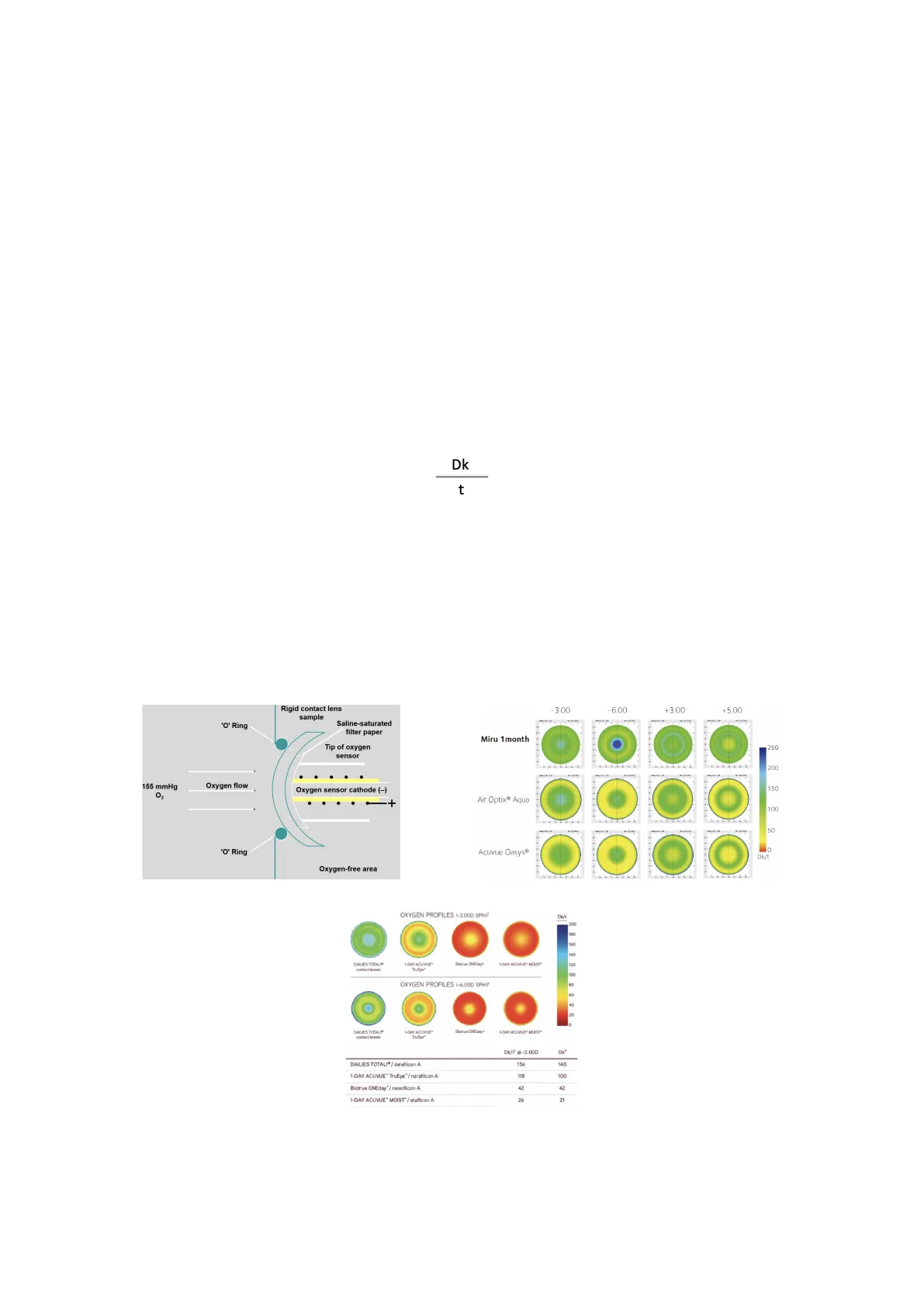
b. OXYGEN TRANSMISSIBILITY (Dk/t) Dk t t is thickness, and may be considered central thickness of the CL or average thickness (then it is known by L: Dk/L). Commonly measured for a -3.00 D lens. e.g .: Dk/t=8.9x10-9 (cm/s) (ml O2/ml x mmHg) @ 25℃ Lab measurement:
Rigid contact lens sample 'O' Ring Saline-saturated filter paper Tip of oxygen sensor 155 mmHg Oxygen flow Oxygen sensor cathode (-) . . -+ 100 50 Acuvue Oasys® Dk/t Oxygen-free area OXYGEN PROFILES (-3.00D SPH) Dk/t 200 160 DAILIES TOTALI contact lenses 1-DAY ACUVUE" TruEye" Biotrue ONEday" I-DAY ACUVUE" MOIST" 120 100 OXYGEN PROFILES (-6.000 SPHY 80 60 20 DAILIES TOTALI* contact lenses 1-DAY ACUVUE" TruEye" Biotrue ONEday" 1-DAY ACUVUE" MOIST" lo Dk/t+ @-3.00D DAILIES TOTAL1*/ delefilcon A 15€ 140 1-DAY ACUVUE^ TruEye^/narafilcon A 118 100 Biotrue ONEday"/ nesofilcon A 42 42 1-DAY ACUVUE^ MOIST*/ etafilcon A 26 21 -6.00 +3.00 +5.00 Miru 1month 250 200 150 Air Optix® Aqua 0 'O' Ring -3.00 - Positive lens: Thicker in the center than in the periphery. - Negative lens: Thicker in the periphery than in the center. 53- Lens with prismatic ballast: Thicker area. - Truncated lens: Zone of free passage of oxygen. - Bifocal lens: Denser addition segment and lower Dk/t. Remember that the cornea is not very generous: if a part receives more oxygen than needed, it does not distribute it to other poorer areas. Therefore, local areas of edema are possible, central in a positive lens, annular in a negative lens, inferior, etc.
Equivalent Oxygen Percentage (EOP)
c. EQUIVALENT OXYGEN PERCENTAGE (EOP) It is defined as the partial pressure of oxygen available at the corneal surface. - 21% with open eyes and no CL. - 8% with closed eyes and no CL. - But, what happens when a CL is in place? - Dk/t of the CL. - Diameter of the CL: smaller corneal rigid CLs, larger soft CLs, very large scleral CLs. - Movement of the CL: increased in corneal rigid CLs. - Much reduced in CLs worn at night (e.g., orthokeratology). If lens diameter and movement are not considered, only Dk/t: EOP Dk/t EOP = 6.915 x In (Dk/t x 109) - 9.778 Holden & Mertz, 1984 (obtained with the Dk/t values of 1984!)
Edema Prevention: Oxygen Needs
d. EDEMA PREVENTION: HOW MUCH O2 IS NEEDED? Avoid corneal edema in daily wear of CLs (10% O2): 24 e-9 units. (Latest estimations: between 19.8 and 32.6 e-9 to avoid swelling with soft CLs). Avoid corneal edema in overnight wear of CLs: 87 e-9 units. Compromise: nocturnal edema of 8% (double increase in corneal thickness): 34.3 e-9 units. - This value assumes that during the next day all edema will be resolved and the following night will start with 0% edema. - To avoid edema adding upon successive nights of CL wear. 54
CL Wearing Schedules
e. CL WEARING SCHEDULES Daily wear: we wear CLs from morning to night. Sporadic overnight wear: we sleep with the CLs 2 or 3 nights a week, not consecutive. Continued or planned overnight wear: we wear CLs without removing them from the eyes from a week to up to a month (not recommended).
CL Replacement Schedules
f. CL REPLACEMENT SCHEDULES Daily replacement (disposable): we wear CLs from morning to night and discard them at night. Weekly, monthly replacement: we wear CLs from morning to night and clean + disinfect overnight, replace at the end of week / month / 15 days ... Other replacement: for example orthokeratology, scleral lenses, rigid corneal lenses, commonly are replaced at longer intervals (6 months or more). Need daily cleaning and disinfection overnight.
LLENÇAR LES LENTŠ DE CONTACTE A L' AIGUERA CONTAMINA ELS OCEANS resta . 45 million people in the U.S. wear contact lenses . 15-20% of contact wearers flush lenses down the sink or toilet . An estimated 6-10 metric tons of plastic lenses end up in wastewater in the U.S. each year . In wastewater treatment, lenses likely breakdown to form microplastics . Microplastics pose risk to aquatic organisms, marine animals, and entire food supply optic ax men.org
CL Wettability, Contact Angle
g. CL WETTABILITY, CONTACT ANGLE Sessile drop: a) Water Advancing Angle b) Water Receding Angle we we. AA ++ + RA Tear film spreading over CL on eye opening Tear film stability over CL between blinks Captive bubble: 55
· CERAMICA, FREGALLS DRAPS, GUANTS . EXCREMENTS D'ANIMALS . BOLQUERS I COMPRESES POLS D'ESCOMBRAR CENDRES I RESTES DE CIGARRETA. Si les llencem a la brossa, ho podem evitar.A B lens surface Air water Olet Oright air H2O lens surface CL wettability: - Surface tension of a liquid: tendency of the molecules to adhere to each other. Liquid aims at reducing surface exposed to air. Ideally, it would form spherical droplets. - Low surface tension is required for a liquid to wet a solid surface (to spread over the solid surface). More molecules of liquid need to move from the center of the droplet to its surface. If surface tension is high, this would require lots of energy, so liquid does not spread. - Wetting agents (e.g., surfactants) increase spreading of liquid over solid surface by lowering its surface tension. - CLs are distributed in blisters filled with liquids made of different components that may increase wettability ... but ... once in the eye, they are in contact with the tear film. - Tear film surface tension is 2/3 that of saline, so it may spread more easily over the CL ... in a new CL. - CL with deposits may drastically reduce its wettability. - CL wettability may be increased with: - Internal wetting agents (monomers added to the mix, such as GMA, NVP, PVA). - Surface wetting agents. - Release of wetting agents from the interior of the CL to the surface with each blink (such as PVA). Some of these may be added to solutions so that during the night they are absorbed into the CL to be released to the eye during daily wear (mostly during the first 1.5h). Biofinity' multifocal CooperVision® ACUVUE OASYS BRAND CONTACT LENSES HYDRACLEAR PLUS AIR OPTIX plus HydraGlyde Alcon a Novartit company SMMARTSHEL TECHNOLOGY UV ROCKING
Elastic (Young's) Modulus
h. ELASTIC (Young's) MODULUS How will the CL deform once placed on the ocular surface. Will influence how much corneal astigmatism is corrected with the tear film, comfort, etc. 56
Ojeft Oright20 Elastic (Young's) Modulus - MPa values 70 1.60 1% WC - Modulus - 1.40 1.06 1.20 1.0 0.82 0.70 Water content (%) Modulus (MPa) 0.40 0.20 0.0 ACUVUE" ADVANCE" ACUVUE" OASYS* Biofinity® AIR OPTIX" PureVision® AIR OPTIX" AQUA O Night&Day AirOptix PureVision OASYS Advance Biofinity Acuvue2 Proclear
Coefficient of Friction (Lubricity)
i. COEFFICIENT OF FRICTION (Lubricity) How easy is for the eyelid to move over the CL. Depends on surface properties, wettability ... Greatly influences comfort, LWE ... 0.5 Contact Angle 0.423 0.4 0.382 0.3 0.222 0.2 0.1 Lid wiper 0.042 0.018 0.0 ACUVUE® OASYS® ACUVUE® ADVANCE" Biofinity® AIR OPTIX® AQUA AIR OPTIX* NIGHT & DAY* PureVision® 1. JJVCData on file 2005 Out of Package After 4h Wear 2. MATERIALS TYPES 40s 50s 60s 70s 80s 90s 2000 PMMA RGP + silicone to increase Dk + water to improve Dk & comfort Hydrogel (HEMA based) Low water High water - lonic *Non-ionic + silicone to increase Dk + surface treatment to resist deposit Silicone Hydrogel
MATERIALS TYPES
PMMA
a. PMMA - Patented: 1934. - Easy to manufacture and polish. - Easy to maintain. - Dk O2=0. - Not used nowadays.
Gas Permeable Materials
b. GAS PERMEABLE MATERIALS 57
Bausch + Lomb Oasys Biofinity Air Optix Aqua Totalt (A) Out of Package After 4h Wear Upper eyelid Coefficient of friction (after 100 cycles) Ultra Oasy Biofinity Air Optix Aqua Total Static Coefficient of Friction 0.5 0.4 0 (B) 1.52 1.50 1.5 50 1.00 0.80 0.5 0.39 0.60 AQUA NIGHT & DAY* 0.050 Bausch + Lomb- Addition of fluorine monomer to siloxane acrylate (MMA + siloxane monomer). - Less surface charge (less attraction to certain proteins). - Dk O2=40 to 100+. - Good wettability. - Lower modulus of elasticity (higher flexibility). - Surface is more easily damaged (careful with more abrasive cleaning systems). Boston IV A GP lens material suited for daily wear use. Available in a wide range of parameters to suit most fitting situations. Indications/Features · Myopia . Hyperopia http://www.bausch.com/ · Astigmatism . Daily wear Material Properties Trade Name: Boston IV Material Name: itafocon B Oxygen Permeability (Dk): 19* Wetting Angle: (Captive Bubble) 17 deg. Hardness: (Rockwell R) 117 Saline Absorption: 1.0% Refractive Index: 1.469 Specific Gravity: 1.10 Tint Blue, Electric Blue, Clear *polarographic method (ISO/Fatt) Boston Equalens II A high Dk gas permeable (GP) lens material formulated for daily or extended wear. Available in a wide range of parameters to suit most fitting situations. Indications/Features · Myopia . Hyperopia · Astigmatism . Daily wear . Extended wear . Overnight Orthokeratology Material Properties Trade Name: Boston Equalens II Material Name: oprifocon A Oxygen Permeability (Dk): 85* Wetting Angle: (Captive Bubble) 30 deg. Hardness: (Rockwell R) 114 Saline Absorption: 1.0% Refractive Index: 1.423 Specific Gravity: 1.2 Tint Blu *polarographic method (ISO/Fatt) DESCRIPTION INDICATIONS MATERIAL CHARACTERISTICS MATERIAL CHARACTERISTICS Daily Wear . Lathe cut . Molded firm Bifocal Luminous Transmittance+ (Crystal Blue) 98% Lenses with diameters of 7.0 mm to 10.5 mm are available for extended wear . Spherical, aspheric, bifocal or toric anterior and/or posterior Toric Myopia Luminous Transmittance (Violet) 97% Lenses with diameters of 7.0 mm to 21.0 mm are available for daily wear Extended Wear . Lathe cut . Molded firm contact lenses with spherical or aspheric anterior or posterior surfaces in tinted versions. Hyperopia Luminous Transmittance+ (Sapphire Blue) 95% Center Thickness 0.05 to 0.07 mm Astigmatism Presbyopia Luminous Transmittance+ (Emerald Green) 95% Base Curve 6.50 to 9.00 mm Keratoconus Pellucid Marginal Degeneration Luminous Transmittance+ (Forest Green) 90% Powers Daily Wear -20.00 to +12.00 Diopters Material is thermoset copolymer derived from fluorosilicone acrylate monomers. Wetting Angle 14.7º Powers Extended Wear -20.00 to +8.00 Diopters May be plasma treated. Following Penetrating Keratoplasty, Radial Keratotomy, or LASIK Surgery (Receding Angle)++ Wetting Angle 62 Bifocal Add Powers +0.25 to +4.00 Diopters Non-Diseased Eyes (Contact Angle)+++ Specific Gravity 1.16 Monocentric Bifocal Add Diameter 4.0 to 9.0 mm Hardness (Shore D) 8.4 Monocentric Bifocal Prism 1.0 to 2.5 Diopters Water Content < 1% Concentric Bifocal Add Diameter 2.0 to 4.0 mm Oxygen Permeability* 40 x 10-11 Dk at 35° C + Determination of the Spectral and Luminous Transmittance, ISO8599: 1994 ++ Method adapted from article; A New Method for Wetting Angle Measurement; M. Madigan, B. Hol,den and D. fong; International Eyecare, 01/1998, vol. 2, no. 1, p. 45 +++ Sessile Drop Technique per ANSI Z80.20, 8.11 *(cm2/sec)(mL. 02)/ (mL x mm Hg) ISO/ANSI Method, ISO 9913-1 Paragon HDS® (paflufocon B) Refractive Index 1.449 (n, at 25° C) Chord Diameter 7.0 to 21.0 mm . A peripheral curve system on the posterior surface allows tear exchange between the lens and the cornea. Daily & Extended Wear 58
Can’t find what you’re looking for?
Explore more topics in the Algor library or create your own materials with AI.
