Controlled Drug Part 5: Classification, Custody, and Abuse Management
Slides from University about Controlled Drug Part 5. The Pdf covers various aspects of controlled drugs, such as their classification, safe custody, prescription, and the management of abuse. It is useful for university students.
See more15 Pages


Unlock the full PDF for free
Sign up to get full access to the document and start transforming it with AI.
Preview
CONTENT
Part 1
- Classification
" Governance and accountability
Part 2
- Safe custody
- Record keeping
Part 3
Prescribing Controlled Drugs
Part 4
- Dependence and misuse 1
Part 5
- Dependence and misuse 2
" Destruction of CD's
- Drug driving
Travelling abroad
Part 6
Obtaining Controlled Drugs
- Possession and supply
" Import and export
- Cannabis-based products for medicinal use in humans
Part 7
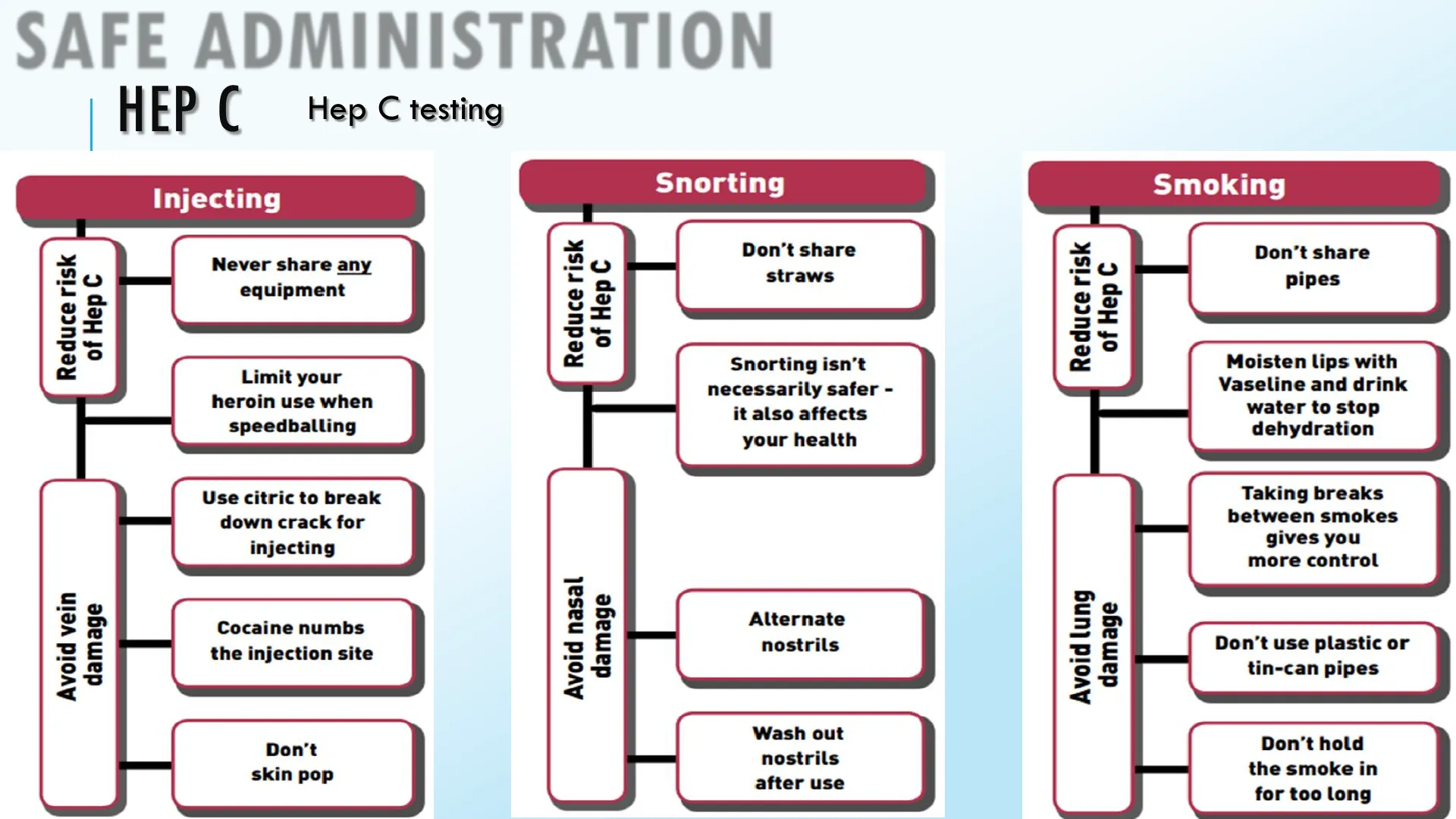
Formative practiceSAFE ADMINISTRATION
HEP C
Hep C testing
Injecting
Reduce risk of Hep C
Never share any equipment
Limit your heroin use when speedballing
Use citric to break down crack for injecting
Avoid vein damage
Cocaine numbs the injection site
Don't skin pop
Snorting
Reduce risk of Hep C
Don't share straws
Snorting isn't necessarily safer - it also affects your health
Avoid nasal damage
Alternate nostrils
Wash out nostrils after use
Smoking
Reduce risk of Hep C
Don't share pipes
Moisten lips with Vaseline and drink water to stop dehydration
Taking breaks between smokes gives you more control
Avoid lung damage
Don't use plastic or tin-can pipes
Don't hold the smoke in for too longInjecting
V Wash the site To clean a needle, draw up clean, cold water through it into the syringe barrel, flush it out again, and repeat. V Change needles V Avoid tap or bottled water Repeat the cleaning process with household bleach. V Use new filters Repeat the process with cold water again. V Don't share your needle, syringe, water, spoon or filter V Use a needle exchange service
Bacteria
Viruses
Dangerous injecting sites:
. Arteries, veins and capillaries
Vein damage
Injecting
. Neck . Breasts . Penis . Groin . Only inject in veins . Arteries have a pulse . How veins collapse
Overdose
Reduce the risk by:
Some drugs damage veins more than others:
- Call an ambulance (dial 999)
DVT
- Temazepam
. Check if they are breathing
- Crack/cocaine
. Do not leave them alone . Stop them rolling onto their back
V Don't mix drugs
. Pills/capsules . Too much acid . Tell the ambulance staff what they have taken
V Not injecting - snort, swallow, smoke or chase
If you see someone overdose:
V Take a test dose of drugs V Only inject half a barrel at a time V Inject with other people V Don't lick the needle
NEEDLE EXCHANGE
To provide harm reduction services to those over 18 years old users of: Opioids e.g. Heroin
>Stimulants e.g. Cocaine >Non prescribed anabolic steroids > Performance enhancing drugs
NEEDLE EXCHANGE SCHEMES
The Misuse of Drugs Regulations 2001 allows that healthcare professionals and persons employed or lawfully engaged in the provision of drug treatment services are authorised to supply certain drug paraphernalia without committing an offence under s9A of the Act.
NEEDLE EXCHANGE
Reduce BBV and other infections. Safer injecting practices.
" Avoiding an overdose.
" Safe disposal of injecting equipment.
" Other health and welfare services (including condom provision)
PROVISION
"Sterile needles and syringes "Sharps containers for return of used equipment "User friendly, Non judgemental, Client centred and confidential service.
GatewayPSYCHO ACTIVE SUBSTANCES
Meaning of "psychoactive substance"
Any substance which- (a)is capable of producing a psychoactive effect in a person who consumes it, and (b)is not an exempted substance (section 3 of act, see next slide) For the purposes of this Act a substance produces a psychoactive effect in a person if, by stimulating or depressing the person's central nervous system, it affects the person's mental functioning or emotional state; and references to a substance's psychoactive effects are to be read accordingly. For the purposes of this Act a person consumes a substance if the person causes or allows the substance, or fumes given off by the substance, to enter the person's body in any way.
EXEMPT SUBSTANCES
- Controlled drugs (within the meaning of the Misuse of Drugs Act 1971).
- Medicinal products.
- Alcohol or alcoholic products.
- Nicotine.
- Tobacco products.
- Caffeine or caffeine products.
- Food
COLLECTION OF DISPENSED CONTROLLED DRUGS
COLLECTING CONTROLLED DRUGS
When a Schedule 2 CD is collected from a pharmacy the pharmacist MUST determine if the person collecting it is: . The patient . The patients representative Healthcare professional
ACTIONS THE PHARMACIST SHOULD TAKE
Person
Action
PATIENT
Pharmacist MAY request evidence of identity unless already known to the pharmacist.
PATIENTS REPRESENTATIVE
Pharmacist MAY request evidence of identity unless already known to the pharmacist.
HEALTHCARE PROFESSIONAL
The pharmacist must obtain 1. Name of healthcare professional. 2. Address of healthcare professional. 3. May request evidence In the absence of evidence of identity the pharmacist has discretion over whether to supply or not.
RECORD KEEPING
CONTROLLED DRUGS REGISTER
CLASS OF DRUG: MORPHINE PRODUCT: ZOMORPH STRENGTH: 10mg FORM: MR capsules
| Date drug received | Name and address of person or firm from whom obtained. | Amount obtained | Date of supply | Name & address of person or firm supplied | Particulars as to the license or authority of person or firm supplied to be in possession | Amount supplied | Collected by (patient, representative or healthcare professional) | Proof of identity requested (Y/N) | Proof of identity provided (Y/N) | Balance |
| 15.1.21 | Browns Wholesalers 25 The Avenue, Portsea | 3 × 60 180 | 15.1.21 | Thomas Thompson 60 Malbec Road Portsea | Dr L McEwan FP10 | 120 | patient | N | N | 60 |
ADMINISTRATION
* *Additional measures and restrictions may be put in place i.e. in prison
Schedule 1 only administered or prescribed under licence Schedule 2,3 or 4 can be administered to a patient by: . Doctor or dentist . Pharmacist or nurse independent prescriber . Supplementary prescriber acting in accordance with a CMP A person acting in accordance with the directions of a prescriber · e.g. hospital MAR
DESTRUCTION OF CONTROLLED DRUGS
Patients can destroy CDs themselves Pharmacist may destroy patient-returned CDs In any other circumstance destruction by a pharmacist of a Schedule 1 or 2 must be witnessed by an authorised person. (Records must be kept) When destroying CDs you must comply with the current legal requirements SOPs MUST in place for the documentation of returned CDs and their destruction
DENATURING CDS
Schedule 2, 3 and 4 (part 1)
CDs should be denatured before disposal · Home Office. Denaturing renders CD irretrievable before being placed in pharmaceutical waste container and sent for incineration. Environment Agency T28 exemption .* Guards against misuse of drugs, harm to environment or people and prevention of supply.
RECORDS OF CD DESTRUCTION
Record in CD register or Patient Returns Record Book Name, form and strength of CD Quantity Date destroyed Signature of professional destroying it Signature of authorised person who witnessed destruction
AUTHORISED WITNESS TO CD DESTRUCTION
Police officer UGPhC inspector OChief pharmacist or prescribing advisor who reports directly to chief executive or director Medical director of CCG Senior executive member of organisation
METHODS OF DENATURING CDS
| Dosage form | Method of destruction |
| Tablets | Crush before adding to denaturing kit |
| Oral liquid | Pour into denaturing kit |
| Ampoules | Empty liquid contents into denaturing kit, or add water to dissolve powder contents and empty mixture into denaturing kit. Dispose of ampoule or vial as sharps pharmaceutical waste |
| Patches | Remove backing and fold patch over, place into denaturing kit or pharmaceutical waste bin |
| Spent methadone bottles | Rinse bottle and add liquid to denaturing kit |
SPILT METHADONEDRUG DRIVING
DOffence of driving whilst impaired through drugs, Section 4 of Road Traffic Act 1988. DA new offence of driving with certain specified controlled drugs in excess of specified levels came into force in March 2015 in England and Wales.
2 groups of drugs
COMMONLY ABUSED DRUGS
Commonly abused drugs E.g. cannabis, MDMA, ketamine, cocaine, LSD, heroin, methylamphetamine Very low limits have been set.
LICENSED MEDICINES
Licensed medicines that have a significant liability to be abused. E.g. clonazepam, diazepam, temazepam, lorazepam, oxazepam, flunitrazepam, methadone, morphine, amfetamine These have limits which are generally above the normal therapeutic range. Patients prescribed or advised by a healthcare professional to take these for medical use could test above the limits but would be able to use the statutory 'medical defence'.
ADVICE TO PATIENTS
Do not drive if impaired. Patients who are prescribed drugs which are covered by the new law should keep suitable evidence with them when they drive which shows the medication is being taken in accordance with the directions of a healthcare professional.
TRAVELLING ABROAD
IMPORT AND EXPORT
Licences are needed for Schedules 1, 2, 3 & 4 (part 1) Licence not needed for Schedule 4 (part 2), if by a person for self- administration No restriction for Schedule 5
www.gov.uk/travelling-controlled-drugs
* Jo Update ... GOV.UK Search on GOV.UK Q > Coronavirus (COVID-19) | National lockdown: stay at home -> Brexit | Check what you need to do Home > Passports, travel and living abroad > Travel abroad
Bringing medicine containing a controlled drug into the UK
You need to prove your medicine is prescribed to you if: . it contains a 'controlled drug' . you have it on you when you're entering the UK What sort of proof you need depends on the category of drug and how much of it you're bringing in. Related content Controlled drugs: personal licences Bringing food, animals or plants into Great Britain Bringing goods into the UK
TRAVELLING TO UK
Schedule 2, 3 or 4 (part 1) CDs
Persons travelling for < 3 months do not generally need to obtain licence " automatic covered under the provision of a Home Office general licence " carry letter of proof from prescribing doctor. Persons travelling for > 3 months require personal export/import licence. Personal export/import licences comply with UK Customs and Excise control, not necessarily other countries visited.
Schedule 5 or 4 (part 2) CDs
. Carry proof medicine prescribed . Keep medicines in original, correctly labelled packaging
TRAVEL OUTSIDE THE UK
Carry proof medicine prescribed Keep medicines in original, correctly labelled packaging Check rules and regulation for countries visited and transited - website / embassy
NEXT STEPS
Good reference sources: nhs.uk - Can I take my medicine abroad? gov.uk - travel abroad
Can’t find what you’re looking for?
Explore more topics in the Algor library or create your own materials with AI.
