Final Exam Direccion De Personas: Strategic Human Resources Management
Document from University about Final Exam Direccion De Personas. The Pdf explores strategic human resources management, covering its definition, importance for competitive advantage, and various organizational strategy levels. This University-level material in Economics, produced for a final exam, also details approaches to Strategic HRM and employee dismissal strategies.
See more26 Pages


Unlock the full PDF for free
Sign up to get full access to the document and start transforming it with AI.
Preview
Strategic Management of Human Resources
What is Strategic HRM?
· What is Strategic HRM? . It refers to all actions that affect people's behavior when a company formulates and implements its strategy. · Strategic HRM links people management decisions (e.g., hiring, training, rewarding) to the long-term strategic objectives of the organization. "Decisions regarding the orientation of HR processes that influence individual behavior, considering internal and external organizational factors."
Why is HR Strategy Important?
. Why is HR Strategy Important? . Human resources are a critical asset for achieving competitive advantage. · Aligning HR policies with company strategy: o Improves organizational performance. ○ Encourages employee commitment and capability. ○ Increases strategic agility and innovation.
Organizational Strategy Levels and HR's Role
- Corporate Strategy: Overall direction and scope (e.g., expansion, diversification).
- Business Strategy: How each business unit competes (e.g., cost leadership, differentiation).
- Functional Strategy: Departmental support to achieve higher-level goals (e.g., HR, Marketing, Operations).
- HR strategy is a functional strategy but must align with business-level and corporate-level strategies (this is called vertical alignment).
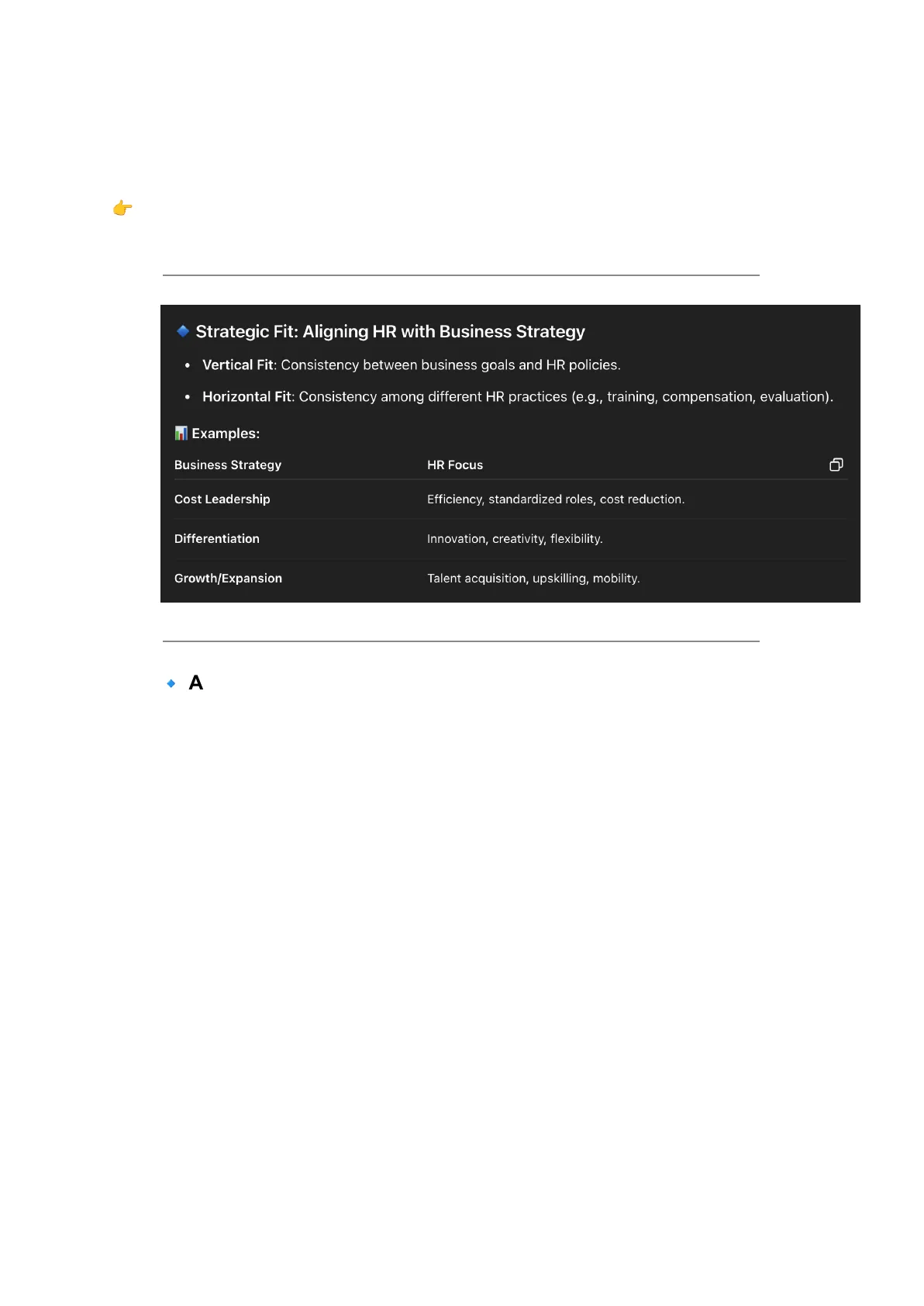
Strategic Fit: Aligning HR with Business Strategy
· Vertical Fit: Consistency between business goals and HR policies. · Horizontal Fit: Consistency among different HR practices (e.g., training, compensation, evaluation).
Examples of Business Strategy and HR Focus
Business Strategy HR Focus Cost Leadership Efficiency, standardized roles, cost reduction. Differentiation Innovation, creativity, flexibility. Growth/Expansion Talent acquisition, upskilling, mobility.
Approaches to Strategic HRM
- Best Fit Model (Contingency Approach) . HR strategy depends on the context: business model, market, technology, culture, etc. . There's no one-size-fits-all; the goal is coherence with external conditions.
- Best Practice Model (Universalist Approach) . There are universal HR practices that work well regardless of context: ○ Selective hiring o Internal promotions ○ Performance-based rewards ○ Extensive training ○ Employee involvement Criticism: Doesn't consider company-specific factors.
Characteristics of Strategic HRM
· Long-term perspective: Develop future talent and leadership. · Proactive: Anticipate challenges (e.g., digital transformation, globalization). · Integrative: Coordinates with all departments and business units. . Performance-oriented: Measures HR's impact on strategic outcomes.
Summary: What You Need to Remember about Strategic HRM
· Strategic HRM is about making people decisions with a strategic purpose. · The alignment between business goals and HR policies (vertical fit) is essential. . There are two main approaches: adapting HR to the company's strategy (Best Fit) or applying high-performance practices in all contexts (Best Practice). . HR should act as a strategic partner, not just an administrative function.
Planning of Human Resources Needs
What is HR Planning?
. Definition: Process of forecasting and ensuring the right number of employees, with the right skills, at the right time. . It transforms organizational strategy into HR action plans to support business goals.
Key Goals of HR Planning
· Anticipate future HR needs . Avoid staff shortages or surpluses . Align workforce with strategic plans
Why Is HR Planning Important?
Benefits of HR Planning
. Reduces staff turnover, absenteeism, and training & hiring costs . Ensures workforce readiness for technological change . Improves employee development and organizational performance · Supports strategic alignment with other departments (e.g., marketing, finance)
Why Some Companies Don't Do It
· Difficulty in quantifying planning value . Focus on short-term financial or production goals . Lack of knowledge or HR departments
HR Planning Must Answer
· Are job roles clearly defined and structured? . Is recruitment effective and efficient? · Are future skills being developed? · Can employees adapt to changes (e.g., tech)? . What skills will be needed-and how to acquire them?
Stages of Human Resources Planning
Stage 1: Workforce Analysis & Forecasting
1. Inventory of current staff (qualifications, turnover, absenteeism) 2. Forecasting needs: ○ Qualitative: Expert judgment (e.g., Delphi method) ○ Quantitative: Regression, time series, learning curves 3. Labour market analysis (internal vs. external) 4. Budgeting: Convert HR needs into monetary terms
Stage 2: Define HR Goals & Policies
· Translate forecasts into HR policies (e.g., hiring, training) . Align with company-wide goals · Determine: ○ If new hires are needed ○ If staff reductions are necessary
Stage 3: Scheduling
. Set timelines for recruitment, training, and internal movements . Use survival rates to estimate turnover and predict vacancies
Stage 4: Control & Evaluation
· Compare actual outcomes vs. forecasted: ○ Staffing levels ○ Productivity ○ Budget compliance · Evaluate ROI of HR plans (results vs. costs)
Employee Dismissal Strategies
Reasons for Dismissal
· Cost reduction · Low performance · Mergers or downsizing . Voluntary exits or early retirement
Costs of Dismissals
. Recruitment & training costs lost · Severance pay, orientation, relocation · Drop in productivity
Alternatives to Dismissal
- Labour Policies: · Hiring freeze, part-time contracts, natural attrition
- Job Design: · Relocation, transfer, job sharing, demotions
- Compensation Policies: · Salary cuts, bonus reduction
- Training: · Retraining, upskilling, internal mobility
Final Takeaways on HR Planning
. HR planning connects strategic vision with people management. . Its value lies in anticipation, efficiency, and alignment. . Planning must be data-driven but also flexible to adjust to market and internal shifts. · Effective planning reduces risk, supports growth, and enhances organizational resilience.
Structure Management and Workflow
Organizational Structure and Workflow Overview
Why do companies organize internally?
· Assign clear roles and responsibilities . Facilitate coordination and task flow . Avoid role ambiguity and internal conflicts · Improve efficiency (resource use) and effectiveness (goal achievement)
Organizational Structure = Pattern of formal/informal relationships used to meet company goals Workflow = The flow (tangible & intangible) of tasks, materials, information, and decisions across departments . It moves horizontally and vertically . Includes decision, information, and material flows
Types of Organizational Structures
- Linear (Simple) · Small businesses, low cost, high flexibility · Owner = decision maker · Close superior-subordinate relationships
- Departmental Organization · By function (e.g., HR, Finance) · By product (e.g., shoes, electronics) · By territory (e.g., Spain, France) · By customer type (e.g., B2B, B2C)
- Matrix Organization · Dual authority: by project + department . Cross-functional teams, temporary resource allocation · Requires strong coordination
- Others . Circular: central authority surrounded by concentric layers · Hybrid: combines multiple types · Clover: includes flexible work, outsourcing, customer self-service · Network: outsourcing-based, decentralized
Job Analysis and Description
Job Analysis: Describes the purpose, tasks, conditions, and required skills for a job -> Produces a Job Description Document
Why is Job Analysis Useful?
· Supports restructuring · Clarifies hierarchy and authority · Adjusts workforce size . Evaluates individual and group performance · Guides new hires and career development
Job Description Sheet Parameters
1. Job title 2. Department/Area 3. Summary and objectives 4. Tasks and responsibilities 5. Required knowledge, skills, attitudes 6. Job context 7. Supervision given/received 8. Analysis date
Applications of Job Descriptions in HR
Job descriptions impact:
| Area | Application |
|---|---|
| @ Organizational Goals | Job roles reflect company objectives |
| Technology | Adjusts job content, increases or reduces complexity |
| HR Planning | Matches talent supply to company needs |
| 2 Recruitment & Selection | Defines candidate profile for vacancies |
| Performance Evaluation | Basis for assessing performance and training needs |
| š Compensation | Ensures internal and external pay equity |
| Career Planning | Helps employees identify steps for promotion |
| A Health & Safety | Assesses ergonomic and psychosocial risks from tasks. |
Job Analysis Methods
Data Collection Techniques
· Observation, interviews, expert meetings, employee diaries, tests
Structured Job Analysis Methods
· Focused on position: ○ FJA, MPDQ, JIMS, OAI, Method Analysis, Hay Plan · Focused on person: 0 PAQ, PAA, CIT
HAY Method
· Compares jobs using factors like: ○ Competence (technical, planning, communication) ○ Problem solving (complexity) ○ Responsibility (freedom, impact, scope)
HR Information Systems (HRIS)
Definition of HRIS
Systems that record, store, and manage HR data to improve decision-making and efficiency.
Advantages of HRIS
· Reduces costs · Accelerates processes . Provides real-time insights · Enhances decision-making
Applications of HRIS
· Payroll, fringe benefits · Selection, training, development · Communication (email, intranet) . Enterprise tools: SAP, Meta4, Delt@, Contrat@
Final Takeaways on Structure Management
· An effective structure + clear job descriptions = better performance and strategic alignment . Job analysis supports planning, recruitment, evaluation, compensation, safety . HRIS enhances all HR functions through automation and data
Recruitment, Selection, and Induction
The Hiring Process Phases
1. Recruitment - Attracting candidates 2. Selection - Choosing the best fit 3. Induction - Integrating the new hire All steps must align with staff planning and the job description previously developed.
Associated Costs of Hiring
· Recruitment ads, tests, interviews · Orientation and training . Vacancy cost and productivity gap
Hiring Challenges
· Defining and assessing key competencies · Measuring motivation . Deciding who makes the final decision · Involving department heads to ensure retention
Recruitment Definition and Objectives
Definition: Process to attract and locate qualified candidates for open positions. Objectives:
Can’t find what you’re looking for?
Explore more topics in the Algor library or create your own materials with AI.
