Psicología Social: Actitudes y Comportamiento en la UNAM
Diapositivas de UNAM Universidad Del Atlántico Medio sobre Psicología Social. El Pdf explora la conexión entre creencias y comportamiento, las teorías de auto-presentación, auto-justificación y auto-percepción en el ámbito universitario de Psicología.
Ver más23 páginas

Visualiza gratis el PDF completo
Regístrate para acceder al documento completo y transformarlo con la IA.
Vista previa
Psicología Social: Comportamiento y Actitudes
UNAM
UNIVERSIDAD DEL
ATLÁNTICO MEDIO
Psicología Social
UNIDAD IV
PARTE I
Comportamiento & actitudes
Dra. Hande Musullulu
hande.musullulu@pdi.atlanticomedio.es
Introducción a las Actitudes
- Relación entre lo interno (actitudes) y lo externo
(comportamiento) - especulación de filósofos,
teólogos y educadores
. Suposición de los psicologos sociales:
creencias y sentimientos privados moldean el
comportamiento público
6
AGRESIVA
7
PASIVA
14 FLEXIBLE
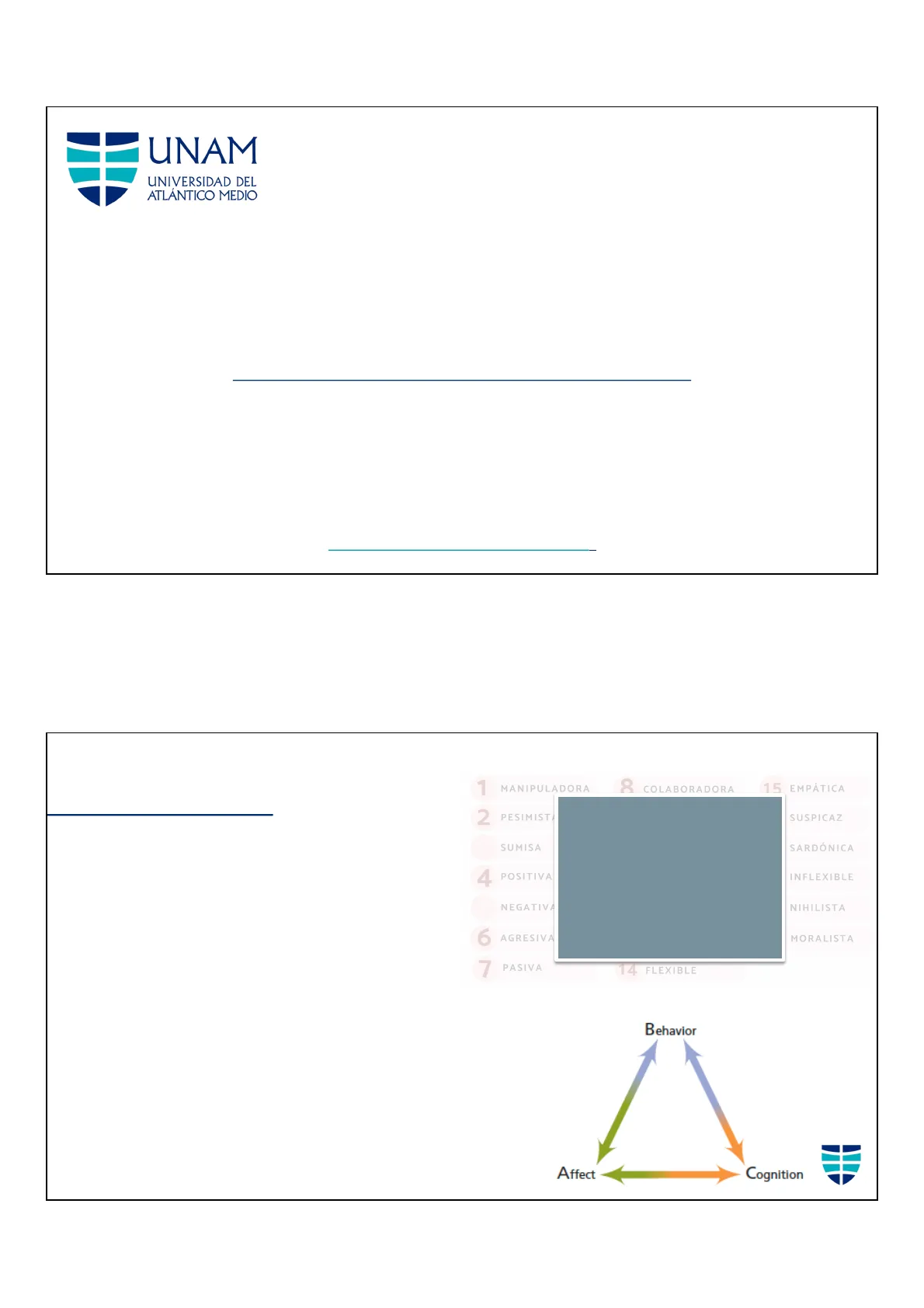
- Definición de actitudes: creencias, sentimientos
y tendencias de comportamiento - Eficiencia de las actitudes en la evaluación del
mundo - ABC de las actitudes: Afecto, tendencia de
comportamiento (Behaviour), Cognición
1
MANIPULADORA
& COLABORADORA
15 EMPÁTICA
2
PESIMISTA
Actitud
SUSPICAZ
SUMISA
SARDONICA
4
POSITIVA
INFLEXIBLE
NEGATIVA
Una reacción evaluativa favorable
y
uno,
o desfavorable hacia algo o
alguien (a menudo arraigada en
las
creencias
de
manifestada en los sentimientos y
el comportamiento pretendido de
uno).
NIHILISTA
MORALISTA
Behavior
Affect
Cognition
Actitudes: La Conexión entre Creencias y Comportamiento
Actitudes y Acciones: Predicción del Comportamiento
¿Hasta que punto, y en qué condiciones, las actitudes del corazón impulsan nuestras acciones exteriores?
¿Por qué sorprendió al principio a los psicólogos sociales la aparentemente escasa relación entre actitudes y acciones?
Las actitudes expresadas por las personas apenas predijeron
sus diferentes comportamientos (Allan Wicker en 1969):
- Las actitudes de los estudiantes hacia el engaño tenían poca
relación con la probabilidad de que realmente hicieran trampas. - Las actitudes hacia la iglesia sólo estaban modestamente
relacionadas con la asistencia a la iglesia un domingo cualquiera. - Las actitudes raciales autodescritas daban pocas pistas sobre los
comportamientos en situaciones reales.
El estudio de Batson et al. (1997)*
Actitudes: Cuando las Actitudes Predicen el Comportamiento
Influencias Sociales Mínimas en las Actitudes
CUANDO LAS INFLUENCIAS SOCIALES SON MINIMALES
- actitudes implícitas (inconscientes)- se forman a una edad temprana
- actitudes explícitas (conscientes)- influencia mas social
Medición de Actitudes
¿Cómo las medimos?
- microsonrisa, microfruncimiento de ceño, etc.
- Prueba de asociación implícita (IAT)
- Esta prueba utiliza los e las personas entre objetos de actitud y
palabras evaluativas.
-
Se considera que los emparejamientos mas faciles (y las respuestas
más rápidas) indican asociaciones inconscientes más fuertes.
tiempos de reacción para medir las asociaciones automáticas d
implícita
1
PROCESAMIENTO
DUAL
explícita
v
- Las actitudes raciales implícitas han predicho con exito las relaciones interraciales entre compañeros de piso.
comportamiento de consumo, apoyo a candidatos políticos, etc. - los autoinformes explícitos son el mejor indicador - alta activación de la amígdala en reacciones implícitas*, y el lóbulo frontal para regular y identificarlas
- El IAT no es tan fiable como se cree
Actitudes: Cuando las Actitudes Predicen el Comportamiento
Influencias Mínimas sobre el Comportamiento
CUANDO OTRAS INFLUENCIAS SOBRE EL COMPORTAMIENTO SON MÍNIMAS
- El comportamiento no sólo se ve influido por actitudes internas, sino también por factores
situacionales. - Las influencias sociales pueden ser lo suficientemente importantes como para hacer que las personas
actuen en contra de sus creencias fundamentales. - Predecir el comportamiento individual es un reto debido a diversos factores, similar a predecir el
bateo de un jugador de beisbol o cricket.
Actitudes: Cuando las Actitudes Predicen el Comportamiento
Actitudes Específicas del Comportamiento
CUANDO SE EXAMINAN ACTITUDES ESPECÍFICAS DEL COMPORTAMIENTO
Actitud hacia el
comportamiento
"Estoy a favor de la
forma física"
Normas subjetivas
"Parece que mis
vecinos hacen footing
Intención de
comportamiento
"Voy a empezar la
semana que viene"
Comportamiento
y van al gimnasio"
Control percibido
"Yo podría hacer
esto fácilmente"
La teoría del comportamiento planificado
Icek Ajzen, en colaboración con Martin Fishbein, ha demostrado que a) las actitudes, b) las normas
sociales percibidas y c) los sentimientos de control determinan las intenciones que guian el
comportamiento.
En comparación con sus actitudes generales hacia un estilo de vida saludable, las actitudes específicas
de las personas hacia el footing predicen mucho mejor su comportamiento al respecto.
Actitud hacia la
conducta
Norma Subjetiva
Intención
Conducta
Control Percibido
Actitudes: Cuando las Actitudes son Potentes
Comportamientos Automáticos y Autoconciencia
CUANDO LAS ACTITUDES SON POTENTES
- La mayoría de nuestros comportamientos son automáticos
- Descuidos, comportamientos habituales
Autoconciencia- estudio: - - "Edward Diener y Mark Wallbom (1976) observaron que casi todos los estudiantes universitarios afirman que
copiar en el examen es moralmente incorrecto. - A los estudiantes de la Universidad de Washington se les asignó una tarea de resolución de anagramas (que,
según se les dijo, era para predecir el coeficiente intelectual) y se les dijo que pararan cuando sonara una campana
en el aula. - Si se les dejaba solos, el 71% hacía trampas y se pasaba del timbre. Entre los estudiantes que se hicieron
conscientes de sí mismos -trabajando frente a un espejo mientras ofan sus propias voces grabadas- hizo trampas.
sólo el 7%.
Esto nos hace preguntarnos: ¿ Los espejos a la altura de los ojos en las tiendas harían que la gente fuera más consciente
de su actitud ante el robo?".
Research Close-Up: Actitudes Prejuiciosas Predicen Comportamiento Discriminatorio
research
CLOSE-UP
You've Not Got Mail: Prejudicial Attitudes
Predict Discriminatory Behavior
We have seen that strongly held attitudes predict specific
actions, especially when the actions are unconstrained
by social pressures. After 9/11, some people formed
strongly felt attitudes regarding Arabs. That led Univer-
sity of Michigan social psychologist Brad Bushman and
his co-researcher Angelica Bonacci (2004) to wonder
how strongly attitudes toward Arab Americans mightinfluence unconstrained behavior toward them. They
wanted to assess the race-relevant attitudes of univer-
sity students and then, some time later, to correlate their
expressed attitudes with their natural behavior in a situa-
tion offering anonymity. (Any ideas as to how you might
have done that?)
Their strategy was, first, to embed eleven attitude
statements about Arab Americans in a set of question-
naires administered to nearly 1,000 introductory psy-
chology students early in their spring 2002 semester.
Using a 1 ("strongly disagree")-to-10 ("strongly agree")
scale, the students responded to statements such as
these :
- "A major fault of Arab Americans is their conceit,
their overbearing pride, and their idea that they are a
chosen ethnic group." - "If there are too many Arab Americans in America,
our country will be less safe." - "If I knew I had been assigned to live in a dorm
room with an Arab American, I would ask to change
rooms."
Among the many other questions the students
answered was one asking if they would be willing to par-
ticipate later in an "unsolicited e-mail study." With their
attitudes now measured, and their informed consent
granted, more than 500 of these students (all European
American) would, two weeks later, unwittingly partici-
pate in a clever experiment. Each person received an
e-mail addressed to an individual with an Arabic name
(Mohammed Hameed for male participants and Hassan
Hameed for female participants) or to a European name
(Peter Brice or Jullianna Brice). Half the students received
an e-mail stating that the intended recipient had received
a prestigious scholarship that required acceptance within
48 hours:
Thank you for applying for a Glassner Foundation
Scholarship. These scholarships are highly competi-
tive and are given only to a few select individuals.
They cover tuition for four years. . . . Because of the
large number of applicants, this year we are late in
sending out these notices. .. . We are happy to inform
you that you have been selected to receive a Glass-
ner Foundation Scholarship. Congratulations! ... We
ask that you respond to this e-mail within 48 hours to
inform us whether you will formally accept our schol-
arship offer. [If not] we would like to extend offers to
other students on our waiting list. . . .
The other half were told the bad news: They did not
receive the scholarship (but were welcome to respond if
they wanted to be on the waiting list).
Had you received such a misdirected e-mail, without
knowing you were actually participating in an experi-
ment, would you have returned the e-mail to the sender,
noting the error so that it could be re-sent? Some 26 per-
cent of women but only 16 percent of men did so. And
did it matter who the intended recipient was?
As Figure 4.3 shows, it did indeed. The partici-
pants (who generally expressed stronger feelings of
prejudice toward Arab Americans than toward Afri-
can Americans, Asian Americans, or Hispanic Ameri-
cans) were less likely to reconvey the good news of the
scholarship award to intended recipients with Arabic
names. This discriminatory behavior was most strik-
ingly evident among those students who had earlier
expressed higher-than-average prejudice toward Arab
Americans. Moreover, as Figure 4.4 shows, the stu-
dents with highly prejudicial attitudes also were more
willing than were those low in prejudice to reconvey
bad news to Arabs. Thus, in the months after 9/11,
prejudicial attitudes did indeed predict subtle but rel-
evant discriminatory behavior.
(continued)
Percent
Conveying Good News
European target
Arab target
40
30
20
10
0
Low
High
Prejudicial Attitude
FIGURE :: 4.3
Effect of Prejudicial Attitudes on the Rate
of Reconveying Good News to Those with
European and Arabic Names
Percent
Conveying Bad News
European target
Arab target
40
30
20
10
0
Low
High
Prejudicial Attitude
FIGURE :: 4.4
Effect of Prejudicial Attitudes on the Rate
of Reconveying Bad News to Those with
European and Arabic Names
Comportamiento: ¿Cuándo Afecta Nuestro Comportamiento a Nuestras Actitudes?
Influencia del Comportamiento en las Actitudes
Comportamiento: ¿ Cuándo afecta nuestro comportamiento a nuestras actitudes?
- Comportamiento->actitudes
- A veces defendemos aquello en lo que creemos. Pero también creemos en lo que defendemos.
- El comportamiento influye en las actitudes, pero ¿influyen las acciones en las actitudes?
Sarah permanece hipnotizada y se le dice
que se quite los zapatos cuando cae un libro
al suelo. Quince minutos después cae un
libro y Sarah se descalza tranquilamente.
"Sarah", pregunta el hipnotizador, "¿por
qué te has quitado los zapatos?". "Bueno ...
tengo los pies calientes y cansados",
responde Sarah. "Ha sido un día muy
largo".
El acto produce la idea - Autopersuasión
A George le implantan temporalmente electrodos en
la región del cerebro que controla los movimientos de
su cabeza. Cuando el neurocirujano José Delgado
(1973) estimula los electrodos por control remoto,
George siempre gira la cabeza. Sin ser consciente de
la estimulación a distancia, ofrece una explicación
razonable para el giro de su cabeza: "Estoy buscando
mi zapatilla". "He oído un ruido". "Estoy inquieto".
"Estaba mirando debajo de la cama".
Autopersuasión
¿Non has encontrado lo que buscabas?
Explora otros temas en la Algor library o crea directamente tus materiales con la IA.