La Crisi Missilistica di Cuba: Armamenti, Diplomazia e Appeasement
Slide dall'Università sulla Crisi Missilistica di Cuba: gli Armamenti, la Diplomazia Americana e la Strada Verso L'appeasement. Il Pdf, utile per lo studio universitario di Storia, analizza la crisi missilistica cubana, le forze nucleari strategiche e il ruolo della diplomazia americana nel percorso verso l'appeasement.
Mostra di più42 pagine

Visualizza gratis il Pdf completo
Registrati per accedere all’intero documento e trasformarlo con l’AI.
Anteprima
Marc Vezzi - Relazione nell'ambito del corso Gli Stati Uniti nel contesto globale
Corso di LM in Studi storici dal Medioevo all'età contemporanea, a. a. 2018-2019
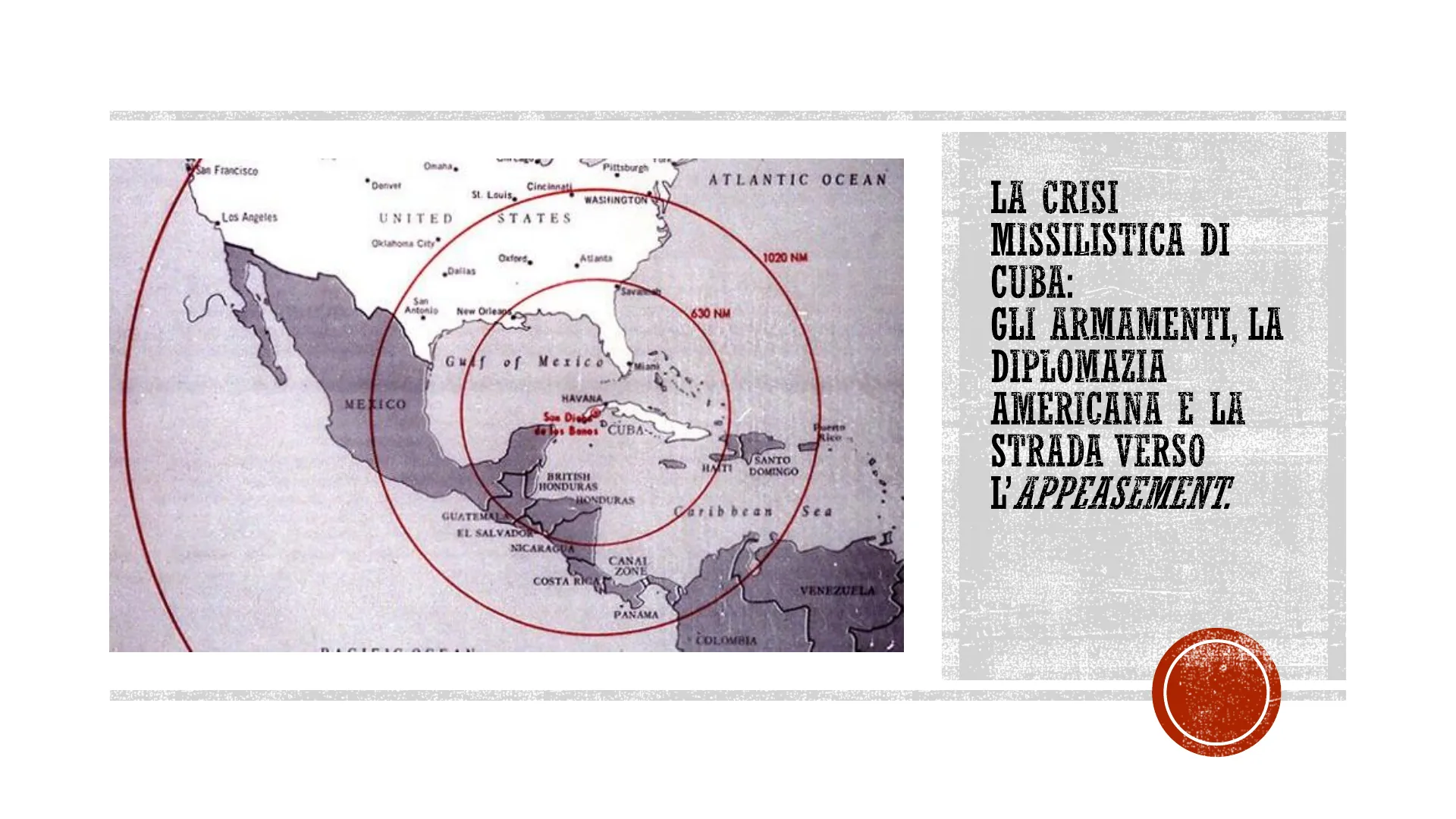
San Francisco Omaha. Pittsburgh · Denver Cincinnati St. Louis. WASHINGTON Los Angeles UNITED STATES Oklahoma City" Atlanta 1020 NM „Dallas San Antonio New Orleans 630 NM Gulf of Mexico HAVANA MEXICO · Son Dieb Te los Bonos CUBA .. Bueno Rico BRITISH HONDURAS HONDURAS Caribbean Sea GUATEMALA EL SALVADOR NICARAGUA CANAL ZONE COSTA RICA VENEZUELA PANAMA COLOMBIA
LA CRISI MISSILISTICA DI CUBA
GLI ARMAMENTI, LA DIPLOMAZIA AMERICANA E LA STRADA VERSO L'APPEASEMENT
ATLANTIC OCEAN VSANTO DOMINGOLA CRISI MISSILISTICA DI CUBA:
- Gli armamenti -> Ordine di battaglia nucleare
Norris R.S., Kristensen H.M., "The Cuban Missile Crisis: A nuclear order of battle, October and November 1962", Bulletin of the Atomic Scientists, 68(6), pp. 85-91, 2012.
- La diplomazia americana: il ruolo decisivo di Robert
Kennedy o un successo di squadra?
White M., "Robert Kennedy and the Cuban Missile Crisis: A Reinterpretation", American Diplomacy, 2007.
- La strada verso l'appeasement.
"Foreign Relations of the United States, 1961-1963", Volume VI, Kennedy Khrushchev Exchanges, Document 83. Message From Chairman Khrushchev to President Kennedy.
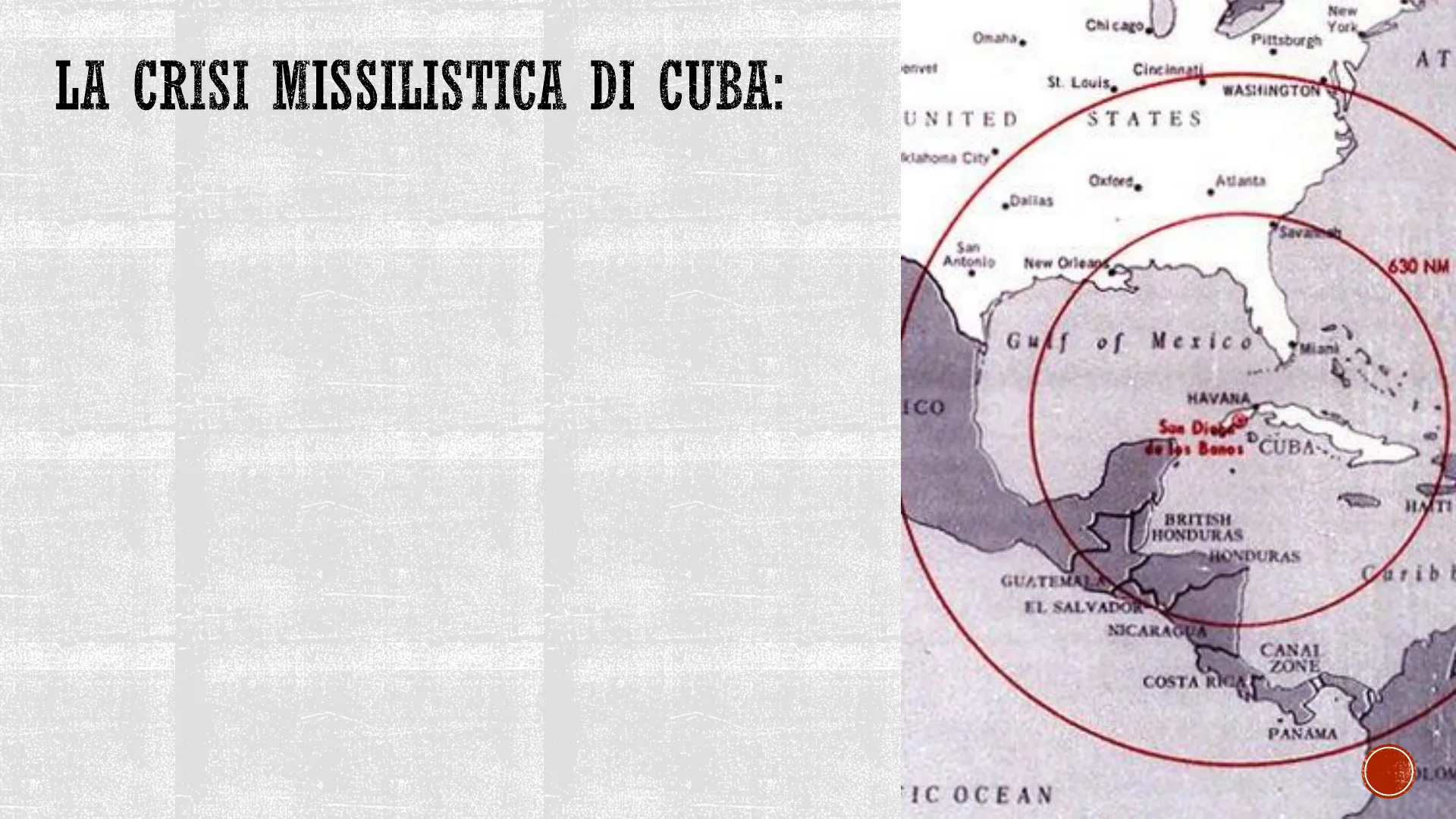
Omaha. Pittsburgh AT Cincinnati St. Louis_ WASHINGTON UNITED STATES Ictahoma City" Oxford. Atlanta „Dalias 7 Savamsh San Antonio New Orleans 630 NM Gulf of Mexico HAVANA ICO Son Diebe Tos Bones "CUBA ... HATI BRITISH HONDURAS HONDURAS Carib GUATEMALA, EL SALVADOR NICARAGUA CANAI ZONE COSTA RICA PANAMA IC OCEAN Chi cago, New York
LA GUERRA FREDDA
CONTESTO STORICO
- 1959 invasione sovietica Ungheria
- 1961 costruzione del muro di Berlino
- La corsa agli armamenti
- Altalenanti tentativi di distensione
- Rivoluzione cubana e altalenanti rapporti USA-Cuba (aprile 1961 sbarco alla Baia dei Porci, agosto 1962 allineamento cubano all'URSS)
- Crisi missilistica cubana: 16 - 28 ottobre 1962
NATO Patto de VarsaviaNeclear order Soviet Union United States United States United States Soviet Union Local forces Cuba NATO Global forces Regional forces Cuban Missile Crisis Nuclear weapons (peal forces Global forces trent forces Battle Nuclear weapons Global forces United States sind Sie NATO Global forces Battle Regional forces Nuclear order Soviet Union T Local forces Regional forces Battle Battle Didhen \oclear weapons Keelene order 1 Bronse asker Cuba Battle Cuba NATO NATO Cuban Missile Crisis Nuclear order Local furces viet Union Cuba Battle Cuban Missile Crisis! Battle Regional farves United States NATO Cuban Missile Crisis Nuclear order
GLI ARMAMENTI
ORDINE DI BATTAGLIA NUCLEARE
- Norris R.S., Kristensen H.M., "The Cuban Missile Crisis: A nuclear order of battle, October and November 1962", Bulletin of the Atomic Scientists, 68(6), pp. 85-91, 2012.
NATOBattleBile
Il mondo diviso
L'ORDINE DI BATTAGLIA NUCLEARE
Il mondo diviso
FORZE LOCALI
Table 1. Estimated nuclear order of battle during cuban missile crisis, October-November 1962 LOCAL FORCES IN AND AROUND CUBA COUNTRY TYPE NUMBER OPERATIONAL NUMBER OF OPERATIONAL WARHEADS SS-4 MRBMs (medio r.) 42 6-8 6-8 SS-5 IRBMs (r. interm.) 32 NONE AVAILABLE, NEVER ARRIVED 0 SOVIET UNION FROG SRBMs (corto r.) 12 READY 12 FKR-1 LACMs(m. da crociera) 80 READY 80 IL-28 GRAVITY BOMB (bombardieri con capacità nucleare) 6 AIRPLANES STILL IN CRATES 0 (172) TOTAL ~95-100 San Cristobal MRBM Site Havana Sagua La Grande MRBM Site Guanajay IRBM Site Bay of Pigs Caribbean Sea Guantanamo Bay NIKE HERCULES SAMs ? ? US DEFENSE SYSTEMS1 BOMARC, LONG-RANGE ANTI-AIRCRAFT MISSILES ? ? 1 Within the interceptor squadrons, there were more than 1,000 aircraft on alert. Florida (90 Miles) Bahamas
Los Angeles 2200 NM Seattle CANADA 1020 NM .Salt Lake City New York San Francisco Pittsburgh · Denver Cincinnati St. Louis. WASHINGTON Los Angeles UNITED STATES Oklahoma City" Oxford. Atlanta „Dallas San Antonio New Orleans 630 NM Gulf of Mexico Miami MEXICO - . San Diebe de los Banos CUBA -. Fuerto Rico . HAITI SANTO DOMINGO BRITISH HONDURAS HONDURAS Caribbean Sca EL SALVADOR NICARAGUA CANAL ZONE COSTA RICA VENEZUELA PANAMA COLOMBIA PACIFIC OCEAN VENEZU TOP SECRET BRAZIL. ECUADOR 32740 Map of the western hemisphere showing the full range of the nuclear missiles under construction in Cuba, used during the secret meetings on the Cuban crisis. Chi cago, Omaha. ATLANTIC OCEAN 1020 NM HAVANA SANTO DOMINGO GUATEMALA
Il mondo diviso
FORZE REGIONALI
ARMI STATUNITENSI E NATO RIVOLTE A EST
REGIONAL FORCES IN EUROPE COUNTRY TYPE NUMBER OPERATIONAL NUMBER OF WARHEADS US AND NATO FORCES (missili balistici) ITALY JUPITER IRBMS (m da 30 YES 6-8 GERMANY MACE CRUISE MISSILES crociera) 90 YES 0 US/NATO BASES AIRCRAFT BOMBS2 (bombe x ~300 cb.) YES ~300 TURKEY JUPITER IRBMS (missili 15 YES 15 UNITED KINGDOM THOR IRBMS balistici) 60 YES 60 TOTAL 450-500 SOVIET AND WARSAW PACT FORCES SS-4 MRBMs (medio r.) 528 YES 528 SOVIET UNION SS-5 IRBMs (r. intermedio) 28 YES 28 AIRCRAFT 23 YES ? TOTAL ~550 *On Quick Reaction Alert, or QRA, and alert aircraft based in Germany, Italy, Greece, Netherlands, Turkey, and the United Kingdom and on Sixth Fleet aircraft carriers in the Mediterranean.
ARMI SOVIETICHE RIVOLTE AD OVEST
REGIONAL FORCES IN EUROPE COUNTRY TYPE NUMBER OPERATIONAL NUMBER OF WARHEADS US AND NATO FORCES (missili balistici) ITALY JUPITER IRBMS (m da 30 YES 6-8 GERMANY MACE CRUISE MISSILES crociera) 90 YES 0 US/NATO BASES AIRCRAFT BOMBS2 (bombe x ~300 YES ~300 TURKEY JUPITER IRBMS (missili 15 YES 15 UNITED KINGDOM THOR IRBMS balistici) 60 YES 60 TOTAL 450-500 SOVIET AND WARSAW PACT FORCES SS-4 MRBMs (medio r.) 528 YES 528 SOVIET UNION SS-5 IRBMs (r. intermedio) 28 YES 28 AIRCRAFT ?3 YES ? TOTAL ~550 *The number and type unknown; however, there is a possibility that there were Tu-16, Tu-22, or MIG-21 aircraft based in the western Soviet Union or Warsaw Pact countries. cb.)
Il mondo diviso
FORZE GLOBALI
GLOBAL FORCES COUNTRY/COMMAND TYPE NUMBER OPERATIONAL STATUS NUMBER OF OPERATIONAL WARHEADS SS-6 ICBMs SS-7 ICBMs 6 YES 6 36 YES 36 (NO SLBM) TOTAL 42 (m. intercontinentali) 3M BISON BOMBERS 60 YES TOTAL 160 BOMBER-DELIVERED WEAPONS ATLAS D/E/F ICBMs TITAN I ICBMs 121 YES 121 53 YES 53 MINUTEMAN IA ICBMs 8 YES 8 TOTAL 182 (m. balistici) B-47 BOMBERS 880 YES B-52 BOMBERS 639 YES 2,952 B-58 BOMBERS 76 YES TOTAL 1,595 BOMBER-DELIVERED WEAPONS (1479 bombardieri, 1003 petroliere) ATLANTIC COMMAND SLBMs (missili b. sottomarini) 1124 112 16 PACIFIC COMMAND5 REGULUS CRUISE MISSILE crociera)4 YES 4 TOTAL ~220 EUROPEAN COMMANDE ~250 GRAND TOTAL ~3,500 "These were deployed on seven nuclear-powered balistic missile submarines. Mace cruise missiles were on Okinawa, and Regulus cruise missiles were aboard submarines. There were three aircraft carriers-the Oriskany, the Bon Homme Richard, and the Kitty Hawk-in the western Pacific. Each of the three aircraft carriers had an estimated 40 nuclear weapons aboard for its Air Wing, Several dozen other aircraft were readied at US bases in Allied countries. "Many of the regional forces used were linked to European Command's war plan. Each of the two aircraft carriers-the Franklin D. Roosevelt and the Enterprise-in the Mediterranean had an esti- mated 40 nuclear weapons aboard its aircraft. Dozens of other aircraft were readied at US bases in NATO countries. SOVIET UNION TU-95 BEAR BOMBERS 100 YES 270 (b. a lungo raggio) US STRATEGIC AIR COMMAND (armi nucleari totali) MACE CRUISE MISSILE (m. da 16 YES-«Il generale sovietico Anatoly Gribkov dichiarò che Chruščëv e i suoi consiglieri militari sapevano "che le forze nucleari strategiche americane erano piu numerose delle nostre di circa 17 a 1 nel 1962 ». (Gribkov A and Smith W (1994) Operation Anadyr:U.S. and Soviet Generals Recount the Cuban Missile Crisis. Chicago, IL: Edition Q.)
CONCLUSIONI ORDINE DI BATTAGLIA NUCLEARE
- 1. La crisi missilistica cubana si è sviluppata nello STADIO INIZIALE della corsa agli armamenti;
- 2. Le forze degli USA -> DETERRENZA/GUERRA (SICUREZZA obiettivo secondario);
- 3. In seguito, con l'evoluzione dei livelli di nuclearizzazione, il rischio di una guerra nucleare sarebbe stato ancora più forte.
LA DIPLOMAZIA AMERICANA
IL RUOLO DECISIVO DI ROBERT KENNEDY O UN SUCCESSO DI SQUADRA?
- White M., "Robert Kennedy and the Cuban Missile Crisis: A Reinterpretation", American Diplomacy, 2007.
MRBM LAUNCH SITE 2 SAN CRISTOBAL 1 NOVEMBER 1962
THIRTEEN DAYS
A memoir of the Cuban missile crisis
Robert F. Kennedy Introductions by ROBERT S. MCNAMARA and HAROLD MACMILLAN
IL SUCCESSO DELLA STRATEGIA AMERICANA
ROBERT KENNEDY O SFORZO DI SQUADRA EXCOMM?
Executive Committee of the National Security Council
16 OTTOBRE
Invasione: un'alternativa
TOJO ROBERT MCNAMARA (Segretario alla Difesa) GEORGE BALL (Sottosegretario di Stato)
17 OTTOBRE
R. Kennedy non parla di invasione
- DEAN ACHESON (ex Segretario di Stato)
- LLEWELLYN E. THOMPSON (ex ambasciatore USA in URSS)
18 OTTOBRE
R. Kennedy con Ball per il blocco
19 OTTOBRE
«It would be very, very difficult indeed for the President if the decision were to be for an air strike, with all the memory of Pearl Harbor and w h all the implications this would have for us in whatever world there would be afterward. For 175 years we had not been that kind of country. A sneak attack was not in our traditions. Thousands of Cubans would be killed without warning, and a lot of Russians too. ».
19 OTTOBRE
R. Kennedy esorta al blocco
- «Sarebbe stato davvero molto difficile per il Presidente se la decisione fosse stata per un attacco aereo, con tutto il ricordo di Pearl Harbor e con tutte le implicazioni che questo avrebbe avuto per noi in qualunque mondo futuro. Per 175 anni non eravamo stati quel tipo di paese. Un attacco furtivo non era nelle nostre tradizioni. Migliaia di cubani sarebbero stati uccisi senza preavviso e anche molti russi».
20 OTTOBRE
Combinazione blocco e attacco aereo (preannunciato)
Non hai trovato quello che cercavi?
Esplora altri argomenti nella Algor library o crea direttamente i tuoi materiali con l’AI.