Origins of the Earth and the Great Oxidation Event
Slides from University about Origins of the Earth, the Great Oxidation Event. The Pdf explores the origins of Earth, focusing on the Great Oxidation Event and its implications, covering concepts like Snowball Earth and convection currents, suitable for university-level science students.
See more33 Pages


Unlock the full PDF for free
Sign up to get full access to the document and start transforming it with AI.
Preview
Learning Objectives
By the end of the session you should
- Be able to discuss what the Great Oxidation Event was
- State when it occurred in the geological time line
THAT TIME OXYGEN ALMOST KILLED EVERYTHING
- Explain why the process was slow rather than an 'explosion'
- Explain the role of oxygen in changing the life of the time
- Describe the emergence of life
Geological Timeline
+ Younger Eon Era Period Epoch + Today Holocene 11.8 Ka Pleistocene Pliocene Neogene Miocene Oligocene Paleogene Eocene Paleocene 66 Ma Cretaceous ~ Phanerozoic Mesozoic Jurassic Triassic ~ + 252 Ma Permian ~ Carboni- ferous Pennsylvanian ~ Paleozoic Devonian ~ Silurian ~ Ordovician ~ Cambrian ~ - 541 Ma Proterozoic ~ ~ - 2.5 Ga Archean ~ + 4.0 Ga Hadean ~ ~ - 4.54 Ga Geological timeline Ga is billions of years Ma is millions of years Older Quaternary Cenozoic Mississippian ~Geological timeline
What is the current epoc called and why ?
Pre-life - Hadean Eon
- From 4.6 to 3.8Ga ago
- Earth was forming with a molten iron core and a lighter crust
- Methane, water, ammonia, nitrogen and carbon dioxide gases formed the early atmosphere
What is today's atmosphere made of?
Appearance of Life - Archean Eon
Between 3.8 and 2.5 Ga : Atmosphere had changed - now CO2 some N2 and CH4 and some O2 Where had the oxygen come from ? What would disappearing methane mean ? (Hint: what do we call methane today) How can we tell life was there?
Stromatolites
How did they form ? From cyanobacteria which may form large layered structures They form a mat which traps sediment, sometimes calcium carbonate, called stromatolites if dome shaped and oncolites if round.
Cyanobacteria and Atmospheric Change
How were cyanobacteria changing the atmosphere? Photosynthesis But ...
- Cyanobacteria are aerobic, so oxygen needed to rise in the atmosphere before cyanobacteria appeared. Photosynthesisers in the Archean were anaerobes possibly including: · purple and green sulfur bacteria bacteria (do not release oxygen- anoxygenic ) · green bacteria and heliobacteria (which do- oxygenic ).
Photosynthesis Process
In photosynthesis what is used to reduce the CO, fixed ? DesWhat do sulfur bacterial use to fix CO. 2 + CO2 ----- > C6H1206 +
Cyanobacteria and Blue Green Algae
What are the characteristics of bacteria? What are the characteristics of algae ? Why the misidentification ?
Adding Oxygen to the Atmosphere
Why were cyanobacteria thought to be the first photosynthesisers ?
Changing Atmosphere and the Great Oxidation Event
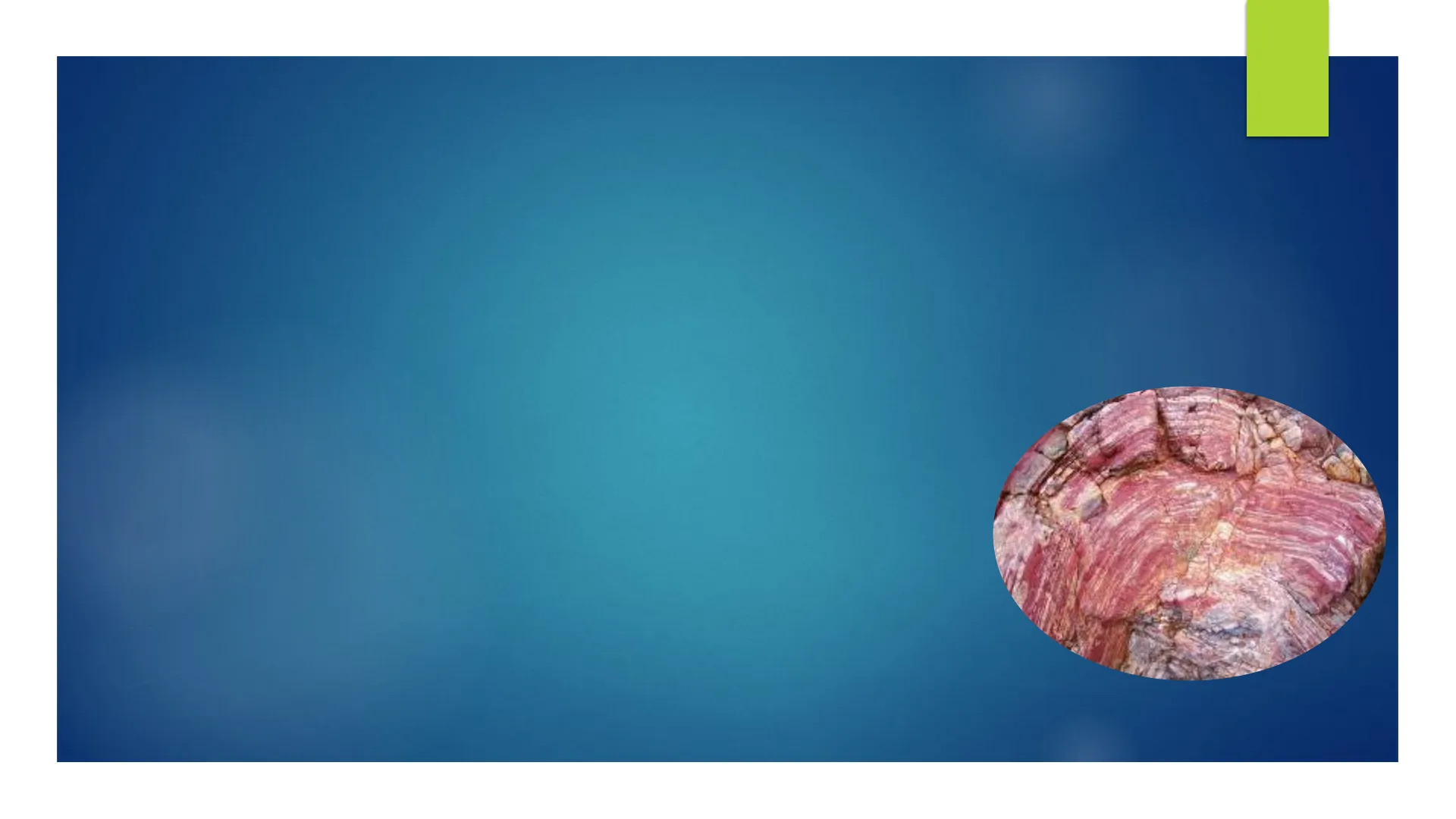
Changing atmosphere heralds start of life - the Great Oxidation Event So if photosynthesis produced oxygen why did the Cambria explosion of life not happen earlier ? Oxygen oxidised the soluble iron in the seas and formed iron iii oxide layered rock - or BIFs Banded Iron Formations Reducing components in the atmosphere (methane, ammonia, etc.) were oxidized and lost from the skies As oxygen rose, and organisms increased a tipping point was reached, now oxygen in the atmosphere and dissolved in water increased - to 10% of today's levels
Oxygen: Good or Catastrophe?
Oxygen a good thing? Great oxidation event is also known as 'The Oxygen Catastrophe' - a mass extinction : Oxygen was poisonous to the main life form at the time- anaerobes who died out Reducing the methane levels by oxidation Most life to this point was anaerobic
Snowball Earth and Oxygen Rise
And then it got much colder ? Why? O2 on the up The rise of oxygen in Earth's atmosphere has experienced many setbacks since the first photosynthesising cyanobacteria appeared, probably 2.7 billion years ago Steep final rise in oxygen to today's level Volcanic hydrogen sulphide and methane keep oxygen down 2.7-2.4 bya Oxygen level down to almost zero again 1.9 bya Atmospheric oxygen (percentage of today's level) 10 SNOWBALL EARTH "BORING BILLION" 8 6 Terrestrial algae ("greening of the continents") 4 STINKING, SEWER- LIKE SEAS 2 0+ 4 3 2 1 0 BILLION YEARS AGO (bya) 2.7 bya Cyanobacteria 2.4 bya Great oxygenation event 750 to 650 million years ago AnimalsSnowball earth Loss of greenhouse gases leads to fall in temperature ** Surface of earth and seas freeze Is that all bad?
Convection Currents and Life Development
Convection currents What are they ? : How might they help further life develop ?
Oxygen Levels Over Time
O2 on the up The rise of oxygen in Earth's atmosphere has experienced many setbacks since the first photosynthesising cyanobacteria appeared, probably 2.7 billion years ago Steep final rise in oxygen to today's level Volcanic hydrogen sulphide and methane keep oxygen down 2.7-2.4 bya Oxygen level down to almost zero again 1.9 bya Atmospheric oxygen (percentage of today's level) 10 SNOWBALL EARTH "BORING BILLION" 8 6 Terrestrial algae ("greening of the continents") 4 STINKING, SEWER- LIKE SEAS 2 0+ 4 3 2 1 0 BILLION YEARS AGO (bya) 2.7 bya Cyanobacteria 2.4 bya Great oxygenation event 750 to 650 million years ago Animals
Earth's Appearance Before and After GOE
Change of Earth before and after GOE Before Sky: orange Ocean: green After Sky: blue Sea: blue
The Atmosphere and Ozone
The atmosphere Rise in oxygen lead to a rise in ozone : Ozone produced by UV light acting on oxygen in the stratosphere O O o Sun's UV rays 0 o 0+02-03 o O O o Why is this beneficial ?
The Boring Billion
A billion years between oxygen appearing and life booming O2 on the up The rise of oxygen in Earth's atmosphere has experienced many setbacks since the first photosynthesising cyanobacteria appeared, probably 2.7 billion years ago Steep final rise in oxygen to today's level Volcanic hydrogen sulphide and methane keep oxygen down 2.7-2.4 bya Oxygen level down to almost zero again 1.9 bya Atmospheric oxygen (percentage of today's level) 10 "BORING BILLION" 8 Terrestrial algae ("greening of the continents") 4 STINKING, SEWER- LIKE SEAS 2 0 4 3 2 1 0 BILLION YEARS AGO (bya) 2.7 bya Cyanobacteria 2.4 bya Great oxygenation event 750 to 650 million years ago Animals SNOWBALL EARTH 6The Boring Billion Superficially, little happened for a billion years in terms of biological evolution Climate, oceans and atmosphere were relatively stable Complexity of life increased both microscopic and macroscopic started to appear at the end Oxygen levels fluctuated
Endosymbiosis
What is symbiosis ? What is endosymbiosis? Mitochondria- how did they evolve What advantage did endosymbiosis give? Remember advantage has to be to both parties
Aerobic Respiration Advantages and Problems
What is the advantage of aerobic respirationWhat is the problem with aerobic respiration? Free radicals -produced as a bi-product How did aerobic species get around the problem ? Enzymes And antioxidants
Survival in Aerobic Conditions
What happened to those that couldn't survive aerobic conditions Some became extinct, freeing up niches for aerobes Some 'moved' to extreme conditions O Natural selection on a bacterial level
Welcome to the Cambrian Explosion
Prokaryotes Early Precambrian Late Precambrian Early Cambrian Eukaryotes Hemichordata Echinoderms Chordates Mollusks Worms metazoans Arthropods Cnidaria Prokaryotes Eukaryotes Comb Jellies Sponges PlacozoaThe Cambrian explosion Oxygen levels and appearance of life First life -aquatic Then terrestrial plants Insects and other invertebrates were some of the earliest land animals · dragonflies · millipedes ** Life moved from aquatic to terrestrial 500- 400Ma O2 in water is 3% of that in air Phanerozoic Paleozoic Mesozoic Cenozoic Period Cambrian Ordovician Silurian Devonian Permian Triassic Jurassic Cretaceous Paleogene Neogene 30 * 25 % Atmospheric oxygen Arthropods 20 Bony fish Dinosaurs Cattle Cetaceans Megabeasts 15 Amphibians Diverse shelled marine animals Freshwater fish Aquatic tetrapods 10 Burrowing animals 5 Small mammals 0 Land plants Giant trees Forest fires Small ferns 600 400 300 200 100 0 Million years ago Figure 5 Phanerozoic time line shows atmospheric O2 concentration and major evolutionary events, including major mass extinctions (indicated by *: Ordovician-Silurian, late Permian, and Cretaceous-Paleogene). Based on data from various sources (55,335,775). See text for explanation. Eon Era 35 Carboniferous Giant insects Bats * Flying reptiles
Advantages of Life on Land and in Water
On land In water
The Rise of Land Plants
Started in the : Cambrian period - 500 million years ago Aquatic plants developed an 'alarm system' Contributed to the rise in oxygen Moss Vascular plants- ferns - Gymnosperms gnetophytes monocots conifers - eudicots ginkgo - magnoliids dicots cycads - ANA grade gymnosperms flowering plants seed plants ferns horsetails pteridophytes clubmosses vascular plants hornwort. bryophytes { mosses liverworts- land plants charophytes \ green chlorophytes / algae green plants red algae glaucophytes ***- chromophytes cyanidiophytes PLANTS Plantae (Haeckel 1866, emend Cav .- Sm. 1998) cyanobacteria + biflagellate protozoan Angiosperms
Evolution of Animals
What came next ? Arthropods - insects and spiders : Amphibians - 300 million years ago Mammals- 200 million ago Birds 150- million yeas ago
Homeobox Genes and Land Adaptation
Homeobox genes Prior to the Cambrian explosion evolution of the homeobox or hox genes Hox genes allowed a period of evolutionary experimentation and competition First land animals mainly came on land to mate and avoid predation Early land animals had to solve the same problems that plants faced when they moved to the land : water conservation, gas exchange, reproduction and dispersal, and the fact that water no longer supported them. Like plants, animals evolved waterproof external layers, internal gas exchange system ways of reproducing without water, support systems to allow them to move on land. HOM-CH Y Chromosome H 1 1
Learning Objectives Review
You should now be able to discuss: What the Great Oxidation Event was State when it occurred in the geological time line Explain why the process was slow rather than an ‘explosion' The role of oxygen in changing the life of the time ** The emergence of life
THAT TIME OXYGEN ALMOST KILLED EVERYTHING
Can’t find what you’re looking for?
Explore more topics in the Algor library or create your own materials with AI.
