Blood Lipids: Transport of Lipids by Lipoproteins
Slides from University about Blood Lipids. The Pdf provides a detailed explanation of lipid transport in the blood, specifically focusing on lipoproteins, their composition, and structure. This Biology material is suitable for university students and includes diagrams of lipoprotein structures like chylomicrons and LDL.
See more15 Pages

Unlock the full PDF for free
Sign up to get full access to the document and start transforming it with AI.
Preview
Lipid Transport Overview
Here we consider lipid transport and the role of lipoproteins, which are particles complexing lipid and protein (known as apolipoprotein or apoprotein). As hydrophobic substances required to be transported in an aqueous medium (i.e. blood), most lipids need to be packaged in lipoproteins. The exception is free fatty acids, which are carried in blood bound to albumin.
Lipoprotein Types and Composition
This is a summary of principal lipoprotein types, e.g. chylomicrons, VLDL, IDL, LDL and HDL. We also see that their general composition includes lipids such as triglyceride (TG), cholesterol and cholesterol (or cholesteryl) ester along with phospholipids and apolipoproteins or apoproteins (of which there are several families).
- Lipoproteins
- Composed of triglyceride, cholesterol ester (in inner core) + cholesterol, phospholipids, apolipoproteins (eg. apo-Al, -All, -AIV, -B48, -B100, -CI, - CII, -CIII, -D, -E) in outer layer
- Chylomicrons (& chylomicron remnants)
- Very low density lipoprotein (VLDL)
- Intermediate density lipoprotein (IDL) / VLDL remnants
- Low density lipoprotein (LDL)
- High density lipoprotein (HDL)
NB: free fatty acids transported bound to albumin
Lipoprotein Structure and Function
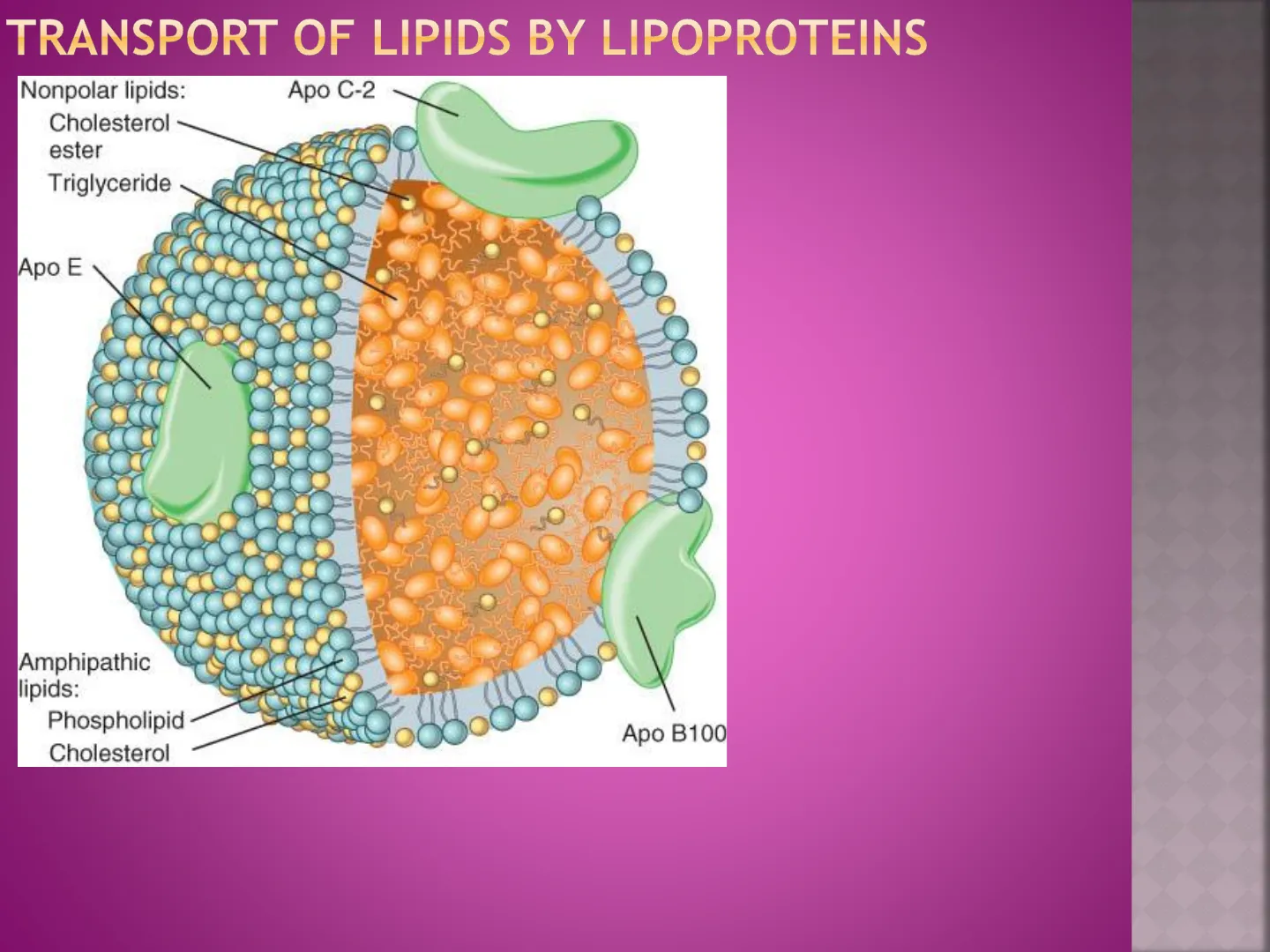
Nonpolar lipids: Apo C-2 Cholesterol ester Triglyceride Apo E Amphipathic lipids: Phospholipid Cholesterol Apo B100 Most lipids are transported in the blood in combination with proteins as lipoproteins.
- Note non polar lipids in centre
This image serves to illustrate general lipoprotein structure, i.e. a phospholipid monolayer containing cholesterol and apolipoproteins enclosing a highly hydrophobic (non-polar) core, made up of TG and cholesterol (or cholesteryl) ester. Of course the types of apolipoproteins present, along with the content of TG and cholesterol/cholesterol ester (which affects the particle density and diameter), will depend on the specific lipoprotein.
Specific Lipoprotein Functions
- Chylomicrons form in small intestinal mucosal cells and contain exogenous (dietary) lipids. They enter villi lacteals, are carried into the systemic circulation and reach tissues where their triglyceride fatty acids are released and stored in the adipocytes and used by muscle cells for ATP production. Chylomicron remnants are removed by the liver.
- VLDLs contain endogenous triglycerides. They are transport vehicles that carry triglycerides synthesized in hepatocytes to adipocytes for storage. VLDLs are converted to LDLs via IDLs.
- LDLs carry about 75% of total blood cholesterol and deliver it to cells throughout the body. When present in excessive numbers, LDLs deposit cholesterol in and around smooth muscle fibers in arteries.
- HDLs remove excess cholesterol from body cells and transport it to the liver for elimination (reverse cholesterol transport).
Lipid Transport Pathways
- In the overall scheme of lipid transport, chylomicrons formed in the small intestine after a meal are TG-rich lipoproteins that carry exogenous (i.e. dietary) lipids into the blood, as the result of fat digestion and absorption. Chylomicrons are therefore part of the exogenous lipid transport pathway. In contrast, VLDL are liver-produced TG-rich lipoproteins that carry endogenous TG (formed by the liver) in the circulation. VLDL particles are therefore part of the endogenous lipid transport pathway. Both chylomicrons and VLDL deliver fatty acids (as TG) to tissues such as adipose and muscle. Chylomicrons when depleted of TG become chylomicron remnants, which are cleared by the liver. Similarly, VLDL when depleted of TG become VLDL remnants known as IDL (reflecting a change in particle density and lipid/apoprotein composition). In humans, a large percentage of IDL are processed by the liver (using hepatic lipase) to from LDL, which are further enriched with cholesterol. It is LDL which is mainly responsible for carrying cholesterol in the blood for supply to tissues, by binding to LDL receptors - the LDL-LDL receptor complex is then internalised (via receptor-mediated endocytosis). LDL cholesterol has picked up the label as "bad cholesterol" in view of its well recognised atherogenic role (re cholesterol deposition in arteries). On the other hand, HDL is responsible for removing excess cholesterol from tissues (as well as blood vessels) and depositing it with the liver for elimination. This is known as reverse cholesterol transport and has contributed to HDL cholesterol having a reputation as "good" cholesterol. HDL's role is facilitated by the enzyme lecithin: cholesterol acyltransferase (LCAT), which binds to HDL and converts free cholesterol picked up from tissues, to cholesterol esters for efficient transport in the HDL core.
Classes of Lipoproteins
- Chylomicrons (2 % protein)
- form in intestinal mucosal cells (express apo B48)
- transport exogenous (dietary) fat (TG & cholesterol)
o apo-CII activates lipoprotein lipase that releases the fatty acids from the chylomicron for absorption by adipose & muscle cells; liver processes what is left. Chylomicron remnant uptake via receptor mediated endocytosis by liver.
- VLDLs (10% protein)
- transport endogenous TG (from liver) to fat cells
- converted to LDLs (via IDL)
- LDLs (25% protein) --- "bad cholesterol"
- carry 75% of blood cholesterol to body cells
- apo-B100 is docking protein for LDL receptor-mediated endocytosis of the LDL into a cell
NB: Lp(a) = modified LDL (highly atherogenic) featuring apo(a)
- HDLs (40% protein) --- "good cholesterol"
- carry cholesterol from cells to liver for elimination
- apo-Al activates LCAT
Apolipoprotein Regulatory Roles
- This is an overview of the various main classes of lipoproteins, which highlights the essential regulatory roles of some key apolipoproteins. E.g. apolipoprotein CII (or apo-CII) is responsible for activating lipoprotein lipase that liberates fatty acids from chylomicrons and VLDL, to be taken up and either metabolised or stored (once again as TG) in muscle or adipose tissue, respectively. As we saw before, the resulting lipid-depleted chylomicrons (chylomicron remnants) are removed by the liver; while a fraction of lipid-depleted VLDL (VLDL remnants or IDL) go on to provide LDL. Another key apolipoprotein is apo-B100 carried by LDL particles, which allows them to bind to LDL receptors and supply cholesterol to tissues (via receptor- mediated endocytosis). Apo-B48 is also noteworthy as it is the signature apolipoprotein expressed by chylomicrons that distinguishes them as having been produced by the gut (as part of the exogenous or dietary lipid transport pathway). As another example, apo-Al expressed by e.g. HDL regulates LCAT activity. Note that lipoprotein (a) or Lp(a) is a highly atherogenic subclass (and itself an independent risk factor for coronary artery disease), derived from modifying LDL by the addition of apo(a).
Apolipoproteins and Their Roles
This is a fuller overview of the apolipoprotein families, involving the apo-A subfamily through apo-E and not forgetting apo(a), along with explanations of their roles in lipid transport and metabolism.
Apolipoprotein Types
- Apo A-I, Apo A-II, Apo A-IV
- Apo B-48, Apo B-100
- Apo C-I, Apo C-II, Apo C-III
- Apo D
- Apo E
- Apo(a)
- Note Apo B is an integral apolipoprotein whereas the others are peripheral apolipoproteins.
Role of Apolipoproteins
- Solubilizes highly hydrophobic lipids e.g. Apo B
- Contains signals (ligands) to regulate movement
- e.g. Apo B-100 & Apo E for LDL receptor, Apo E for LDL receptor-related protein, Apo A-I for HDL receptor
- Enzyme Cofactors e.g. Apo A-I for lecithin cholesterol acyl transferase (LCAT), Apo C-II for lipoprotein lipase, Apo A-II activates hepatic lipase
- Enzyme inhibitors e.g. Apo A-II & Apo C-III for lipoprotein lipase, Apo C-I for cholesteryl ester transfer protein
- Lipid Transfer Protein e.g. possibly Apo D
Lipoprotein Fraction Profiles
This table presents a summary of lipoprotein fraction profiles in terms of origin of formation, major lipid and apolipoprotein contents and major functions in lipid transport. You can see that chylomicrons are distinguished by the expression of apo-B48; while LDL has the distinction of expressing only apo-B100.
particle major lipid components major apolipo- proteins origin major function Chylomicrons dietary TG apo-B48, -AI, -AIV, -C, -E gut transport dietary TG to tissues after fatty meal VLDL endogenous TG apo-B100, - C, -E liver transport endogenous TG IDL cholesterol/TG Apo-B100, - C, -E liver transport cholesterol (LDL precursor) LDL cholesterol apo- B100 liver transport cholesterol (major supply) for tissues HDL cholesterol/ apolipoprotein Apo-AI, -AII, -C, -E tissues reverse cholesterol transport
Chylomicron Structure
Here is the structure of a chylomicron, expressing the distinctive apoB-48 along with e.g. apoC-II essential for the activation of lipoprotein lipase.
Apolipoproteins B-48 C-III C-II Cholesterol Phospholipids Triacylglycerols and cholesteryl esters
LDL Structure
And here is the structure of LDL, which expresses apo-B100 for binding to the LDL receptor, prior to receptor mediated endocytosis.
Phospholipid monolayer ApoB-100 Triacylglycerols Free (unesterified) cholesterol Cholesteryl esters Figure 21-39a Lehninger Principles of Biochemistry, Fifth Edition @ 2008 W. H. Freeman and Company
Lipoprotein Density and Diameter
You can see here that varying contents for TG and apolipoprotein influence lipoprotein density and diameter. So increasing relative TG content is associated with larger diameter and lower density (making chylomicrons the largest, least dense lipoproteins). Conversely, increasing relative protein content is associated with increasing density and smaller diameter (making HDL the smallest, most dense lipoprotein).
- chylomicron, VLDL, IDL, LDL, HDL
increasing density increasing diameter increasing protein content increasing TG content
Lipoprotein and Lipid Transport Schematic
This schematic gives an overview of lipid transport by lipoproteins, including both the exogenous (dietary) pathway involving chylomicrons and the endogenous pathway involving hepatic VLDL production, VLDL metabolism to IDL and then IDL metabolism to LDL. LDL is of course responsible for the majority of "forward" cholesterol transport to extrahepatic tissues. In contrast, HDL can be seen returning cholesterol to the liver re reverse cholesterol transport.
Liver Intestine Reverse cholesterol transport HDL LDL Extrahepatic tissues VLDL Chylomicron remnants VLDL remnants (IDL) Chylomicrons Capillary HDL precursors (from liver and intestine) lipoprotein lipase Free fatty acids Mammary, muscle, or adipose tissue Figure 21-40a Lehninger Principles of Biochemistry, Fifth Edition 2008 W. H. Freeman and Company
Can’t find what you’re looking for?
Explore more topics in the Algor library or create your own materials with AI.
