Edexcel GCSE Geography A notes on climate and climate change by Savemyexams
Document from Savemyexams about Edexcel GCSE Geography A. The Pdf provides detailed notes on weather hazards and climate change, specifically for the Edexcel GCSE Geography A program, covering topics like the atmosphere as a global system and human activity impacts. These High school Geography notes are structured with bullet points and diagrams, making them ideal for self-study.
See more39 Pages

Unlock the full PDF for free
Sign up to get full access to the document and start transforming it with AI.
Preview
Edexcel GCSE Geography A: Weather Hazards & Climate Change
Contents
- 2.1.1 The Atmosphere as a Global System
- 2.1.2 Changes in the Global Climate
- 2.1.3 Human Activity & Global Climate Change
- 2.1.4 Climate of the UK
Your notes
Page 1 of 39
2015-2024 Save My Exams, Ltd. . Revision Notes, Topic Questions, Past PapersSave My Exams
Head to www.savemyexams.com for more awesome resources
Your notes
The Atmosphere as a Global System
Atmospheric Heat Transfer
The atmosphere is constantly moving solar heat energy FROM the equator TO the poles to reach a
balance in temperature
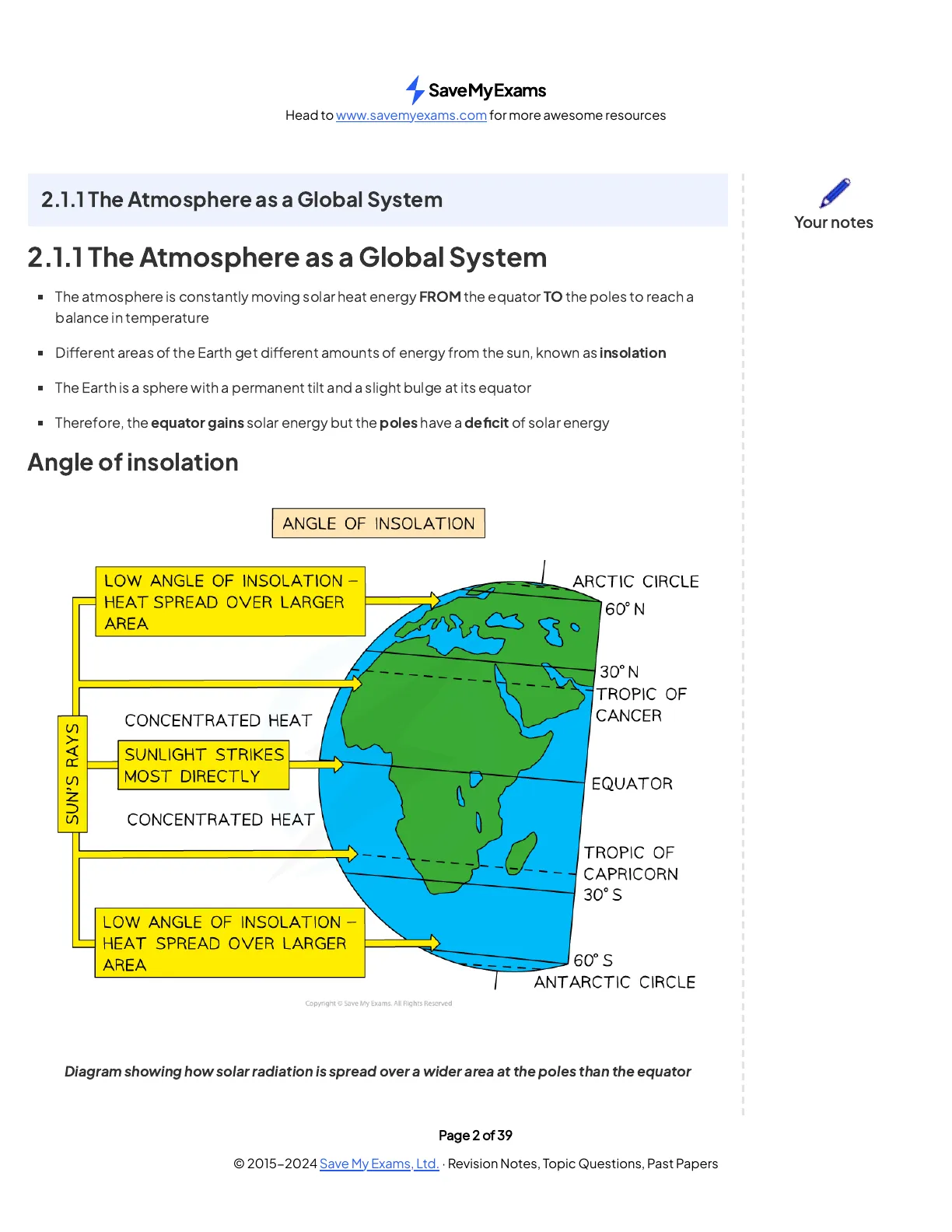
Different areas of the Earth get different amounts of energy from the sun, known as insolation
The Earth is a sphere with a permanent tilt and a slight bulge at its equator
Therefore, the equator gains solar energy but the poles have a deficit of solar energy
Angle of Insolation
ANGLE OF INSOLATION
LOW ANGLE OF INSOLATION -
HEAT SPREAD OVER LARGER
AREA
ARCTIC CIRCLE
60° N
CONCENTRATED HEAT
30° N
TROPIC OF
CANCER
SUN'S RAYS
SUNLIGHT STRIKES
MOST DIRECTLY
EQUATOR
CONCENTRATED HEAT
TROPIC OF
CAPRICORN
30° S
LOW ANGLE OF INSOLATION -
HEAT SPREAD OVER LARGER
AREA
60° S
ANTARCTIC CIRCLE
Copyright @ Save My Exams. All Rights Reserved
Diagram showing how solar radiation is spread over a wider area at the poles than the equator
Page 2 of 39
2015-2024 Save My Exams, Ltd. . Revision Notes, Topic Questions, Past Papers4
Wind Formation
To circulate the warm air around the Earth, specific wind and pressure patterns exist
Air always moves from high pressure to lower pressure
- This movement of air generates wind
Winds are large-scale movements of air due to differences in air pressure - Pressure differences happen because the Sun heats the Earth's surface unevenly
The global circulation system begins at the equator because it is the hottest part of the Earth
Air rises at the equator, leading to low pressure and rainfall at the surface
When the air reaches the edge of the atmosphere, it cannot go any further and so it travels north and
south
The air in the atmosphere becomes cold and begins to sink back towards the surface, creating high
pressure and dry air - The cool air will then 'rush' from the high pressure zone to the low pressure zone at the equator to be
warmed again by the Sun, at the same time creating wind
Your notes
Page 3 of 39
2015-2024 Save My Exams, Ltd. . Revision Notes, Topic Questions, Past Papers4
Wind Pressure Cell System
WIND PRESSURE CELL
Your notes
4. AS THE AIR COOLS
IN THE ATMOSPHERE IT
BECOMES DENSER AND
BEGINS TO SINK,
LOWERING THE
ATMOSPHERIC PRESSURE
3. AS THE AIR RISES,
INTO THE ATMOSPHERE
IT ADDS PRESSURE
LOW
PRESSURE
ATMOSPHERIC
WINDS
PRESSURE
2. AS THE AIR RISES,
THE SURFACE
PRESSURE LOWERS
5. AS THE AIR SINKS,
THE SURFACE
PRESSURES RISES
HIGH
PRESSURE
SURFACE
WINDS
LOW
PRESSURE
SURFACE
1. AS THE SUN HEATS
THE SURFACE, AIR
EXPANDS AND BEGINS
TO RISE
6. THERE IS A PRESSURE
DIFFERENCE NOW. TO
BALANCE THIS, AIR
RUSHES TO THE LOW
PRESSURE AREA. THE
GREATER THE PRESSURE
DIFFERENCE, THE
STRONGER THE WINDS
Copyright & Save My Exams. All Rights Reserved
The wind pressure cell system shows the distribution of pressure at Earth's surface and upper
atmosphere
Air movement within the cell is roughly circular and helps move surplus heat around the Earth
- Each cell generates different weather patterns
Examiner Tips and Tricks: Weather vs. Climate
What is weather?
Remember that weather is what you get locally on a day-to-day basis, but climate is what you
expect a place to be over time (usually 30 years).
Page 4 of 39
2015-2024 Save My Exams, Ltd. . Revision Notes, Topic Questions, Past PapersSave My Exams
Head to www.savemyexams.com for more awesome resources
You expect the UK to be wet and cold (not always but mostly!), but you would expect the
Mediterranean to be warm-that is climate.
Your notes
Pressure Differences and Air Movement
Pressure differences
Air moves in the atmosphere either towards the ground (subsidence) or up into the atmosphere
(convection)
These movements influence air pressure and rainfall
- The sea and land heat up differently
- Sea:
- Forms high pressure in summer and low pressure in winter
- It takes longer to heat and cool
- Air is denser and cooler in summer but warmer in winter
- Land:
Generally, it forms areas of lower pressure in summer and higher pressure in winter
It heats quickly in summer and the air is lighter and rises - It cools quickly in winter
Influence of Air Movement on Weather Conditions
Table Showing Influence of Air Movement on Weather Conditions
| Air Movement | Cause | Weather Conditions |
|---|---|---|
| Subsidence (sinking air) | It occurs in areas with low-intensity solar radiation, such as the poles or at high altitudes where the air is very cold. Air becomes denser and sinks towards the ground. As air sinks, it begins to warm and can therefore hold more moisture, preventing clouds from forming. | Forms high-pressure areas where the air is descending. Brings clear skies or very thin clouds. Creates arid or semi-arid conditions due to very little precipitation. |
| Convection (rising air) | It occurs in areas with high levels of solar radiation. The ground heats the air above and rises. As air rises, it cools and condenses into water droplets, which form clouds. | Low-pressure areas are created as air moves upward. Thick, heavy cloud cover with heavy rainfall creates wet tropical regions. |
Page 5 of 39
@ 2015-2024 Save My Exams, Ltd. . Revision Notes, Topic Questions, Past PapersSave My Exams
Head to www.savemyexams.com for more awesome resources
Your notes
Global Pressure Belts
- Abroad pattern of latitudinal high and low pressure belts are created via the horizontal bands of the
Hadley, Ferrel and Polar cells - However, the distribution of land and sea affects the location of these pressure zones, so the pattern is
not symmetrical in each hemisphere, despite the mirroring of the cells
Global pressure belts
90°
N
HIGH
f
60°
LOW
HIGH
LOW
30°
-HIGH
HIGH
0°
- LOW
-LOW ----
EQUATOR
30°
- HIGH
- - HIGH-
-HIGH
--.
Exams
DOWN
LOW
60°
0
3200
HIGH
km
90°
KEY:
HIGH
MEDIUM
LOW
AIR PRESSURE
Copyright Save My Exams. All Rights Reserved
Pattern of latitudinal high and low pressure belts created by the Hadley, Ferrel and Polar cells
Redistribution of Heat
Heat is transferred around the world by two main methods
Page 6 of 39
@ 2015-2024 Save My Exams, Ltd. . Revision Notes, Topic Questions, Past Papers
QW4
Save My Exams
Head to www.savemyexams.com for more awesome resources
Your notes
- Circulation cells
- Ocean currents
Circulation Cells and the Tri-Cellular Model
Circulation cells
In both hemispheres, heat energy transfer occurs where 3 atmospheric circulation cells meet
These are the Hadley, Ferrel, and Polar cells and are shown via the tri-cellular model
GLOBAL ATMOSPHERIC CIRCULATION MODEL
RISING POLAR CELL
RISING COLD
WARM AIR
SINKING
COLD AIR
ATMOSPHERIC
WINDS
FERRELAIR
90°
POLAR
HIGH
1
CELL
60°
SINKING
COLD AIR
SUB POLAR LOWA
PRESSURE
DIRECTION OF
SURFACE WINDS
HEAT IS
TRANSFERRED
FROM
HADLEY
CELL
SUB - TROPICAL HIGH PRESSURE
EQUATORIAL
REGIONS TO
POLAR
REGIONS
RISING
HOT AIR
EQUATORIAL LOW PRESSURES
TRADE WINDS
3
HADLEY
30°
VCELL
SUB -ITROPICAL HIGH PRESSURE
4
SINKING
COLD AIR
SUB POLAR LOW
PRESSURE 60°
EASTERLIES
WINDS
FERREL
CELL
90° POLAR HIGH
AIR
RISING RISING
WARM COLD
SINKING
COLD AIR
POLAR CELL
AIR
1
HEAVY PRECIPITATION
2
VARIABLE PRECIPITATION, WINDS AND CALMS
3
HEAVY RAINFALL WITH VARIABLE WINDS AND CALMS
4
HIGH RATES OF EVAPORATION, VARIABLE WIND AND CALMS
Copyright @ Save My Exams. All Rights Reserved
Page 7 of 39
@ 2015-2024 Save My Exams, Ltd. . Revision Notes, Topic Questions, Past Papers
2
30°
WESTERLIES
WINDS4
Save My Exams
Head to www.savemyexams.com for more awesome resources
Your notes
The tri-cellular model
Each hemisphere has three cells (the Hadley cell, Ferrel cell and Polar cell)
These circulate air from the Earth's surface through the atmosphere and back again
- The Hadley cell is the largest and extends from the equator to between 30° and 40° north and south
Trade winds blow from the tropical regions to the equator and travel in an easterly direction - Near the equator, the trade winds meet, and the hot air rises and forms thunderstorms (tropical
rainstorms)
From the top of these storms, air flows towards higher latitudes, where it becomes cooler and
sinks over subtropical regions
This brings dry, cloudless air, which is warmed by the Sun as it descends
The climate is warm and dry (hot deserts are usually found here)
Ferrel cell is in the middle and occurs from the edge of the Hadley cell to between 60° and 70° north
and south of the equator
This is the most complicated cell, as it moves in the opposite direction from the Hadley and Polar
cells
Air in this cell joins the sinking air of the Hadley cell and travels at low heights to mid-latitudes,
where it rises along the border with the cold air of the Polar cell
This occurs in the mid-latitudes and is the reason for lots of unsettled weather (particularly in the
UK) - The polar cell is the smallest and weakest of the atmospheric cells
It extends from the edge of the Ferrel cell to the poles at 90° north and south
The air in these cells is cold and sinks, creating high pressure over the highest latitudes
The cold air flows out towards the lower latitudes at the surface, where it is slightly warmed and
rises to return at altitude to the poles
Coriolis Effect and Global Wind Belts
Coriolis effect
- Each cell has prevailing winds associated with it
These winds are influenced by the Coriolis effect
The Coriolis effect is the appearance that global winds and ocean currents curve as they move
The curve is due to the Earth's rotation on its axis, and this forces the winds to actually blow diagonally
Page 8 of 39
@ 2015-2024 Save My Exams, Ltd. . Revision Notes, Topic Questions, Past PapersSave My Exams
Head to www.savemyexams.com for more awesome resources
Your notes - The Coriolis effect influences wind direction around the world in this way:
In the northern hemisphere it curves winds to the right - In the southern hemisphere it curves them left
- The exception is when there is a low-pressure system:
In these systems, the winds flow in reverse (anti clockwise in the northern hemisphere and
clockwise in the southern hemisphere)
Global wind belts - surface winds
. The combination of pressure cells, the Coriolis effect and the 3-cells produce wind belts in each
hemisphere:
The trade winds: Blow from the subtropical high-pressure belts (30 degrees N and S) towards the
Equator's low-pressure zones and are deflected by the Coriolis force
The westerlies: Blow from the sub-tropical high-pressure belts to the mid-latitude low areas, but
again, are deflected by the Coriolis force - The easterlies: Polar easterlies meet the westerlies at 60 degrees S
Global atmospheric circulation affects the Earth's climate
It causes some areas to have certain types of weather more frequently than other areas:
The UK has a lot of low-pressure weather systems that are blown in from the Atlantic Ocean on
south-westerly winds, bringing wet and windy weather
Ocean Conveyor Belt
Ocean conveyor belt
Ocean currents move heat energy around the globe
Currents (warm or cold) act like 'rivers' of water in the sea
Cold currents move towards the equator and warm currents move towards the poles
- Each ocean has its own pattern of current
E.g. the warm Atlantic Ocean waters of the low latitudes are moved to high latitudes via the North
Atlantic Drift
The direction of all ocean currents occur because of the Coriolis effect and prevailing surface winds
Circulation occurs through convection currents
These are driven by cold water freezing into ice at the poles - The polar cold waters are denser, saltier sea water which sinks to the ocean floor
Page 9 of 39
@ 2015-2024 Save My Exams, Ltd. . Revision Notes, Topic Questions, Past Papers
Can’t find what you’re looking for?
Explore more topics in the Algor library or create your own materials with AI.
