Bioethics: what is not, Università Cattolica Del Sacro Cuore Presentation
Slides from Università Cattolica Del Sacro Cuore about Bioethics: what is not. The Pdf explores the concept of bioethics, refuting common prejudices about its "unscientific" nature and alleged futility, defining it as a rational discipline that analyzes complex situations to protect patient values. This University Philosophy document offers detailed explanations and arguments for self-study.
See more42 Pages

Unlock the full PDF for free
Sign up to get full access to the document and start transforming it with AI.
Preview
(Bio)ethics: What Is Not
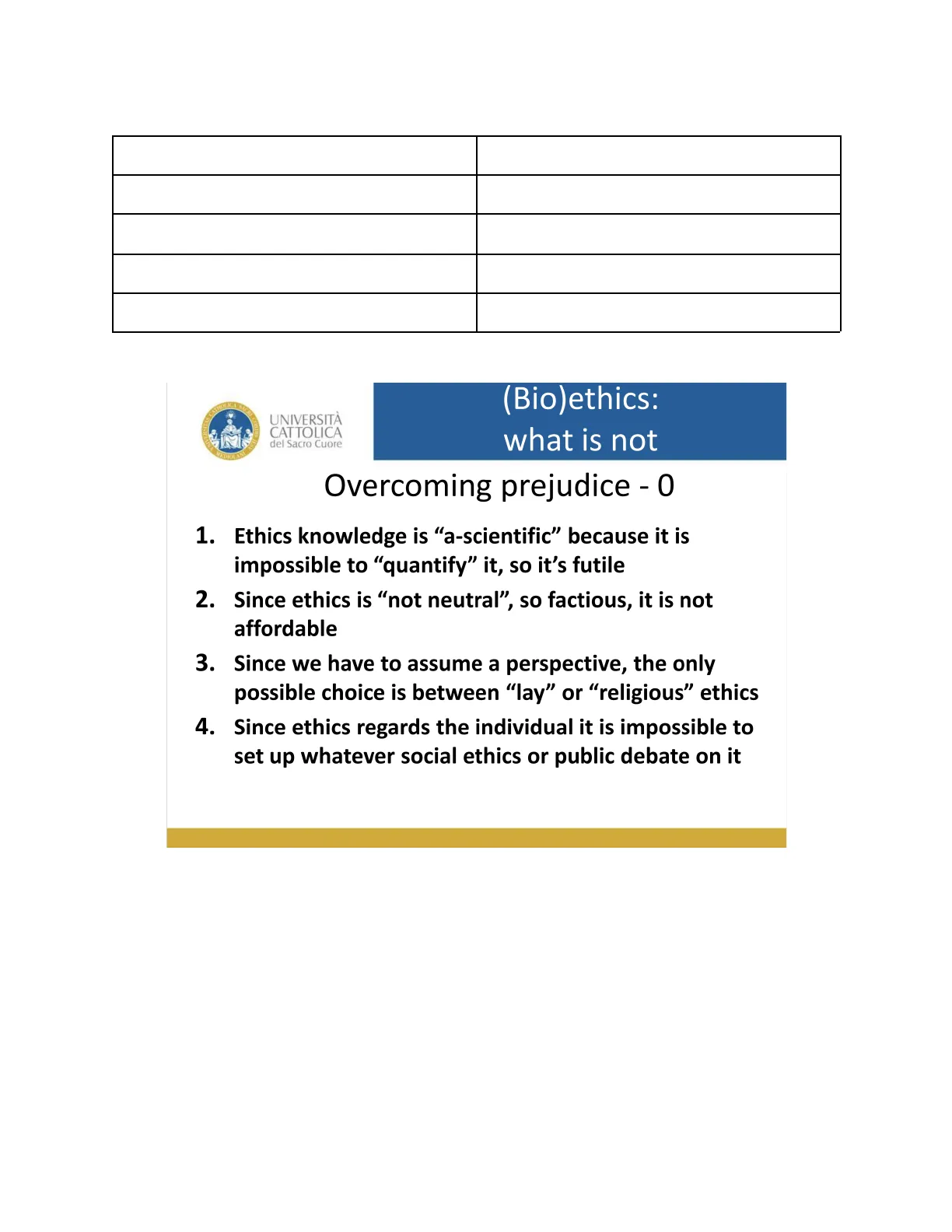
Overcoming Prejudice - 0
1. Ethics knowledge is "a-scientific" because it is impossible to "quantify" it, so it's futile 2. Since ethics is "not neutral", so factious, it is not affordable 3. Since we have to assume a perspective, the only possible choice is between "lay" or "religious" ethics 4. Since ethics regards the individual it is impossible to set up whatever social ethics or public debate on it
Today we have 3 hours as usual and we will try to address and overcome the serious prejudice on bioethics.
The first prejudice is - "ethics knowledge is "a-scientific" or not scientific because it is impossible to "quantify" it or to be objective. For example, empirical knowledge from maths, physics, or biology has quantitative methods to address reality (cell species, organs, and so on). According to this prejudice, ethics is not a science because ethics is not allowed to be objective as it is not allowed to quantify its data, conclusions, or its argumentation. We can say that the basic background of ethics is shared withempiric sciences which is the use of the first principles of thought. We have seen this in the last century through very imminent experts of logic.
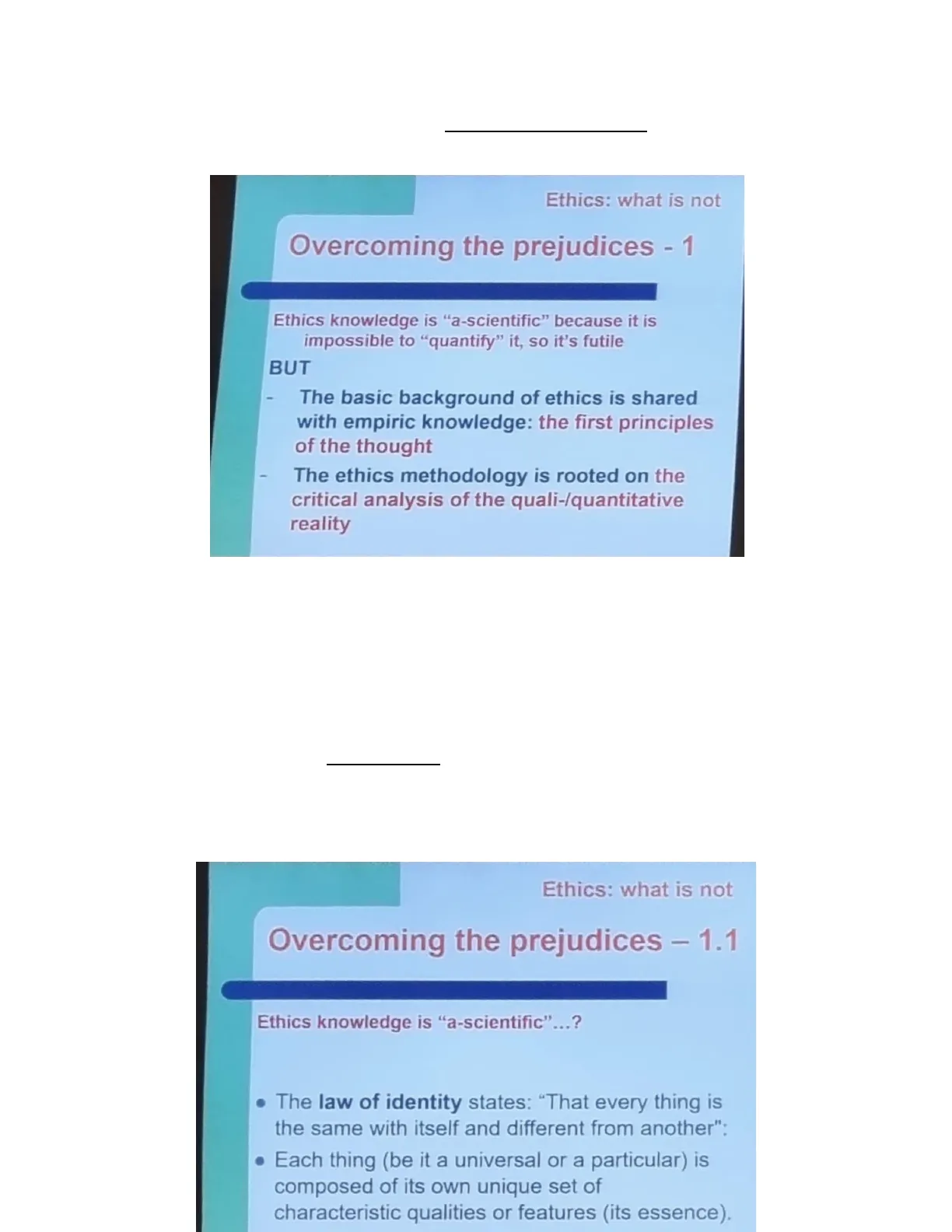
Ethics: What Is Not - Overcoming Prejudices - 1
Ethics knowledge is "a-scientific" because it is impossible to "quantify" it, so it's futile BUT
- The basic background of ethics is shared with empiric knowledge: the first principles of the thought
- The ethics methodology is rooted on the critical analysis of the quali-/quantitative reality
The other consideration for overcoming this prejudice is that ethics methodology is closely rooted in the critical analysis of quantitative and qualitative reality. This is the law of identity. We approach this sentence that comes from Aristotle, who had the say on the first analytics. He was the first to attempt to organize and set up logic in western philosophy. Anyways, the law of identity states that "everything is the same with itself and different with another". The symbolic representation of this is "A is A and not # A". In other words, each particular thing is composed of its own unique set of characteristic features that identify this thing. For example, the screen is a screen and not a stand
Ethics: What Is Not - Overcoming Prejudices - 1.1
Ethics knowledge is "a-scientific" ...?
- The law of identity states: "That every thing is the same with itself and different from another":
- Each thing (be it a universal or a particular) is composed of its own unique set of characteristic qualities or features (its essence).form, shape, materials, composition, color, and so on.
The law of non-contradiction is the second principle of thought, it states that "no one can believe that the same thing can (at the same time) be and not be". The symbolic representation of this can be - the two propositions "A is B" and "A is not B" are "mutually exclusive". At the same time, I cannot say "this is a desk" and "this is
Ethics: What Is Not - Overcoming Prejudices - 1.1 (Continued)
Ethics knowledge is "a-scientific" ...?
The Law of Non-contradiction: "No one can believe that the same thing can (at the same time) be and not be."
The two propositions "A is B" and "A is not B" are "mutually exclusive" and «jointly exhaustive»
not a desk". It may seem obvious but for experts of logic, it is not.
Finally, the law of excluded middle. According to this, "two contradictory propositions, one must be true, and the other false". So, if the principles of thought organize all kinds of knowledge including ethics, ethics is not a-scientific and we cannot drop ethics from the list of sciences even if ethics uses the principles of thought in its own way.
Ethics Knowledge: A-Scientific? Overcoming Prejudice - 4
Ethics knowledge is "a-scientific" ...?
The laws of thought (Aristotle, On interpretation). The Law of Excluded Middle states that of two contradictory propositions (i.e. where one proposition is the negation of the other) one must be true, and the other false
Another way to overcome this first prejudice is by using the tools of ethics methodology which are the critical analysis of qualitative and quantitative reality. But what does this really mean?
- Critical means the rigorous use of reason.
- Analysis means to stay systematic, deep, punctual, and avoid approximation.
- Qualitative and Quantitative reality. The reality of our patient is complex, his pathology, his disease, his illness, these are the 3 words in English that define the reality of health problems. Pathology is the biological basis of disease. While the disease itself is the clinical scenario we try to identify and diagnose. Illness can be defined as the individual emotions the patient experiences. Reality is very complex and includes both empirical and non-empirical aspects. The empirical aspect can be signs or symptoms. Non-empirical can be a patient's consent to the treatment. It may be non-empirical but it is still very real.
Ethics Knowledge: Overcoming Prejudice - 6
Ethics knowledge is:
- Critical: rigorous use of the reason (intellection and intuition)
- Analysis: systematic inquiry
- Qualitative/Quantitative reality: The reality is needed to be dealt with in its complexity of empirical and not-empirical aspects
So, (bio)ethics is a "metodologically" lay discipline
If ethics critically analyzes reality, we can consider that ethics is a methodologically "lay" discipline independent from a particular ethical framework. We will very briefly discuss the use of reason. We say reason has 2 arms which are intellection and intuition.
- In dictionaries, we find intellection is said to be an act of an intellect, the action of understanding as opposed to imagination.
- Intuition is immediate apprehension or cognition, the concentration of knowledge and attaining of that knowledge without any evident rational thought or interference. For example, a new disease like Covid-19. The first physicians had an intuition by looking at that the first patients affected, that they were patients that presented a new disease due to a new virus.
Ethics: Critical Use of Reason
1. an act of the intellect: thought 2. exercise of the intellect: reasoning 3. the action or process of understanding, as opposed to imagination.
1. immediate apprehension or cognition 2. knowledge or conviction gained by intuition 3. the power or faculty of attaining to direct knowledge or cognition without evident rational thought and inference
Critic : rigorous use (intellection and intuition)
Conclusion: Ethics and Empirical Disciplines - Overcoming Prejudice - 7
CONCLUSION: Ethics shares with empirical disciplines (physics, mathematics, etc.) the same "laws of thought" (but) applied to own MATERIAL and FORMAL OBJECTS
GENERALLY: The Material Object of a science is the matter with which the science deals. The Formal Object of a science is the precise aspect under which that science deals with its subject matter.
The conclusion is that ethics shares with empirical disciplines the same "laws of thought" but applied to its own material and formal objects. In general, the material object of a science is the matter with which the science deals. The formal object is the precise aspect under which science deals with its subject matter.
The material object is represented by human acts, the actions that characterize the human being as a whole. These are actions carried out by willingness. Human acts are different from other acts which are performed in common with other living things like digestion. The formal object can be summarized in the sentence "do good avoid evil". What is evil? For us, evil is the pathology that seeks to kill. Good is to solve or heal the disease, more particularly the patient. Georges Canguilhem, a French epistemologist stated in his famous essay that disease doesn't exist, a patient with a disease exists.
Ethics: Material and Formal Objects - Overcoming Prejudice - 7.1
In the case of Ethics:
- the Material Object consists of human acts. Human acts are acts performed by a man as a man - acts in which his superior faculties of both intellect and will are used - as opposed to those acts which man performs in common with animal and vegetative life (e.g .; digestion)
- The Formal Object is the moral rectitude of man's human acts in relation to man's natural end ("do good avoid evil").
To address its object, ethics uses 2 main tools that we share independently from our personal ethical frameworks.
- First one is human reason.
- The other is experience, which involves getting and keeping in touch with reality.
Ethics: Sources - Overcoming Prejudice - 7.2
In order to reach its conclusions, Ethics draws upon the following sources:
- Human reason (its primary source) closely linked to
- Experience [reality] (contemporary and historical)It's interesting to underline that human experience is closely linked to reality. It is so
Reason and Reality: Avoiding Ideological Bias - Overcoming Prejudice - 8.1
Why is the close link of reason to reality so crucial?
For avoiding a so-called double "ideological bias":
- Giving the reality aspects that do not exist
- Reducing reality to one of its constituents
essential to link reason and reality to avoid ideological bias.
- The first ideological bias is to see aspects of reality that do not exist. For example, seeing a Hippogriff which simply does not exist. It may seem that this bias is easy to avoid but that isn't the case always. For example, during the Nazi regime, Aryan people thought they were superior to all other humans and could decide who to kill or keep alive but of course, this is not true and it is not the reality.
- The second ideological bias is reducing a particular thing in reality. If I affirm that in this space we have desks and chairs, it's true but if I say Aula 6 has only desks and chairs, it's not true because the class has other things as well. This is more frequent than you can imagine. For example, if I say I need the patient's
Can’t find what you’re looking for?
Explore more topics in the Algor library or create your own materials with AI.
