GCSE Music AOS Revision Booklet: Baroque Style and Film Music
Document from GCSE Music AOS Revision Booklet. The Pdf is a detailed revision booklet for high school students studying Music, focusing on Baroque style and film music. It includes sections on musical forms, devices, composers, instruments, and techniques, providing a clear and structured guide for exam preparation.
See more64 Pages


Unlock the full PDF for free
Sign up to get full access to the document and start transforming it with AI.
Preview
Section Five - Musical Forms and Devices
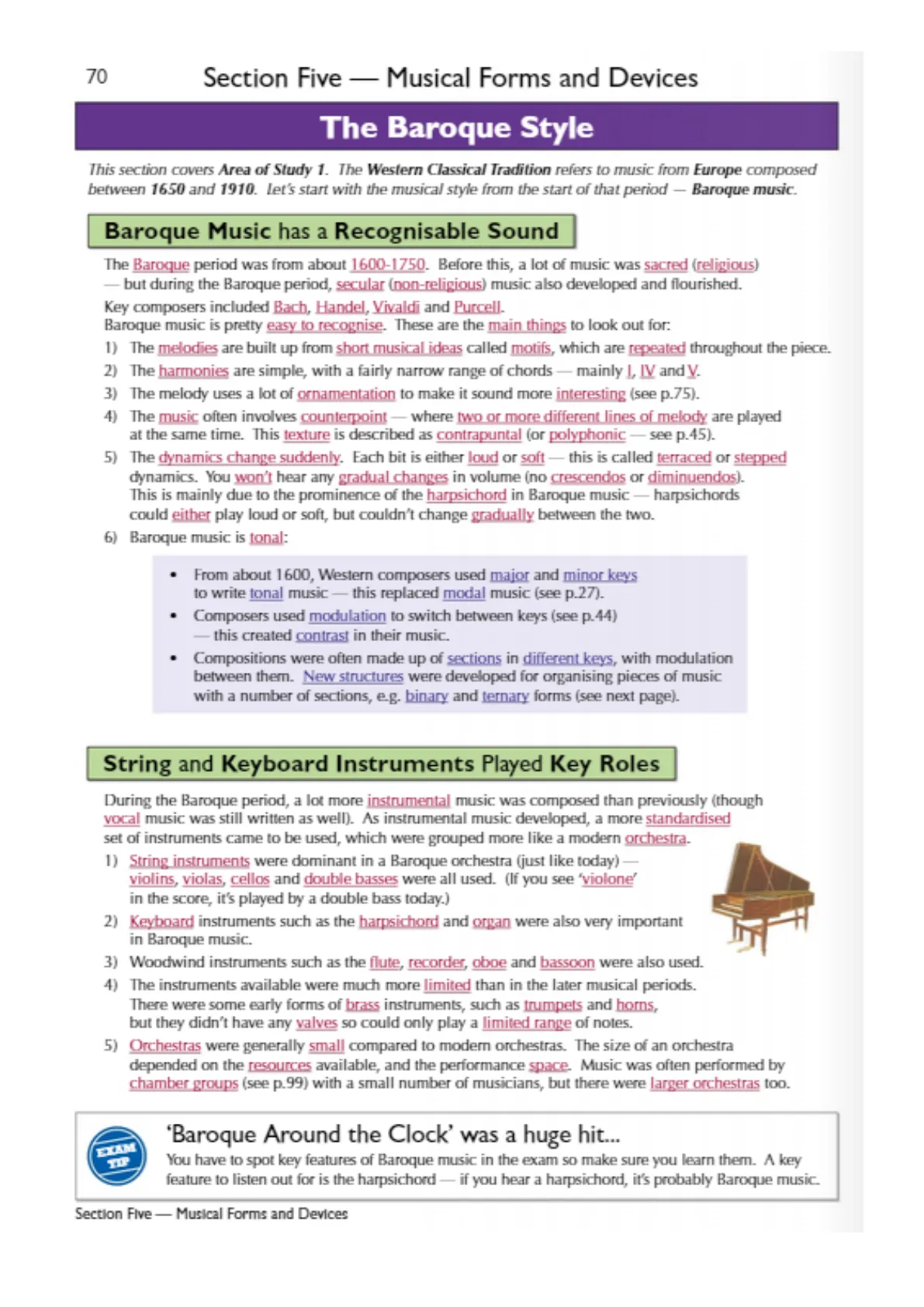
The Baroque Style
This section covers Area of Study 1. The Western Classical Tradition refers to music from Europe composed between 1650 and 1910. let's start with the musical style from the start of that period - Baroque music.
Baroque Music has a Recognisable Sound
The Baroque period was from about 1600-1750. Before this, a lot of music was sacred (religious) - but during the Baroque period, secular (non-religious) music also developed and flourished. Key composers included Bach, Handel, Vivaldi and Purcell. Baroque music is pretty easy to recognise. These are the main things to look out for:
- The melodies are built up from short musical ideas called motifs, which are repeated throughout the piece.
- The harmonies are simple, with a fairly narrow range of chords - mainly I, IV and V.
- The melody uses a lot of ornamentation to make it sound more interesting (see p.75).
- The music often involves counterpoint - where two or more different lines of melody are played at the same time. This texture is described as contrapuntal (or polyphonic - see p.45).
- The dynamics change suddenly. Each bit is either loud or soft - this is called terraced or stepped dynamics. You won't hear any gradual changes in olume (no crescendos or diminuendos). This is mainly due to the prominence of the harpsichord in Baroque music - harpsichords could either play loud or soft, but couldn't change gradually between the two.
- Baroque music is tonal: . From about 1600, Western composers used major and minor keys to write tonal music - this replaced modal music (see p.27).
- Composers used modulation to switch between keys (see p.44) - this created contrast in their music.
- Compositions were often made up of sections in different keys, with modulation between them. New structures were developed for organising pieces of music with a number of sections, e.g. binary and ternary forms (see next page).
String and Keyboard Instruments Played Key Roles
During the Baroque period, a lot more instrumental music was composed than previously (though vocal music was still written as well). As instrumental music developed, a more standardised set of instruments came to be used, which were grouped more like a modern orchestra.
- String instruments were dominant in a Baroque orchestra (just like today) - violins, violas, cellos and double basses were all used. (If you see 'violone' in the score, it's played by a double bass today.)
- Keyboard instruments such as the harpsichord and organ were also very important in Baroque music.
- Woodwind instruments such as the flute, recorder, oboe and bassoon were also used.
- The instruments available were much more limited than in the later musical periods. There were some early forms of brass instruments, such as trumpets and horns, but they didn't have any valves so could only play a limited range of notes.
- Orchestras were generally small compared to modern orchestras. The size of an orchestra depended on the resources available, and the performance space. Music was often performed by chamber groups (see p.99) with a small number of musicians, but there were larger orchestras too.
ELIM "Baroque Around the Clock' was a huge hit ... You have to spot key features of Baroque music in the exam so make sure you learn them. A key feature to listen out for is the harpsichord - if you hear a harpsichord, it's probably Baroque music.
Section Five - Musical Forms and Devices
Baroque Structures
Baroque composers used standard structures and devices to construct their music. Some of these are used throughout the Western Classical Tradition, but the basso continuo was only really used in the Baroque period.
Baroque Music Often Had a Basso Continuo
- A continuo (or basso continuo) is a continuous bass part. Most music written in the Baroque period has a continuo that the harmony of the whole piece is based on.
- The continuo can be played by more than one instrument, but at least one of the continuo group must be able to play chords (e.g. a harpsichord, organ, lute, harp, etc.). A cello, double bass or bassoon could also be used. The most common combination was a harpsichord and a cello.
- Continuo parts were usually written using a type of notation called figured bass. Only the bass notes were written on the stave, but numbers underneath the notes told the performers which chords to play. The continuo players would then improvvise using the notes of the chord.
- If there weren't any numbers written, the chord would be a normal triad (the root, the third and the fifth). A 4 meant play a fourth instead of the third, and a 6 meant play a sixth instead of the fifth. A Z meant that a 7th should be added to the chord.
- The improvisation is called a realization - the performer would 'realize' a continuo part.
7 Some version of Handel's Water Music stil have the continuo written in figured boass.
Binary and Ternary Forms are Made Up of Different Sections
Some standard structures were particularly popular with Baroque composers:
- Binary means 'in two parts' - binary form has two sections.
- Binary form is usually used for Baroque dances, e.g. bourrée, minuet, gavotte, sarabande and gigue.
- Each section is repeated. You play Section A twice, and then Section B twice, so it goes AABB.
- Section B contrasts with Section A - the two bits should sound different.
- The contrast is often made by modulating to related keys. Pieces in a minor key usually modulate to the relative major, e.g. A minor to C major. Pieces in a major key usually modulate to the dominant key (V), e.g. C major to G major.
- Ternary form has three sections. The general structure is ABA, but the sections are often repeated, producing structures such as AABBAA.
- Section A ends in the home key, normally with a perfect cadence (see pages 42-43). This makes it sound like a complete piece in itself.
- In Section B the music often modulates to a related key, like the dominant or relative minor, and then goes back to the home key before it ends.
- The last section can be exactly the same as Section A, or a slightly varied version. If it is varied, you call it Al instead of A.
In a ritornello, the same musical idea or theme is repeated at various points in the piece. A more formal structure of this type is a rondo, where a main theme (A) is repeated, separated by a number of different sections, creating forms such as ABACA (see p.85). That's this page done - better continuo onto the next one ... For binary form, have a listen to the Sarabande and Gavotte from J.S. Bach's French Suite No.6 in E Major, or Handel's Music for the Royal Fireworks (the Minuets and Siciliano 'La Paix').
Section Five - Musical Forms and Devices
Baroque Structures
Variations are pieces which start with one pattern or tune, and then change it in different ways. There are two main structures for variations - 'theme and variation form' (on this page) and "ground bass form' (next page).
Theme and Variation Form Varies the Melody
- In theme and variation form, the there's usually a memorable melody.
- The theme is played first. There's a short pause before the first variation is played, then another pause before the next variation. Each variation is a self-contained piece of music. There can be as many or as few variations as the composer wants.
- Each variation should be a recognisable version of the main theme, but different from all the others.
theme Variation Variation 2 Variation 3 "The Harmonious Blacksmith' by Handel is in theme and variation form.
You can Vary a Melody in Lots of Ways
- Start off with a basic theme.
- Add notes to make the melody more complex.
- Remove notes to simplify the melody.
- Change the metre - e.g. from 2 beats in a bar to 3.
- Add a countermelody - an extra melody over the top of the theme.
- You can also change the tempo, change the key (from major to minor or vice versa), change some or all of the chords or add a different type of accompaniment (e.g. an Alberti bass - see p.39).
A fantasia is a composition with an improwised feel - the composer uses their imagination and skill to compose a piece that doesn't follow a set structure. Fantasias often involve variations on a theme. Try some variations on the theme of revision ... The examples of variations on this page are fairly simple, but they can become quite complex and require a lot of skill and practice to play well. See if there are any for your instrument that you could have a go at.
Section Five - Musical Forms and Devices
Baroque Structures
A few more structures to get your head around on this page - first up, it's ground bass form, which is another type of variation. Then it's onto the strangely-named concerto grosso, then finally the prelude.
Ground Bass Pieces Have Repetition AND Variety
- A ground bass is a repeated bass part that's usually four or eight bars long. It can be played by the left hand on a harpsichord or piano, or by the cello and double bass in a chamber orchestra (see p.99)_
- A ground bass is a type of ostinato - a short pattern of notes repeated throughout a piece of music.
- The tune is played over the ground bass part. First you hear the main tune, then a load of variations. The variations are played as one continuous piece - there are no gaps between them.
- The ground bass part can be varied too. You change the starting note but keep the pattern the same. First time round, the ground bass aume starts on C Later on you get the same nume starting on G.
- The ground bass piece gets more and more complex as it goes on. It can be developed by adding extra, decorative notes to the melody, using more advanced harmonies and adding more instruments to give a richer texture.
The Concerto Grosso was a Popular Form of Orchestral Music
- In a concerto grosso, a small group of soloists (called the concertino) is contrasted with the rest of the orchestra (the ripieno) and the basso continuo. The ripieno is usually a string orchestra.
- Handel wrote several concerto grossi (plural for grosso) - in his Concerto Grosso No. 5 (Op. 6), the concertino is made up of two violins and a cello, the ripieno is a string orchestra, and the continuo is played on the harpsichord.
- 1.5. Bach composed a set of six concertos known as the Brandenburg Concertos, which include some excellent examples of concerto grossi. He used different instruments in the concertino in different concertos - for example, the concertino is two recorders and a violin in No.4, and a flute, violin and harpsichord in No.5 (unusually, the harpsichord plays both the continuo and a solo part in this concerto).
- Baroque composers also wrote solo concertos. Here a single solo instrument is 'showcased", allowing its performer to demonstrate the instrument's capabilities, accompanied by an orchestra. Vivaldi's 'Four Seasons" is a solo concerto for the violin. It was this type of concerto that was further developed by composers such as Mozart and Haydn in the Classical period - see p.83.
Some Works Have an Introduction Called a Prelude
- In the Baroque period, a prelude was a short, relatively simple piece of music. It usually served as an introduction to a longer piece or to a number of pieces of music.
- The first movement of a suite (a set of dances) is often a prelude
- A prelude was often used as an introduction to a more complex piece such as a fugue. Bach wrote a prelude and fugue in each of the 24 keys in 'The Well-Tempered Clavier" - a collection of solo pieces for keyboard instruments.
- In the Romantic period (see p.86-87), the term came to be used to describe a short, stand-alone piece.
Freshly ground bass - it goes all powdery ... The Brandenburg Concertos got their name because Bach dedicated and presented them to a nobleman called the Margrave of Brandenburg in 1721. The Margrave had admired some of Bach's earlier compositions.
Can’t find what you’re looking for?
Explore more topics in the Algor library or create your own materials with AI.
