Technology 1º Eso - Unit 3: Materials and Tools, Ferrous and Non-Ferrous Metals
Slides from High school about Technology 1º Eso - Unit 3. The Pdf explores materials and tools, with a focus on ferrous and non-ferrous metals, detailing their properties and applications in schematic tables. This Presentation is suitable for High school students studying Technology.
See more65 Pages


Unlock the full PDF for free
Sign up to get full access to the document and start transforming it with AI.
Preview
UNIT - 3 MATERIALS AND TOOLS
When you finish this unit ...
You should be able to:
- To know the origin of the materials of technical use.
- Describe the characteristics of materials: wood, metals and plastics.
- To know the properties of materials for technical use.
- To know the tools that allow machining and shaping of materials.
- Handle tools to perform basic operations: cutting, grinding, filing, nailing and gluing.
- Work the materials taking into account the safety measures in the use of the workshop tools.
- Develop a work plan to build a technological object.
Index
Index.
- Introduction
- Raw materials
- The materials.
- Wood
- Wood and its derivatives
- Woodworking
- Environmental impact of the timber industry
- Metals.
- Metal working
- Metal forming techniques
- Environmental impact.
- Plastics
- Types of plastics
- Plastic machining
- Conformation with plastics
- Plastics recycling
- Links to Internet resources
Bibliography.
Introduction to Materials and Properties
Materials and the knowledge of their properties are one of the factors involved in the technological process. It is very important to know their properties and characteristics in order to provide the best possible solution to each technical problem.
Materials have been very important for the development of mankind, to the point that they have served to identify historical epochs: Stone Age, Age of Metals. When we have talked about the evolution of technology, one of the factors analyzed has been the materials used in each era. If we had to point out a material that was important in the 20th century, we would undoubtedly have to talk about plastics. We could speak of the Plastic Age.
In this unit we will study three types of materials for technical use: wood, metals and plastics. We will also learn about the techniques used in the machining of these materials and the most appropriate tools in each case.
It is also very important, at the same time that we know the tools and their handling, to know and be able to apply the basic safety measures to avoid accidents in the workshop.
Raw Materials and Their Transformation
The first materials used by human beings were elements found in nature: branches, stones, animal skins, etc.
Raw materials are those elements existing in nature that have not been subjected to transformation processes.
Raw materials can be renewable or non- renewable.
Renewable resources are those that can be regenerated and therefore do not run out, such as wood and wool. Non- renewables are those that are depleted when used, as is the case of oil and coal.
It is very important to be aware of the importance of making a good use of raw materials, especially those that are n MATERIAS PRIMAS
Materials are obtained from the raw materials through a process that includes the following steps:
- Extraction, by which raw materials are obtained from nature. Minerals and rocks are extracted from mines and quarries; while wood or wool must be collected after planting or breeding.
- Transformation. Raw materials are subjected to different physical or chemical processes in order to obtain the materials. For example, metals are obtained from ore in metallurgical industries, and plastics are obtained from petroleum in petrochemical industries. ALE
. Elaboration.Once transformed, the materials take different commercial forms, wood is presented as slats, boards and planks; cotton or wool yarns and fabrics; metal sheets or rods.
Recycling and Material Classification
. Recycling. In many occasions materials can be obtained from discarded products, which once recovered are used as raw material in the transformation of new materials. It is very important to be aware of the importance of recycling more and more, in order to preserve natural resources.
Activities:
- Classify the following raw materials into renewable and non-renewable: wool, petroleum, iron ore, cork, cotton, water, clay, wood.
- Write the name of materials that can be obtained from each of the following raw materials: pine, petroleum and cotton.
The Materials
Technological products are manufactured with a wide variety of materials that we can classify in different ways: by their origin, by the way they are obtained, by their nature, etc.
Materials can be natural and synthetic.
- Natural materials: are those obtained from nature and after using physical procedures (cutting, spinning, grinding, etc.) are obtained in commercial forms; cotton, wood and wool.
- Synthetic materials are those obtained by chemical processes from natural materials, such as plastics, concrete, paints and paper.
The applications that the materials may have will depend on their properties and characteristics.
Types of Materials
3.1. Types of materials
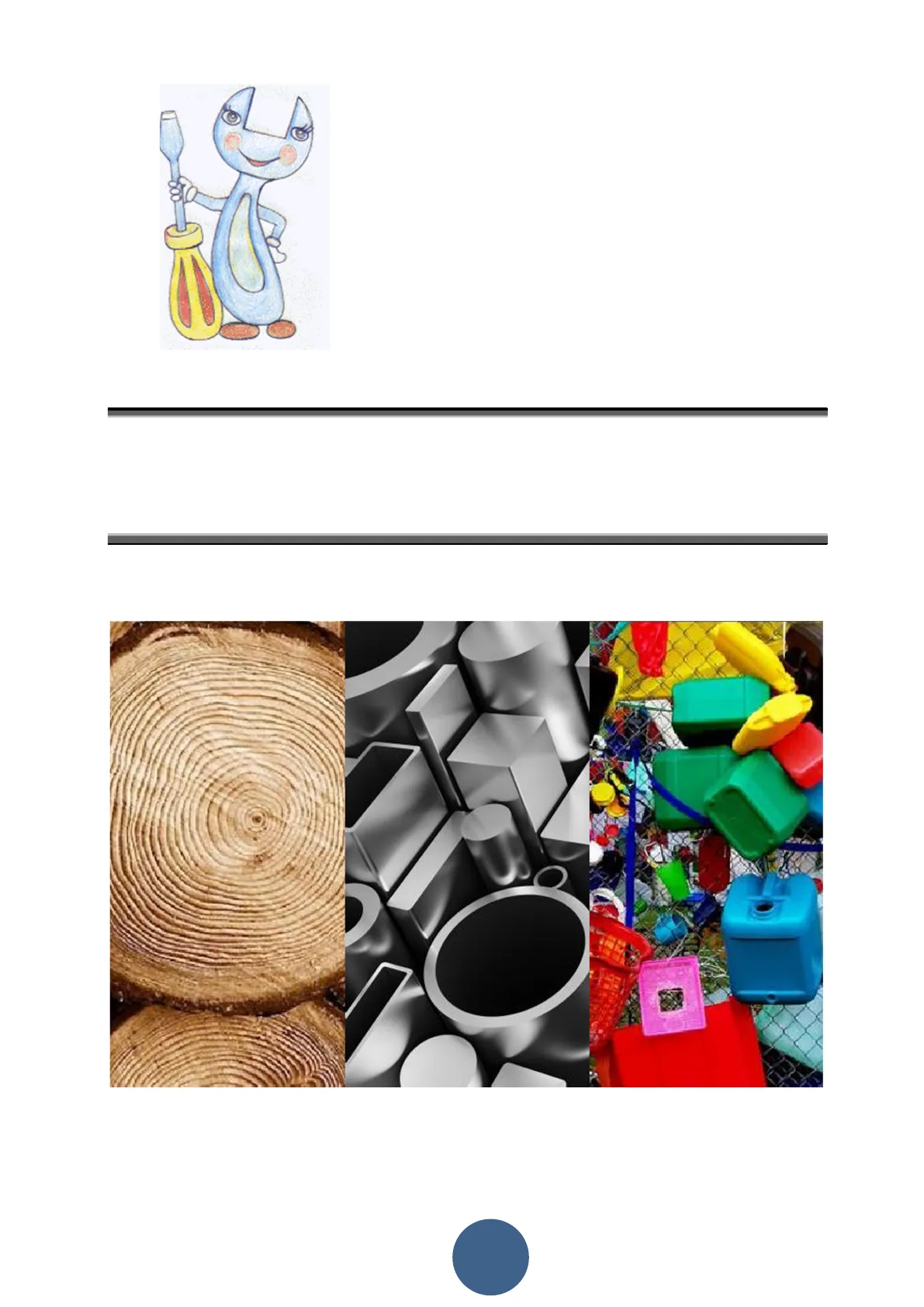
Materials can be classified into the following groups: wood, metals, plastics, stone materials, textiles, ceramics and glass.
PRODUCTOS TECNOLOGICOS se elaboran con I MATERIALES se obtienen a partir de los más utilizados son pueden ser 1 MATERIAS PRIMAS MADERAS Naturales pueden ser TEXTILES Sintéticos Renovables METÁLICOS No renovables PÉTREOS CERÁMICOS PLÁSTICOS
- Wood is obtained from the woody part of trees. It is used in the manufacture of furniture and construction materials, in decoration, in the paper industry and as fuel.
- Metals are extracted from ores. They are used for structures, machine parts, tools, connecting elements, electrical and electronic equipment, windows, gratings, etc.
- Plastics are synthetic materials obtained mainly from petroleum. They are used to manufacture all kinds of objects and can replace wood and metals in many applications.
- Stones: obtained from rocks. They are used in construction. They are marble, granite, cement, concrete, etc.
- Ceramics: obtained by molding clay with water and firing it in a kiln at high temperatures. It is used for pots, construction materials, decorative objects, etc.
- Textiles: they are obtained in the form of yarns which in turn are used to obtain fabrics. They are obtained from natural or synthetic materials.
When using a material, we always choose it based on its properties. The properties of materials are the set of characteristics that make the material behave in a certain way in response to external stimuli such as light, heat, forces, etc.
In order to study the different types of materials it will be necessary for us to know and understand the different properties that they can present.
Material Properties Overview
3.2. Material properties
Properties can be classified into physical, chemical and ecological.
PROPIEDADES de tipo FÍSICO QUÍMICO ECOLÓGICO 1 pueden ser como la son Eéctricas Oxidación Tóxicos Ópticas Reciclables Térmicas Biodegradables Mecánicas Resistencia Dureza Tenacidad Rigidez
3.2.1. Physical properties
These are those that affect the material but do not alter its chemical composition. These in turn can be classified as: electrical, optical, thermal, mechanical and acoustic.
- Electrical. They have to do with the capacity of the materials to allow the passage of electricity or not. Thus, we will have electrically conductive or insulating materials. Conductor
Optical and Thermal Properties
- Optics. It has to do with the behavior of materials in the presence of light. Thus we can speak of transparent materials, those that let light pass through and we can see the images through them; translucent materials, when light passes through but distorts the image; and opaque materials, which do not let light pass through and we cannot see through them.
- Thermal. They have to do with the behavior that the material has in front of the heat. We will have materials that are good conductors of heat and others that will be good insulators of heat.
Mechanical Properties of Materials
- Mechanical. These are those related to with the behavior of materials when subjected to certain types of forces (stresses): o We can say that a material is resistant if it does not break when a certain force is applied to it. o It is rigid if it does not lose its shape when a force is applied to it, it is plastic if it is permanently deformed when a force is applied to it, or elastic if it is deformed when a force is applied to it and then recovers its original shape when the force is released. o A material is hard when it does not scratch easily; on the contrary it is soft if it can be scratched or punctured. Barro. Plomo. Vidrio.
- It is tenacious if, when hit, it deforms without breaking and, on the contrary, it is fragile if it breaks when hit.
3.2.2. Chemical properties
They are those that affect the material by altering its chemical composition. Oxidation is the behavior of some materials in the presence of some atmospheric or chemical agents. This property is present in metals.
3.2.3. Ecological properties
These are those that relate to how the material may affect the environment.
- Toxic. The harmfulness of materials to the environment or living beings.
- Recyclable. The ability of materials to be reused to make new materials.
- Biodegradable. The ability of materials to decompose naturally into simpler substances. Reciclable Tóxico Biodegradable
Composite Materials and Alloys
3.3. Composite materials
These composite materials are created when it is necessary to combine the properties of several types of materials into one.
The tetrabrik is a composite material formed by layers of plastic, cardboard and aluminum. The plastic makes it impermeable, the cardboard provides resistance and the aluminum preserves the food by keeping out the light.
Carbon fiber is often combined with other materials to form composites. For example, it is combined with some plastics and results in very strong and lightweight materials. They are used to make bicycle frames, tennis rackets, airplanes, cars, etc.
Chipboard and MDF, which we will see later and use in the workshop, are also composite materials. They are made from wood or fiber scraps and agglomerated (glued) with glue.
naiden B
3.4. Alloys
Metals are often not used in their pure state, but in alloys. An alloy is composed of two or more elements, at least one of which is metallic. The best known examples are steel, which is an alloy of iron and carbon; bronze, which is an alloy of copper and tin; brass, which is an alloy of copper and zinc.
NOTEUSTA ATA SANTANDER EDANILO ARIZA MUSA SEPT CAT ANIMA MEA DOD Steel Bronze Brass
Can’t find what you’re looking for?
Explore more topics in the Algor library or create your own materials with AI.
