Oscar Wilde e Bernard Shaw: figure chiave del Modern Drama
Document from University about Oscar Wilde and Bernard Shaw. The Pdf explores the lives and works of these two important dramatists, contextualizing them within the "Modern Drama" period. It covers their style, language, and recurring themes, providing a comparative framework for Literature students.
See more8 Pages


Unlock the full PDF for free
Sign up to get full access to the document and start transforming it with AI.
Preview
Introduction to Modern Drama
TEMA 51 : O. WILDE Y B. SHAW
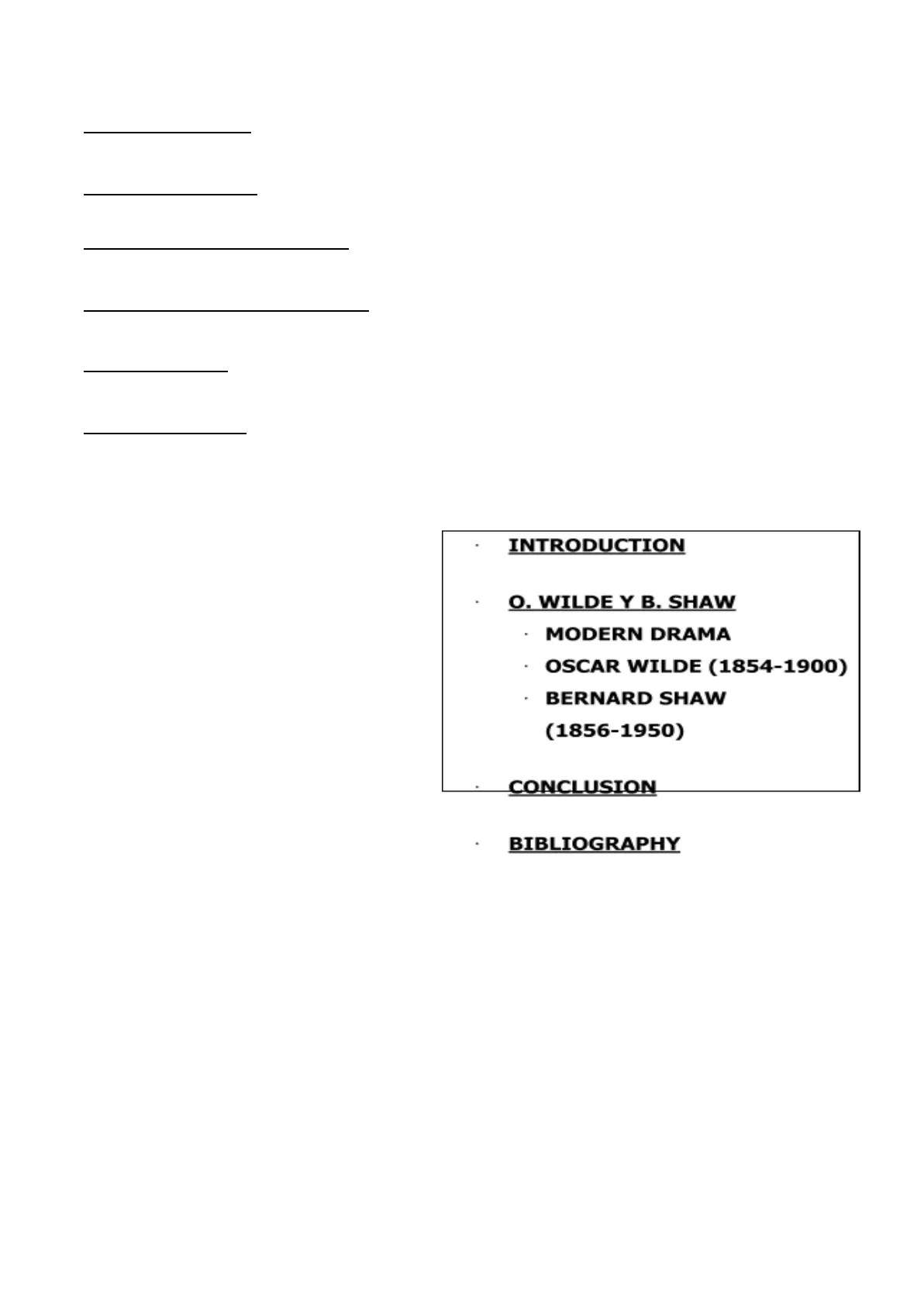
0. INTRODUCTION 1. MODERN DRAMA 2. OSCAR WILDE (1854-1900) 3. BERNARD SHAW (1856-1950) 4. CONCLUSION 5. BIBLIOGRAPHY . INTRODUCTION O. WILDE Y B. SHAW
- MODERN DRAMA
. OSCAR WILDE (1854-1900) . BERNARD SHAW (1856-1950) CONCLUSION . BIBLIOGRAPHY 10. INTRODUCTION
- State of mind characterised as: o Neither of the earlier Victorians o Nor of the 20th century Writers of the 1890s are styled: "Late Victorians" "1st of the Moderns"
- Among others, O. Wilde was proponent of "art for art's sake" they believed that art should be: Unconcerned with controversial issues (ex: politics). Restricted to celebrating beauty in a highly polished style. The "aesthetes" include in their group painters, critics and the young Yeats.
- Hence, Unit 51 will deal with these two great writers' lives and works, which will be analysed in the following sections. Nevertheless, a description of Modern Drama is presented before in order to understand those important figures in a more detailed way.
Modern Drama Overview
1. MODERN DRAMA
- _ It begins with the witty drawing-room comedies of Oscar Wilde: o He founded no dramatic school. o His wit was personal and irresponsible (unlike wit of Restoration comedy reflected an attitude to relation between sexes, part of a view of society held by a whole social class). Bernard Shaw brought still another kind of wit into drama:
- 0_Provocative paradox, meant to tease and disturb, to challenge the complacency of audience. 0_His discussion plays were given dramatic life through the mastery of theatrical techniques. 0_He represents the anti-Victorianism of the late Victorians.
- _Other attempts by 20th cent. dramatists to debate social questions on the stage: o Deserve respect for their humanity and intelligence. o They lack Shaw's verbal and intellectual brilliance and his superb capacity to entertain.
- Ireland another really impressive variety of dramatic activity: o The Irish Literary Theatre to encourage new developments in the drama.
- _ It cannot be said of the drama as it can of poetry and fiction in this period that a technical revolution occurred which changed the whole course of literary history with respect to that particular literary form. Once those aspects concerning Modern Drama have been exposed, we will focus on the most significant writers at that time, who are Oscar Wilde and Bernard Shaw.
Oscar Wilde: Life and Works
2. OSCAR WILDE (1854-1900) Thus, this section presents a brief description about the author's living, which will be followed by the analysis of his main works. So that, with regard to his life, we can say that:
- Oscar Wilde was a Dubliner distinguished by both his class and his education.
- He was the son of a romantically inclined mother who dabbled in sentimental nationalist verse. 2- He aspired to shine in England and to be central figure in fashionable metropolitan coterie of artists.
- He also acted out the parts of a London socialite and of a provocative social critic.
- There were both a seriousness and an acute awareness that he was acting.
- His homosexuality took him to prison and the alienating bias of his art became manifest.
- We can consider some of his subversive characteristics, which provoke a response to difference: o The artificial style of his prose. o The excessive elaboration of his poetry. o The aphoristic and paradoxical wit of his plays. Concerning his works, we can enumerate the following ones:
Oscar Wilde's Early Works
- Vera: or, The Nihilists (1880) :
- Pretty minimal mastery of theatre technique.
- The Duchess of Padua (1883) .
- The Decay of Lying (1889) .
- The Critic as Artist (1890) .
- They suggest something of the aphoristic dialogue of his later comedies.
- The Soul of Man Under Socialism (1891) :
- Longest and most provocatively serious essay.
- Idea of freedom and liberation from drudgery and the rule of machines.
- The Picture of Dorian Gray (1890-1) :
- This story explores Victorian assumptions and values about a variety of issues including art. (Plot).
- Wilde's view of art the artist can have no ethical sympathies.
- A controversial story criticism of superficial self-love and of Victorian society (no moral responsib)
- Salome (1891) : The most powerful and influential of his tragedies, written in French.
- Victim of outrageous treatment of Bible history and its author's reputation.
- Its striking, overwrought imagery and shocking juxtapositions of repulsion and sexual desire, death and orgasm, were powerfully transformed.
- A Florentine Tragedy (1894-7) .
- We can also mention that Wilde's successful plays were written and performed during 1892-1895: o Brilliantly witty and epigrammatic comedies. o Social concern. Some examples are:
- The Truth of Masks (1891) .
- The clue of his comedies, which always handle dangerous and compromising secrets.
- A Woman of No Importance (1893) illegitimate birth.
- Lady Windermere's Fan (1892) culpable indiscretions.
- An Ideal Husband (1895)
- The Importance of Being Earnest (1895) obscure social origins.
3- These are the dark background to the light comedy of O. Wilde.
- Revelation of a hypocritical society resonance to plays Wilde's own destiny was to underscore.
- Real achievement of these plays undercurrents of boredom, disillusion, alienation & real feeling
- Despite evocations of flippancy, snobbery and abrupt shifts in attitudes and judgements triumph in capturing a fluid, funny mood of "irresponsibility" which challenges all pretension.
Oscar Wilde: A Brief Biography
SUMMARY Oscar Wilde: A Brief Biography Oscar Wilde (1854-1900) was an Irish playwright, poet, and author, celebrated for his sharp wit, flamboyant style, and brilliant social commentary. Born in Dublin, Wilde was educated at Trinity College, Dublin, and later at Magdalen College, Oxford, where he embraced the aesthetic movement, which advocated "art for art's sake." Wilde moved to London, where he became a central figure in the city's cultural and social scenes. He published a variety of works, including essays, poems, and his only novel, "The Picture of Dorian Gray" (1890). His success as a playwright came in the early 1890s with a series of highly popular and critically acclaimed comedies. Wilde's career and life took a dramatic turn in 1895 when he was imprisoned for "gross indecency" due to his homosexual relationships, a crime at the time. After two years of hard labor, Wilde was released and spent his remaining years in relative obscurity in France, where he died of meningitis in 1900.
Wilde's Style, Language, Themes, and Tone
Wilde's Style, Language, Themes, and Tone Style: Wilde's style is distinguished by its elegance, wit, and epigrammatic quality. He often employed paradox and aphorism, creating memorable lines that highlighted the absurdities and contradictions of society. His works are richly detailed and imbued with a sense of aesthetic beauty, reflecting his belief in "art for art's sake." Language: Wilde's language is characterized by its precision, musicality, and humor. His dialogue is crisp and sparkling, full of clever repartee and wordplay. Wilde's use of language often serves to both entertain and critique, exposing the superficiality and hypocrisy of social conventions. Themes:
- Hypocrisy and Social Pretension: Wilde frequently explored the duplicity and insincerity of Victorian society. Plays like "The Importance of Being Earnest" satirize the earnestness and moral rigidity of the upper classes.
4. Aesthetics and Beauty: As a proponent of the aesthetic movement, Wilde believed in the value of beauty and art. This is evident in his works that celebrate the beautiful and the ornate, often questioning the relationship between art and morality.
- Identity and Duality: Wilde's characters often grapple with issues of identity and the double lives they lead, as seen in "The Picture of Dorian Gray" and "The Importance of Being Earnest."
- Love and Marriage: His comedies frequently examine romantic relationships and the institution of marriage, highlighting both its absurdities and its emotional depth. Tone: Wilde's tone ranges from lighthearted and humorous to biting and satirical. Even when critiquing societal norms, his works maintain a playful and engaging quality. Wilde's humor is often sophisticated and layered, appealing to audiences' intellect and sensibilities. Conclusion Oscar Wilde remains a towering figure in English literature, renowned for his wit, his critique of Victorian society, and his contribution to modern drama. His plays and writings continue to be celebrated for their artistic merit and their incisive examination of human nature and social mores.
Bernard Shaw: Life and Career
3. BERNARD SHAW (1856-1950) Similar to the previous section, the current one provides an analysis on Bernard Shaw's living and career. In regard to his life, some aspects can be highlighted, for example:
- Born in Dublin, one of the Anglo-Irishmen who have contributed so brilliantly to English literature
- Soon, interested in social reform.
- One of the founders of the Fabian Society organisation dedicated to the promotion of socialism.
- He was never a conventional socialist social & political attitude affected by his belief in active & individually willed kind of evolution (Life Force) and his admiration of vitality & power.
- A music critic, he often mocked conventional taste and fashionable preferences.
- It can also be said that Shaw's "revolutionary imagination" ambition to create a "New Drama". Now, it is time to consider some of his main works, such as: Victims to censorship
Bernard Shaw's Main Works
- The Philanderer (1893) .
- Mrs Warren's Profession (1893) : (Plot)
- It confronts 2 contemporary women's issues: o Future professional careers of educated, would-be independent. o Female prostitution.
- Arguments suggest propriety of both vocations; but internal tensions derive from the juxtaposition of a liberated daughter and her mother.
- It ends not with reconciliation, compromise or feminine solidarity, but with a slammed door and an isolated character happily engrossed in her work.
- Shaw complained in 1898 in the Preface together with: Classifying them as "Unpleasant Plays". 5
Can’t find what you’re looking for?
Explore more topics in the Algor library or create your own materials with AI.
