Othello by William Shakespeare: Analysis of Themes and Characters
Document from about Othello. The Pdf explores the main themes of William Shakespeare's tragedy, such as jealousy, deception, race, and trust, analyzing the plot and character dynamics. This University-level Literature document, produced in 2024, provides a detailed examination of the work's contemporary relevance and the impact of manipulation.
See more9 Pages

Unlock the full PDF for free
Sign up to get full access to the document and start transforming it with AI.
Preview
Othello: A Shakespearean Tragedy
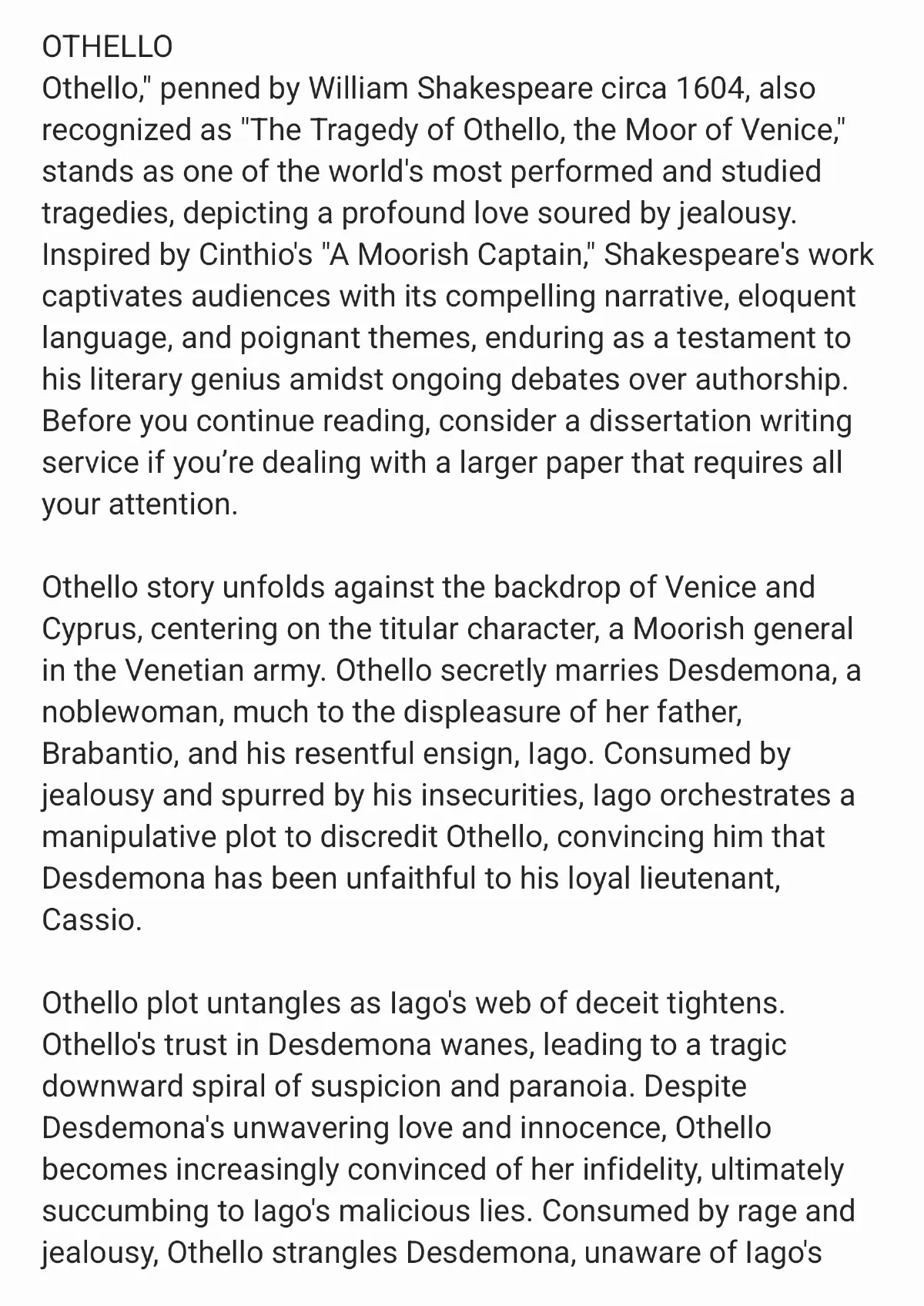
OTHELLO Othello," penned by William Shakespeare circa 1604, also recognized as "The Tragedy of Othello, the Moor of Venice," stands as one of the world's most performed and studied tragedies, depicting a profound love soured by jealousy. Inspired by Cinthio's "A Moorish Captain," Shakespeare's work captivates audiences with its compelling narrative, eloquent language, and poignant themes, enduring as a testament to his literary genius amidst ongoing debates over authorship. Before you continue reading, consider a dissertation writing service if you're dealing with a larger paper that requires all your attention.
Othello Plot Summary
Othello story unfolds against the backdrop of Venice and Cyprus, centering on the titular character, a Moorish general in the Venetian army. Othello secretly marries Desdemona, a noblewoman, much to the displeasure of her father, Brabantio, and his resentful ensign, lago. Consumed by jealousy and spurred by his insecurities, lago orchestrates a manipulative plot to discredit Othello, convincing him that Desdemona has been unfaithful to his loyal lieutenant, Cassio.
Othello plot untangles as lago's web of deceit tightens. Othello's trust in Desdemona wanes, leading to a tragic downward spiral of suspicion and paranoia. Despite Desdemona's unwavering love and innocence, Othello becomes increasingly convinced of her infidelity, ultimately succumbing to lago's malicious lies. Consumed by rage and jealousy, Othello strangles Desdemona, unaware of lago'streachery until it is too late. What happens to Othello at the end of the play is that in a moment of devastating realization, Othello takes his own life, unable to bear the weight of his actions and the truth of his betrayal.
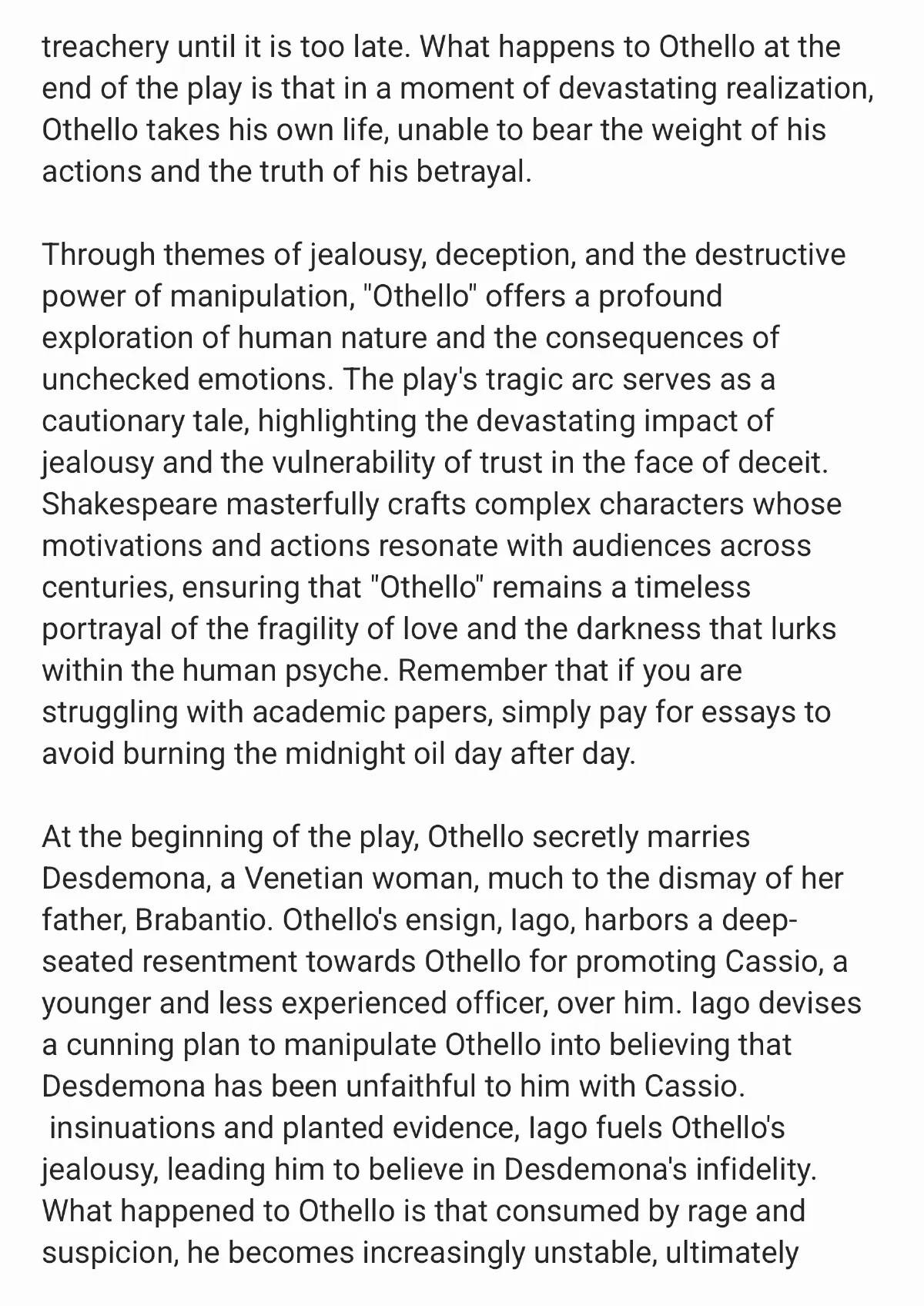
Through themes of jealousy, deception, and the destructive power of manipulation, "Othello" offers a profound exploration of human nature and the consequences of unchecked emotions. The play's tragic arc serves as a cautionary tale, highlighting the devastating impact of jealousy and the vulnerability of trust in the face of deceit. Shakespeare masterfully crafts complex characters whose motivations and actions resonate with audiences across centuries, ensuring that "Othello" remains a timeless portrayal of the fragility of love and the darkness that lurks within the human psyche. Remember that if you are struggling with academic papers, simply pay for essays to avoid burning the midnight oil day after day.
At the beginning of the play, Othello secretly marries Desdemona, a Venetian woman, much to the dismay of her father, Brabantio. Othello's ensign, lago, harbors a deep- seated resentment towards Othello for promoting Cassio, a younger and less experienced officer, over him. lago devises a cunning plan to manipulate Othello into believing that Desdemona has been unfaithful to him with Cassio. insinuations and planted evidence, lago fuels Othello's jealousy, leading him to believe in Desdemona's infidelity. What happened to Othello is that consumed by rage and suspicion, he becomes increasingly unstable, ultimatelyleading him to murder Desdemona. In the final moments of the play, Othello realizes the truth about lago's deception but tragically takes his own life in despair over what he has done.
The play explores themes of jealousy, manipulation, and the destructive power of unchecked emotions. Have you already written your Othello essay? If not, say, 'write my homework,' and our experts will provide a quick solution.
The plot summary of Othello depicts the noble Moor secretly marrying Desdemona, angering her father lago. Manipulating Othello with lies, lago convinces him of Desdemona's infidelity with Cassio. Consumed by jealousy, Othello strangles Desdemona. Emilia exposes lago's treachery, leading to his arrest. Othello, realizing his tragic mistake, kills himself. Cassio survives, appointed governor of Cyprus. The play ends with the tragic demise of Othello, a victim of jealousy and manipulation, and the exposure of lago's villainy.
Character Analysis
Othello Character
Othello is a noble and esteemed Venetian army general known for his bravery and leadership on the battlefield. However, he is also susceptible to jealousy and insecurity, particularly regarding his marriage to Desdemona. Despite his love for her, Othello's deep-seated insecurities are exploited by lago, leading him to spiral into madness and despair tragically.
Desdemona Character
Desdemona is a virtuous and loyal woman who deeply loves Othello. She is portrayed as innocent and pure-hearted, with unwavering devotion to her husband. Despite her genuinelove and loyalty, in the plot of Othello she becomes a victim of lago's manipulation, falsely accused of infidelity and ultimately murdered by Othello in a fit of jealousy.
Cassio Character
Cassio is a young and honorable officer in the Venetian army, admired for his skills and professionalism. He is loyal to Othello and maintains integrity throughout the play, though he becomes unwittingly entangled in lago's schemes. What happens to Cassio at the end of Othello is that despite facing setbacks and accusations, Cassio remains steadfast in his commitment to duty and ultimately helps to reveal lago's villainy
Iago Character
lago is the primary antagonist of the play, characterized by his deceitful and manipulative nature. He harbors a deep- seated resentment towards Othello and orchestrates a complex scheme to undermine him. Cunning and ruthless, lago manipulates the other characters for his gain, exploiting their weaknesses and sowing discord to achieve his malicious goals.
Brabantio Character
Brabantio is Desdemona's father, a senator in Venice. He initially opposes Desdemona's marriage to Othello due to racial prejudices, but he is ultimately powerless to prevent it. Brabantio represents the societal attitudes of the time regarding interracial marriage and reflects the themes of prejudice and discrimination explored in the play.
Roderigo Character
Roderigo is a wealthy and foolish suitor of Desdemona who becomes a pawn in lago's schemes. He is hopelessly in lovewith Desdemona and is easily manipulated by lago, who exploits his desperation for personal gain. Roderigo's gullibility and naivety make him susceptible to lago's machinations, ultimately leading to his demise.
The Duke of Venice Character
The Duke of Venice is a figure of authority representing the rule of law and justice in the play. He intervenes in the conflicts arising from Othello's marriage to Desdemona and presides over the trial of Othello and lago. The Duke's role underscores Venice's societal norms and values and highlights the contrast between public duty and personal vendettas.
Montano Character
Montano is the governor of Cyprus, where much of the play's action takes place. He is a respected figure in the military and serves as a foil to characters like Cassio and Othello. Montano's calm and rational demeanor contrasts with the tumultuous events around him, providing stability amidst the chaos.
Emilia Character
Emilia is Desdemona's maid and lago's wife, characterized by her wit and intelligence. While initially loyal to Desdemona, she becomes unwittingly complicit in lago's schemes. However, as the truth unfolds, Emilia demonstrates courage and integrity, ultimately exposing her husband's betrayal at great personal risk.
Lodovico and Gratiano Characters
Lodovico and Gratiano are Venetian noblemen who play minor roles in the play. Lodovico is Desdemona's cousin and a member of the Venetian delegation to Cyprus, whileGratiano is Brabantio's brother. They serve primarily as witnesses to the unfolding tragedy and contribute to resolving the play's conflicts.
Bianca Character
Bianca is a courtesan in Cyprus and a foil to Desdemona. She is involved in a tumultuous relationship with Cassio, who treats her as a mere dalliance. Bianca's character highlights the contrast between genuine love, superficial infatuation, and the double standards regarding women's behavior in society. If you're interested in analyzing protagonists from other literary works, consult our Louis Sachar's Holes character summary.
Analysis of Othello Acts
If you're wondering how many acts in Othello, the answer is five. Below is a short summary and key points of each act.
Themes in Othello
"Othello," one of William Shakespeare's most famous tragedies, explores several central themes that resonate throughout the play. Here are some of the main themes:
Jealousy Theme
Perhaps one of the most prominent Othello plot summaries, jealousy drives much of the plot's conflict. Othello's jealousy towards Desdemona, fueled by lago's manipulation, leads to tragic consequences. Similarly, lago's jealousy of Cassio and resentment towards Othello propel him to orchestrate a series of deceptions that ultimately destroy lives.
Race and Otherness Theme
Othello is a Moor, an outsider in Venetian society. Throughout the play, characters make derogatory comments about his race, reflecting the racism prevalent in the society. Othello's race becomes a significant factor in the characters' perceptions of him, contributing to his insecurities and vulnerability to manipulation.
Appearance vs. Reality Theme
The theme of appearance versus reality is central to "Othello." Characters often misinterpret situations and people based on superficial appearances, leading to tragic misunderstandings. lago, in particular, manipulates appearances to deceive those around him, creating a stark contrast between what seems to be true and what is actually true.
Manipulation and Deception Theme
lago is the master manipulator of the play, using deception to achieve his own selfish ends. He manipulates characters' emotions and perceptions, exploiting their weaknesses and vulnerabilities. The theme of manipulation highlights the power dynamics at play in relationships and underscores the destructive consequences of deceit.
Love and Trust Theme
"Othello" also explores the complexities of love and trust. Othello and Desdemona's love is genuine and profound, but it is ultimately destroyed by jealousy and suspicion. The breakdown of trust between characters, particularly Othelloand Desdemona, is a tragic commentary on the fragility of human relationships.
Power and Authority Theme
Power dynamics, both within personal relationships and societal structures, are central to the play. Othello's position as a military leader grants him authority, but it also makes him vulnerable to manipulation by those around him. lago's quest for power and control drives much of the plot's conflict, highlighting the corrupting influence of ambition.
Fate and Free Will Theme
"Othello" grapples with the interplay between fate and free will. While characters make choices that lead to tragic outcomes, there is also a sense of inevitability to the play's events. Othello's tragic downfall is the result of his own actions as well as the manipulation of others, raising questions about the extent to which individuals are responsible for their destinies.
Studying "Othello" is still important today because it talks about things that are still relevant, like jealousy, racism, and how people can manipulate each other. In today's world, where we're still dealing with issues of race and identity, the play's message about how jealousy and prejudice can ruin lives is still really powerful. Othello, the main character, struggles with his identity and fitting in, which is something a lot of people can relate to. The play makes us think about how important it is to trust each other and understand each other's perspectives in our relationships, and that's why it still
Can’t find what you’re looking for?
Explore more topics in the Algor library or create your own materials with AI.
