Lesson 1. What Is Social Education? Notes
Document from University about Lesson 1. What Is Social Education?. The Pdf explores the concept of social education, its origins, objectives, and the ethical dilemmas faced by social educators. This university-level material is presented in a mixed style, useful for autonomous study.
See more15 Pages

Unlock the full PDF for free
Sign up to get full access to the document and start transforming it with AI.
Preview
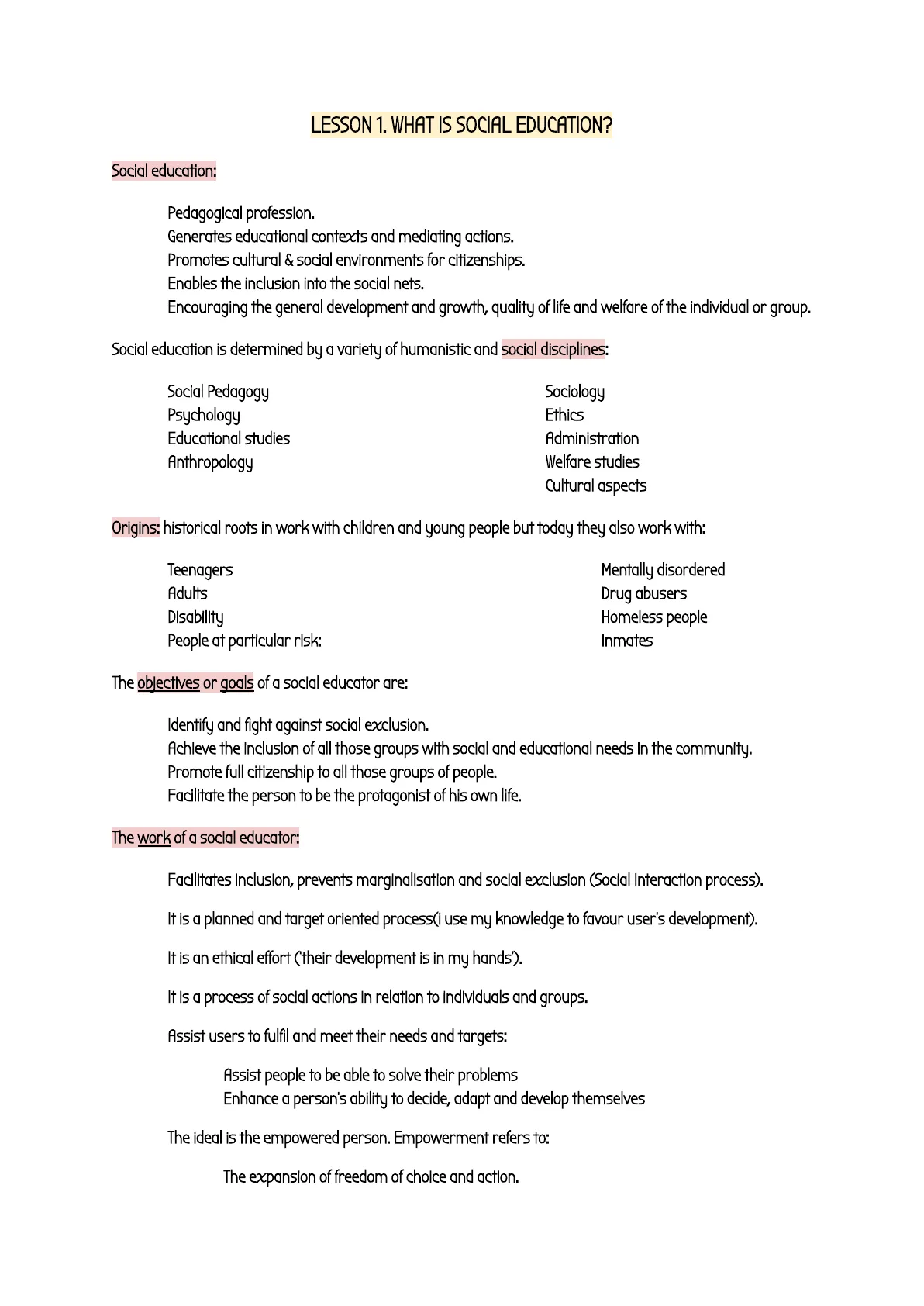
LESSON 1. WHAT IS SOCIAL EDUCATION?
Social Education Definition
Social education:
- Pedagogical profession.
- Generates educational contexts and mediating actions.
- Promotes cultural & social environments for citizenships.
- Enables the inclusion into the social nets.
- Encouraging the general development and growth, quality of life and welfare of the individual or group.
Disciplines Determining Social Education
Social education is determined by a variety of humanistic and social disciplines:
- Social Pedagogy
- Psychology
- Educational studies
- Anthropology
- Sociology
- Ethics
- Administration
- Welfare studies
- Cultural aspects
Historical Roots and Target Groups
Origins: historical roots in work with children and young people but today they also work with:
- Teenagers
- Adults
- Disability
- Mentally disordered
- Drug abusers
- Homeless people
- People at particular risk:
- Inmates
Objectives of a Social Educator
The objectives or goals of a social educator are:
- Identify and fight against social exclusion.
- Achieve the inclusion of all those groups with social and educational needs in the community.
- Promote full citizenship to all those groups of people.
- Facilitate the person to be the protagonist of his own life.
Work of a Social Educator
The work of a social educator:
- Facilitates inclusion, prevents marginalisation and social exclusion (Social Interaction process).
- It is a planned and target oriented process(i use my knowledge to favour user's development).
- It is an ethical effort (their development is in my hands').
- It is a process of social actions in relation to individuals and groups.
- Assist users to fulfil and meet their needs and targets:
- Assist people to be able to solve their problems
- Enhance a person's ability to decide, adapt and develop themselves
- The ideal is the empowered person. Empowerment refers to:
- The expansion of freedom of choice and action.
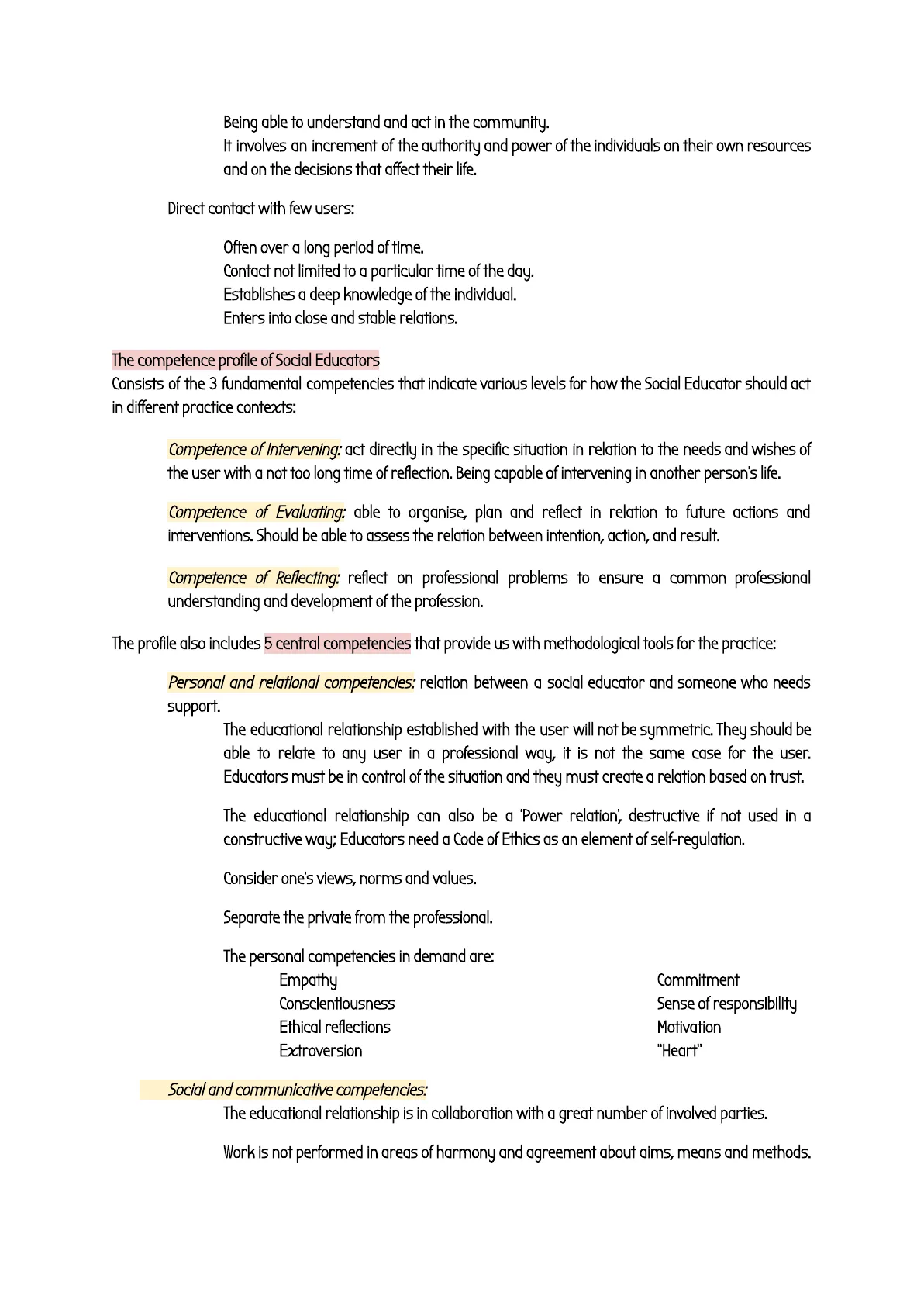
- Being able to understand and act in the community.
- It involves an increment of the authority and power of the individuals on their own resources and on the decisions that affect their life.
- Direct contact with few users:
- Often over a long period of time.
- Contact not limited to a particular time of the day.
- Establishes a deep knowledge of the individual.
- Enters into close and stable relations.
Competence Profile of Social Educators
The competence profile of Social Educators Consists of the 3 fundamental competencies that indicate various levels for how the Social Educator should act in different practice contexts:
- Competence of Intervening: act directly in the specific situation in relation to the needs and wishes of the user with a not too long time of reflection. Being capable of intervening in another person's life.
- Competence of Evaluating: able to organise, plan and reflect in relation to future actions and interventions. Should be able to assess the relation between intention, action, and result.
- Competence of Reflecting: reflect on professional problems to ensure a common professional understanding and development of the profession.
Central Competencies for Practice
The profile also includes 5 central competencies that provide us with methodological tools for the practice:
- Personal and relational competencies: relation between a social educator and someone who needs
support.
- The educational relationship established with the user will not be symmetric. They should be able to relate to any user in a professional way, it is not the same case for the user. Educators must be in control of the situation and they must create a relation based on trust.
- The educational relationship can also be a 'Power relation', destructive if not used in a constructive way; Educators need a Code of Ethics as an element of self-regulation.
- Consider one's views, norms and values.
- Separate the private from the professional.
- The personal competencies in demand are:
- Empathy
- Commitment
- Conscientiousness
- Sense of responsibility
- Ethical reflections
- Motivation
- Extroversion
- "Heart"
- Social and communicative competencies:
- The educational relationship is in collaboration with a great number of involved parties.
- Work is not performed in areas of harmony and agreement about aims, means and methods.
- Learn to work in teams with many tasks.
- Know other professions and terminology.
- Collaborate with parents, relatives and authorities.
- Knowledge of mediation and conflict resolution (understand, handle and solve conflicts)
- Analyse problems and "weird "situations based on theories and experience.
- Handle difficult conversations.
- Speech adjustment depending on the individual.
- Master Counselling techniques to counsel and guide users, parents and relatives.
- System competencies:
- Knowledge and ability to work within the system and institutions.
- Understand organisations, administrative systems.
- Knowledge of systems of evaluation and documentation of social educational work.
- Ability to participate in decision taking as a professional: child, family policy, labour market ...
- Participate in current social debates as a professional.
- Needs a continuing development of the competences for the current tasks at any time.
- Competences generated by professional practice:
- It is a profession building its own system of concepts.
- Be familiar with recognised, predominant social educational theories.
- Seek and gain new knowledge and transform it into practice.
- Know and internalise the norms, ethics and morals of the profession.
- Know the terminology, concepts and ethical foundations of close professions.
- Cultural and creative competencies:
- Cultural competencies:
- Self-assessment of own ideas and values.
- Understanding different cultures and cultural values.
- Know the cultural values of those you plan to work with.
- Ability to relate with other cultures.
- Intercultural communication training.
- Creative competencies:
- Master forms of expression.
- Using creativity, movement and music to be a part of the social educational work.
- Cultural competencies:
LESSON 2. THE SOCIAL PROFESSIONS IN SPAIN
Social Professions Terminology in Different Countries
Social professions have different names in other countries:
- Social educators
- Social workers
- Social pedagogues
- Care workers
- Specialised educators
- youth workers
- Community workers
- Cultural animators
Relationship Among Social Professionals in Spain
We are going to explore the relationship among the main professionals who work in the Social field in Spain: Psychologist Social Educator Pedagogue Social Worker
Over the last three decades, pedagogues, traditionally linked to the education in schools, have been incorporated into workplaces, where social intervention takes place.
Evolution of Social Professions in Spain
Disrupted by the civil war and the Fascist Regime over 40 years. Dictatorship impeded a Welfare state development, impeded the development of the 1st Training initiatives.
The First school for Social Assistants was: "the social welfare school for women", Barcelona 1932. The Regime left social supportive initiatives to La Falange, the Catholic Church and Sección Femenina
As a result we have a considerably delay in the professionalisation of social work, specific training and conceptualization
Social Professional Figures
- Social worker: Social Assistants they would call themselves "Social Workers". Social work affairs. In the mid 50's the professional activity began to become recognized and was finally consolidated in the 60's. In 1981: "Social assistant training" became a university course.
- Social educator: direct predecessor of the figure "Specialised Educator" (60's-70's). This figure gradually became a professional specialised in educational intervention outside the school. In 1991 Specialised educators had their own university training called Social Education.
- Pedagogue: presence in the field of social-intervention relatively recent. In mid-80's presence was recognized and valued in the non-formal sphere. Despite this late start, it has had notable progress. It has a presence in non-formal education and in the field of social intervention. They carry out functions similar to those carried out by other figures (social educator and social worker). They hold positions of more responsibility as they previously held a higher qualification.
Situation in Spain with regard to professionals coexisting with interrelated functions in the field of social education is relatively complex.
Professional Areas for Social Workers, Social Educators and Pedagogues in Spain
Table 1: Professional areas for social workers, social educators and pedagogues in Spain
QUALIFICATION PROFESSIONAL AREAS Social worker Social educator Peda- gogue Home help and home visit services Primary care teams Day care centres Emergency social services Child protection centres Care for children, young people and families Technical teams Fostering and adoption Care for women Specialised so- cial services Care for people with disabilities Care for the elderly (homes, social- health and day centres) Care for drug addicts (recovery cen- tres, day centres, homes, social and labour integration services) Shelter and care for refugees and immigrants Professional Areas S.worker S.educator Pedagogue Primary healthcare centres Home-care for people suffering from chronic or terminal illnesses Health Support organisations Hospitals Social healthcare centres Mental health services Penitentiary institutions Detention cen- tres Justice Youth justice Monitoring alter- native / non-in- carcerated penal measures Mediation Technical assessment for judges
Primary Social Care ServicesQUALIFICATION PROFESSIONAL AREAS Social worker Social educator Peda- gogue Teachers in schools Primary Care Teams Schools Educational guidance School workshops for transition to work Occupational training centres and occupational transition programmes Adult training centres Local educational services/pro- grammes (health education, environ- mental education, transport safety, forestry, etc.) Other centres, programmes and educational ser- vices Leisure services, extracurricular activities, school camp and summer play groups Play groups Educational programmes for visits to museums/libraries/centres of cultural or natural interest) Civic centres, cultural centres, other centres Professional Areas S.worker S.educator Pedagogue Public administration youth departments Public administration cultural departments Community development Companies and institutions Human resource departments Training departments Production of educational materials Housing services Non-profit organisations and bodies working on interna- tional cooperation programmes)
Specific Functions of Social Workers and Pedagoges
Social workers:
- Management of services
- Social assistance
- Awarding grants
- Awarding social assistance
- Monitoring individual cases
Pedagogues:
- Diagnosing the educational needs
- Carrying out specialised educational interventions
- Pedagogical consultancy
There are very few areas of activity that can be considered exclusive to one of the 3 profiles. There are several overlaps of functions. Until 2009, Social Education was a 3-years university education and they got a Diploma,whilst Pedagogues got a Degree, after 5-years at university. Specialised Postgraduate training courses interesting to the different professionals that comprise the field of Social Education.
Can’t find what you’re looking for?
Explore more topics in the Algor library or create your own materials with AI.
