Habilidades Comunicativas: Principios y Elementos Esenciales en Psicología
Slides about Habilidades Comunicativas. The Pdf explores fundamental communication principles, essential skills, and various elements of the communication process. The Pdf, a University level resource for Psychology, covers verbal and non-verbal communication, cultural sensitivity, and the Johari window.
See more20 Pages


Unlock the full PDF for free
Sign up to get full access to the document and start transforming it with AI.
Preview
HABILIDADES COMUNICATIVAS.
UNIT 1: BASICS PRINCIPLES OF COMMUNICATION.
Why are communication skills important to psychologists?
- Verbal behavior is the most prevalent and distinctive human behaviour .: It is distinctive because other animals have language? Do they communicate? Is language a synonym for communication?
- Communication: The way of exchanging messages or information between two or more people and sharing a meaning.
- Language: the system of communication which relies on the vocal or non-vocal codes, used in transferring information. (is a tool of communication) (es importante porque es simbólico, lo que hace que un estímulo arbitrario evoque una respuesta directa)
2. We can Exchange messages without having to live things firsthand.
- Definition of communication/language:
Topographical features: Interaction between 2: puede ser comunicación con nosotros mismos, To transfer information BUT sharing this information: no necesitamos compartir información para transferirla, ni compartir un significado cuando nos comunicamos, ni tiene que estar de acuerdo la persona. Intentionality: some authors affirm that communication must be intentional, defining intentionality in the sense of an undeniable direction towards a certain content or goal. Setting conditions (social, physical, organismic or combination): afectan los estímulos y las respuestas en una interacción. Varies in style (dialectical, cultural ... ) (channels, vocal ability, motor ability, visual perception, sensorial perception, particular behavior history, particular culture ... )
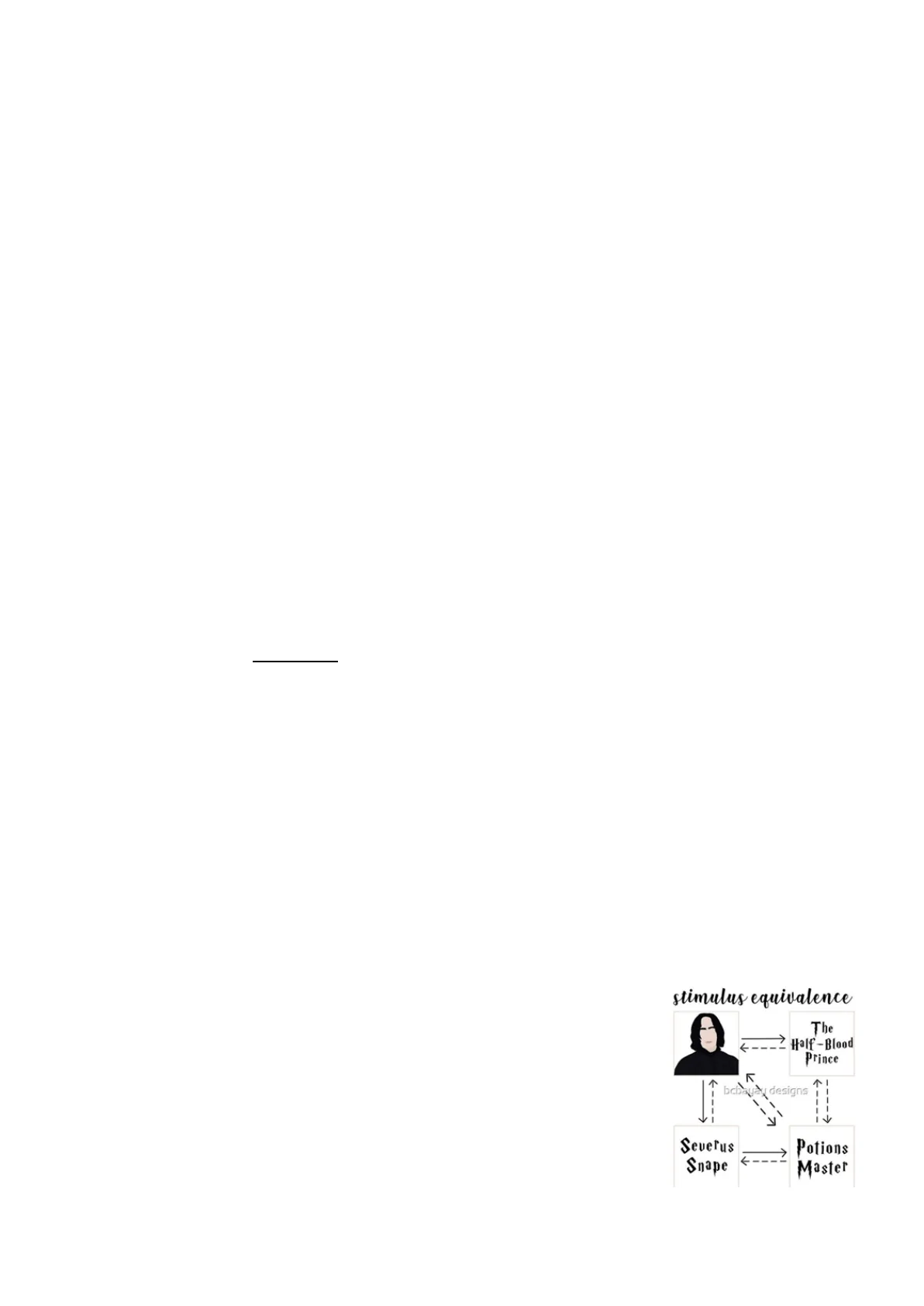
Functional features: Eliciting responses: Words, symbols, sounds, gestures ... any arbitrary stimulus can elicit a classical response. Operant responses: Words, symbols, sounds, gestures ... any arbitrary stimuli can evoke an operant response. Referential learning (symbolic): Words, symbols, sounds, gestures ... any arbitrary stimuli can transfer its function to other arbitrary stimuli without direct pairing. stimulus equivalence
The Half -Blood Prince K bebayay designs 7 - -> V Severus Snape > --- Potions Master
3. Looks like articulate language is very important for human behavior compared to other animals (?) l
Language acquisition:
- Una prueba continua defiende que la comunicación humana evolucionó desde la comunicación animal. Evolución de la comunicación gestual
- Una tesis discontinua dice que el lenguaje es único y repentino de los humanos.
- Skinner: language is learned through conditioning learning (environmental factors).
- Chomsky: humans have an innate ability for language, driven by a universal grammar encoded in the brain, and that language acquisition cannot be explained solely by environmental learning.
Nature of language acquisition:
- Vocal aparatos: la posición de la laringe es descendente.
- Broca and Wernicke's area. Area's homologs enter species.
4. Effective and fast way if changing someone's environment:
- Changing behaviors without direct pairing (communication can transform our environment with little response cost)
- Getting contact with appetitive (AND aversive) stimulation in a fast and easier way
- To improve the development of the species
- To get better resources
- And our goal as psychologists (MOST OF THE TIME), is to change behaviors through communication (human resources, research, clinical practice, sports, behavioral economy, etc .... )
UNIT 1 B: BASIC PRINCIPLES OF COMMUNICATION
LANGUAGE GAMES: (Ludwig Wittgenstein's):
Refers to the idea that the meaning of words and expressions depend on their use in specific forms of life or social contexts. Language isn't just about naming objects or describing facts but is embedded in various human activities, or games where meaning emerges through use.
1. Language has many functions: no solo describe cosas, sino que pregunta, manda, bromea ... 2. Meaning is contextual: the meaning or words is determined by how they are used within a particular social activity or game, like giving directions, making a promise, or participating in a debate.
3. Language if fluid: different games have different rules. Lo que funciona en un contexto puede no funcionar en otro.
4. No flex essence: there is no single, universal logic behind all language. Instead, different forms of life dictate how languages function.
(ejemplos en diapos)
Los juegos de lenguaje no se basan en las definiciones sino en observar el lenguaje en la práctica y como afecta al entorno social. (focus on the function)
"Communication is the way people exchange message or information sharing a meaning" + " ... towards a goal"
We need to detect the language game that we are in. (more specifically: who are the audience, in which context ad what's my goal)
ESSENTIAL COMMUNICATION SKILLS:
1. Active listening: concentrado en el que habla, mostrando que entendemos, respondiendo y recordando cosas clave. Importante: helps build trust, allows the audience to feel understood.
2. Clarity: asegurarse que el mensaje está siendo entendido reduciendo la mala interpretación. A través de feedback, sintetizar, preguntar (open vs closed questions)
3. Emotional discrimination: To share others emotions, to make them feel understood and act based on these emotions (adaptar la comunicacion).
- Buscar que ha producido esa emoción en la otra persona (no pensar que es igual que tu).
- Hacer que el cliente aclare y especifique las palabras correctas que describen lo que sienten.
4. Non-verbal communication: body language, facial expressions, eye contact, posture, and gestures to communicate. Importancia: a través del lenguaje no verbal se puede dar más información y ayudar a la comunicación.
5. Cultural sensitivity: being open to different perspective, avoiding premature judgments, and maintaining a neutral stance in communication, basado en la cultura. Crea un ambiente de soporte para el cliente, sin miedo a que le critiquen o castiguen.
6. Written communication in a professional setting: writing professional reports, case notes, and psychological assessments. Clarity, conciseness, and ethical considerations.
UNIT 2: ELEMENTS OF COMMUNICATION.
Communication by Aristotle:
Speaker Content Audience/ Listener EFFECT
Communication by Lasswell: A descriptive analysis
Content (what) Means/channel Audience/ Listener (whom) EFFECT (what)
Generic model of communication
Other communication models include elements of communication such as:
Messages Context Circular in nature, as both persons send and receive messages simultaneously Feedback [Feedforward] Source/ Receiver Source/ Receiver Noise Encoding! Decoding Encoding/ Decoding [Feedforward) Channels Feedback All elements are interrelated and interdependent Messages
MAIN ELEMENTS IN COMMUNICATION:
1. SENDER / SOURCE / ENCODER / SPEAKER: Person (individual) who sends the message by using symbols to produce the required response.
- The sender plays the specific role of initiating communication.
- Sender's features have a great impact on the message.
2. RECIPIENTS / RECEIVER / DECODER / LISTENER. Person who receives the message.
3. ENCODING - DECODING. The act of creating messages. That is, transmitiendo ideas through speech or writing (habilidad de convertir información, de eliminar las fuentes de confusión y de trasladar el discurso a acciones).
4. MESSAGE: Information itself. Can be matched with the type of audience.
5. CHANNEL / MEDIUM: Channel used to transmit the message (mas de un canal a la vez)
6. FEEDBACK: Allow us to analyze the effectiveness of the message.
7. CONTEXT:
Encodes Decodes Source Message Channel Receiver Communication Skill hearing Communication Skill Attitudes Content Elements Treatment Structure Code seeing Attitudes Knowledge touching Knowledge Social System smelling Social System Culture tasting Culture Channels Speaker (Who)Culture, particular, behavioral history, moment in time, mood, small talk, climate conditions ... NOISE.
Act of communicating
1. Create the message (as sender or recipient - response) 2. Mind the ever-changing role of speaker and listener 3. Mind the channel(S) 4. Mind the context
Individual abilities
1. Detect your goal 2. Be aware of the audience and their features 3. Try to be clear, asking for feedback, looking out for people's reactions, and eliminating sources of confusion (e.g., cultural issues, mistaken assumptions) 4. Adapt the type of questions (if opened vs. closed) 5. Show empathy, active listening, emotional discrimination
SOME COMPONENTS TO BE AWARE IN A DEBATE:
Our own emotional reactions, creation of the message, channel and context, practice breathing, elaborate your arguments and anticipate other people's arguments, decide the level of complexity and emotional content you want to use, be aware of your non-verbal behavior, possible cultural issues ...
UNIT 3 A: LEVELS OF COMMUNICATION:
1. INTERPERSONAL COMMUNICATION: la normal.
2. INTRAPERSONAL COMMUNICATION: Verbal communication, in a private or public manner, is emitted and received only by us. Speaker and listener Speaker Listener
Intrapersonal comunicación: JOHARI WINDOW.
Known to myself Unknown to myself OPEN AREA BLIND AREA Known to others This is information about you that both you and others are aware of. It includes behaviors, skills, attitudes, and characteristics you openly share. The larger this area is, the more effective communication and trust there tends to be (eg., your name, your job role, visible behaviors). This is what others see in you, but you're unaware of. It can include certain habits, behaviors, or traits that others notice but you don't. Feedback from others can help reduce this blind area (e.g., Others may see you as impatient in meetings, but you may not notice it yourself). (EXERCISE WE JUST DID!) Unknown to others This area includes information you know about yourself but choose not to reveal to others. It may involve personal feelings, secrets, or insecurities that you prefer to keep private (e.g., you may be struggling with self-doubt but never express it to your coworkers). UNKOWN AREA This is information about yourself that neither you nor others are aware of. It may include hidden talents, unknown fears, or potential that has yet to be discovered. This area can sometimes be revealed through experiences, self-discovery, or therapy. (e.g., you might have a hidden talent for a skill you've never tried, like public speaking) Es usado en self-awareness (conciencia) , ejercicios, comunicación training y team-building activities. - HIDDEN AREA - Se divide en 4 cuadrantes representando diferentes aspectos de la conciencia personal. - What is known and unknown to yourself and others. - La meta de la OPEN AREA es mejorar la conciencia personal, compartir con los demás más.
INTRAPERSONAL COMMUNICATION: SELF-REVELATION OR SELF-DISCLOSURE.
Communication of information about yourself to another person, usually informacion that you normally keep hidden. Information about (values, beliefs, desires, cosas que has hecho, cualidades o características) VS.
Can’t find what you’re looking for?
Explore more topics in the Algor library or create your own materials with AI.