Unit 1: The Earth in the Universe, its movements and effects
Document about Unit 1: The Earth in the Universe. The Pdf explores the Universe, the Solar System, and the Earth's movements, including rotation and revolution, and their impact on day/night cycles and seasons. This high school Science material, produced for autonomous study, covers topics like the Coriolis Effect and equinoxes.
See more20 Pages

Unlock the full PDF for free
Sign up to get full access to the document and start transforming it with AI.
Preview
The Earth in the Universe
P. of INDEPENDENT TART - HINDOS G STARS weic Scen everything From Unit 1: The Earth in the Universe mars we Meet me at midnight are mad .. of star stu C Fly Me To The Moon
The Universe
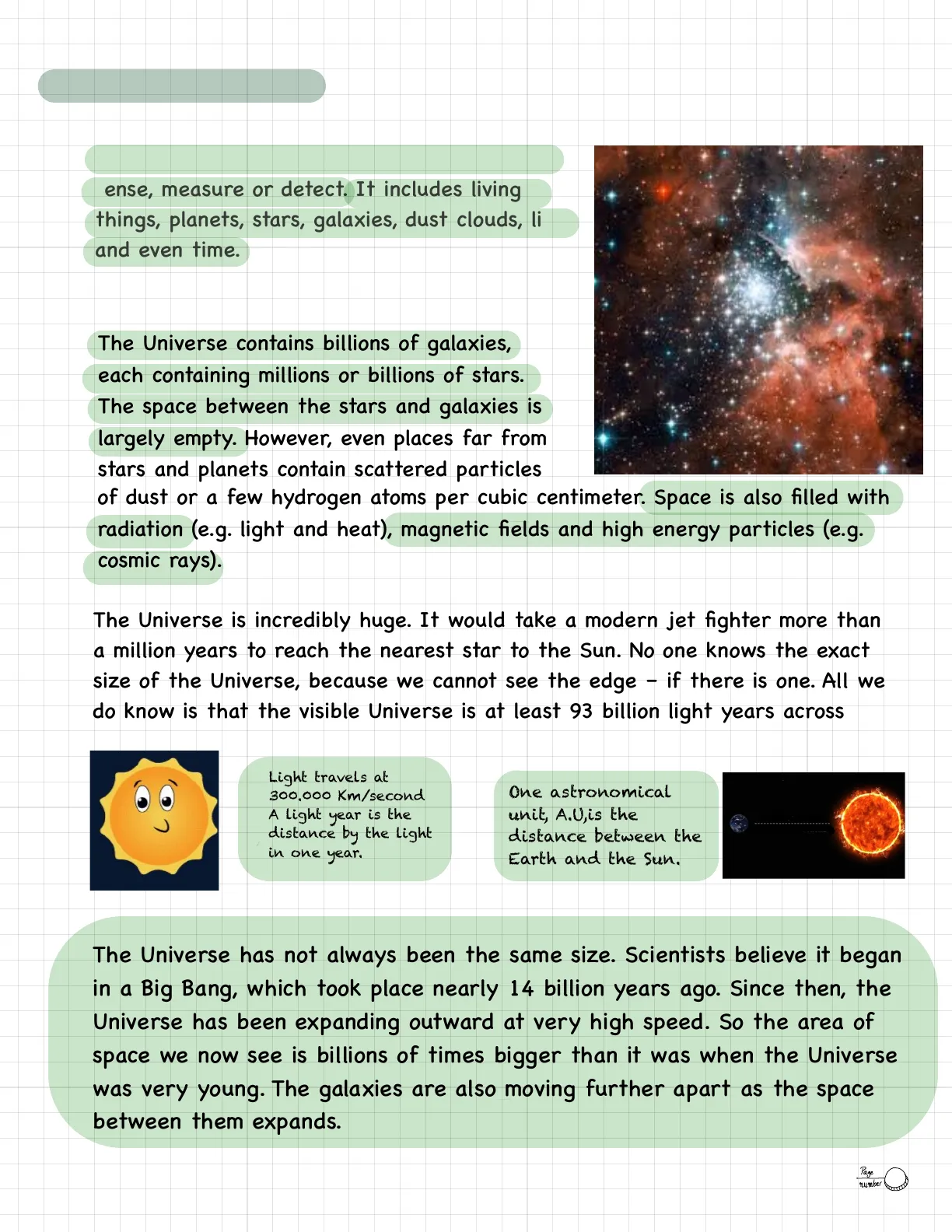
1. The universe The Universe is everything we can touch, feel, sense, measure or detect. It includes living things, planets, stars, galaxies, dust clouds, light, and even time. Before the birth of the Universe, time, space and matter did not exist. The Universe contains billions of galaxies, each containing millions or billions of stars. The space between the stars and galaxies is largely empty. However, even places far from stars and planets contain scattered particles of dust or a few hydrogen atoms per cubic centimeter. Space is also filled with radiation (e.g. light and heat), magnetic fields and high energy particles (e.g. cosmic rays). The Universe is incredibly huge. It would take a modern jet fighter more than a million years to reach the nearest star to the Sun. No one knows the exact size of the Universe, because we cannot see the edge - if there is one. All we do know is that the visible Universe is at least 93 billion light years across Light travels at 300.000 Km/second A light year is the distance by the light in one year . One astronomical unit, A.U, is the distance between the Earth and the Sun. ? Light years Astronomic unit The Universe has not always been the same size. Scientists believe it began in a Big Bang, which took place nearly 14 billion years ago. Since then, the Universe has been expanding outward at very high speed. So the area of space we now see is billions of times bigger than it was when the Universe was very young. The galaxies are also moving further apart as the space between them expands.
Page number 1
Universe Activities
Activities 1. Fill the gaps. a) The includes everything we can touch, feel, sense, measure, or detect. b) A is a large system of stars and other matter. c) The space between stars is filled with particles and . d) The is the event that started the expansion of the Universe. 2. . Short Answer Questions: a) How long would it take a jet fighter to reach the nearest star to the Sun? b) What is a light year, and how far does light travel in one year? c) Describe the Big Bang and its significance in the formation of the Universe. d) What do scientists know about the size of the visible Universe? 3. Determine whether the following statements are true or false. Correct the wrong ones. a) The Universe is mostly filled with empty space. b) A modern jet fighter can reach the nearest star in a few years. c) The Universe has been expanding since the Big Bang. d) The visible Universe is less than 93 million light years across. e) Galaxies are moving closer together as the Universe expands.
Page number 2
Galaxies
Galaxies Overview
2. Galaxies When you look at this photo nearly every object here is identified as a galaxy, and as you can see there a variety of shapes that exist. The Milky Way Galaxies are vast collections of stars, gas, dust, and dark matter bound together by gravity. They are the building blocks of the Universe, with each galaxy containing millions or even billions of stars. Our Solar System is part of a galaxy called the Milky Way. Galaxies began forming shortly after the Big Bang, around 13.8 billion years ago. Initially, the Universe was filled with clouds of gas and dust. Gravity pulled these clouds together to form the first stars, and over time, these stars grouped together to form galaxies.
Importance of Studying Galaxies
The Importance of Studying Galaxies Studying galaxies helps astronomers learn about the history and future of the Universe. By observing different types of galaxies, scientists can understand how stars are born, live, and die, and how the Universe has evolved since the Big Bang.
Types of Galaxies
Types of galaxies Spiral galaxies Shape: Spiral galaxies are shaped like flat, rotating disks with a bulging center and spiral arms that extend outwards. The spiral arms are made up of stars, gas, and dust. Features: The Milky Way, our galaxy, is a spiral galaxy. These galaxies often have bright, young stars in their spiral arms. The center of a spiral galaxy, known as the bulge, contains older stars. Elliptical galaxies Shape: Elliptical galaxies range in shape from nearly spherical to elongated ovals. They do not have spiral arms. Features: These galaxies are made up mostly of older stars and have very little gas and dust. Examples: The galaxy M87 is a famous elliptical galaxy. Irregular galaxies Shape: Irregular galaxies have no definite shape. They look like chaotic clouds of stars, gas, and dust. Features: These galaxies often form when two galaxies collide or when a galaxy is influenced by the gravity of a larger galaxy nearby. Examples: The Magellanic Clouds are irregular galaxies.
Page number 3
Galaxies Activities
Activities 4. Describe what a galaxy is and what it contains. 5. What type of galaxy is the Milky Way, and what are its key features? 6. How do elliptical galaxies differ from spiral galaxies? 7. Explain one reason why a galaxy might not have a definite shape. 8. Provide two reasons why astronomers study galaxies. 9. True or False: correct the false ones. a) Spiral galaxies do not have spiral arms. b) Elliptical galaxies contain mostly older stars and little gas and dust. c) Irregular galaxies have a well-defined, consistent shape. d) The Milky Way is an elliptical galaxy. 10. Fill in the blanks a) The Milky Way is an example of a galaxy. b) _ galaxies often contain regions where new stars are forming and have a chaotic appearance. c) An galaxy typically has little gas or dust and mostly older stars. d) The is the central part of a spiral galaxy, where older stars are concentrated. e) The is the name of a elliptical galaxy.
1
Page number 4
Stars
Star Formation
3. Stars hands pencil on !! Glue On a dark, clear night, you can look up in the sky and get a good view of thousands of stars. But, what is a star? A star is a huge bowl of hot glowing gases altogether by its own gravity. Stars come in different sizes and colors, temperatures and brightness, and sometimes have unusual characteristics. The closest star to Earth is our own Sun. Like everything else in nature, stars are born, live out their days, and die- sometimes, spectacularly. Although stars are not actually alive, they do have a life cycle: stages and steps that they go through from beginning to end. And in the beginning, there is only dust and gas. This giant molecular cloud is called stellar nursery, and this is where baby stars are formed. Turbulence in the cloud, creates knots and clumps of material. When a knot is large enough, it collapses under its own gravity, creating a core that begins to heat up. This hot core is called a protostar. The gravitational pull of the protostar will continue to attract dust and gas overtime, and the increased mass will cause the core to become hotter and denser. Once the core is hot enough and dense enough fusion kicks off, and the hydrogen gas begins to turn into helium. A star that is fusing hydrogen is not a protostar any longer, but has entered something called the "main sequence". The life of a star on the main sequence is a constant battle against gravity. Stars are so massive, that if gravity was the only force working on them, they would collapse immediately. Fortunately, stars have super-hot cores that create pressure and work against gravity, producing a state of equilibrium. The star will be OK as long as the force of gravity, pulling the gases in word and pressure from the core pushing the gas is outward are in balance. Eventually, however, the star will run out of hydrogen to convert into helium, and when that happens, gravity wins. The inner layers of the star begin to collapse, increasing heat and pressure at the core.
Page number 5
Star Evolution and Death
Meanwhile, the outer layers expand several hundred times their normal size, and the star becomes a red giant, or if the original star was massive enough, a red supergiant. When a medium sized star becomes a red giant, there is temporarily enough heat and pressure in the core to fuse, helium into carbon, preventing further collapse. Once the helium is gone, however, the core collapses again, and the outer layers of the stars are blown away. The collapsed core becomes a white dwarf, a dance slowly cooling remnant about the size of a planet. The atoms in a white dwarf are so close together that it's simply cannot collapse anymore but once the stored heat in it is gone, it will no longer glow and will become a black dwarf spinning darkly in space. The fate of massive stars is a very different one. A red supergiant will also fuse helium into carbon, but once the helium is gone, there is enough mass to power other fusion reactions, including iron. When there's nothing left if use, the core is no longer producing energy and gravity wins. The temperature of the core rises to over 100 billion degrees, the iron atoms are crushed together, and the core pushes out from the heart of the star in an explosive shock wave. This shock wave causes a huge explosion called a supernova, which blasts most of the material left in the star out into interstellar space. So much energy is released in a supernova that for a few days it can shine brighter than an entire galaxy. The core that remains might collapse into either a small, dense object called a neutron star, or if it is more massive it may collapse into a black hole. The leftover gases from the death of a storm eventually form a new star nursery where brand new stars can be created.
Page number 6
The Solar System
Solar System Formation
4. The Solar System. Our Solar System is one of over 500 known solar systems in the entire Milky Way galaxy. The Solar System came into being about 4.5 billion years ago when a cloud of interstellar gas and dust collapsed resulting in a solar nebula, a swirling disc of material that collided to form the Solar System. The Solar System is located in the Milky Way's Orion star cluster. Only 15% of stars in the galaxy host planetary systems, and one of the stars is our own Sun.
Planets of the Solar System
Revolving around the sun are eight planets. The planets are divided into two categories, based on the composition, Terrestrial and Jovian. Terrestrial planets: The terrestrial planets are Mercury, Venus, Earth, and Mars, are primarily made of rock material. RESTRIAL PLANETS Mercury Venus Earth Moon Mars Their surfaces are solid, they don't have ring systems they have very few or no moons and they are relatively small. The smallest and closest to the Sun is Mercury, which has the shortest orbit in the Solar System at about three Earth months. Venus is the hottest planet with temperatures of up to 464℃ due to an atmosphere of carbon dioxide and extensive lava flows. Next to this world of fire is the world of water, Earth. The water systems on this planet helped create the only known environment of the universe capable of sustaining life. The last of the terrestrial planets, Mars, might have also supported life about 3.7 billion years ago, when the planet had a watery surface, and moist atmosphere.
Page number 7
Can’t find what you’re looking for?
Explore more topics in the Algor library or create your own materials with AI.
