Microbial Forensic and Anthropology: Crisis Management and New Technologies
Slides from University about Microbial Forensic. The Pdf explores Microbial Forensic and Anthropology, discussing crisis management, infectious phenomena, and the risks and benefits of new technologies in Biology for university students.
See more21 Pages

Unlock the full PDF for free
Sign up to get full access to the document and start transforming it with AI.
Preview
Microbial Forensic Anthropology
Microbes.
Microbial ForensicAnthropology The science of humanity
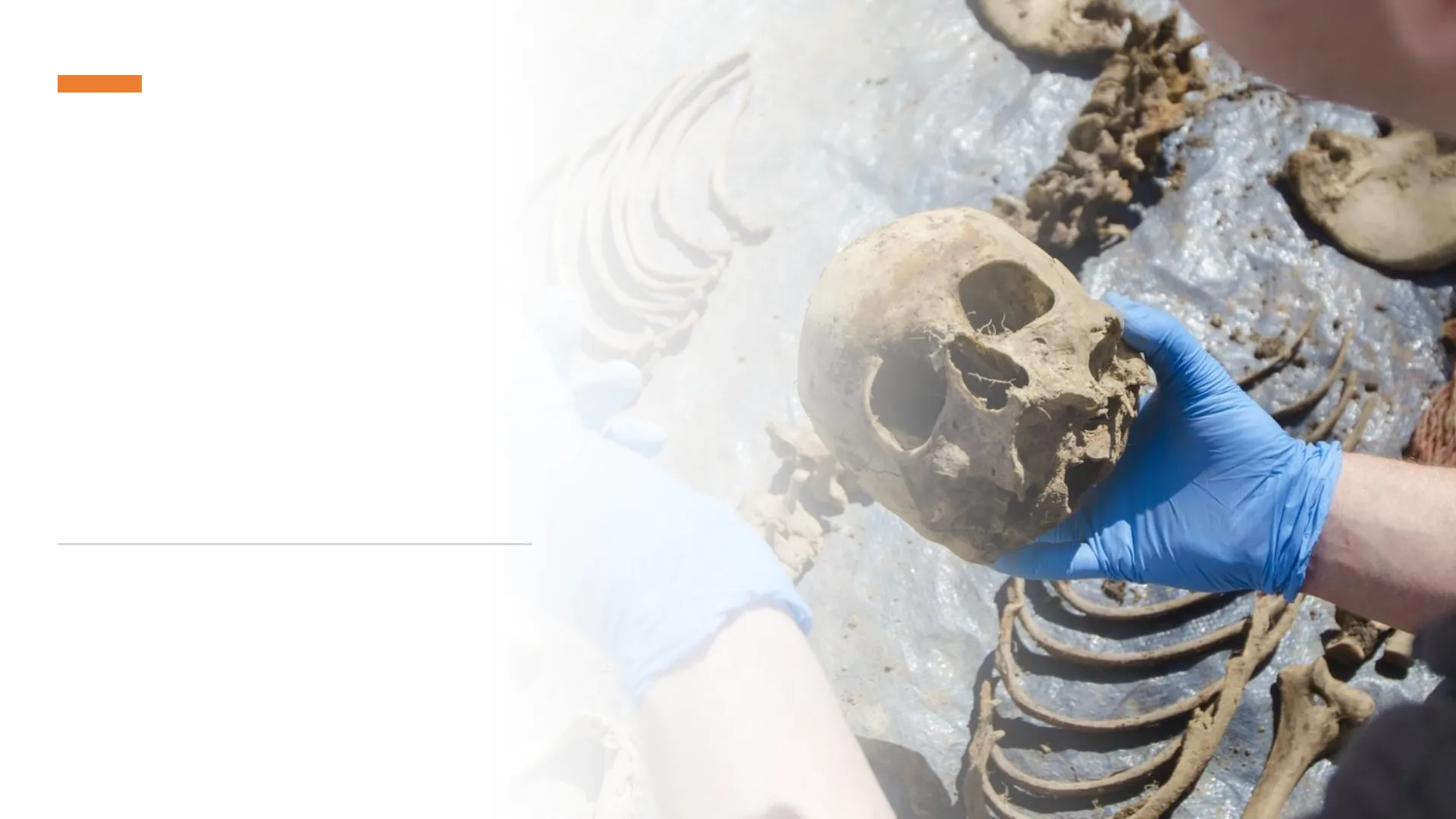
Anthropological research facility Body FarmWhat happens when a human die? Internal temperatures change Immune system shut down Microbial agents grow Nitrogen release Skin rupture Decomposition; one of the most ecosystem processThe five stages of Body Decomposition; an important ecosystem process
Stages of Body Decomposition
FRESH The failure of the immune system leads to proliferation of the gut microorganisms Migration of the microbes to the other organs Low level of oxygen within cells > decrease of microbial population and diversity
BLOAT Tissue autolysis and the release of nutrients -> domination of anaerobic bacteria; production and accumulation of gases due to fermentation
ACTIVE DECAY Internal pressure of gases causes the rupture of the skin -> aerobic conditions; domination of aerobic bacteria
ADVANCED DECAY Slow depletion of nutrients > decrease in microbial activity
SKELETONIZATION Microbial profile of dry remains resembles soil microbiome
Microbial Decomposers and Decomposition Stages
Microbial decomposers Bacteria, eukaryotes (non-fungal), fungi
Fresh O II C H2N NH2 Ascomycota Stromatonectria Unidentified Proteobacteria Pseudomonas Enterobacteriaceae I Death Proteobacteria Wohlfahrtiimonas Ignatzschineria Firmicutes Sporosarcina Firmicutes Lactobacillos Basidiomycota Lysurus Bacteroidetes Myroides Dry remains Active decay Ascomycota Yarrowia Proteobacteria Acinetobacter Nematoda Rhabditidae Firmicutes Planococcaceae I Proteobacteria Zygomycota Mortierellaceae Stramenopiles Plasmopara Pseudomonadaceae Chromatiaceae Proteus Advanced decay Current BiologyCadaver Decomposition Island (CDI) Where do Decomposer Microbes come from?
Microbial Clock Calibration for PMI
Calibration of "microbial clock" to determine post-mortem interval (PMI)
Fresh Proteobacteria Pseudomonas Enterobacteriaceae Ascomycota Stromatonectria Unidentified 1 Death Proteobacteria Wohlfahrtiimonas Ignatzschineria Firmicutes Sporosarcina Firmicutes Lactobacillies Basidiomycota Lysurus Bacteroidetes Myroides Ascomycota Yarrowia Proteobacteria Acinetobacter Nematoda Rhabditidae Firmicutes Planococcaceae I Proteobacteria Zygomycota Mortierellaceae Pseudomonadaceae Stramenopiles Plasmopara Chromatiaceae Proteus..........
Microbiological Methods for DM Analysis
rDNA - Primer Metagenomic DNA 16S, 18S, or ITS-specific primers PCR Amplification 7% 8% 4% 16% /12% 17% 36% Sequencing Microbiological Methods for DM Analysis (Thanatomicrobiome and Necrobiome)
Microbiology in Service of the Law
Microbiology in service of the law Geolocation (e.g., via substrate analysis) Personal identificationand biological sex discrimination (via autochthonous microbiota) Trace evidence (e.g., on mobile phones) - Microbial traces left behind Possible sources of forensically relevant microbiota Manner and cause of death (e.g., via ingested microbiota or those transferred between people) Post-mortem interval estimation (e.g., via thanatomicrobiome analysis) Localisation through animal microbiome (e.g., from pet ownership and animal industries) Clothing (including shoes and jewellery)
Bioterrorism and Biocrime
wided by EMRI WARI Biological weapons Bioterrorism Biocrime
Bioterrorism: A Threat to Healthcare and Global Peace
Bioterrorism A Threat To The Healthcare And Global Peace Biological select agents or toxins 1. Affect only humans. 2. Affect only animals and crops. 3. Affect humans. animals, and crops. ELVEÏICharacteristics for potential bioterrorism agents · Pathogenic organisms or toxins that multiply rapidly while retain viability and pathogenic attributes. . These agents can be delivered to targeted population in sufficient quantity to cause the disease.
- High morbidity or lethal
- Highly infectious
- Suitable for Mass production
- Stable under different conditions
- Easy to deliver
- Can be modified and engineered
Distinguishing Natural vs. Induced Attacks
U.S. MAIL WARNING ANTHRAX LETTERS Natural vs induced: How to distinguish them? Rioterrorism Expert Investigates "tacks That Shocked America The agent specificity The spatial and temporal distribution The origin and dynamics JE CLOSED?But, Common pathogens or toxins have also been used for biological attacks While rare agents were detected in natural outbreaks
ON ダ ブ ル で ポ イ ン ト 。 WE HELLO? EAR ME? 500? AFRICA MSF EBOLA FATALITIES: 1000 + ComicsCriteria* Selected agent Emergence or altered pathogen Unusual distribution Multiple starting points Unusual spreading Present Absent Amerithrax (USA)+ Rajneesh attack (USA)+ Aum Shinrikyo attack (Japan) + Common bacterial toxinst Shigella dysenteriae (USA)+ Neurotoxin botulinium A (Worldwide)+ Ebola virus (West Africa)# Yersinia pestis (Madagascar)+ E coli 0104:H4 (Europe)+ All biological attackst SARS-COV (Worldwide)+ Amerithrax (USA)+ Ebola outbreak (West Africa)+ H1N1 Influenza (Worldwide)+ Amerithrax (USA)+ Shigella dysenteriae (USA)+ Rajneesh attack (USA)+ Aum Shinrikyo attack (Japan) + Francisella tularensis (Kosovo)+ Yersinia pestis (Madagascar)₺ Shigella dysenteriae (USA)+ H1N1 Influenza (Worldwide)+ All biological attackst Coronavirus (Worldwide) Zika virus (Worldwide)+ *Consensual criteria. +Induced cause. +Natural cause." The media's the most powerful entity on earth. They have the power to make the innocent guilty and to make the guilty innocent, and that's power. Because they control the minds of the masses." - Malcolm X @fatimakarimms
Crisis Management: Lessons from COVID-19
Crisis Management: lessons learned from COVID-19
Key Elements of Crisis Management
Early detection Early reaction Trained personnel Epidemiology and surveillance Nationalization of technology Open data Employment of AI + Strong economy O +Crisis Management Health industry Accademic experts Crisis plannification Strategic stockpills Artificial intelligence Health authorities Legal authorities Crisis communication Data fusion Outbreak response teams Web surveillance Geo localisation Institutionnal surveillance Web navigation Smart cities Internet of things Population Healthcare giver Social media Emergency services
Duality of Decisions in Infectious Phenomenon Management
Duality of decisions in infectious phenomenon management
Type of change Science progress Internet screening Open data Improved surveillance systems Use of Artificial intelligence Increased communications Positive effect Better understanding of infectious process Weak signal detection Sharing of the knowledge Early detection and characterisation Collection and fusion data Better acceptance from the population New risk Creation of new threats Data manipulation Misuses of the data Privacy and human right violation Lose of human expertise Fake news"what once required an expensive laboratory may now be done by a skilled individual in a Garage, and will be difficult to prevent or detect"
References
References
- Metcalf JL, Carter DO, Knight R. Microbiology of death. Curr Biol. 2016 Jul 11;26(13):R561-R563. doi: 10.1016/j.cub.2016.03.042. PMID: 27404249
- Speruda, M., Piecuch, A., Borzęcka, J., Kadej, M. & Ogórek, R. (2022) Microbial traces and their role in forensic science. Journal of Applied Microbiology, 132, 2547- 2557. https://doi.org/10.1111/jam.15426
- Koch L, Lopes AA, Maiguy A, Guillier S, Guillier L, Tournier JN, Biot F. Natural outbreaks and bioterrorism: How to deal with the two sides of the same coin? J Glob Health. 2020 Dec; 10(2):020317. doi: 10.7189/jogh.10.020317. PMID: 33110519; PMCID: PMC7535343.
- Jansen HJ, Breeveld FJ, Stijnis C, Grobusch MP. Biological warfare, bioterrorism, and biocrime. Clin Microbiol Infect. 2014;20(6):488-496. doi:10.1111/1469-0691.12699
Can’t find what you’re looking for?
Explore more topics in the Algor library or create your own materials with AI.
