Walt Whitman: Life, career, and impact on American poetry
Slides about Walt Whitman's life, career, and impact on American and European poetry. The Pdf, suitable for high school Literature students, provides a concise overview of his early years, journalism career, and the publication of 'Leaves of Grass'.
See more23 Pages

Unlock the full PDF for free
Sign up to get full access to the document and start transforming it with AI.
Preview
Life of Walt Whitman
- He was born in New York into a working-class family in 1819.
- He had little formal education.
- At eleven he started to work as an office boy and then became a printer's apprentice for a local newspaper.
- He became a journalist supporting radical democratic causes.
. He travelled widely through his country.. He acquired a self-taught culture including the Bible, Homer, Dante, Shakespeare, Carlyle, Goethe, Hegel, Emerson, oriental religion and philosophy.
- In 1855 he published the first edition of Leaves of Grass. Nine editions followed, each containing new poems.
- The third edition, in 1860, aroused the indignation of puritanical readers and gained Whitman a reputation for obscenity and homosexuality.
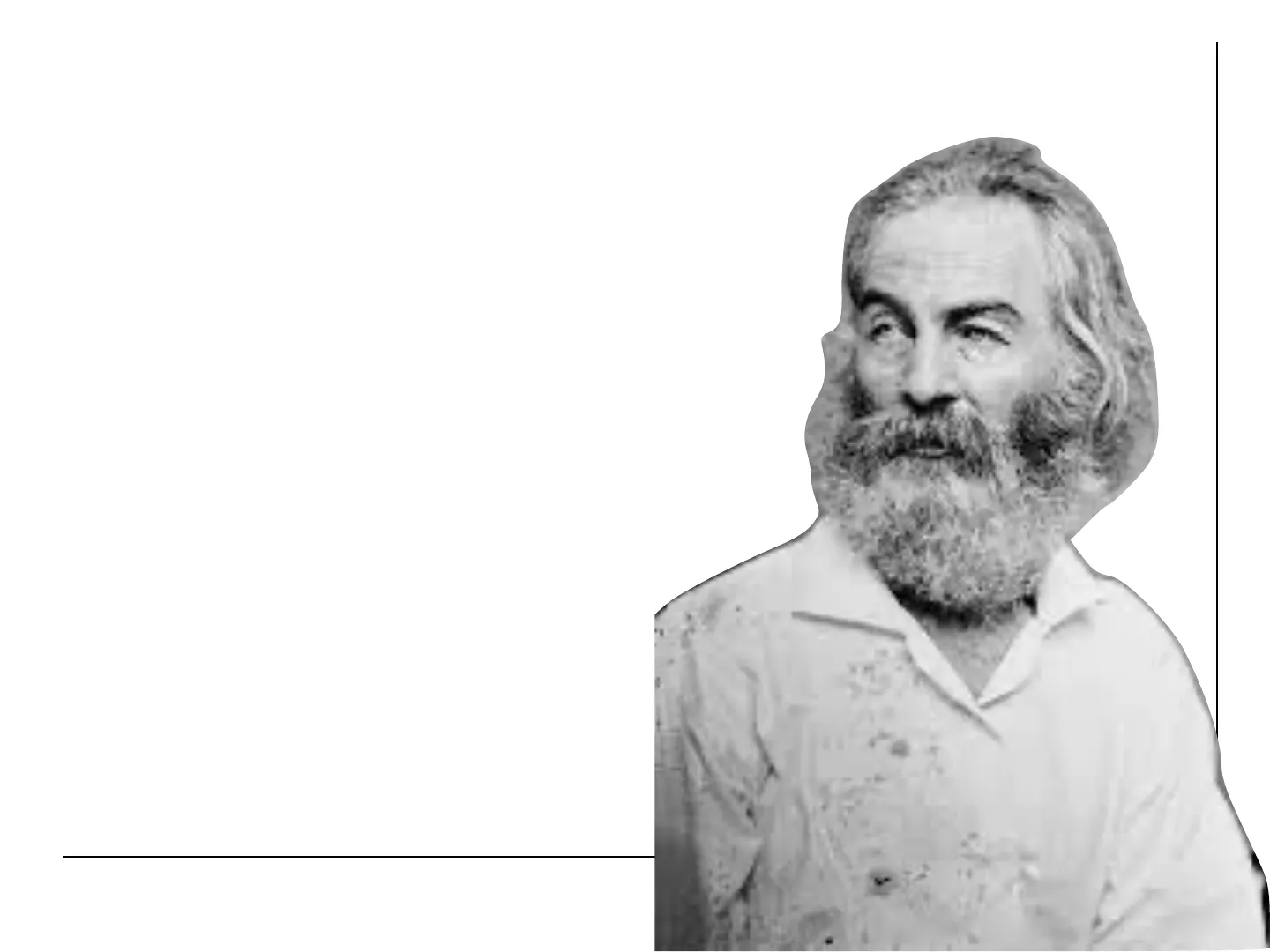
Walt Whitman in 1864
- During the Civil War he visited wounded soldiers in the army hospitals.
- He continued to believe in the value of democracy and technological progress.
- The fourth edition of Leaves of Grass (1867) contained poems on the Civil War and on the death of President Lincoln
- In 1873 he retired to Camden, New Jersey, where he was visited by admirers and disciples.
Whitman's Influence
- Whitman's popularity in Europe grew in the 1870s, he was especially appreciated by the Aesthetic Movement.
- He influenced later poets such as Ezra Pound, Carl Sandburg, and, more recently, the Beat Generation.
- He is generally regarded as the father of American poetry, as the first voice that was distinctly new and 'American'.
Leaves of Grass
- Published on 4th July -> American Independence Day.
- Included a preface where the author introduced the subject matter, the language and the aim of his poetry.
- Not a collection of poems but a life-long poem.
Leaves of Grass: The Original 1841 Edition
LEAVES of GRASS WALT WHITMAN
- A total of ten different editions published between 1855 and 1892.
- Implied a process of development and expansion resulting from a transcendental sense of the unity of all things.
- All of life and experience, reality itself, were a process, a continuing, all-embracing flow.
Whitman and Transcendentalism
- Whitman was deeply influenced by Ralph Waldo Emerson (1803-82), who shaped the thought of the American Renaissance with his philosophy called Transcendentalism.
- Had a transcendental sense of the unity of all things
- Contact with nature was the best means to reach truth and awareness of the unity of all things.
Whitman's Transcendentalist Views
- Saw himself contained in other men and women (oneness and multiplicity were the same thing).
- Embraced mankind in brotherly love.
- Adopted Emerson's idea of self-trust and self-reliance.
The Body and the Soul in Whitman's Poetry
- Whitman's poetry is a poetry of the body.
- Developed the theme of sex openly labelled 'immoral' by American puritanical readers.
- Concerned with the dignity of the individual: made of body and soul right to self-expression and personal experience body and soul are not related hierarchically but coexist democratically
The Figure of the Poet
The poet
- expresses the spirit of his country
- gives voice to the common man
- reveals the truth like a prophet
Themes in Whitman's Work
- Optimism and romantic faith in the dynamic future of the American nation.
- Democracy and the American dream.
- Other subjects like slavery, the Civil War, poverty, education, love, aging and death.
- The self-celebration of the poet as a prophet of his country.
Whitman's Poetic Style
- Use of free verse.
- Long lines containing lists indicating the variety of people and situations the poets meet.
- Use of anaphora = repetition of the same word at the beginning of successive lines.
- The participle often replaces the finite verb.
- Use of dialect and common speech.
- Few similes and metaphors.
Free Verse Characteristics
- Rejects the conventional patterns of regular verse.
- Lines have irregular length.
- No rhyme or very irregular rhyme.
- No traditional metre with a fixed pattern of stressed and unstressed syllables.
- Alliteration and assonance compensate for the absence of other traditional musical devices.
O Captain! My Captain! by Walt Whitman
O CAPTAIN! MY CAPTAIN ! BY WALT WHITMAN. I. 2 O CAPTAIN ! my captain ! our fearful trip is done The ship has weathered every yrack, the prize we sought is wond The port is near, the bells I hear, the people all exulting, While follow eyes the steady keel, the vessel grim and daring. But O heart ! heart ! heart ! Leave you not the little spot Where on the deck my captain lies, Fallen cold and dead. II. O captain ! my captain ! rise up and hear the bells Rise up ! for you the flag is flung, for you the bugle trills : For you bouquets and ribboned wreaths, for you the shores a-crowd- ing : For you they call, the swaying mass, their eager faces turning. O captain ! dear father ! This arm I puch beneath you It is some dream that on the deck You've fallen cold and dead. beneath your head III. My captain does not answer, his lips are pale and still : My father does not feel my arm, he has no pulse nor will. and 9 But the ship, The ship is anchored safe its voyage closed and done : From fearful trip the victor ship.comes in with object won ! Exult, O shores ! and ring, O bells ! But I, with silent tread, Walk the spot my captain lies Fallen cold and dead. Sound,
O Captain! My Captain! Stanza 1
1 O Captain! my Captain! our fearful trip is done, 2 The ship has weather'd every rack, the prize we sought is won, 3 The port is near, the bells I hear, the people all exulting, 4 While follow eyes the steady keel, the vessel grim and daring; 5 6 7 9 But O heart! heart! heart! O the bleeding drops of red, Where on the deck my Captain lies, Fallen cold and dead. 8
O Captain! My Captain! Stanza 2
10 11 12 13 14 15 16 O Captain! my Captain! rise up and hear the bells; Rise up-for you the flag is flung-for you the bugle trills, For you bouquets and ribbon'd wreaths-for you the shores a-crowding, For you they call, the swaying mass, their eager faces turning; Here Captain! dear father! This arm beneath your head! It is some dream that on the deck, You've fallen cold and dead.
O Captain! My Captain! Stanza 3
17 18 19 20 21 22 23 24 My Captain does not answer, his lips are pale and still, My father does not feel my arm, he has no pulse nor will, The ship is anchor'd safe and sound, its voyage closed and done, From fearful trip the victor ship comes in with object won; Exult O shores, and ring O bells! But I with mournful tread, Walk the deck my Captain lies, Fallen cold and dead.
Analysis of O Captain! My Captain!
The title of the poem, 'O Captain! My Captain!' refers to Abraham Lincoln as a captain of the ship. Here, the "ship" is a symbol of the civil war fought to liberate the slaves. According to the poet, the ship is sailing nearer to the shore, meaning the war is about to end. They have achieved their coveted goal. Being a moment of victory, everyone is happy. However, they have to consider, at the same time, that their metaphorical "captain" of the ship is no more. When he lived, he guided the multitude with his fatherly guidance. After his death, the nation is fatherless. In this agony, the poet writes the verses. However, the mood of the poem is not gloomy. Even if they have lost Lincoln, the dream Lincoln has seen is not lost.
SMILE'S ANALYSIS of O Captain! My Captain!
This poem is an elegy and consists of 3 stanzas in totality, having 2 quatrains in each. Most of Walt Whitman's poems use repetition and rhythm to render a spellbinding poetic beauty. He uses anaphora constantly, as several verses begin with the same word/ phrase. Anaphora is generally used for joyous chants and rendering celebratory feelings in a poem's entirety. 'O Captain! My Captain!' makes use of 'father' and 'heart' to mourn the death of assassinated Abraham Lincoln the fallen ship's captain is a reference to Abraham Lincoln, whereas the ship is also an allusion to the United States of America during its early years of independence.
Do not Let - Carpe Diem (Seize the Day) by W. Whitman
Do not let the day end without having grown a bit, without being happy, without having risen your dreams. Do not let overcome by disappointment. Do not let anyone you remove the right to express yourself, which is almost a duty. Do not forsake the yearning to make your life something special. Be sure to believe that words and poetry it can change the world. Whatever happens, our essence is intact. We are beings full of passion. Life is desert and oasis. We breakdowns, hurts us, teaches us, makes us protagonists of our own history. Although the wind blow against the powerful work continues: You can make a stanza. Never stop dreaming, because in a dream, man is free. Do not fall into the worst mistakes: the silence. Most live in a dreadful silence. Do not resign escape. "Issued by my screams roofs of this world," says the poet. Rate the beauty of the simple things. You can make beautiful poetry on little things, but we cannot row against ourselves. That transforms life into hell. Enjoy the panic that leads you have life ahead. Live intensely, without mediocrity. Think that you are the future and facing the task with pride and without fear. Learn from those who can teach you. The experiences of those who preceded us in our "Dead poets", help you walk through life. Today's society is us "poets alive." Do not let life pass you live without that.
Cogli il giorno (Seize the Day)
Non lasciare che la giornata termini senza essere cresciuto un po', senza essere stato felice, senza aver elevato i tuoi sogni. Non lasciarti sopraffare dalla delusione. Non permettere a nessuno di negarti il diritto di esprimerti - che è quasi un dovere. Non abbandonare il desiderio di rendere la tua vita speciale Assicurati di credere che le parole e la poesia possano cambiare il mondo. Qualunque cosa accada, la nostra essenza è intatta. Siamo esseri pieni di passione. La vita è deserto e oasi; ci abbatte, ci ferisce, ci insegna, ci rende protagonisti della nostra storia. Anche se il vento soffia contro, il potente lavoro continua: e tu puoi comporre una strofa. Non smettere mai di sognare, perché nei sogni l'uomo è libero; non cadere per il peggiore degli errori: il silenzio. Molti di noi vivono in un silenzio terribile.
Can’t find what you’re looking for?
Explore more topics in the Algor library or create your own materials with AI.
