Cáncer: Tipos, mecanismos de inducción y metástasis en Biología
Diapositivas sobre Cáncer: Tipos, mecanismos de inducción y metástasis. El Pdf, un recurso de Biología para Universidad, detalla la invasión local, la metástasis y la inmortalidad replicativa de las células tumorales, apoyado por ilustraciones detalladas.
Ver más30 páginas


Visualiza gratis el PDF completo
Regístrate para acceder al documento completo y transformarlo con la IA.
Vista previa
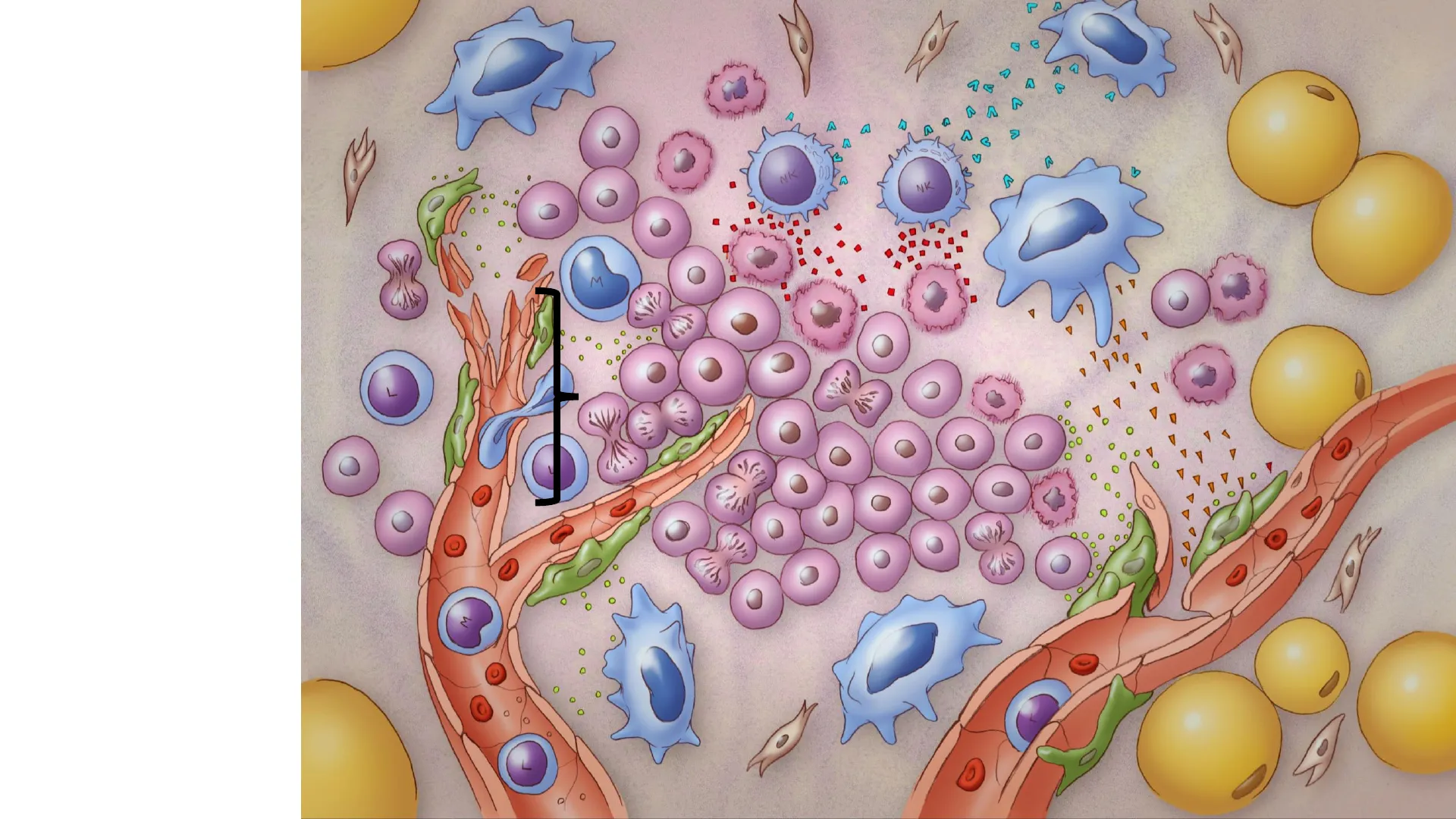
P V 493 A P A A A 53 NK NK M
- Grupo de enfermedades
- Originado en diferentes tejidos del cuerpo
L
- Formación de tumores
- Crecimiento descontrolado de células 'anormales'
W Cáncer: Tipos de tumores
- Primarios
Originados in situ
- Secundarios
Provienen de un tumor de menor grado
Originados en un tejido distinto
Hallmarks of Cancer: New Dimensions
Definición de "Hallmarks del cáncer"
Propiedades funcionales adquiridas por las células, las cuales son cruciales para la formación y progresión de los tumores malignos Representan un intento de englobar la gran diversidad de fenotipos malignos utilizando una serie de características funcionales comunes a la mayoría de los tipos de cáncer
Definición de "Hallmarks del cancer"
- Propiedades funcionales adquiridas por las células, las cuales son cruciales para la formación y progresión de los tumores malignos Representan un intento de englobar la gran diversidad de fenotipos malignos utilizando una serie de características funcionales comunes a la mayoría de los tipos de cáncer
Características que definen un tumor
Antes del siglo XX
- Los tumores son entidades homogéneas
- Crecimiento descontrolado
Siglo XX
- Los tumores presentan aberraciones genéticas y metabólicas
- Complejidad del tejido tumoral
Hanahan & Weimberg, 2000
- Tumores con diferentes orígenes comparten características
- Crecen, invaden y colonizan
Hanahan & Weimberg, 2011
- Interacciones inter e intracelulares definen el microambiente tumoral
2020's
- Single cell transcriptomic analysis
Normal Cell Division vs. Cancer Cell Division
continued normal cell divisionof healthy cells
Apoptosis of damaged, unrepaired cell
Carcinogenesis
El proceso en donde las células adquieran la capacidad de proliferar independientemente de las señales que regulan la activación del ciclo celular.
Ciclo celular: alteraciones
E2F target genes
E2F/DP
EWS/ELL
INK4 CKIs
RB
p16INK4A
PISINK48
p18INK4C
p19INK4D
Cyclin
E
Cyclin
A
CDK2
Growth
factor
Cyclin
D
Cyclin
CDK2
DNA replication
CDK4/6
DNA
pol II
GI
p21CIPI
S
EWS/FLI
G0
p53
MDM2
Cyclin
A
p27KIPI
p57KIP2
T
p14ARF
M
G2
Cyclin
A
CDKI
EWSIELL
Cyclin
B
CDKI
CDKI
Cyclin
A
Cyclin
B
EWSIELL
Mediated by EWS/FLI
Gene deletion/mutation
Gene amplification
Rare genetic mutations
CDK2
Cyclin
A
Evasión de señales antiproliferativas
>Evasión de señales antiproliferativas: genes supresores de tumores
- Son genes que controlan la proliferación, reparación celular y muerte celular.
Tumor Suppressor Gene Proteins
Growth factor
INHIBI
INHIBIT
Receptor
Signaling
enzymes
Transcription
factors
DNA
Cell nucleus
Cell proliferation
Normal
Cell Cycle
Proto-oncogene (gas)
Tumor Suppressor Gene (brakes)
1st Knockout Mutation
(Susceptible carrier)
STOP
ncer tumor cells proliferate
2nd Knockout Mutation
(Leads to inability to stop growth)
STOP
incer tumor cells proliferate
p53: el guardian del genoma
A
Lung
R158L/P
Adenocarcinoma
Lung Squamous R158H/L/fs
Cell Carcinoma
Glioma (Low Grade)
R273C/H/L
43
Esophageal Adenocarcinoma R248Q/W
Head & Neck Squamous
Cell Carcinoma
0
0
Hepatocellular Carcinoma
R249S
Breast Invasive Carcinoma
R273C/H/L/P
8
0
Pancreatic Ductal
8
Adenocarcinoma
0
Bladder Urothelial
10
Carcinoma
0
Colorectal
17
Adenocarcinoma
0
Prostate
# Mutations
5
G245D/S
O
TAD
DBD
OD
0
100
200
300
393 aa
0
100
200
300
393 aa
Negative
Regulators
Positive
Regulators
Stress
Response
Cell Fate
Family |Epigenetic
OU SATY
Core
DNA damage
Translation
ARF
p53
ATM
HPC
ncRNA
miA-34a
Becin
AKT
FADO SHAY
021
SLUGI
nTOF
4
PUMA
INK
CAM
MACE
NOX
8
CASIN
WEE
Apoptosis
Proliferation
ROS
control
Metabolism
Cell Cycle
2.
Melanoma
R213*/Q
# Mutations
TAD
DBD
OD
R248L/Q/W
Stomach Adenocarcinoma
R273C/H/S
133
R248P/Q/W
Ovarian Serous
211 Cystadenocarcinoma
R273C/H/L/P
R175C/H
Uterine Corpus
Endometrioid Carcinoma
R248Q/W
Invasion
EMT &
TME
Pluripotency
Inflammation/
Autophagy
DRIT
response
R248Q/W
Glioblastoma
R282W/fs
Los Hallmarks del cáncer: evolución
Shit-sufficionay in
growth signals
Evading
apoptosis
Insensitivity to
anti-growth signals
Deregulating
cellular
metabolism
Avoiding
immune
destruction
7
Resisting
cell death
100
Enabling
replicative
immortality
1
Genome
instability &
mutation
1
Tumor-promoting
inflammation
Limitlass replicativa
Sustaining
proliferative signaling
Evading
growth suppressors
Emerging hallmarks &
enabling characteristics
Unlocking
phenotypic
plasticity
Nonmutational
epigenetic
reprogramming
+
+ 00
+
Sustained
angiogenesis
Tissue invasion
& metastasis
Senescent
cells
Polymorphic
microbiomes
Inducing or accessing
vasculature
Activating invasion
& metastasis
Hanahan & Weinberg.
Cell 2000; 100:57
Hanahan & Weinberg.
Cell 2011; 144:646
Hanahan & Weinberg.
Cancer Discov 2022; 12:31
Señal proliferativa sostenida
Hormonal Signalling
0
0
Blood Vessel
0
Endocrine
Autocrine
00
Ligand
Paracrine
Señal proliferativa sostenida: mecanismos
o growth factor
7
CELL GROWTH
AND DIVISION
growth factor
receptor
Phosphorylation
cascade
Production
of proteins
P
TRANSLATION
MNKI
MNKI
Inactive
Active
Increased
translation of
certain MRNAS
nucleus
TRANSCRIPTION
MRNA
c-Myc
c-Myc
Inactive
Active
Transcription of genes
promoting cell growth and division
- Capacidad para mantener la división celular activa de manera crónica
- Utiliza receptores de membrana, los cuales al ser activados, prenden vías de señalización intracelular que regulan el ciclo celular
Señal proliferativa sostenida: protooncogen
Protooncogen
DELETION OR POINT MUTATION
IN CODING SEQUENCE
GENE AMPLIFICATION
CHROMOSOME REARRANGEMENT
DNA
RNA
I
I
I
DNA
RNA
hyperactive
protein made in
normal amounts
normal protein greatly
overproduced
nearby strong
enhancer causes
normal protein to
be overproduced
fusion to actively transcribed
gone greatly overproduces
fusion protein; or fusion
protein is hyperactive
Señal proliferativa sostenida: formas de proliferación
Múltiples formas para mantener la proliferación:
- Señales autoproliferativas y para las células circundantes
- Aumentan la expresión de receptores
- Alteraciones estructurales en los receptores que aumentan la afinidad por sus ligandos
- Alteraciones estructurales que propician la activación de receptores en ausencia de ligandos (activación constitutiva)
Evasión de supresores del crecimiento
- Las células malignas deben evadir la acción de programas que regulan negativamente la proliferación y el crecimiento celular
- Muchas vías de señalización que ayudan a esta evasión, son reguladas por proteínas supresoras de tumores
Wpeissner: own work
normal chromosomes
maternal, paternal
first hit
mutation in tumor
suppressor gene
second hit
loss of wild-type
chromosome
no functional
tumor suppressor
left
tumor
suppressor
gene
mutation
chromosome
loss
Inducción y acceso a la vasculatura
Circulating
precursor
endothelial cells
- Angiogénesis
0
O
0
Angiopoietin 1
Neuropilin
VEGF
0
VEGFR2
MMPs
O
C
0
PDGF
PDGFR
Endostatin
Angiopoietin 2
0
0
bFGF
0
0
bFGFR
Integrin
n
0
0
0
0
O
Platelet
VEGF
0
bFGF
PDGF
Alpha granules
0
Endostatin
Angiostatin
Platelet factor 4
NDC 50242-069-01
Ust No .: 15734
100mg
25 mg/ml
AVASTIN
(bevacizumab)
For Intravenous Use
100 mg
25 mg/eil
NO PRESERVATIVES.
DISCARD UNUSED PORTICI
AVASTIN®
Genentech
R
0
Nature Reviews | Drug Discovery
Tumour
10
0
Inducción y acceso a la vasculatura: mecanismos
7
VESSEL CO-OPTION
VASCULOGENIC MIMICRY
CANCER-SPECIFIC MECHANISMS
PERICYTE
ENDOTHELIAL CELL
ENDOTHELIAL-LIKE CELL
TUMOR CELL
Invasión local y metástasis
1
Epithelial to
Mesenchymal
Transition
2
Cell Mobilization
M
0-0
0:0
3
Intravasation
O
Hematopoietic
Stem Cells
0:0
00
0:0
Pre-Metastatic
Niche
0
0-p-
-O-CH
0
o
OH
OH
Metabolites
S
Neutrophils
undergoing NETosis
5
Niche Colonization
4
Extravasation
Inmortalidad replicativa
Progressive telomere shortening
Self-renewal
Telomeres shorten with
every cell division in all
somatic cells
Pre-malignant
cells can bypass
M1 checkpoint
M1 Senescence
M2 Crisis
To continue to divide, cancer
cells must engage a mechanism
to maintain telomere length at a
new steady state
Inmortalidad replicativa: inestabilidad cariotípica
unprotected
chromatid
ends
end-to-end
fusion
8
point of
fusion
telomere
erosion
3
8
mitosis
fused sister
chromatids
Figure 10.15b The Biology of Cancer (C Garland Sc
nonhomologous
chromosome
new point
of fusion
point of
fusion
earlier point
of fusion
earlier point
of fusion
next
mitosis
anaphase bridge
La inestabilidad cariotípica generada es tan severa que
las células activan la maquinaria apoptótica
nowy breakage
+
Resistencia a la muerte celular
MPT-driven necrosis
Necroptosis
Extrinsic apoptosis
Ferroptosis
Intrinsic apoptosis
RCD
Pyroptosis
ICD
Apoptotic
morphology
Necrotic
morphology
Parthanatos
ADCD
Entotic cell death
LDCD
NETotic cell death
Reprogramación del metabolismo
- Se da una reprogramación de las tres actividades metabólicas:
- Bioenergética (alterada)
- Biosíntesis (incrementada)
- Balance redox (reajustada)
- El resultado es una ventaja selectiva que les permite crecer y proliferar a una tasa mucho mayor
Catabolismo y anabolismo
Nutrientes
que contienen
energía
Glúcidos
Grasas
Proteínas
Macromoléculas
celulares
Proteínas
Polisacáridos
Lípidos
Acidos Nucleicos
CATABOLISMO
·Degradativo, oxic
·Genera energía, produce
ATP.
Catabolismo
ADP+Pi
NAD+
NADP+
ANABOLISMO
·Sintético, redu
·Utiliza energía, consume ATP.
ATP
NADH
NADPH
Anabolismo
.Los productos finales son
materias primas del catabolismo
· "GENESIS"
Energía
química
Productos
finales no
energéticos
CO2, H2O
NH3
Moléculas
precursoras
Aminoácidos
Monosacáridos
Ácidos grasos
Bases nitrogenadas
Modificado del "Lehninger
Principios de Bioquímica", 4ª ed.
Nelson, D.L. y Cox, M.M. Omega.
2006.
.Los productos finales e
intermedios son materias
primas del anabolismo
·Genera desechos que se
excretan al entorno
· "LISIS"
7
Inflamación pro y antitumoral
Primary tumor site
Metastatic site
Tumor
initiation
Progression
Invasion
Colonization
Dormancy
Intravasation
Extravasation
T cell
exclusion
Dissemination
Tumor cell
CAF
Blood
vessel
ECM/
basement
membrane
CD8+ T cell
NK cell
DC
Eosinophil
Endothelial cell
CD4+ T cell
Macrophage
Lymphatic
vessel
Platelet
Treg
Neutrophil
Monocyte
Immature
myeloid cell
Invasive/
metastatic
tumor cell
Epithelial cell
Pre-metastatic niche
¿Non has encontrado lo que buscabas?
Explora otros temas en la Algor library o crea directamente tus materiales con la IA.