Smart Grids: gestione della potenza attiva e IoT per l'energia
Slide dall'Università degli Studi di Firenze su Smart Grids. Il Pdf esplora il concetto di Smart Grids, approfondendo l'Internet of Things e l'Advanced Metering Infrastructure. La presentazione, utile per lo studio universitario di Informatica, analizza la gestione della potenza attiva e il bilanciamento tra produzione e consumo di elettricità.
Mostra di più43 pagine

Visualizza gratis il Pdf completo
Registrati per accedere all’intero documento e trasformarlo con l’AI.
Anteprima
Sistemi Avanzati per le Energie Rinnovabili
Energia Eolica e Marina
RENTIN TUDIORUM + UN UNIVERSITÀ DEGLI STUDI FIRENZE ITAS DIEF DIPARTIMENTO DI INGEGNERIA INDUSTRIALE SMART GRID I 1.$ Smart Grids Prof. Alessandro Bianchini alessandro.bianchini@unifi.it Ing. Marco Ciampolini marco.ciampolini@unifi.it REASE 0 A.A. 2021/2022REASE 0 ENT S+ FLOREA DIORUM UA UNIVERSITÀ DEGLI STUDI FIRENZE DIEF DIPARTIMENTO DI INGEGNERIA INDUSTRIALE
Summary
- The smart grids
- Internet of Things (loT)
- Advanced Metering Infrastructure (AMI)
- Grid connected converters
- Active Power Management
- Length scales
- Smart User
- Conclusions
※ 我 C 1REASE 0 ENT S+ FLOREA DIORUM UA UNIVERSITÀ DEGLI STUDI FIRENZE DIEF DIPARTIMENTO DI INGEGNERIA INDUSTRIALE
Introduction
Yesterday
Centralised power Large thermal generation with some renewables ..... One way power flows Passive consumption
Tomorrow
Clean, local power Carbon Capture and storage Smaler role for certralsod thermal generator Larger role for biogas CHP O O O O Expanded heat networks Engaged and eficient consumption/prosumption O Two way power flows Source: breakingenergy.com 2REASE 0 ENT S+ FLOREA DIORUM UA UNIVERSITÀ DEGLI STUDI FIRENZE DIEF DIPARTIMENTO DI INGEGNERIA INDUSTRIALE
Introduzione e Obiettivi
In order to achieve the 2030 European CO2 target, the energy production from fossil fuels must be integrated even more with a relevant share of REN sources. However, several issues arise in terms of power grid design and management:
- the intermitting nature of the electrical energy produced from renewables leads the operating parameters of the grid (voltage, frequency, reactive power released, high-order harmonics) to vary significantly over time
- the high inertia of centralized power plants may overcharge the power grid when working in off-design conditions; in fact, centralized power plants play the role of compensating the variations in electricity production from renewables to ensure a stable supply to the end users
- European power grids are currently not able (in average) to allocate more than the 30- 40% of their capacity to REN production. In fact, an electricity network which is not born to forecast the growth of distributed power generation (local small plants at low voltage for the most) will lead to excessive O&M costs, which will end up on end-user's bill.
The actual power grids are not able to operate in this way and need to evolve:
- globally, to ensure the exchange of energy fluxes over long distances
- locally, to adequately absorb the energy produced from renewable sources 3REASE 0 ENT S+ FLORE DIORUM UA UNIVERSITÀ DEGLI STUDI FIRENZE DIEF DIPARTIMENTO DI INGEGNERIA INDUSTRIALE
The smart grid: Definitions
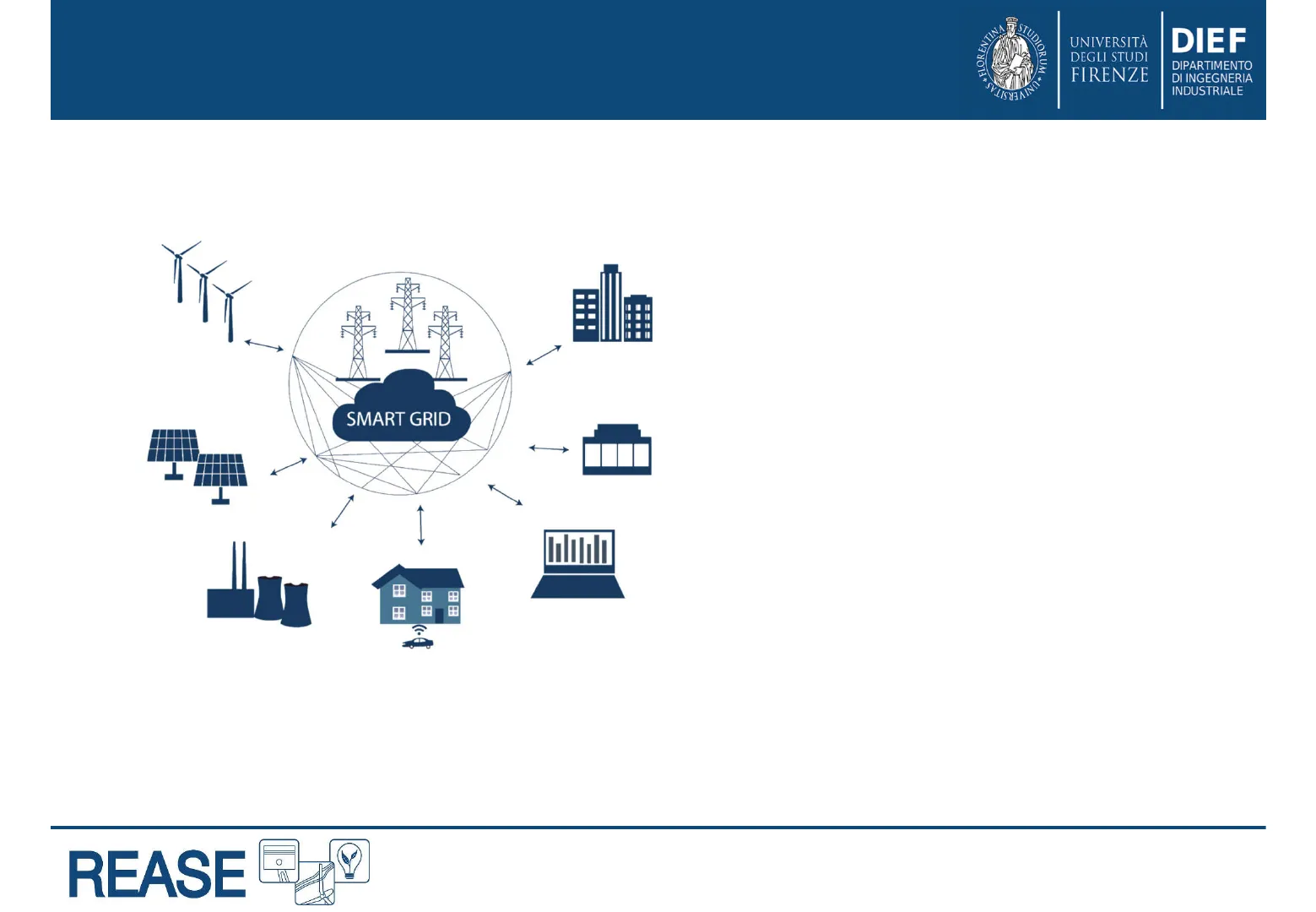
"The Smart Grid can be defined as an electric system that uses information, two-way, cyber-secure communication technologies, and computational intelligence in an integrated fashion across electricity generation, transmission, substations, distribution and consumption to achieve a system that is clean, safe, secure, reliable, resilient, efficient, and sustainable. This definition covers the entire spectrum of the energy system from the generation to the end points of consumption of the electricity. The ultimate Smart Grid is a vision, and it will require cost justification at every step before implementation, then testing and verification before extensive deployment."
- H. Gharavi and R. Ghafurian, "Smart Grid: The Electric Energy System of the Future,“ in Proceedings of the IEEE, vol. 99, no. 6, pp. 917-921, June 2011 … “ we define a Smart Grid to be an end-to-end cyber-enabled electric power system, from fuel source to generation, transmission, distribution, and end use, that will: 1) enable integration of intermittent renewable energy sources and help decarbonize power systems, 2) allow reliable and secure two-way power and information flows, 3) enable energy efficiency, effective demand management, and customer choice, 4) provide self-healing from power disturbance events, and 5) operate resiliently against physical and cyber attacks."
- Anuradha M. Annaswamy; Massoud Amin, "IEEE Vision for Smart Grid Controls: 2030 and Beyond," in IEEE Vision for Smart Grid Controls: 2030 and Beyond, pp.1-168, 20 June 2013 4REASE 0 ENT SA FLORE DIORUM UA UNIVERSITÀ DEGLI STUDI FIRENZE DIEF DIPARTIMENTO DI INGEGNERIA INDUSTRIALE
What makes a grid Smart?
" ... the digital technology that allows for two-way communication between the utility and its customers, and the sensing along the transmission lines is what makes the grid smart. ... the Smart Grid will consist of controls, computers, automation, and new technologies and equipment working together; these technologies will work with the electrical grid to respond digitally to our quickly changing electric demand." (source: smartgrid.org)
Energy flow
Information flow Utility company data center Energy managment system control Automatic meter reading Remote power control Demand response Real time pricing Billing and monitoring data Microgrid
- Grid-tied storage Centralized power plants Transmission Transport grid Behind- the-meter storage Advanced metering communication device Residential (smart home) Distributed energy resources and storage systems Renewable energy sources Commercial and industrial smart buildings Source: pewtrusts.org 5 IVERREASE ENTI S+ FLORE DIORUM UA UNIVERSITA DEGLI STUDI FIRENZE DIEF DIPARTIMENTO DI INGEGNERIA INDUSTRIALE
Smart Grid and Distributed Generation
The distributed generation (DG) consist of modular and often renewable-energy generators and provide several potential benefits:
- lower-cost electricity 1
- higher power reliability and security /
- fewer environmental consequences
- reduced transmission line issues
DG requires additional control procedures for the network in the vicinity of the connection nodes. This is due to:
- power transit capability control, due to the variation in current flow caused by the DG intermittent operation (compared to the traditional central generation design)
- voltage changes: rapid voltage changes (RVC) and supply voltage cariations (SVV) due to unprogrammed DG connection 1
- islanding: the independent operation of a distribution network section, while it is disconnected from the main grid but still energized by the DG units Source: pewtrusts.org 6REASE 0 ENT S+ FLORE DIORUM UA UNIVERSITÀ DEGLI STUDI FIRENZE DIEF DIPARTIMENTO DI INGEGNERIA INDUSTRIALE
Smart Grid Technologies
The smart grid would be able to identify and solve the aforementioned problems as well as to optimize the management of the electric (but also thermal) power fluxes. The design of a smart grid requires innovative elements, compared to the traditional system:
- communication infrastructure: communication lines/media, standard communication protocols, big-data analysis centers
- smart components for measuring and metering: smart meters /
- hardware infrastructure: energy storage systems, superconductors, HVDC transmission (high- voltage DC), FACTS technology (Flexible Alternating Current Transmission)
- automatic-control and remote-control systems (fault detection, management of power fluxes)
That suggests that the Internet of Things (loT) paradigm applies to the "things" and procedures involved in Smart Grid applications.
- an loT is a network that connects uniquely identifiable "things" to the internet 1
- the "things" have sensing/actuation and potential programmability capabilities (embedded) /
- the unique identification and sensing allows the information of the "thing" to be collected and the state of the "thing" can be changed from anywhere, anytime, by anything (IEEE Definition) 7REASE 0 ENT S+ FLOREA DIORUM UA UNIVERSITÀ DEGLI STUDI FIRENZE DIEF DIPARTIMENTO DI INGEGNERIA INDUSTRIALE
IoT Networks
WiFi
Protocols that allow wireless access to local broadband networks. They have been developed for multimedia applications, so they usually transmit a huge data, with high energy consumption, which entails strong limitations of applicability for loT field
Cellular Networks
Standard communication technologies mobile phone, or GPRS, GSM (2G), HSPA (3G), LTE (4G) and coming 5G. Because of the high energy consumption are mostly used in combination with Low Power Mesh and Wireless Bus for the communication between concentrators and control centers
Mesh Networks Low Power
Networks based on meshed low-power nodes self-configuring network architectures, capable of supporting dynamic data routing and optimized for low power consumption (such as ZigBee).
Power Lines
The transmission of information takes place by modulating the low power electrical signal. Protocols are available for both the residential and utilities. 8REASE 0 ENT S+ FLOREA UNIVERSITÀ DEGLI STUDI FIRENZE DIEF DIPARTIMENTO DI INGEGNERIA INDUSTRIALE
IoT Reference Architecture
Web / Portal Dashboard API Management Event Processing and Analytics 1 1 Aggregation / Bus Layer ESB and Message Broker Communications MQTT / HTTP ARDUINO Devices Manager Identity & Access Management Source: wso2.com 9REASE 0 ENTI S+ FLOREA MORUM +UA UNIVERSITA DEGLI STUDI FIRENZE DIEF DIPARTIMENTO DI INGEGNERIA INDUSTRIALE
Advanced Metering Infrastructure
AMI is an integrated system of smart meters, communications networks, and data management systems that enables two-way communication between utilities and customers
Water Meter
Management Centre Tstat Gas Meter HVAC System Smart Appliances Lighting Controls Home Gateway Data Concentrator Home Automation System & "In-Home" Display Electricity Meter I 1 Heat Meter HAN I LAN 1 NAN WAN SERVIZI "OLTRE IL CONTATORE" TELELETTURA E TELEGESTIONE
HAN (Home Area Network)
Short-range wireless standards (ZigBee, Bluetooth, WiFi) to connect home appliances to smart meters
LAN (Local Area Network)
Mesh network topology (PLC, 802.15.4g) to aggregate smart meter nodes to a Data Aggregation Point (DAP), or Star network topology such as cellular M2M (GPRS, 3G, LTE, NB-IoT, LPWAN) to connect each meter directly to the base station
NAN (Neighborhood Area Net.)
Star network topology (cellular M2M) to connect the DAP to the base-station (GPRS, 3G, LTE) or to the cloud via ethernet or fiber 10
Non hai trovato quello che cercavi?
Esplora altri argomenti nella Algor library o crea direttamente i tuoi materiali con l’AI.