Dispensa su Network e Social Capital, Università degli Studi di Milano-Bicocca
Documento dall'Università degli Studi di Milano-Bicocca su Network e Social Capital. Il Pdf esplora il capitale sociale e le reti sociali, analizzando le prospettive di misurazione micro e macro, con contributi di Coleman, Putnam e Granovetter, utile per Economia a livello universitario.
Mostra di più58 pagine


Visualizza gratis il Pdf completo
Registrati per accedere all’intero documento e trasformarlo con l’AI.
Anteprima
Dispensa Network and Social capital
Scienze dell'organizzazione (Università degli Studi di Milano-Bicocca) Scansiona per aprire su Studocu Studocu non è sponsorizzato o supportato da nessuna università o ateneo. Scaricato da Arm (photoarmmela@gmail.com)1
NETWORKS AND SOCIAL CAPITAL
When we talk about Social Capital we're referring to a relational concept that deals with sociability, social networks, trust, norms of reciprocity and cooperative actions. It's also a multidimensional concept that refers to individuals (micro, Coleman), to organisations (meso), to societies (macro, Putman), depending on the issue researchers are investigating. Lastly, it's a spatially based concept that refers to countries, regions, cities, virtual/digital communities. For example, we can say that our city has a higher social capital than other cities. Important difference: Social networks and social capital are two different things. With Social Networks, we refer to all relations one actor has, meaning that we also include conflictual relations, avoidance, blaming, non cooperative ones (every relationship in one's life, either positive or negative) while Social capital refers to those always cooperative relations 'embedded in the social structure useful to reach an aim otherwise difficult or impossible to reach (Coleman, 1990). Social capital is always positive in the short term of the micro level, while it isn't always positive in the macro level = INCORPORATO/ INCASTONATO
Strands of Social Capital
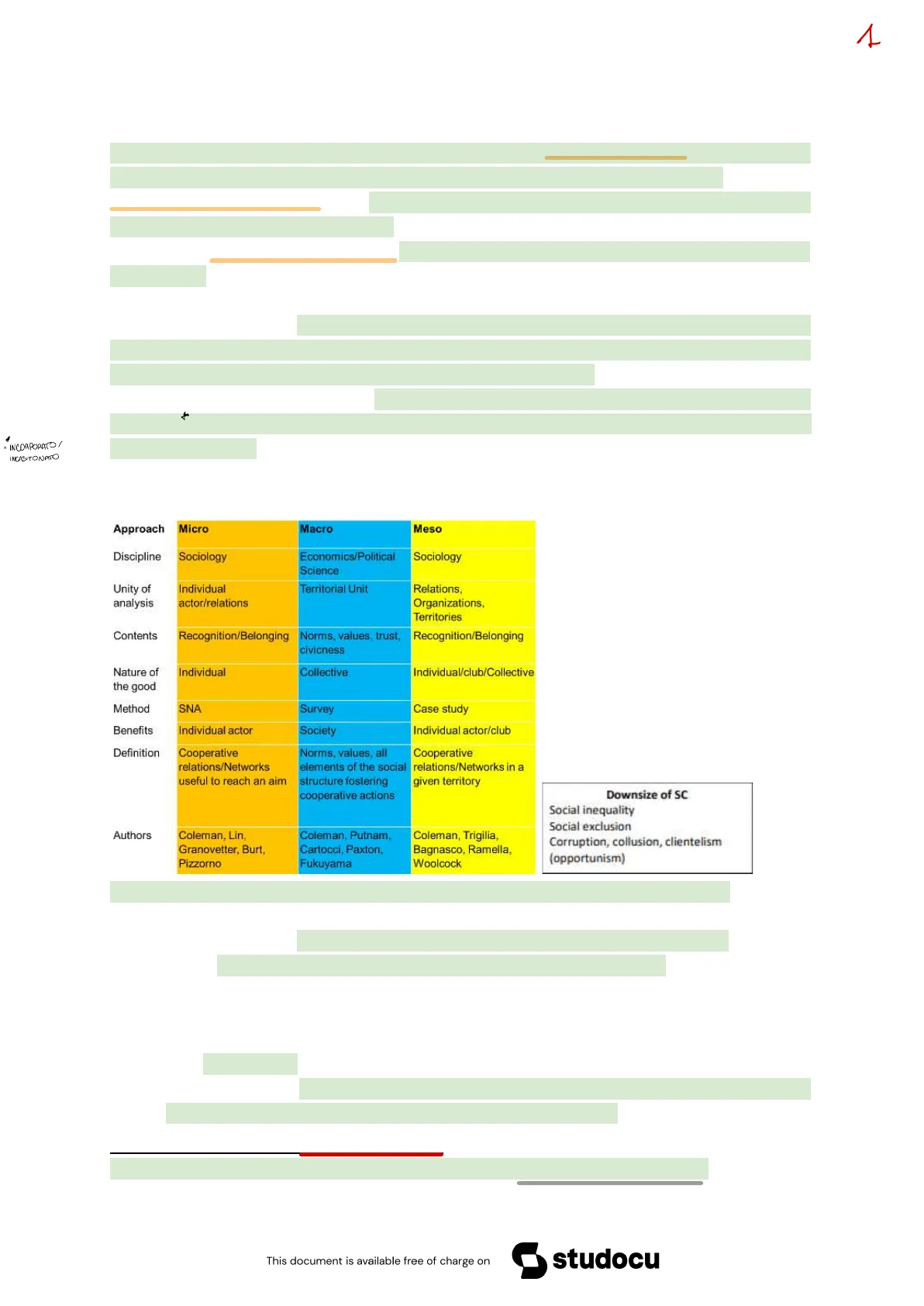
Social Capital can be divided into three strands:
| Approach | Micro | Macro | Meso |
| Discipline | Sociology | Economics/Political Science | Sociology |
| Unity of analysis | Individual actor/relations | Territorial Unit | Relations, Organizations, Territories |
| Contents | Recognition/Belonging | Norms, values, trust, civicness | Recognition/Belonging |
| Nature of the good | Individual | Collective | Individual/club/Collective |
| Method | SNA | Survey | Case study |
| Benefits | Individual actor | Society | Individual actor/club |
| Definition | Cooperative relations/Networks useful to reach an aim | Norms, values, all elements of the social structure fostering cooperative actions | Cooperative relations/Networks in a given territory |
| Downsize of SC | Social inequality Social exclusion | Corruption, collusion, clientelism (opportunism) | |
| Authors | Coleman, Lin, Granovetter, Burt, Pizzorno | Coleman, Putnam, Cartocci, Paxton, Fukuyama | Coleman, Trigilia, Bagnasco, Ramella, Woolcock |
Effetti del Capitale Sociale
The effects of SC can be put into two different definitions: benefits and downsize. We could notice that you can have different kinds connected to different levels:
- individual level: credits and success as benefits and obligation as downsize;
- Club: local development and city renewal as benefits and Nimby (acronym for "Not In My Backyard" describes the phenomenon in which residents of a neighbourhood designate a new development (e.g. shelter, affordable housing, group home) or change in occupancy of an existing development as inappropriate or unwanted for their local area) as downsize;
- Collective level: democracy and economic growth as benefits and Social inequality, corruption, collusion, clientelism (opportunism) as downsize.
MEASURING SC ON A MICRO LEVEL
If we want to measure SC on a micro level we can use three different techniques: This document is available free of charge on studocu Scaricato da Arm (photoarmmela@gmail.com)2
Tecnica Name Generator
1) Name Generator: It measures social relationships at individual levels, meaning that you have to interview single individuals with questions such as:
- Who is your neighbour/brother/friend?
- Who are your three best friends?
- With whom did you discuss personal matters during the last six months?
- Who helped you to get your current job?
- Who do you ask for advice if you have a problem in doping your job?
With questions like the ones above, we can use the answers to obtain names and construct a data table. After that,to create a structure of the individual's network, you need to ask: "do these people know each other?" An output for a name generator would end up looking like this:
Esempio di Output Name Generator: Tabella Amici
Table nº2: Friends
| Name | Sex | Age | Birthplace | Family situation | Degree | Profession | Place of residence | Frequency of contacts | With children present? | How long have you known him/her? | Where did you meet? |
| 1 | |||||||||||
| 2 | |||||||||||
| 3 | |||||||||||
| 4 |
Matrice di Prossimità/Adiacenza
We can now build a proximity/adjacency matrix (A proximity is a measurement of the similarity or dissimilarity, broadly defined, of a pair of objects. If measured for all pairs of objects in a set, the proximities are represented by an object-by-object proximity matrix) that would end up looking like this:
| Alberta | Guido | Veronica | Noe mi | Luca | |
| Alberta | - | 1 | 1 | 0 | 1 |
| Guido | 1 | - | 1 | 0 | 0 |
| Veronica | 1 | 1 | . | 1 | 1 |
| Noemi | 0 | 0 | 1 | - | 1 |
| Luca | 1 | 0 | 1 | 1 | - |
Rappresentazione Grafica della Rete
Out of this we can get a graph, which will be our outcome (the visual representation of the matrix): ->nodes=dots We can see that Veronica covers a very important position in this structure, she's crucial. If we delete her the two parts are not connected anymore. We can now see how the structure of the network is crucial to understand the spread of information, economic behaviours, careers ... etc ...
Informazioni dal Name Generator
What information do we get from the name generator technique? You can have information about the network by obtaining the following measures:
- Size (how many members->in the previous case we have five individuals); Nº ACTUAL CONNECTION
- Density: it's the number of direct actual connections divided by the number of possible connections in a network. It facilitates the transmission of info, ideas, rumours and diseases. The greater the density, the more likely is a network to V° POSSIBLE CONNECTION Scaricato da Arm (photoarmmela@gmail.com)3 be considered a cohesive community and a source of social support. Typically, smaller networks have greater density (in the matrix, if everybody knows each other density is 1, if they don't know each other density is 0)
- Structural holes (for example veronica is a structural hole, she connects parts of the networks that are not connected by passing info or ideas->nodes that aren't deeply involved in a network, but that function as a bridge between two or more networks "filling" the structural hole)Ronald Burt calls the situation in which Ego connects individuals who are themselves connected but who, without the presence of Ego would have no connection with one another a "structural hole" = INDIVIDUO CENTRALE DEL GRUPPO
- Popularity/centrality: who is the central individual of one network. The sheer number of connections between nodes is called "degree"| and almost all networks have nodes with higher degrees, which makes them more popular or powerful within the network. There are various measures of power or prominence, in fact if you get "nominated" by someone with a higher degree (one of the "populars"), you also score fairly high on power. Through the member with higher degrees you can get to someone you want to reach inside your network (process of "betweenness"). In the structural hole diagram Ego has a high level of betweenness. NUMERO DI CONNESSIONI TRA I NODi
> You can have information about the individuals and their relations:
- You can know if they have a strong or weak tie (legame forte o debole). Granovetter studied this relation, saying that acquaintances are weak ties because they are less likely to be socially involved with one another (low-density) compared to close friends (strong ties with high-density). Weak ties facilitate the flow of information from otherwise-distant parts of a network while also helping integrate social systems. The definition of what constitutes a weak tie can be slippery because it's not settled on what actually makes a tie "weak". Weak ties function as bridges, something that strong ties can't do, and whatever they bring to the network plays an important role in the social life of networks.
- You can understand the homophily which indicates the similarities between the individuales
Tecnica Position Generator
2) Position Generator this technique is used to understand the position/prestige in the society. All of the positions in the labour market have a prestige score, the prestige of a lawyer is different from that of a taxi driver. The idea of the position generator is that society can be understood as a pyramid and in order to build that pyramid, we have to ask the following question: "Of your friends, relatives, acquaintances .. etc, is there anyone who is a lawyer, builder etc ...? " This document is available free of charge on studocu Scaricato da Arm (photoarmmela@gmail.com)4
Esempio di Domande Position Generator
| Relation | Sex | Age | Since when do you know hanter | When did you -Profe-ssam | Place of residence |
| 1. Cohabitant | |||||
| 2. Non-cohabitant family | |||||
| 3. Friend | |||||
| 4. Acquaintance | |||||
| 5. Work colleague | |||||
| 1. Lawyer | |||||
| 2. Police officer | |||||
| 3. Businessman | |||||
| 4. Builder | |||||
| 5. University Professor | |||||
| 6. Engineer | |||||
| 7. High School teacher | |||||
| 8. Technician | |||||
| 9. High-rank civil servant | |||||
| 10. Politician | |||||
| 11. Truck driver | |||||
| 12 Bishop (or similar for other religions) | |||||
| 13. Priest (or similar for other religions) | |||||
| 14. Mechanic | |||||
| 15. Postman | |||||
| 16. Craftsman |
By using this technique, you won't get a graph because you don't ask if they know each other, you don't have names and, therefore, you won't have the affiliation matrix.
Tecnica Resource Generator
3) Resource Generator: If you use this method, you are interested in understanding the support network of the individual. In this case, the question to ask is: "Is there someone among your acquaintances, friends or relatives whom you could ask for assistance in the following situations? If you know more than one, refer to the one you have known for longer." With this question you can't get a graph because you are not asking for names, the only case you can have a graph is the name generator because you have a list of names.
Esempio di Domande Resource Generator
| 1: Solve a peoblom ul wont | |
| 2 Heb wmh noung | |
| 3 Heb wrh small mpans | |
| 4. Shopping when | |
| Discuss poltes | |
| ( Ostan medical advice | |
| 7. Gef atvice for a family problem | |
| Borrow money in 0: 10,000€) | |
| 9: Help to buy sports ticket | |
| SU: Help to buy tickets for an art or cultural evert | |
| tt. Take cam ọt chájun for several days | |
| 12. Get adoce to send cháfram atroad to study English | |
| 13 Gel a recommendation for a | |
| 14: Help to solve problems with the local adminstration | |
| 15. Get financial advice | |
| 56 Borrow a hobday home |
Output Resource Generator: Tabella Percentuali
With the resource generator you obtain a table with percentages:
| Milan | Lyon | Deris | Madrid | ||
| % of cases | Type of relation ** | Type of relation | Type of relation | Type of relation | |
| MATERIAL | |||||
| Can help when moving house | 79% *** | Family (48%) **** | 12% Friend (42%) | (67%) | 65% Friend (50%) |
| Can help with small jobs around the house | 66% Family (48) | 35% Family (48) | 63% Friend (64) | 72% Friend (62) | |
| EMOTIONAL | |||||
| Can give advice concerning a conflict with family members | 70% Friend (55) | 25% Friend (54) | 66% Friand (52) | 59% Family (53) | |
| CARE | |||||
| Can do your shopping when you are il | 89% Family (74) | 13% Friend (40) | 57% Family (57) | 61% Family (53) | |
| Can look after your children when you cannot | 60% Family (74) | 21% Family | 54% Family (56) | 58% Friand (53) | |
| LEISURE | |||||
| Can provide sports events tickets | 50% Friend (54) | NA | NA | 60% Friend (38) | 48% Friend (45) |
| Can give advice re sending children abroad | 44% Friend (54) | 3% Friend (68) | 46% Family (67) | 47% Friend (29 | |
| Can land you a holiday home | 55% Friend (60) | 16% Family (00) | 40% Friend (52) | 32% Friend (79) | |
| Can provide tickets for cultural events | 60% Friend (60) | NA | N.A | 78% Friend (100 |
Place of residence Since when do you know him/her They are not listed according to the prestige Scaricato da Arm (photoarmmela@gmail.com)
Non hai trovato quello che cercavi?
Esplora altri argomenti nella Algor library o crea direttamente i tuoi materiali con l’AI.