Pain in Oro Facial District: Dental Abscess, Università di Parma
Slide dall'Università di Parma su "Pain in Oro Facial District: Dental Abscess". Il Pdf illustra le differenze tra ascessi e flemmoni, con immagini cliniche e diagrammi anatomici, destinato a studenti universitari di odontoiatria o igiene dentale.
Mostra di più20 pagine

Visualizza gratis il Pdf completo
Registrati per accedere all’intero documento e trasformarlo con l’AI.
Anteprima
Apparato Stomatognatico
DENTAL HYGIENE : MORPHOLOGY AND FUNCTION STOMATOGNATHIC APPARATUS
Dolore nel Distretto Oro-Facciale
PAIN IN ORO FACIAL DISTRICT: DENTAL ABSCESS TAS UDIORUA CITAS . STUD UDIORU PARMENSIC Prof. Paolo Vescovi DDS, PhD, MSc, Spec Oral Surgery MA · UNIVERSIT Dasser and · PARMENSIS UNIVERSITÀ DI PARMA Full Professor in Odontostomatologic Diseases Director European Master Degree in Oral Laser Applications (EMDOLA ) Director School of Speciality in Oral Surgery University of Parma UNIVERSITÀ DI PARMA EMDOLA European Master Degree in Oral Laser Applications
Ascesso Dentale
ABSCESS 1 · A tooth abscess or root abscess is PUS enclosed in the tissues of the jaw bone at the tip or around of an infected tooth. • Usually the abscess typically originate from dead pulp tissue, usually caused by untreated tooth decay, cracked teeth or localized orSIGNS and SYMPTOMS of ACUTE TOOTH ABSCESS . Common symptoms of an acute tooth abscess is a toothache or a persistent, throbbing and localized pain at the site of the infection. · Putting pressure or warmth on the tooth may induce extreme pain. · There may be a swelling present at the base of the tooth on the gum.
Pulp Necrotica e Cellulite
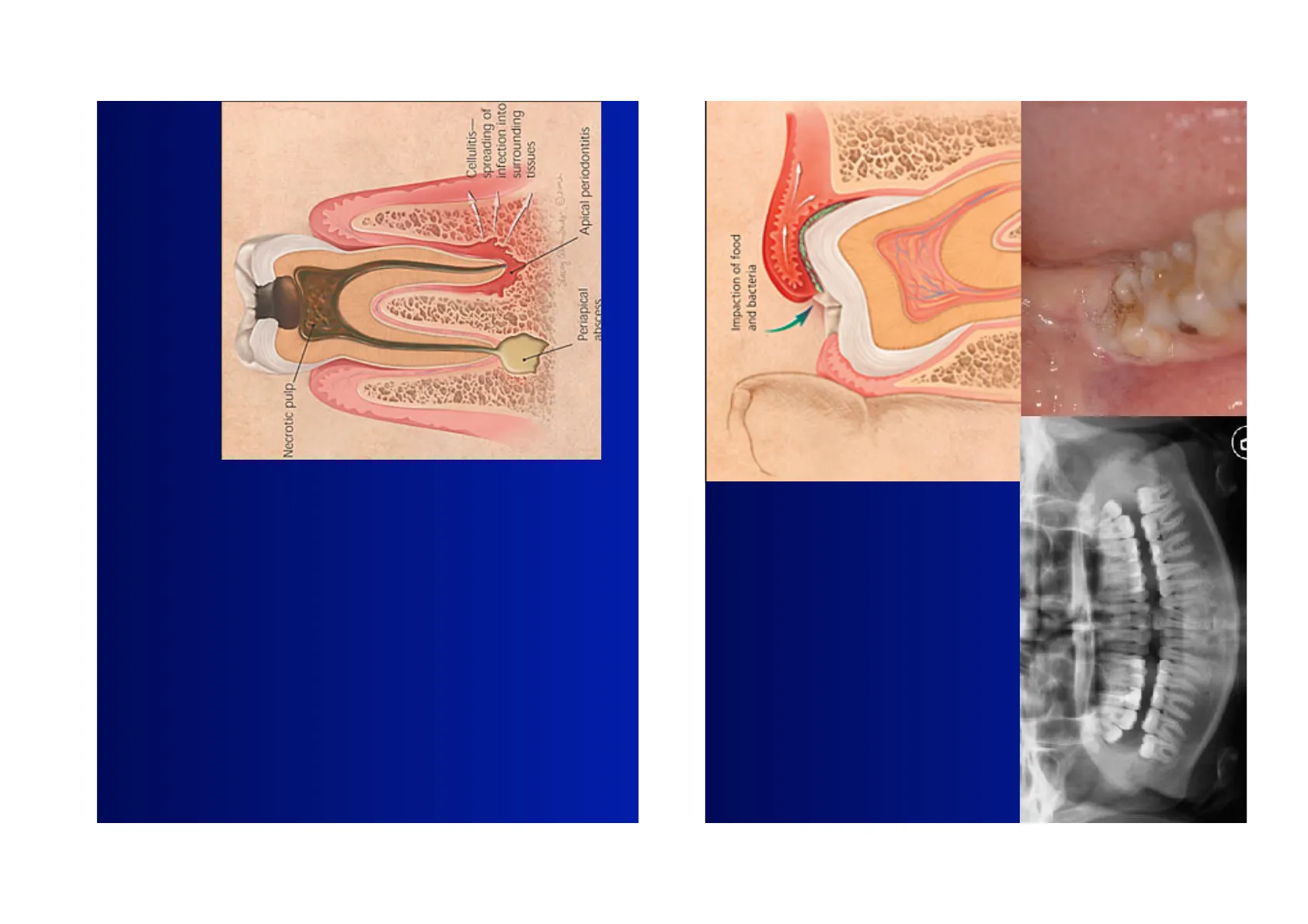
Necrotic pulp Cellulitis- spreading of infection into surrounding tissues Stacey Periapical abscess Apical periodontitis
Terzi Molari Parzialmente Eruiti
PARTIALLY ERUPTED THIRD MOLARS Impaction of food and bacteria · Food and bacteria impaction · Oral hygiene limited · Inflammation, pus formation and diffusionPARTIALLY ERUPTED THIRD MOLARS · RISK OF CARIES IN THE SECOND MOLAR !!! m PARTIALLY ERUPTED THIRD MOLARS · RISK OF CARIES IN THE SECOND MOLAR !!!
Ascesso Parodontale-Gengivale
CPERIODONTAL - GINGIVAL ABSCESS · Food and bacteria impaction · Plaque and calculus formation · Gingival and bone sockets · Inflammation, pus formation and diffusion
Infezione e Gonfiore
Infection inside tooth Abscess Swelling caused by abscess Nerve roots
Altre Cause di Ascesso Facciale Non Dentale
OTHER CAUSES NON DENTAL- RELATED OF FACIAL ABSCESS OSTEITIS OSTEONECROSIS MANDIBULAR FRACTURE
Ascessi e Flemmoni
Definizione di Ascesso
Abscess An abscess (from Latin: abscessus) or apostema, is a collection of purulent exudate that forms within a tissue of the body. Signs and symptoms include redness, pain, warmth, and swelling. The swelling may feel, when palpated, like it is filled with fluid. The area of redness often extends beyond the swelling. 9
Progressione dell'Ascesso
ABSCESSES and FLEGMONS Abscess Suppuration is caused by infection by microorganisms called pyogenic (streptococci or staphylococci). The abscess is characterized by a rapid and painful progression, with all the characteristics of inflammation: pain, heat, redness, swelling and functional limitation of the affected part. It is characterized by a central necrotic region rich in dead neutrophil leukocytes and necrotic tissue cells, around which there is an area of vital neutrophils. On the outside, the proliferation of fibroblasts and parenchymal cells, together with peripheral vasodilation, indicate the beginning of the repair processes. In fact, fibroblasts create over time a wall of connective tissue that will limit the spread of the infectious process. This is the pyogenic membrane, made up of collagen fibers produced by fibroblasts. 10
Definizione di Flemmone
ABSCESSES and FLEGMONS Flegmon A phlegmon (from the Greek φλεγμονή, "burning heat") is an uncircumscribed dispersion of pus or purulent exudate (formed by neutrophils, necrotic cells and liquids), which forms through a process of suppuration (infection) within a tissue or organ, which manages to overwhelm the immune defenses. 11
Differenze tra Ascesso e Flemmone
ABSCESSES and FLEGMONS Flegmon Unlike an abscess, it is poorly delimited by inflammatory tissue but has a tendency to spread into connective tissue. It is therefore characterized by a significant degree of tissue edema and hyperemia, an absence of a limiting inflammatory wall, and a paucity or absence of purulent tissue. 12
Diffusione del Flemmone
ABSCESSES and FLEGMONS Flegmon The bacteria responsible for the infection enter the body from the outside through small lesions of the integuments or from inside the body itself transported by the bloodstream. At the point where they stop and reproduce, an intense inflammatory process begins that spreads rapidly. The affected tissues are significantly affected and rapidly suffer worsening damage, accentuating the acute nature of the disease. This, due to its severity, does not allow the body to put in place the organic defenses capable of containing the spread of the infection, which will therefore show a tendency to conquer new tissues and to extend along the lymphatic vessels. 13
Vie di Diffusione di Ascessi e Flemmoni
ROUTE OF DIFFUSION abscesses and phlegmons Labbro superior: Franslo labiale aguriora Palio dux e pieghe palatine trasvase Palato molle Arco glossupalitino Arco fulagopaladino Tonsille salatire Ugola Fauci Lingua Condotti salivari Soutel me sale Sotomandibolare Gangiva Frenulo laziae inferior: Labbro inferiore 14 Frenulo delin linguaROUTE OF DIFFUSION abscesses and phlegmons atroflessione inviarvratila del fornice (parulidel care delle corona dentaria ergiera poloere bretta. n loaddes arvefarione mandibolare outicale mandibolare periodo Ixmalta periapicele con fivbvia Vlinderde ROUTE OF DIFFUSION abscesses and phlegmons Seno maxilar Sene mandar 16
Segni e Sintomi di Ascesso Oro-Facciale
SIGNS and SYMPTOMS of ORO - FACIAL ABSCESS . In some cases, a tooth abscess may perforate bone and start draining into the surrounding tissues creating local facial swelling. In some cases, the lymphnodes in the neck will become swollen and tender in response to the infection. • It may even feel like a migraine as the pain can transfer from the infected area. 9 2 1 7 10 3 4 8 6 5 11
Sintomi di Ascesso Dentale
- Toothache, dental pain
- Pain when chewing
- Sensitivity of the teeth to hot or cold
- Bitter taste in the mouth
- Bad breath
- Vomiting, Fever , Diarrhea
- Swollen glands of the neck
- General discomfort, uneasiness, or ill feeling
- Swollen area of the upper or lower jaw - a very serious symptom 1
Segni e Sintomi di Ascesso Dentale Cronico
SIGNS and SYMPTOMS of CHRONIC TOOTH ABSCESS · Intra - oral drainage · A chronic abscess may be painless but still have a swelling present on the gum and it is possible to observe pus drainage.• External drainage may begin as a boil which bursts allowing pus drainage from the abscess, intraorally (usually through the gum) or extra orally. · Chronic drainage will allow an epithelial lining to form in this communication to form a pus draining canal (fistula). Sometimes this type of drainage will immediately relieve some of the painful symptoms associated with the pressure. MEDICINA ONLINE
Fistulografia
FISTULOGRAPHY İ SOMETIMES THE FISTULAS SIMULATE NEOFORMATION IN THE GUM
Spazio Parafaringeo e Peritonsillare
Ascesso Parafaringeo o Retrofaringeo
PARAPHARINGEAL AND PERITONSILLAR SPACE > Parapharyngeal of retropharyngeal abscess . This results from infection of the peritubal cells due to acute coalescent mastoiditis.
Malattie delle Tonsille e della Gola
TONSILS AND THROAT DISEASES PERITONSILLAR ABSCESS HEALTHY THROAT PERITONSILLAR ABSCESS
Diffusione dell'Ascesso Peritonsillare
PARAPHARINGEAL AND PERITONSILLAR SPACE Tantiim and Area prestiloidea Area retrostiloidea Ascesso peritonsillare con diffusione mediastinica
Complicazioni Gravi
Angina di Ludwig
ATTENTION ! • Internal drainage is of more concern as growing infection makes space within the tissues surrounding the infection. Severe complications requiring immediate hospitalisation include Ludwig's angina, which is a combination of growing infection and cellulitis which closes the airway space causing suffocation in extreme cases.
Mediastinite
ATTENTION ! · Mediastinitis Also infection can spread down the tissue spaces to the mediastinum which has significant consequences on the vital organs such as the heart. --- Mediastinum Trachea Y Aorta Pulmonary Artery Lung Heart
Caso Clinico di Mediastinite
ATTENTION ! 32 year-old male patient had a tooth extraction which was complicated by right submandibular and deep neck space abscess which tracked to the mediastinum. The CT shows mediastinal gas and fluid (arrow), bilateral pleural effusions and pericardial effusion (yellow arrowheads). Acute mediastinitis is an infection of the mediastinum which is often fulminant and fatal. The majority result from oesophageal perforation (including from primary carcinoma, impacted foreign body, during endoscopy, or spontaneously after vomiting). Other rarer causes are direct extension from adjacent soft tissue spaces (eg retropharyngeal abscess) or as a complication of bronchoscopy. I rangverge MPI A DERIVED\SECONDARY COMPRESSED 512 512 n 100 mm KYP. 120 . 1 10-300 $.500 ET 512-512-240 Tramverse Pos:ITS Individually captured imagea H Plic ri VinH 3)
Ascesso Cerebrale
ATTENTION ! · Brain abscess, while extremely rare, is also a possibility.
Setticemia
ATTENTION ! · Another complication, usually from upper teeth, is a risk of septicaemia (infection of the blood), from connecting into blood vessels.
Sintomi di Sepsi
ATTENTION ! • Heart rate > 90 beats per minute (tachycardia) • Body temperature < 36 °℃ (97 ºF) or > 38 ℃ (100 °F) (hypothermia or fever) • Respiratory rate > 20 breaths per minute or, on blood gas, a PaCO2 less than 32 mm Hg (4.3 kPa) (tachypnea or hypocapnia due to hyperventilation) • White blood cell count < 4,000 cells/ mm3or > 12,000 cells/mm3 (leukopenia, leukocytosis) • Fever and leukocytosis are features of the acute-phase reaction, while tachycardia is often the initial sign of hemodynamic compromise. Tachypnea may be related to the increased metabolic stress due to infection and inflammation, but may also be a sign of inadequate perfusion resulting in the onset of anaerobic cellular metabolism. SEPSIS Rash (develops anywhere on body) Fever/vomiting Cold hands and feet/shivering Rapid breathing (or unusual breathing) Stomach/joint/ muscle pain Drowsy and less responsive/ vacant
Sintomi di Ascesso Peritonsillare
ATTENTION ! PERITONSILLAR ABSCESS · Progressively worsening unilateral sore throat and pain during swallowing usually are the earliest symptoms. • As the abscess develops, persistent redness, edema and pain in the peritonsillar area, fever, malaise, headache and a distortion of vowels informally known as "hot potato voice" may appear. Neck pain associated with tender, swollen lymph nodes, referred ear pain and halitosis are also common. • Limited ability to open the mouth (trismus). • The uvula may be displaced towards the unaffected side. Odynophagia (pain during swallowing), and ipsilateral earache also can occur. 1
Coinvolgimento del Seno Mascellare
ATTENTION ! INVOLVEMENT OF MAXILLARY SINUS Upper "antral" teeth : - first molar - second molar - third molar - pre molar - canine
Non hai trovato quello che cercavi?
Esplora altri argomenti nella Algor library o crea direttamente i tuoi materiali con l’AI.