Memory: Unit IV Long-term Memory, Universidad Europea Presentation
Slides from Universidad Europea about Memory: Unit IV Long-term Memory. The Pdf explores long-term memory, distinguishing between explicit and implicit memory, with examples of neuropsychological assessment and training techniques. The Pdf, suitable for University Psychology students, covers episodic and semantic memory, memory training strategies, and learning processes.
See more36 Pages


Unlock the full PDF for free
Sign up to get full access to the document and start transforming it with AI.
Preview
MEMORY:
Unit IV LONG-TERM MEMORY
Memory and Learning Processes
ue 2024/2025 David Prada Crespo
EPISODIC MEMORY
NEUROPSYCHOLOGICAL ASSESSMENT Examples
Verbal episodic memory (Immediate and delayed)
Word list test (Weschler Memory Scale; WMS) (ages: 18-89)
Logical memory (WMS) (ages: 18-89)
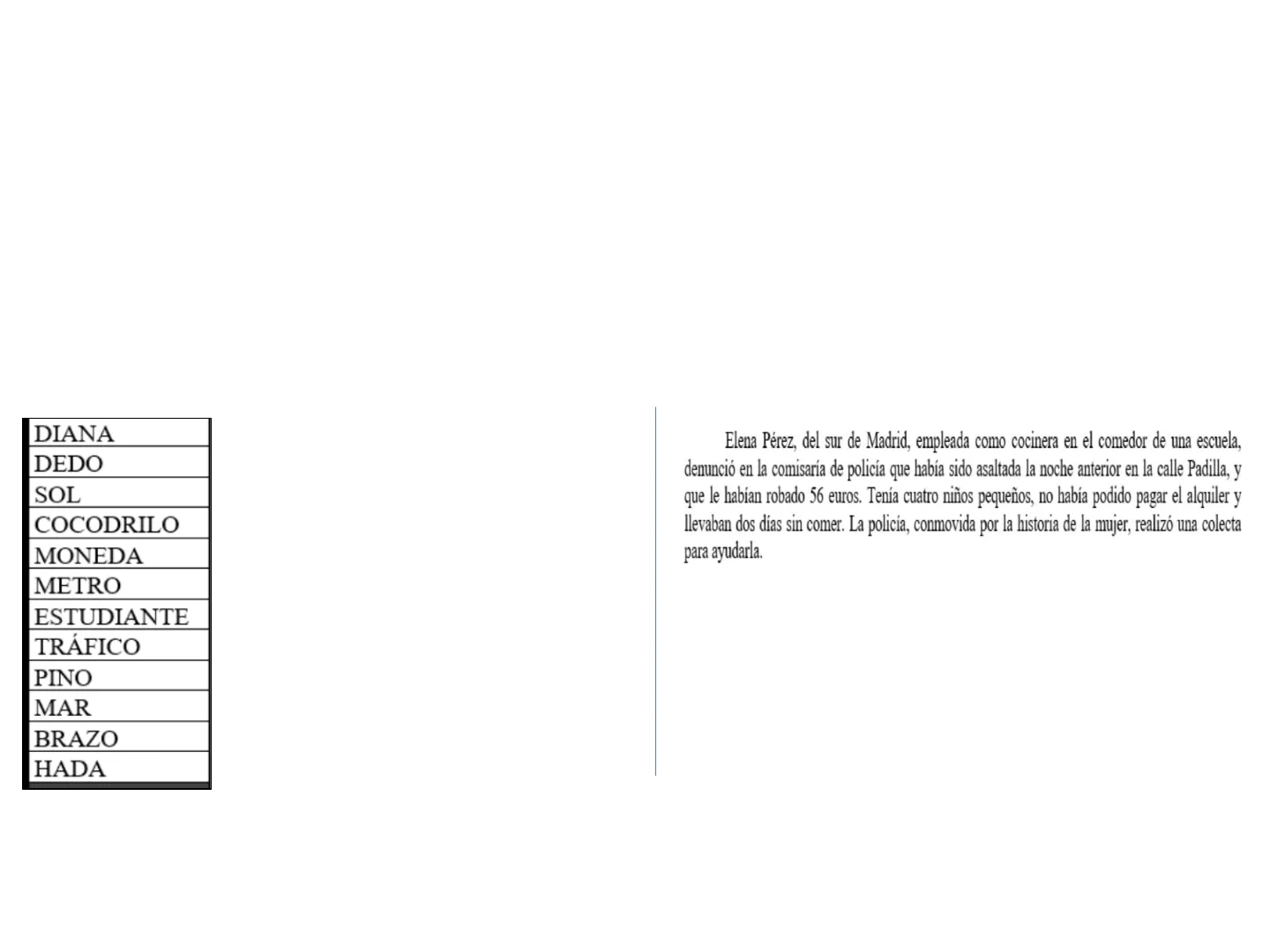
DIANA DEDO SOL COCODRILO MONEDA METRO ESTUDIANTE TRÁFICO PINO MAR BRAZO HADA
- Inmediate recall (4 learning trials)
- Delayed recall (a few minutes later)
- Delayed recall (30 minutes later)
- Recognition (30 minutes later)
Elena Pérez, del sur de Madrid, empleada como cocinera en el comedor de una escuela, denunció en la comisaría de policía que había sido asaltada la noche anterior en la calle Padilla, y que le habían robado 56 euros. Tenía cuatro niños pequeños, no había podido pagar el alquiler y llevaban dos días sin comer. La policía, conmovida por la historia de la mujer, realizó una colecta para ayudarla.
- Inmediate recall.
- Delayed recall (30 minutes later)
- Recognition (30 minutes later)
EPISODIC MEMORY NEUROPSYCHOLOGICAL ASSESSMENT
Examples Visual episodic memory (Immediate and delayed)
Rey test
Form A Form B
+
=
- Copy
- Delayed recall (3 minutes later)
- Delayed recall (30 minutes later)
Visual memory test (7 minutes test)
1 1
- Naming (dual encoding)
- Inmediate recall.
- Delayed recall (free recall -> recall with clues)
EPISODIC MEMORY HOTEL METAPHOR
Hotel Rooms People Main door Hotel reception retrieval
Information Sensory memory Working memory Long-term memory storage encoding
What type of encoding is more efficient in better storing the episodic information in the LTM?
Universidad Europea
MEMORY TRAINING
Addressing sensory problems
Training of attention, working memory ...
Enconding Information
SENSORY MEMORY
WORKING MEMORY
MEMORY INTERVENTION
Training of memory strategies and techniques
WORKING MEMORY
LONG- TERM MEMORY
Storage Retrieval
Training in recovery strategies
Universidad Europea
MEMORY TRAINING UMAM multifactorial memory training program.
MANUAL PRÁCTICO DE EVALUACIÓN Y ENTRENAMIENTO DE MEMORIA
Método UMAM de Memoria?
R Arbatnemiento de Xtaileit
- Stimulation of various cognitive processes (attention, perception, etc.).
- Training of various memory strategies (repetition, association, etc.) and technics (e.g., 3-R).
- Training in solving everyday forgetfulness.
Improvement of metamemory.
Universidad Europea
MEMORY TRAINING
ue
STRATEGIES
Cognitive operations we use to improve the encoding, storage and retrieval of information.
TECHNIQUES
Complex and specific procedures applied to particular materials. They usually involve several strategies.
Intuitive Spontaneus Structured More complex
MEMORY TRAINING
ue
STRATEGIES
Repetition Visualization Dual encoding (visual + verbal) Categorization Association ...
"I'm closing the main door."
L
TECHNIQUES
Unidad de Memoria. Ayuntamiento de Madrid
MAXIMO BUENO MARIA VALIENTE JESUS ALPINO LEON ESPINO
Adaptado de Tony Buzan, 1991
Paying attention to the name Repeating the name Associating the name with someone you know Associating the name with a person's characteristic (physical or psychological) * Associating the name with a particular meaning
ROBERTO CARLOS
LONG-TERM MEMORY
Long-term memory
Explicit memory (declarative)
Implicit memory (non- declarative)
Semantic memory
Episodic memory
Universidad Europea
SEMANTIC MEMORY
Answer the following questions
- What is the capital of Italy?
- Who is the British Prime Minister?
- What important European city is gone through the river Seine?
- What does a psychologist do?
- Is the cat a mammal?
- Is Turmote an English word?
- Is Villaviciosa de Odón located at the north of Madrid?
- What is the sequence of events that happen when you go to the hairdresser or when you go to a restaurant for dinner?
Universidad Europea
SEMANTIC MEMORY
General knowledge of the world - "Mental Encyclopedia" (Tulving)
- The general knowledge about things that can be expressed by words or other behaviors (e.g., drawing) (intact in H.M .! ).
- Information without spatial and temporal components.
. The information retrieval is also conscious and intentional (mainly verbal information).
- Semantic information: "semantized" episodic information.
- Semantic memory is less vulnerable to interferences: it is not so linked to emotional elements as episodic memory.
- It is also less vulnerable to neurological conditions.
Universidad Europea
SEMANTIC MEMORY
General knowledge of the world - "Mental Encyclopedia" (Tulving)
- Information is organized precisely, allowing fast and effective recall (e.g., cats, dogs, and monkeys ... are mammals; eagles and hawks ... are birds) > allows us to understand and adapt to the world efficiently.
- Semantic memory goes beyond words and their meaning. It extends to sensory attributes such as taste and color and general knowledge of how society works (e.g., how to behave in a supermarket ... ).
Small knowledge units combine to create complex structures (NETWORKS): language, concepts and schemes.
- This information and structure change with learning (creation and connection of new semantic networks).
Universidad Europea
SEMANTIC MEMORY
General knowledge of the world - "Mental Encyclopedia" (Tulving)
DOG BED .?
- Semantic dementia (progressive alteration of the semantic system): The patient has an impaired comprehension of the meaning of stimuli (words, objects, signs, situations, norms, etc.). > On the contrary, they can store and retrieve episodic information (e.g., they can remember if you visited him yesterday).
Atrophy of medial and lateral areas of the temporal lobe.
Universidad Europea
SEMANTIC MEMORY
General kp (Tulving
Clinical case:
- 64 old Personnel Manager.
• Sem syste
- He started to experience symptoms such as not understanding traffic signs (e.g., sometimes not respecting the stop sign).
The com stim situa
- Over time, he lost understanding of more stimuli (e.g., not understanding how clothes are worn, not understanding that the sleeve goes on the arm, etc.).
> On t retrie they can yesterday).
ue tic ateral x lobe.
Universidad Europea
SEMANTIC MEMORY
Semantic memory structure: Concepts
CONCEPTS
"DOG"
- Smallest unit of knowledge (generally corresponding to individual words).
- They are abstract mental representations.
- Represent different elements with similar characteristics: German Shepherd; Springer Spaniel, Collie ...
- Can be organized into hierarchies: - superordinate level (e.g., four-footed animal), (TOP LEVEL) - a basic level (e.g., dog), (INTERMEDIATE LEVEL) - subordinate level (e.g., collie). (BOTTOM LEVEL)
Universidad Europea
SEMANTIC MEMORY
Semantic memory structure: Concepts
Semantic information is organized in the LTM: concepts are represented in memory as independent but related units.
has skin can
Superordinate level Animal
O eat breathes
has fins
Bird
has wings can fly has feathers
F
Basic level
has thin, long legs
can - hita
is pink
Canary O
Ostrich
is tall can't fly
Shark
Subordinate level
is yellow IJ dangerous upriver to lay eggs
Hierarchical model of semantic networks (Collins y Quilliam):
- Concepts are related, forming a "network structure." There are more general and more specific concepts (animal > bird > canary).
can sing
- The further apart the concepts are, the longer it takes to make a specific statement (e.g., is a canary an animal? 5" / is a canary a bird? 2").
Universidad Europea
SEMANTIC MEMORY
Semantic memory structure: Concepts
Semantic information is organized in the LTM: concepts are represented in memory as independent but related units.
Street Vehicle Car Bus Truck Ambulance Fire engine
House
Change
Fire
Yellow
Red
Apples
Green
Cherries
Pears
Violets
Roses
Flowers
Sunsets Sunrises Clouds
Spreading activation theory (Collins and Loftus, 1975; abandons the idea of "hierarchy"):
- Concepts are related but not necessarily hierarchically.
- Th activation of one concept propagates through the network, activating other concepts (activation spreads among semantically related concepts).
- Age: Brain deterioration (e.g., of the white matter) makes the propagation of activation between concepts more inefficient and slower ("naming difficulties").
ue
SEMANTIC MEMORY
Semantic memory structure: Schemas
SCHEMAS
"DOG"
- A schema is a well-integrated chunk of knowledge about the world, events, people, or actions. (Bartlett). They serve to infer information we do not know.
- Most human schemas developed out of participation in various social groups.
- Schemas are socio-cultural and context specific (e.g .: What do dogs do? How they behave? How do I interact with them?).
> Some types of schemas:
- Scripts: A schema relating to the typical sequences of events in various common situations (e.g., having a meal in a restaurant).
- Frame: A type of schema in which information about objects and their properties is stored (e.g., Dogs: have four feet; could be brown, grey ... ).
- Stereotypes: generalizations about various groups (e.g., people from Spain are ... ).
Universidad Europea
SEMANTIC MEMORY
ue
Semantic memory structure: Schemas
Example of a schema: going to a restaurant.
m "We expect the waiter to ask if we have a table reserved, to accompany us to a table, to bring the menu and ask if we want to have some aperitif. We choose from the menu what we are going to eat, we order it and the waiter takes note. He/she serves the dishes we have ordered. When we finish dinner, we ask for the bill, we pay, we ask for our coat and we left".
> All this knowledge and successive actions related to the layout of a "restaurant" are contained in our semantic memory.
Universidad Europea
SEMANTIC MEMORY
Semantic memory structure: Schemas
Imagine that one day you come home from university, open the door and find everything in a mess.
Immediately, your scheme of the situation will be activated, leading to infer that someone entered your house while you were at the university. The scheme of "theft" contained in your semantic memory also makes you immediately call the police by phone, wait until the police arrive, and look for the insurance company's telephone number.
> Schemas and scripts: they help us to form expectations about what we can expect in a given situation, and filling the gaps when information is missing.
Universidad Europea
Can’t find what you’re looking for?
Explore more topics in the Algor library or create your own materials with AI.
