The World War I and the Russian Revolution, High school History Presentation
Slides from High school about The World War I and the Russian Revolution. The Pdf explores the causes of the conflict, life in the trenches, and the demographic, economic, and social consequences, enriched with maps and graphs for History students.
See more17 Pages

Unlock the full PDF for free
Sign up to get full access to the document and start transforming it with AI.
Preview
Causes of the Great War
Rivalry among empires
After 1870, due to the nationalist impulse, a series of
clashes were maintained between the different
European powers for hegemony, in a climate of "armed
peace" that announced the imminence of a military
conflict.
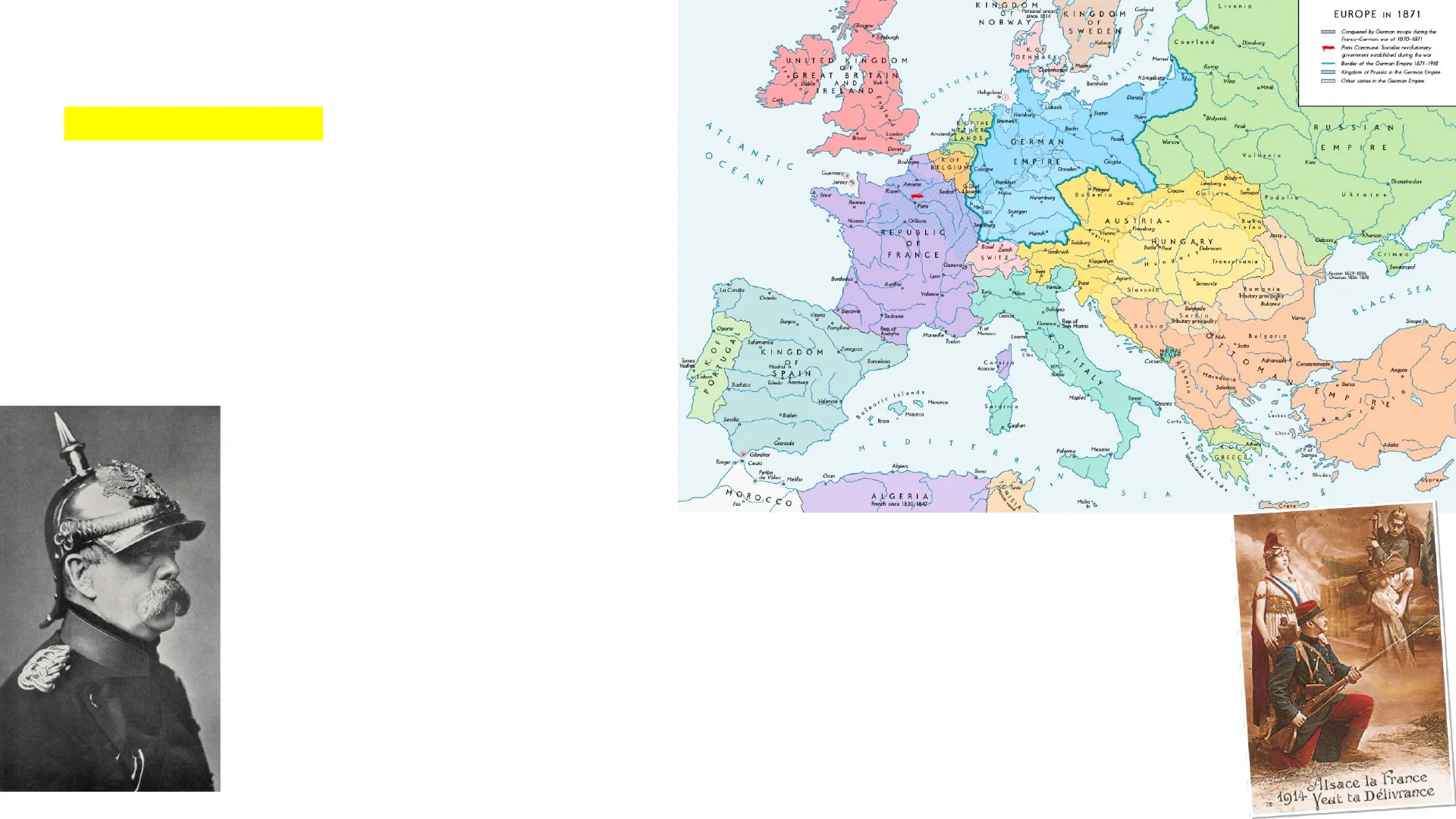
- Clashes with Bismarck's Germany:
- After the Franco-Prussian War, the
regions of Alsace and Lorraine were
incorporated to Germany (1871). - Germany is a newly created state, so
arrived late in the colonial race. He
considered the division of the Berlin
Conference unfair and clashed with
France over the possession of
Morocco. - There was also a strong rivalry
between the United Kingdom and
Germany over political and economic
control of Europe and its trade
routes.
Europe in 1871
KINGDOM
Livonia
Personal union
Gotland
since 1814
KINGDOM
NORWAY
0
Riga
Echteburgh
Conquered by German troops during the
Franco-German war of 1870-1871
UNIT
KINGDOM
Memel 6
Border of the German Empire 1871-1918
GRE
BR
TTAU
N
Diblin
ND
York
RE
AND
Heligoland
Danzig
P Lübeck
Hamburg
Thẩm
Białystok
OFTHE
Pinsk
RUSS
Bristol
GERMAN
Warsaw
EMP
RE
Boulogne
EMPIRE
Glog
Kiev
BELGIUMCologne
" Dresden"
Guernsey
Jersey
Amiens
G.D.p
Sedan
Main
Prague
Bohemia
Čracow
Tarnopol
Ukraine
Olmütz
Per
1871
Stuttgart
Nantes
Orléans
Strasburg
AUSTRIA -
Pressburg
Buko
vind
REPUBLIC
Munich
Jassy a
Kherson SI
Salzburg
Buda % Pest
Debrecen
FRANCE
SWITZ
Klagenfurt
Transylvania
Geneva's
Sevastopol
Lyon
Agronì
Ternesvår
La Coruña
Slavonia
Romania
Tributary principality
Oviedo
Bukarest
La Vitoria
Toulouse
Burgos
.
Pamplona
Rep. of
P.of
.. Andorra
Monaco
Livorno
Nish
Bulgaria
Salamanca
Toulon
@ Sofia
KINGDOM
Cantar?
Constantinople
Angora
Lisbon
.
Toledo Aranjuez
Bursa
Valencia a
Menorca
Pranto
Majorca
L'erbo
Sevilla
Ibiza
Certo RS
6
Gagliar
Granada
E
D
1
T
E
Gibraltar
Samos
Tanger
Couto
Algiers
Peron
Oran
N
Rhodes
Tunis
S
E
A
Fes
ALGERIA
French since 1830,4847
Oroman vassal
TUNISIA
Malta"&
Alsace la France
1914 Veut ta Délivrance
Otto von Bismarck
518 /R Glasgow
SWEDEN
Kalmar
Courland
Dunaburg
K. O.F
Paris Commune: Socialist revolutionary
government established during the war
Kovno
openhoger
0
Königsberg
Thất
Ving
Other states in the German Empire
· Minsk
Cork
England
Bremen&
Berlin
London
Amstord Eat HJE RE
LANDS
Pose
Doverg
Volhynia
Brody .
Frankfurt
Lemberg o
Ekaterinoslav
Brest
Rouen
Galleta
Podolia
Rennes
Nuremberg
Vienna
Austria
HUNGARY
Odessa
Basel
Zurich
Innsbruck
Crimea
Russian 1829-1856
Omroman 1856-1878
Bordeaux
Aurillac
Verice
Valence %
· Bayonne
· Bologna
Belgrade
Serbia
hbutary principality
Varna
Rep.of
Florence e San Marino
Boshig
OF
Zaragoza
Torres
Barcelona
Corsica
Vedras
Madrid a
Ajaccio
M
SPAIN
Macedonia
Badajoz
Salonica
Naples
Taren
P
R
· Bailer
Chio
M
R
Palermo
lonion
Asher
Adala
Messina
AP of
GREECE
A
Bona
de Velez Melilla
1864 to Greece
Islos
BYprus"
8
MOROCCO
Kingdom of Prussia in the German Empire
A
Bornholm
BALTIC
SEA
DENMARK
Main
NORTHSEA
ATLANTIC
OCEAN
BLACK SEA
Sinope
Oporto
Marseille VA
K.
RTUG
Islands
M
Balearic
Sardinha
K. OF ITALY
O
TThe formation of rival alliances
- As the conflict approaches, the powers will establish a series of alliances:
- Germany, Austria-Hungary and Italy signed the Triple Alliance (1882).
- France allied with Russia and the UK in the Triple Entente (1907).
- Rising tensions caused an arms race. Countries spent a lot of money on making
weapons, building warships and training troops. At the beginning of the 20th century,
everyone was preparing for war and any incident could trigger the conflict.
Military Alliances and Spending
UNITED
KINGDOM
1907
RUSSIA
1904
GERMANY 1892
1879
FRANCE
1882
1882
AUSTRIA-
HUNGARY
ITALY
Triple Alliance (1882)
Triple Entente (1907)
1907 military agreements
EVOLUTION OF SPENDING ON ARMS*
Countries
1905
1914
France
854
1 286
Russia
1063
1 834
Germany
938
3 244
United Kingdom
1 257
1 640
Austria-Hungary
555
740
*In millions of marks
Balkan Conflicts
Serbia
Bulgaria
Greece
The Dodecanese
(Italian occupation
from 1912)
Montenegro
Albania
ceded to Bulgaria
by Romania
borders in 1919
A focal point of conflicts: Balkans
Budapest ·
AUSTRO - HUNGARIAN
EMPIRE
ROMANIA
BOSNIA
(annexed
in 1908).
Sarajevo
Bucharest
Belgrade
SERBIA
BULGARIA
MONTENEGRO
·Sofia
Constantinople
(Istanbul)
ALBANIA
(independent
in 1913)
Thessaloniki
OTTOMAN
Ottoman Empire
in 1912
GREECE
EMPIRE
OTTOMAN EMPIRE
TERRITORIES TAKEN BY:
Athens
Crete
- Since the end of the 19th century, the
Balkan part of the Turkish Empire has
been breaking down due to the nationalist
aspirations of different territories such as
Serbia, Bulgaria, Bosnia and Albania,
where independent countries are
emerging. - Austria-Hungary wanted to gain power in
the Balkans. However, Serbia and Russia
also wanted to increase their influence in
the region. - Tensions increased with the annexation of
Bosnia-Herzegovina by Austria-Hungary
(1908), which resulted in two Balkan
wars (1912 and 1913).The outbreak of the war
War started after the assassination of Archduke Franz Ferdinand, heir to the Austrian crown, in Sarajevo
(Bosnia), in June 1914.
Austria accused Serbia of the assassination and declared war. Russia then declared war on Austria to
protect Serbia. Germany, an ally of Austria, declared war on Russia and France. When the German army
invaded Belgium, a neutral country, the United Kingdom declared war on Austria and Germany. Only Italy
remained neutral.
Within a few weeks, the Austro-Serb confrontation had become a European war.
Timeline of War Declarations
28 June 1914
assassination in Sarajevo
war (the country that declares
war appears first)
23 July
Austro-Hungarian ultimatum to Serbia
30 July< />Russian mobilisation
Austria-Hungary - Serbia
(28 July)
31 July
German ultimatum
to Russia and France
Germany - Russia
(1 August)
Germany - France
(3 August)
German mobilisation
French mobilisation
beginning
of August
United Kingdom - Germany
(4 August)
invasion of Belgium
Germany - Serbia
(5 August)POTENCIAS
CENTRALES
(Triple alianza)
Alemania y Austria Hungria (Italia neutral)
Luego se unen Turquía (1914) y Bulgaria (1915
Tienen más población, más ejército, poder naval aunque territorios
dispersos
ALIADOS
(Triple Entente)
Francia, Inglaterra, Rusia + Serbia + Bélgica
Luego Japón (para conseguir zonas de Asia), Italia (para territorios de
Austria), Rumania, Portugal (1916), Grecia y EE.UU. (1917)
Menos población, menos ejército, más cohesionados aunque con dos
frentes abiertos con Alemania.
Characteristics of the Great War
Social Aspects
- Big recruitment due to the nationalist propaganda
A quick end was expected and enlistments were massive. - Integration of women into the workforce
With men in the front, it is necessary to integrate women into the
workforce in munitions factories, in hospitals and driving trams. By
the end of the war, women made up 35% of the industrial workforce
in Germany and Great Britain.
Their access to the world of work was an important step in the fight
for women's rights.
Your Chums are Fighting
Why aren't YOU?
War Stages
WAR OF MOVEMENT
TRENCH WARFARE
FINAL STAGE
1914
1915
1916
1917
1918
1ª battle of the Marne
Bulgaria
joins the war
Battle
of the Somme
USA joins the war
Battle of Tannenberg
Assassination in Sarajevo.
Start of the war (June)
Italy
joins the war
Romania
joins the war
Battle
of Verdun
February Revolution
in Russia
October Revolution
in Russia
Treaty
of Brost-Litovsk
with Russia
Armistico
(November)
2. The development of the Great War
Combatants and Alliances
- The Central Empires (Germany and Austria-Hungary) were joined by the
Turkish Empire and Bulgaria - The Triple Entente (France, the United Kingdom and Russia) with its allies
Serbia and Belgium were joined by Italy, Romania, Greece, the United States,
China and Japan.
World War 1, Explained in 5 Minutes!
https://www.youtube.com/watch?v =- GsolnXOiBg
Daddy, what did YOU do in the Great War
CRISIS
2ªd battle
of the Marne>
Economic and Technical Aspects
ECONOMICS
· Economy of war
Countries repurposed their industries to
manufacture weapons
· Hunger and rationing
Ration cards were imposed to diminish hunger (a
daily ration of food for each person according to
their age or activity).
TECHNICAL
· New weapons
Technological advances will be used in the arms
race, producing very deadly weapons.
Cannons and machine guns were manufactured,
the first tanks and airplanes were used, towns
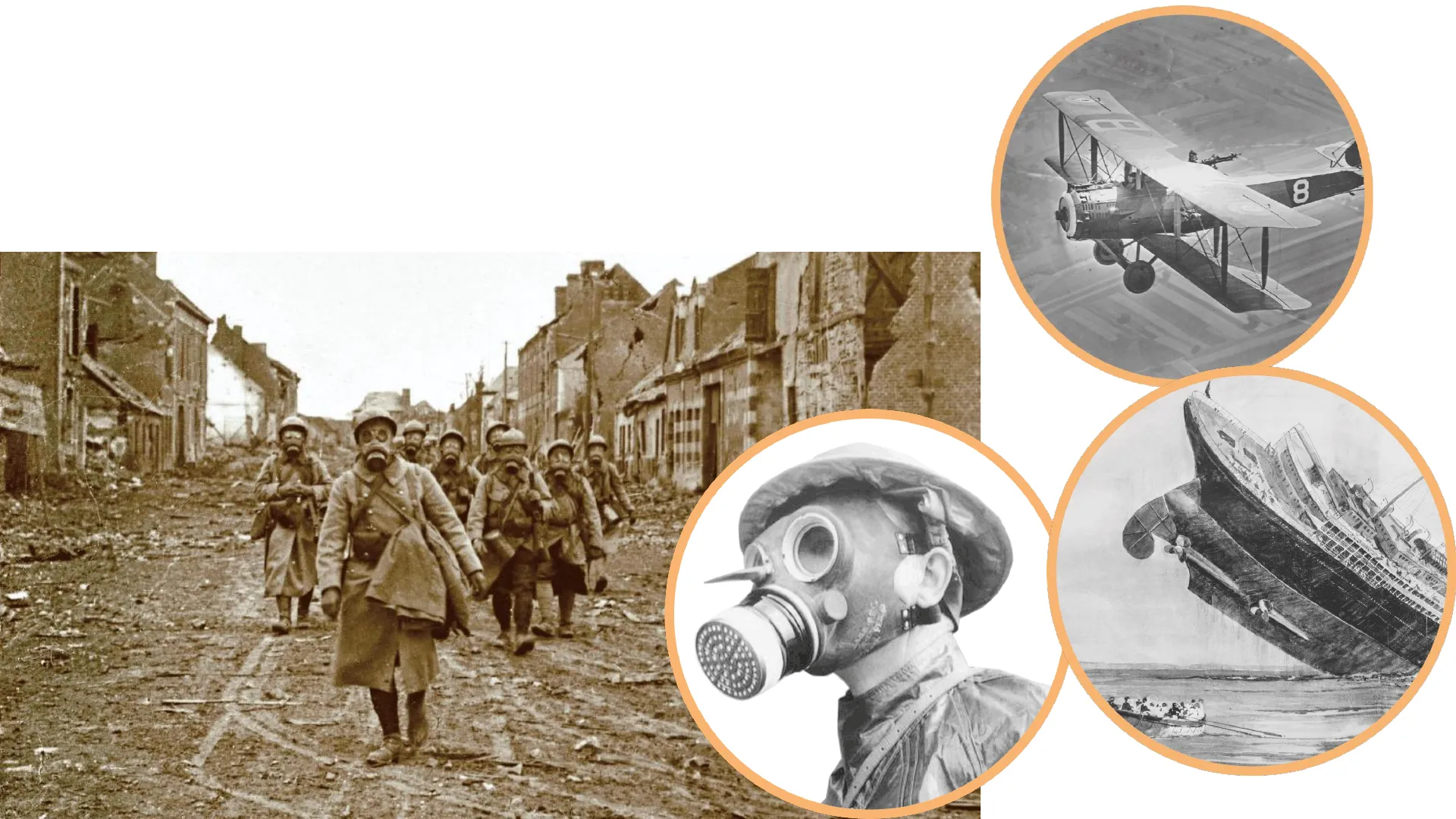
and cities were bombed and gases were used,
which spread terror among the contenders.
Act. 1. Do you believe that in war it is legal to
use all types of weapons?
Should the use and manufacture of weapons be
regulated?
16. DESARROLLO DE LA GRAN GUERRA
Map of the Great War
NORUEGA
San Petersburgo
Imperios centrales en 1914
Oslo.
. Estocolmo
Paises alineados
SUECIA
con los imperios centrales
durante la guerra
Aliados en 1914
Jutlandia
DINAMARCA
RUSIA
Estados neutrales
REINO UNIDO
Lineas del frente (1917)
Tannenberg
PAÍSES
BAJOS
· Là Haya
· Berlin
.....
Bloqueo naval a Alemania
(1916)
Londres .
Brest-Litovsk
BÉLGICA
Zona de guerra submarina
Somme yk . Bruselas
Principales batallas
Verdun
Marne Y
Paris .
AUSTRIA - HUNGRÍA
·
Viena
· Budapest
SUIZA
Caporetto
FRANCIA
Belgrado
· Bucarest
Mar Negro
BULGARIA
SERBIA
· Sofía
Estambul
MONTENEGRO
Córcega
ALBANIA
Galipoli
Lisboa.
Salónica
Sardinha
GRECIA
Baleares
.
Atenas
Tánger ·· Ceuta
Sicilia
Canarias
MARRUECOS .Melilla
ESPAÑOL
ARGELIA
(Fr)
TÚNEZ
(Fr.)
Mediterráneo
· Creta
IMPERIO
OTOMANO
ESPAÑA
PORTUGAL
· Roma
-
Ofensivas de los imperios
centrales
-
Ofensivas victoriosas
de los aliados (1918)
OCÉANO
.....
Linea de la Paz
de Brest-Litovsk
ATLÁNTICO
Paises alineados con los
aliados durante la guerra
Mar
del
Norte
Copenhague
Territorios conquistados
por los imperios centrales
ALEMANIA
RUMANIA
ITALIA
· Madrid
Chipre
MaxPeriods of the Great War
- The war of movement (1914). Germany attacked on France through Belgium and expected France to surrender
quickly (Schlieffen Plan). However, France managed to stop the German advance at the Battle of the Marne. On
the Eastern Front, Germany defeated Russia at the Battle of Tannenberg, - Trench warfare (1914-1917). After the Battle of the Marne, the fronts became immobile with thousands of diseases.
Trenches were built to prevent the enemy from advancing. In addition, new powers entered the war: Turkey (1914),
Italy and Bulgaria (1915), and Romania (1916).
In 1916, the Germans launched a new offensive on the Western Front, but they were stopped by the French at
the Battle of Verdun. In July, the British and French attacked the German lines (Battle of the Somme), with little
success. - The decisive year: 1917. The outbreak of the Bolshevik Revolution marked Russia's retreat from the conflict.
However the decisive event was the entry of the United States into the war in favour of the allies. - The end of the war (1918). Germans signed peace with Russia in 1918 through the Treaty of Brest-Litovsk, resulting
in the loss of a good part of Russian territory. Thanks to American help, the central empires surrendered: first Turkey,
then Austria and finally Germany, with the abdication of Kaiser Wilhelm II. On November 11, 1918, the armistice was
signed between Germany and the allies, ending the war.
Key Events and Stages
WAR OF MOVEMENT
TRENCH WARFARE
FINAL STAGE
1914
1915
1916
1917
1918
1ª battle of the Marne
Bulgaria
joins the war
Battle
of the Somme
USA joins the war
2ªd battle
of the Marne
Battle of Tannenberg
Assassination in Sarajevo.
Start of the war (June)
Italy
joins the war
Romania
joins the war
Battle
of Verdun
February Revolution
in Russia
October Revolution
in Russia
Treaty
of Brost-Litovsk
with Russia
Armistice
(November)
CRISIS
Can’t find what you’re looking for?
Explore more topics in the Algor library or create your own materials with AI.
