Obstructive Sleep Apnea Syndrome: Terminology, Diagnosis, and Treatments
Slides about Obstructive Sleep Apnea. The Pdf, suitable for university students, explores the terminology, diagnosis, and various treatment options for sleep apnea, including CPAP and surgical interventions, as detailed in the outline.
See more19 Pages


Unlock the full PDF for free
Sign up to get full access to the document and start transforming it with AI.
Preview
Sleep Apnea: A Silent Pandemic
Sometimes the patient who suffers from sleep apnea generally does not recognize they are affected by this pathology. More frequently the partner refers to the doctor saying their partner has difficulties breathing during the night and snoring. Also in this case, as we have seen for other respiratory diseases, the first suspect is generally an element starting from the morphology and what the partner generally refers to. An overview of some elements describing sleep apnea: they are 4 pivotal concepts.
- Common
- Dangerous
- Easily recognized
- Treatable
Terminology
We use a particular type of terminology and we should familiarize with some terms like:
- Apnea
- Hypopnea
- Sleep disordered breathing (SDB)
- Obstructive sleep apnea syndrome (OSAS)
- Central sleep apnea syndrome (CSAS)
- Primary snoring
From a simplistic point of view, primary snoring represents the first level of snoring, then we can go on with sleep-disordered breathing, which is a vast class of disorders that affects patients during the night, and then Obstructive sleep apnea syndrome which could be recognized preferentially as obstructive, and I will give you the elements to recognize it from Central sleep apnea syndrome. Two different words are linked by the "sleep apnea syndrome".
Sleep Disordered Breathing (SDB)
SDB represents an umbrella term linked to a constellation of sleep-related disorders, abnormalities of respiration during sleep, which do not meet the criteria for obstructive sleep apnea, central sleep apnea, and other well-defined sleep disorders.
Obstructive Sleep Apnea (OSA) Syndrome
OSAS represents a condition in which we can recognize from polysomnography -which is the gold standard to recognize the syndrome- more than 5 obstructive respiratory events per hour, producing one or more of the following conditions:
- The patient complains of sleepiness, non-restorative sleep, fatigue, insomnia during the day
Page 2 of 22
- The patient wakes up with breath-holding, gasping, or choking during the night
. The bed partner observes breathing interruption, habitual snoring or both
- The patient has developed, without any other reason, deterioration of air status according to hypertension, mood disorder, cognitive dysfunction, coronary artery disease, stroke, congestive heart failure, atrial fibrillation, and type 2 diabetes.
OSA can be the starting point of many other organic problems. If the subject presents these factors, it's enough to recognize 5 or more obstructive respiratory events per hour. Without any other factors, we should demonstrate more than 15 obstructive respiratory events per hour.
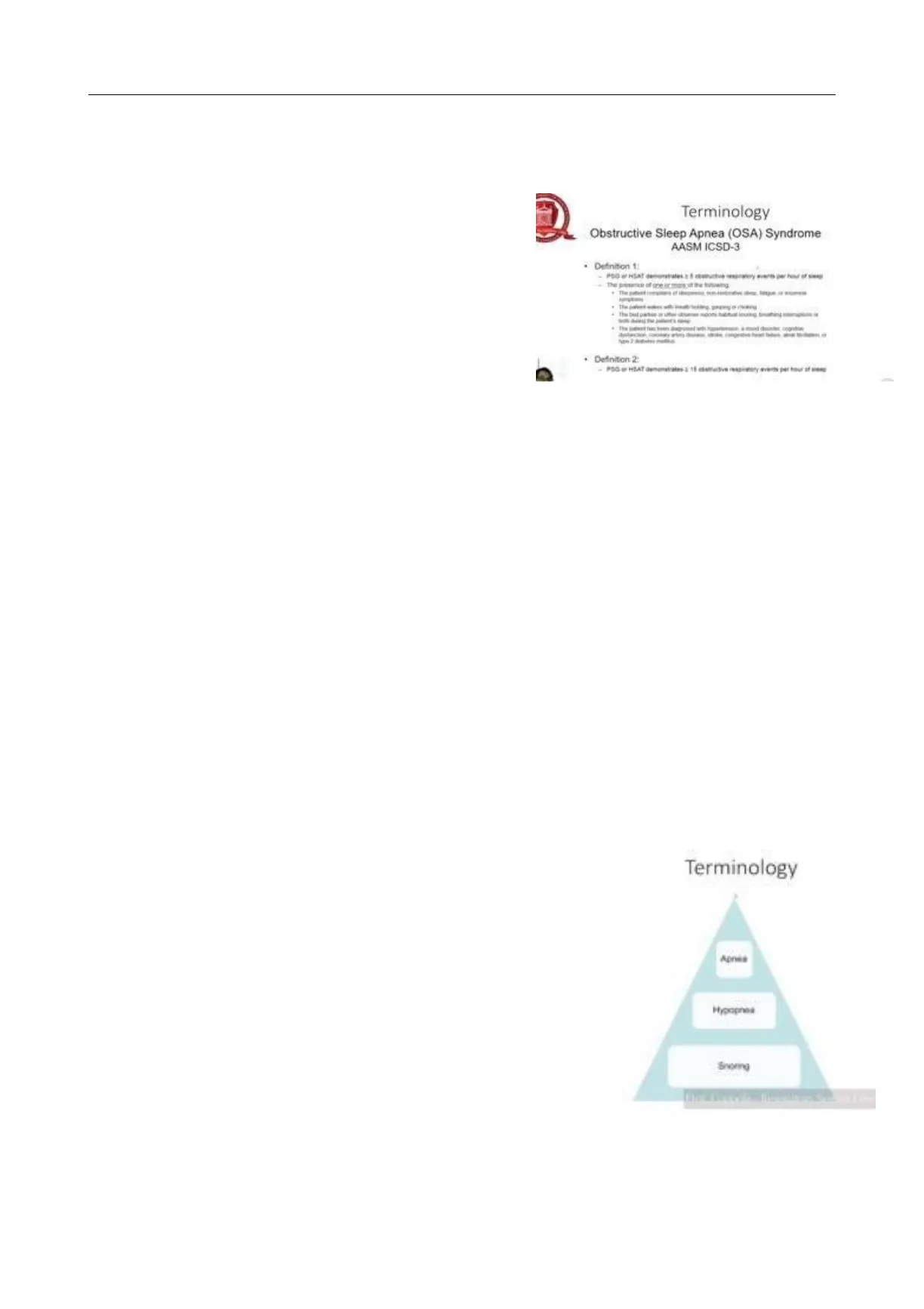
Obstructive Sleep Apnea Syndrome Terminology
AASM ICSD-3
- Definition 1: The presence of one ec mogng at the hurtwing
- Definition 2: Now we have to check what all of this tells us and familiarize ourselves with it.
Central Sleep Apnea (CSA) Syndromes
The other side of the coin is central sleep apnea, which is a collection of disorders characterized by an alteration in the central regulation of breathing during sleep. We will see Cheyne-Stokes respiration, CSA due to medical disorders, for example, neurological symptoms, CSA due to high altitude, in the mountains for example, and you must pay attention to CSA due to medication or substances, hypnotic drugs that people sometimes take without any medical control because they have issues falling asleep and end up abusing these drugs, which deteriorate their sleep. The difference between obstructive sleep apnea and central sleep apnea, which belongs to two completely different pathophysiological mechanisms, lies in the demonstration of Obstructive sleep apnea and the presence of obstructive apnea during sleep, while CSA presents central apnea during sleep.
Primary Snoring
Different is the concept of primary snoring, which is the basal condition, generally. Primary snoring sometimes is almost a joke, for example when your grandparents snore while sleeping, but the primary snoring represents the first step to enter the door of Sleep Apnea syndromes. Pay attention for example to the intensity of snoring that can vary, it can disturb for example the bed partners, but the variation of snoring could be the first element to produce apnea. Snoring without daytime sleepiness/fatigue or evidence of OSA is called primary snoring. Even when primary snoring produces any kind of symptoms we must investigate further. This is the pyramid of sleep-breathing disorders. We have a number of patients affected by snoring. Snoring is the basal event disturbing sleep breathing, then hypopnea, which is an event a little less severe than apnea which is the concept of complete obstruction during breathing. Generally, when we find apnea we find more hypopnea than snoring, thus the pyramid.
Agnes Hypopnos Snoring
Page 3 of 22
Snoring Characteristics
Snoring in the polysomnogram is a respiratory sound generated in the upper airway that typically occurs during the inspiration but may occur also during expiration according to the basal condition of the patient. Now with the polysomnogram result, we can interpret the curve and imagine what the patient suffers during their sleep. It is the cardinal symptom of OSAS and snoring without daytime sleepiness or fatigue is called primary snoring. So, when we have a patient who refers snoring, first of all, we must ask them whether he has any kind of symptoms related to loss of sleep during daytime.
- A respiratory sound generated in the upper airway that typically occurs during in expiration.
- Cardinal symptoms of OS.A
- Seong without daytre aluipiness/fatigue or evidence of OSA is oxied primary snoring
No clear standardized definitions of snoring
Definitions
Apnea is a drop in peak signal excursion by more than 90% of the pre-event baseline for at least 10 seconds. Daytime apnea is something like that. This event could be registered in the breathing of a patient during the night more than 15 times per hour. If you have no co-morbidity or conditions or more than 5 per hour if you have any other kind of complications or predisposing factors. No requirement for desaturation or arousal. This stop in breathing can be connected to additional elements.
Apnea Subtypes
We recognize Central Apnea which is the absence of inspiratory effort throughout the entire period of absent airflow, so the criteria of apnea remain the same, but this is the flux channel in which I can check the drop of flux to recognize a central apnea I move to the channel of thoracic and abdominal movement and when I check for the absence of flow I go to check the presence of effort at the level of the thoracic and abdominal channel. In central apnea, I recognize the drop of flow and absence of effort at the level of the thorax and abdominal channel. It means that in central apnea basically, the subject stops breathing. Central apnea means that the stop in breathing derives from the central regulation of breathing. In Obstructive Apnea instead, it is recognized the same checking at the level of flux, I see a drop of flux, but when I check thoracic and abdominal channel, I see the effort. So in obstructive apnea, I see a stop in the flux but I can check the effort of the thorax and abdomen which tries to overcome the obstruction generally at the level of upper airways. This kind of apnea generally restarts in breathing with explosive inspiration. It is a classic because the effort of the abdomen and thorax overcomes the obstruction and restarts the breathing. Mixed apnea represents A sort of mixed-signal in which the absence in the initial portion of the event of respiratory effort, is followed by a resumption in respiratory effort in the second part.
Page 4 of 22
Mixed Apnea Characteristics
Starts as a central apnea and then became an obstructive apnea, so an absence of flux and effort, and then restarts the effort, but in this restarting the patient also has to overcome an obstruction, so it generates also an obstructive apnea to overcome the obstruction.
A particular and extremely important pattern of breathing during sleep, please remember this, I would like to underline this concept:
- Absent inspiratory effort in the initial portion of the event. followed by resumption of inspiratory effort in the second portion of the event.
Cheyne-Stokes Breathing Pattern
Cheyne-Stokes's breathing must be assessed if a specialist checks a polysomnogram, it's not enough to assess the number of apnea events, we must also recognize and check for the presence of pathological breathing patterns. Cheyne-stokes represent a particular alteration in the pattern of breathing in which episodes of 3 or more consecutive central apnea, or hypopneas are separated by a crescendo decrescendo change in breathing with a kind of cyclicity. If there are more than 5 central apneas per hour and crescendo decrescendo breathing in large monitoring of at least 1 hour we have a Cheyne-Stokes that we saw is extremely important in chronic heart failure. It means that I have a central apnea and then start this breathing, called Diamond breathing, in which the subject starts to breathe in a crescendo decrescendo mood.
- Cheyne-Stokes Breathing
- Episodes of 2 3 consecutive central apneas and/or hypopneas separated by a crescendo/decrescendo change in breathing amplitude with a cycle length of 2 40 seconds, AND
- There are ≥ 5 central apneas and/or central hypopneas per hour of sleep associated with the crescendo/decrescendo breathing pattem recorded over 2 2 hours of monitoring
It's extremely common when maybe you guys become cardiologists and work in a cardiological intensive care unit, you have your setting, a desk and generally, it is characterized by an open space with all the patients you can control directly. When you are on the night shift sometimes you can check also without a polysomnogram, in patients with severe chronic heart failure, this kind of particular breathing pattern. The concept of Hypopnea instead, represents a drop in peak signals equal to or more than 30% of pre-event baseline flux for at least 10 seconds and you must recognize a desaturation of at least 3% at the level of a pulse oximeter. This kind of event is associated with arousal which means activation of the neurovegetative system during sleep. It means that this breathing produces a sort of continuous arousal of the subject who will never achieve satisfactory sleep. According to the central apnea and obstructive apnea definitions, I will have obstructive hypopnea and central hypopnea. Obstructive hypopnea: drop of at least 30% of flux associated with movement of thorax and abdomen, which is also associated with a drop of saturation of at least 3%. Generally, I recognize the hypopnea first and after I recognize the desaturation. The subject tries breathing but is unable to overcome the obstruction and after this kind of sleep (a few minutes) I have the desaturation because I have reduced my breathing flux.
Can’t find what you’re looking for?
Explore more topics in the Algor library or create your own materials with AI.